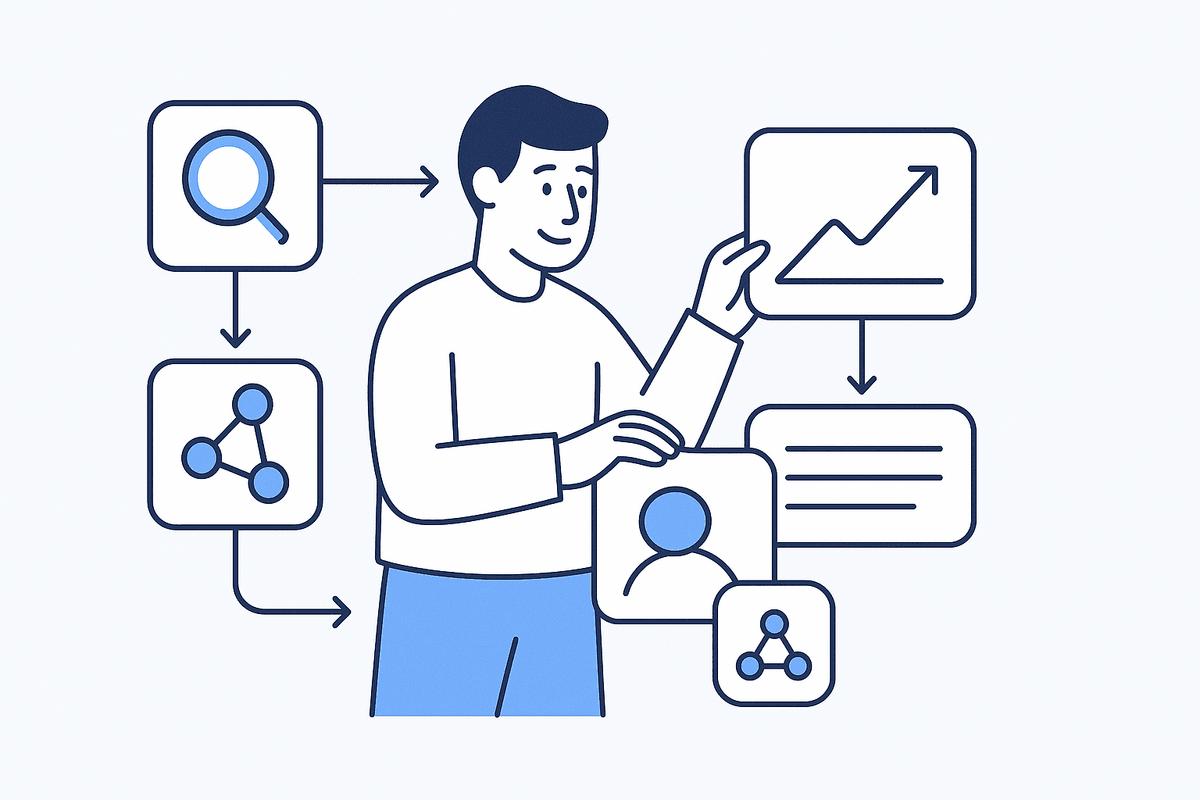
Naver AI Briefing Didn't End SEO: Korean GEO vs Google GEO
Where Korean GEO is heading, as signaled by Naver Mate
SEO basics still matter in the Naver AI Briefing era. What Naver Mate is, Naver's content quality bar, and how to get cited as a source in AI Briefing.
SEO hasn't disappeared in the AI Briefing era. Its role has simply grown from showing up in search results to becoming the source of AI answers. For a long time, running search content was fairly straightforward. Users typed a keyword, scanned titles and descriptions in the results, and clicked the document they liked. The problem is that what users see on the first screen of results has itself changed.
When search results change, the role of content changes
On Google, AI Overviews produce a summary at the top; on Naver, AI Briefing fills that spot. Naver AI Briefing doesn't just show a summary. It places sources, See more, and related questions alongside it, moving users on to their next search.
So content operations have gained a goal. Showing up in search results and getting clicks isn't enough anymore. Now you also have to check whether your content reads as a source worth referencing inside AI Briefing, and whether you've built up enough on the topic to be picked again when follow-up questions come.
This shift is called GEO, Generative Engine Optimization. But talking about GEO in the Korean market using only overseas examples tells half the story. In Korean search, you have to look at Naver AI Briefing and the Naver content ecosystem together.
The signal from Naver Mate
Naver runs the Naver Mate program, which each month selects creators and communities active in its UGC services (Blog, KnowledgeiN, Cafe, Premium Contents, and others) by topic and gives them content activity grants and an emblem.
On the surface it's a creator support program, but from a content strategy standpoint, the selection criteria matter more. Naver says that when selecting Mates, it weighs each service's operating criteria together, with AI Briefing citation count at the center. AI Briefing citation count means the number of times a piece of content has been cited in AI Briefing on the search results page.
That's where the signal comes from. It means that when Naver judges good content, it doesn't just look at search visibility; it also looks at whether the content can be used as a source in AI Briefing. We should draw a line here, though. Calling the Naver Mate selection criteria the general search ranking algorithm would be an overstatement. Mate criteria and search ranking criteria sit at different levels. Even so, it's an important clue for content operators, because it shows what kind of content Naver treats as a more trustworthy source in the AI search era.
Naver's bar for good content
Naver Search Advisor lists five traits of content that users choose in the AI era [1].
| Criterion | Description |
|---|---|
| Firsthand knowledge | Context only the author can provide, such as real cases, problem-solving processes, failures, and hands-on reviews |
| Consistent topic | Channels that keep publishing quality posts on a specific topic are recognized as expert sources |
| Honest authenticity | Disclose sponsorships, paid posts, and whether you bought the product; credit the original author and link the original when quoting |
| Easy-to-read structure | Put the key point first and organize with titles, subheadings, lists, and tables |
| Staying up to date | Volatile information such as policies, prices, and statistics needs visible signs of updates |
None of these five are new. They're also the basics of good SEO content. In the AI Briefing era, though, those basics get stricter, because it's no longer just about a search engine finding a document; it has to judge whether the document is a source AI can put in an answer.
SEO isn't disappearing; its role has grown
The most common misconception in AI search conversations is that SEO is no longer needed. Seeing it that way clouds real operating decisions.
Search engine optimization is the work of organizing a site's content so search engines can understand it well [3]. AI search doesn't remove that foundation. It makes it more important. To build an answer, AI has to understand a document's topic, context, evidence, recency, and the author's experience. If the title and body structure are fuzzy, there are no sources, and nothing has been built up on the same topic, AI has a hard time using the document in an answer too. On the other hand, a channel with clear structure, real experience and evidence, and a steady body of content on the same topic becomes easier for both search engines and AI to interpret.
So the more accurate framing is SEO expanding, not SEO ending. If traditional SEO was about making documents search engines can find and understand, GEO is about making those documents read as citable sources inside AI answers. The basics, including technical SEO, keywords, internal links, and structured data, still form the floor. Experience, trust, topical expertise, depth of intent, and recency management are added on top [2].
Are clicks shrinking, or changing?
It's natural to worry that AI summaries mean fewer clicks. On some searches, users really can read the summary and leave. That's why some people see AI search purely as a zero-click problem.
But Naver has said several times that it designs AI Briefing not as a screen where things end after the summary, but as one that leads into a See more button, related questions, source clicks, and follow-up exploration. In areas where action matters, such as local and commerce, AI summaries are more likely to become an interface that organizes the next action than one that eliminates clicks.
So the question isn't whether clicks disappear. It's which content becomes the candidate for the next click after the AI summary.
Long questions and follow-up questions matter more
The big change in AI search isn't just the results screen. The questions users type into the search box are getting longer. Where people used to search SEO consulting, they now ask things like which content should a B2B SaaS fix first to get cited in AI search. Where they used to search Naver blog top ranking, they now ask things like how should I restructure a blog post to get cited in Naver AI Briefing.
This change reshapes how you run content too. Targeting one head keyword isn't enough. You need to design for the cluster of questions customers ask, comparison situations, pre-purchase concerns, causes of failure, and follow-up paths together.
A GEO checklist for practitioners right now
Turning the principles Naver has published into a working checklist gives you the following.
- Does our content include firsthand experience, cases, and trial and error?
- Are official materials, statistics, and links to originals clear?
- Does the channel as a whole send a consistent signal on a specific topic?
- Are titles, subheadings, paragraphs, and FAQs structured so AI can extract them easily?
- Are the key points of images and videos also explained in text?
- Are posts that need to stay current being updated?
- Are ads, sponsorships, and affiliate relationships disclosed transparently?
- Do we answer long questions, comparison questions, and situational questions as well as short keywords?
- Are the next link, See more, and detailed information ready for users to click after the AI summary?
The key point is that this isn't about fixing a single page. GEO is closer to managing a content portfolio. What matters is which topics you cover consistently, whether sources and updates are accumulating, and whether users can find answers within the same channel as their questions continue.
Covering search, AI Briefing, and follow-up questions with one piece of content
If your team has limited resources, rework one existing post in the order below before you keep adding new ones.
- Rewrite the title and first paragraph around the question: Keep the head keyword, but rewrite the first paragraph so it answers the user's actual question right away.
- Add firsthand experience and evidence: Add cases, conditions, failure stories, statistics, and source links.
- Add an FAQ and comparison tables: Answer likely follow-up questions ahead of time in an FAQ, and put topics that need comparison into tables.
- Leave signs of recency: For information that can change, such as prices or policies, show the revision date and what changed.
- Prepare candidates for the next click: Link related posts, detail pages, and contact or consultation links naturally within the body.
After these five steps, a single post becomes an asset that handles search visibility, AI Briefing citation, follow-up questions, and driving the next click all at once. Reworking posts that already get traffic in this order pays off more than writing lots of new posts.
Now you have to watch Naver too
If you run GEO in Korea, watching only ChatGPT, Gemini, and Perplexity isn't enough. You need to watch Google AI Overviews, but you also need to watch Naver AI Briefing, because Korean users' search behavior and the ecosystem of Naver Blog, KnowledgeiN, Cafe, and Premium Contents all connect to AI Briefing.
AI search optimization is no longer about asking a particular AI chatbot once whether your brand comes up. You need to look at how search results, AI summaries, source citations, follow-up questions, and the next click connect. In the Korean market in particular, you need to track the relationship between Naver search results and Naver AI Briefing separately: which questions trigger AI Briefing, which sources get cited, how much the top search results overlap with AI Briefing sources, and which competitors and topics come up in follow-up questions.
Conclusion: Korean GEO is managing your competitiveness as a source
What Naver has shared isn't a flashy trick. It's closer to the opposite. Write from firsthand experience, build up a topic consistently, disclose sources transparently, structure content so it's easy to read, and update outdated information. It's also a call to take the basics of traditional SEO more seriously.
The target, though, has widened. Search optimization no longer looks only at rankings and clicks. You also have to check whether you appear in AI summaries, whether you're cited as a source, whether you're picked again in users' follow-up questions, and whether the summary leads to the next click.
The gap between teams that embrace this change and teams that don't may not be visible right away, because the signal shows up quietly: rankings hold steady while you drop out of AI answers. That's why you need a routine of putting your own key questions into AI Briefing and recording the results. Even once a month is fine. Pick 10 key questions and compare whether your content appears in the answers, how it's described, and how competitors are mentioned. As those records pile up, which content to fix first starts to show up as data rather than a hunch.
Korean GEO ultimately means managing how competitive you are as a source inside the Naver ecosystem. Diagnosing search results, AI Briefing sources, and follow-up question paths together with TRAIL Search lets you check this wider target one piece at a time, with data.
For related reading, see What is AI Briefing citation count? Whether it's a Naver ranking factor and how to put it in reports, Why queries get longer after AI Briefing: question-style queries and designing question clusters, and The next KPI shown by the Naver AI tab: sourceability, actionability, and the booking and purchase path after the answer.
You can continue with GPTBot vs OAI-SearchBot: Is AI Crawling a Search Signal?, The LLM wiki, Open Knowledge Format for agent knowledge, and How Korean SEO differs from the US.
Frequently asked questions
Do I still need SEO in the AI Briefing era?
Yes. If anything, it matters more. To build an answer, AI has to understand a document's topic, context, evidence, recency, and the author's experience. If the title and body structure are fuzzy and there are no sources, AI has a hard time using the document in an answer too. It's more accurate to see this as SEO expanding, not SEO ending.
Doesn't AI Briefing mean fewer clicks?
On some searches, users may read the summary and leave. But AI Briefing is being designed not as a screen where the journey ends after the summary, but as one that leads into See more, related questions, source clicks, and follow-up exploration. What matters isn't whether clicks disappear but which content becomes the candidate for the next click.
Does becoming a Naver Mate raise my search rankings?
You shouldn't assume that. Naver Mate is a creator support program, and its selection criteria are separate from the general search ranking algorithm. Still, because Mate selection centers on AI Briefing citation counts, it's a useful clue to what kind of content Naver treats as a trustworthy source.
References
Summary
- AI Briefing doesn't just summarize. It also shows sources, See more, and related questions, leading users into their next search.
- Naver lists five traits of good content: firsthand knowledge, a consistent topic, honest authenticity, an easy-to-read structure, and staying up to date.
- SEO isn't disappearing; its role has grown. Experience, trust, and topical expertise now sit on top of a foundation of technical SEO, keywords, and structured data.
- Korean GEO ultimately means managing how competitive you are as a source inside the Naver ecosystem. You need to look at how search results, AI summaries, source citations, follow-up questions, and the next click connect.
Check this topic against your own brand
TRAIL Search measures how ChatGPT and Perplexity answer your customers' questions and finds and fixes where the brand is missing, turning this post into a diagnosis. Start with 10 questions, no card required.
More posts
How ChatGPT search works: the language changed in 4 days
ChatGPT moved its search calls from JSON to a pipe format: five call types, freshness windows, and why AI visibility tracking must keep running.
The LLM wiki and Open Knowledge Format for agent knowledge
Karpathy's LLM wiki and Google's Open Knowledge Format, read from the originals: a format for agent knowledge bases, the RAG difference, and v0.2 trust fields.
What is different about Gemini 4 Argon? Verification
What is different about Gemini 4 Argon compared with earlier models? We check the 1M-token output limit and use cases plus the criteria for verifying AI output.
Keep reading on this topic
- Why Reddit search grew again: AI cites community signalsAI answers favor real community reviews, comparisons, and complaints over official feature lists. How brands can use community signals, by industry.
- GPTBot vs OAI-SearchBot: Is AI Crawling a Search Signal?AI bot crawling may signal a new search channel, but crawl counts aren't visibility. GPTBot vs. OAI-SearchBot, scale vs. Googlebot, and how to track it.
- Naver AI Tab's Next KPIs: Sourcing and the Path to ActionAfter Naver AI Tab, GEO must measure the path from AI answers to bookings, purchases, and inquiries, not just citation rate. Sourcing vs. actionability.
This post is part of the Trend category, which collects all 14 posts on the topic. See all posts in Trend