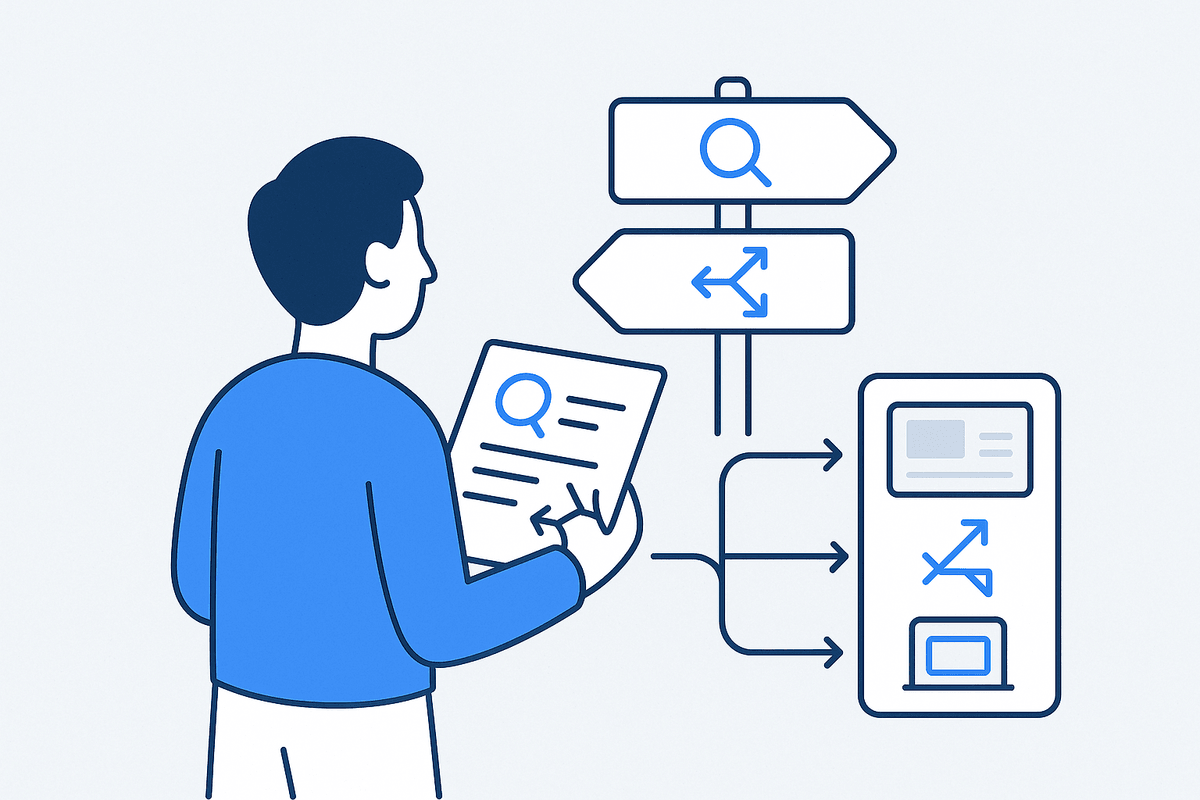
How Korean SEO differs from the US: Naver, Google, and AI
Watch only Google, as you would in the US, and you miss half of Korean users
Korean search runs on three channels: Naver, Google, and AI search. How Naver and Google SEO differ, what to do first on a small team, and one-content tactics.
The Korean search market is a three-channel structure where Naver, Google, and AI search coexist, so an SEO strategy that only watches Google will miss a large share of Korean users. In the US, Google holds the vast majority of search share, so "SEO = Google SEO" is close to true. In Korea, Naver has firmly established its own search ecosystem, and with AI search added on top, strategy has become much more complex.
The structure of the Korean search market
StatCounter data shows Google and Naver competing closely in the Korean search market [1].
| Channel | Key characteristics |
|---|---|
| Technical SEO and E-E-A-T-based evaluation are central | |
| Naver | Centered on its own ecosystem: Blog, Cafe, Naver KnowledgeiN |
| Bing | Integrated with AI search (Copilot) |
| Daum/Kakao | KakaoTalk integration, Tistory blogs |
| AI search | ChatGPT, Perplexity, and others; an emerging channel whose share is still being measured |
The key is the difference by device. On desktop there is a clear tendency for Google to lead, but on mobile Naver's share is much larger [1]. Korea is a market with a high share of mobile search, so the more a business targets mobile users, the less it can leave out a Naver strategy.
Fundamental differences across the three channels
Because each channel evaluates content differently, the optimization approach has to differ too.
| Criterion | Naver | AI search | |
|---|---|---|---|
| Ranking factors | PageRank + E-E-A-T + user signals | Naver ecosystem activity + content quality | Citable structure + accuracy of information |
| Importance of backlinks | High | Low (internal links matter more) | Indirect (training data weighting) |
| Technical SEO | Essential (Core Web Vitals and more) | Moderate (own crawler) | Optional (crawl accessibility) |
| Content format | Web pages (HTML) | Naver Blog, Smart Store | Full text (Markdown-friendly) |
Applying GEO to the Korean market
GEO (Generative Engine Optimization) is a strategy for optimizing citations in AI engines. Applying GEO to Korean-language content comes with a few extra considerations.
- Share of Korean in training data: global LLMs have relatively less Korean training data than English, so competition for citations of Korean content may be lower than in English
- Structured answers in Korean: clearly structuring FAQs and definition sentences in Korean raises the chance of being cited when AI responds in Korean
- Bilingual strategy: publishing English content alongside expands the range of citations in global AI engines
The Princeton GEO study showed experimentally that content with added citations, statistics, and sources gets selected more often in AI answers [2], and this principle applies equally to Korean content.
Optimization strategy by channel
Google SEO in Korea
Technical SEO (Core Web Vitals, mobile optimization, sitemaps, structured data) is the baseline. E-E-A-T signals that state author information, professional credentials, and real experience also affect rankings for Korean content. Keep in mind that Korean search intent can differ from English. It is common for a query like "how to build backlinks" (baengnyeok mandeuneun beop) to carry a different user intent than the English search term.
Naver SEO
The starting point is registering your site in Naver Search Advisor and submitting a sitemap [3]. Naver Blog tends to show up first in Naver search, so running your own website and a Naver Blog in parallel is effective. Naver also tends to weight recent content, so keeping a regular publishing cadence matters.
AI search GEO
The key is building candidate answer paragraphs in structures that AI can easily extract, such as a TL;DR, FAQs, and definition sentences. Cite sources for statistics and data so AI recognizes them as facts, and applying structured data such as Article and FAQPage helps. Publishing in Korean and English at the same time widens the range of citations.
Integrated priorities across the three channels
For teams with limited resources, it's realistic to set priorities by business type.
| Business type | Priority 1 | Priority 2 | Priority 3 |
|---|---|---|---|
| B2B SaaS | Google SEO | AI search GEO | Naver |
| Local services | Naver | Google SEO | AI search GEO |
| E-commerce | Naver + Google SEO | AI search GEO | - |
| Content and media | Google SEO | AI search GEO | Naver |
Covering three channels with one piece of content
Here is a practical process for teams with limited resources.
- Write the main content to Google SEO standards: meet E-E-A-T, structured data, and technical SEO
- Add GEO elements: insert a TL;DR, FAQs, inline citations, and definition sentences
- Publish a summary version for Naver Blog: post a key summary of the main content (500-1,000 Korean characters) on Naver Blog with a link to the original
- Test structured data: validate the schema with the Rich Results Test
Quirks of keyword research in the Korean market
Google and Naver also call for different approaches to keyword research.
| Item | Google keyword research | Naver keyword research |
|---|---|---|
| Tools | Google Keyword Planner, Ahrefs | Naver Search Ads keyword tool |
| Search intent | Informational, transactional, navigational classification | Judged by Naver Smart Block type |
| Search volume data | High accuracy | Shown as bands (ranges) |
| Competition | Keyword difficulty score (KD) | Ad competition index |
Even for the same keyword, the type of content that ranks at the top can differ between Google and Naver. It is common for a keyword where web-page guides rank at the top on Google to have blog review posts at the top on Naver. So rather than using one draft as is on both, adjusting the format per channel performs better.
Five expert tips
Separate the roles of your Naver Blog and your own site. It's efficient to run Naver Blog for brand awareness and as an acquisition channel, and your own site for conversion and building SEO assets. A structure that drives traffic from Naver Blog to your site works well.
Use the GEO effect of publishing in Korean and English at the same time. Publishing content on the same topic in both Korean and English raises the chance that your content is cited from the multilingual training data of AI engines.
Don't underestimate Naver Search Advisor. Many Korean companies use only Google Search Console and ignore Naver Search Advisor. Be sure to check crawl diagnostics, indexing status, and search traffic data [3].
Use Kakao and Daum channels strategically too. Their share is low, but Tistory blogs have the advantage of being indexed well by Google. Running Naver Blog and Tistory in parallel is also a possible strategy for covering Google and Daum at the same time.
Remember the regional signal of a .kr domain. If you target Korean users, a .kr or .co.kr domain can give a slight regional relevance signal in Google's Korean search.
Five common mistakes
The most common mistake is optimizing only for Google and ignoring Naver. For a B2C business, given the share of mobile Naver users, it can be a critical mistake.
Copying Naver Blog content as is onto your own site is also risky. Google may treat it as duplicate content, so post a summary on Naver and the full piece on your own site.
The perception that "Koreans don't use AI search yet" is also changing quickly. Preparing for GEO now is a chance to get ahead. Also keep in mind that search intent can differ between Korean and English keywords, and that building a strategy only from desktop data misses Naver's share on mobile.
Three-channel priorities through industry scenarios
The priority table alone may not make it click. Let's go through three industries as concrete examples.
For a B2B SaaS company, buying decision-makers often run comparison searches on desktop, so Google SEO is priority 1. AI search GEO, checking "does our product show up in ChatGPT answers," comes in as priority 2. Naver can serve as a supporting channel for brand awareness, but it's realistic to keep resources minimal, at the level of managing staff members' personal blogs or community reviews.
For a local service such as a neighborhood clinic or hair salon, it's the opposite. An overwhelming number of users search on mobile while moving between Naver Place, blog reviews, and maps, so Naver is priority 1. Google can be priority 2, supporting local search and map visibility, and AI search GEO priority 3: still early, but worth preparing for.
E-commerce has to watch two channels at once, because the Naver Shopping and Smart Store ecosystem and Google's product rich results both tie directly to revenue. AI search GEO still has few cases that lead all the way to purchase conversion, so it's fine to push it to the next priority.
As you can see, even with the same three channels, the center of gravity shifts completely by industry. The right order is to first confirm with data which device and which channel your customers actually make purchase decisions on, then set priorities.
In the end, SEO and GEO in the Korean market are not an either-or question of "Google or Naver." You need an integrated three-channel strategy that understands how the two channels evaluate content differently, then layers AI search GEO on top.
Where to start a three-channel strategy
Trying to handle all three channels perfectly from day one can mean nothing moves at all. A realistic starting point is to open your traffic logs and first check the share of traffic by channel and device. If Google desktop traffic dominates, start with a Google SEO foundation; if Naver mobile traffic is large, start with Naver content.
Next, pick one flagship piece of content and pilot the integrated three-channel process on it. Instead of trying to rework all your content at once, run one cycle with your one or two highest-traffic posts, covering Google SEO cleanup, adding GEO elements, and publishing a Naver summary, and your team can gauge the time required and the effect. Planning resources for the rest of your content based on this pilot cycle is a safe way to scale. Tracking visibility by channel and AI citations together with a diagnosis tool such as TRAIL Search lets you decide with data which channel to invest in first.
For related reading, see In the Naver AI Briefing era, SEO isn't over: how Korean GEO differs from Google GEO, What is AI Briefing citation count? Whether it's a Naver ranking factor and how to put it in reports, and The next KPIs the Naver AI tab revealed: sourceability, actionability, and the booking and purchase path after the answer.
Frequently asked questions
Isn't doing Google SEO well enough in Korea?
The answer changes when you split by device. Google leads on desktop, but Naver's share is much larger on mobile. For B2C and local businesses with a high share of mobile traffic, it's hard to build an SEO strategy without Naver.
What if we don't have the resources to optimize all three channels?
It's realistic to set priorities by business type. For example, B2B SaaS builds on Google SEO with AI search GEO next, while local services and e-commerce make Naver the priority channel.
Can we post the same article on our Naver Blog and our own website?
We don't recommend it. If you post identical content in both places, Google may treat it as duplicate content. The safe structure is to post a key summary on Naver Blog and the full piece on your own site, linked back to the original.
References
Summary
- The Korean search market is a three-channel structure where Naver, Google, and AI search are used together. The US approach of watching only Google does not carry over as is.
- Device differences are large. There is a clear tendency for Google to be strong on desktop and Naver on mobile.
- The three channels evaluate content differently: Google weighs technical SEO and E-E-A-T more, Naver weighs ecosystem activity and freshness, and AI search weighs citable structure.
- With limited resources, set priorities by business type. An efficient approach is to add GEO elements to Google SEO content, then publish a summary version for Naver alongside it.
Check this topic against your own brand
TRAIL Search measures how ChatGPT and Perplexity answer your customers' questions and finds and fixes where the brand is missing, turning this post into a diagnosis. Start with 10 questions, no card required.
More posts
How ChatGPT search works: the language changed in 4 days
ChatGPT moved its search calls from JSON to a pipe format: five call types, freshness windows, and why AI visibility tracking must keep running.
The LLM wiki and Open Knowledge Format for agent knowledge
Karpathy's LLM wiki and Google's Open Knowledge Format, read from the originals: a format for agent knowledge bases, the RAG difference, and v0.2 trust fields.
What is different about Gemini 4 Argon? Verification
What is different about Gemini 4 Argon compared with earlier models? We check the 1M-token output limit and use cases plus the criteria for verifying AI output.
Keep reading on this topic
- Why Reddit search grew again: AI cites community signalsAI answers favor real community reviews, comparisons, and complaints over official feature lists. How brands can use community signals, by industry.
- GPTBot vs OAI-SearchBot: Is AI Crawling a Search Signal?AI bot crawling may signal a new search channel, but crawl counts aren't visibility. GPTBot vs. OAI-SearchBot, scale vs. Googlebot, and how to track it.
- Naver AI Briefing Didn't End SEO: Korean GEO vs Google GEOSEO basics still matter in the Naver AI Briefing era. What Naver Mate is, Naver's content quality bar, and how to get cited as a source in AI Briefing.
This post is part of the Trend category, which collects all 14 posts on the topic. See all posts in Trend