Naver AI Tab's Next KPIs: Sourcing and the Path to Action
AI summarizing an answer well and users actually taking action are two different problems
After Naver AI Tab, GEO must measure the path from AI answers to bookings, purchases, and inquiries, not just citation rate. Sourcing vs. actionability.
The question in AI search optimization is now expanding beyond "are we cited?" to "do users who see the answer actually take action?" Do they ask a follow-up question, compare products, go to a booking page, open the map, click a purchase link? Naver AI Tab is a good example from the Korean market of why this question has become important.
The question in AI search optimization is changing
The long-standing questions in search optimization were about visibility and clicks. What position do you appear in on the results page, what's the click-through rate, which keywords bring in traffic. SEO revolved around these questions.
After AI search arrived, the question shifted a bit. Does our brand appear in AI answers, is it cited as a source, what sentences describe it when compared with competitors. The terms GEO and AEO emerged because of this change.
But now the next question is needed: do users who see the AI answer actually take action? The reason this question matters is simple. The AI answer is becoming not the end of the search results, but the screen where people choose their next action.
From AI Briefing to AI Tab, and on to action-oriented search
Naver's trajectory makes this change even clearer.
First, AI Briefing played a role closer to providing a summary of the answer, sources, and related questions above the search results. Users see the key information first before opening results one by one, and move on to "see more" or follow-up questions if needed.
AI Tab is more conversational. It lets users narrow conditions, add context, and keep asking comparison questions. As Naver officially describes it, AI Tab is a service that understands search intent and context and broadens the scope of exploration through conversation.
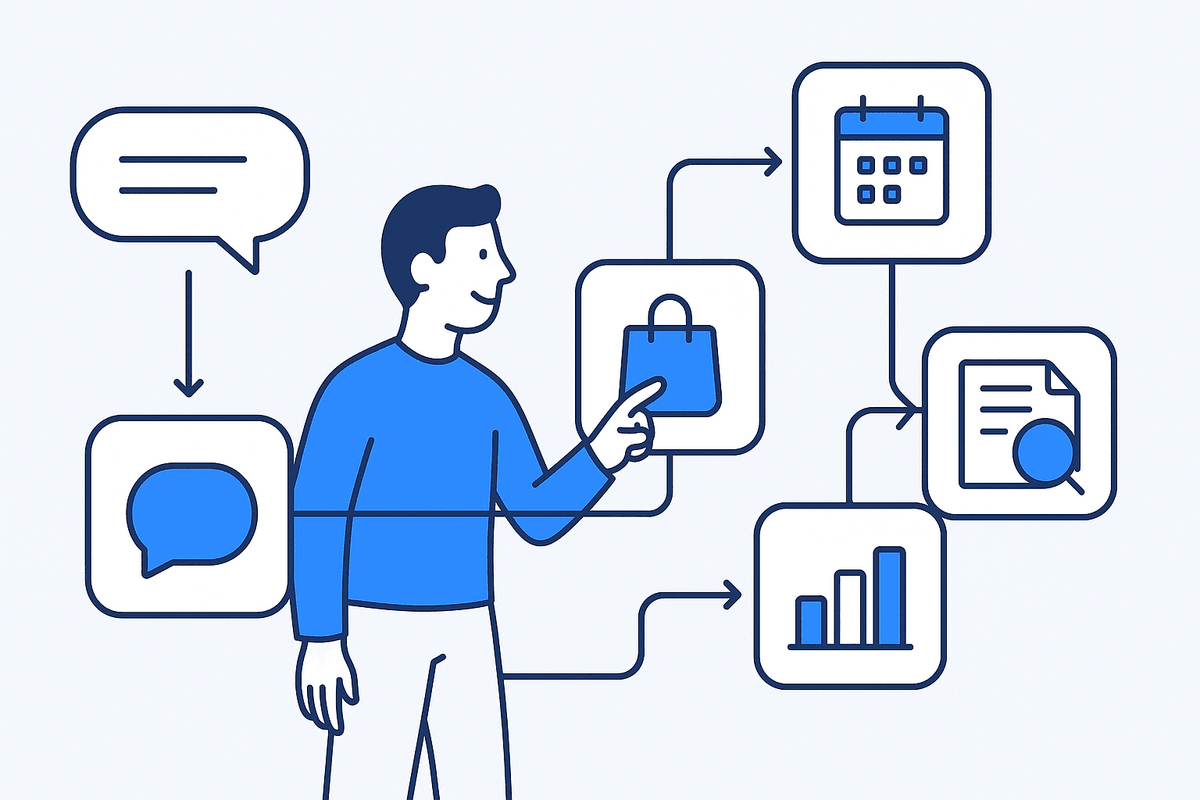
The important point doesn't end there. The AI Tab examples Naver presented include Place information, visitor reviews, blog reviews, booking, shopping, and Smart Lens integration together. It's not just "an AI that summarizes answers well," but something closer to the process in which users decide what to do.
| Stage | Role |
|---|---|
| AI Briefing | A screen where AI organizes the search results first |
| AI Tab | A screen where users narrow down candidates by talking with AI |
| Action-oriented search | A stage where the answer leads to actions like booking, purchasing, visiting, comparing, or inquiring |
Why it matters even more in the Korean market
In global markets, the conversation is mostly about Google AI Overviews and AI Mode. Google has even officially said that users ask more complex and planning-type questions in AI Mode [2]. But in the Korean market, Naver needs to be looked at separately.
Naver's strengths are different. Naver is closer to an everyday-life search touchpoint than a browser. Shopping, Place, Maps, reviews, Blog, Cafe, Naver KnowledgeiN, and Smart Lens are all connected to search. So AI search optimization in Korea rarely ends at simply writing good website documents.
For a local store, Place information, review quality, booking availability, and location data can all have an effect together. For e-commerce, product names, detail pages, prices, reviews, and purchase links all need to be looked at together. For a B2B service, what criteria it's described by in comparison questions, and whether there's a reason to move on to an inquiry or consultation, become important.
That's why Korean-style GEO has to look beyond "does AI know us?" to "which action candidates does AI connect us to?"
Sourcing and actionability need to be looked at separately
When many brands start AI search optimization, they look at citation rate first. Does our brand name appear in AI answers, is it picked up in source links, how many times is it mentioned compared to competitors. These metrics are still needed, but they aren't enough.
Even if your brand is in the AI answer, the connection to business results is weak if users can't move on to a next action. Conversely, even a short brand mention can be a stronger signal if it connects naturally to action candidates like booking, purchasing, inquiring, or visiting. So an AI search diagnosis needs to be split into at least two layers.
| Layer | What it looks at |
|---|---|
| Sourcing | What material the AI answer uses as evidence, and whether our assets are used as evidence for the answer |
| Actionability | What next action users can move on to after the answer |
Naver AI Tab could make this second layer much bigger in the Korean market.
A checklist operators should run now
As AI Tab expands, brand operators shouldn't stop at just looking at the screen. Check the items below against real queries and screens.
1. Define representative action queries. Brand-name searches alone aren't enough. Pick questions users would actually ask, like "dermatology clinic recommendations near Gangnam Station" or "summer running shoes with good reviews."
2. Record the AI answer's sources and action paths separately. Look separately at which sources were used as evidence for the answer, which buttons, links, booking, or purchase candidates appear alongside it, which direction follow-up questions are steered, and what sentences describe competitors.
3. Manage Naver assets at the same level as your website. Check everything: Naver Place basic information and category, visitor reviews and blog reviews, shopping product names and detail pages, maps and booking availability, topic-specific trust assets like Naver KnowledgeiN, Blog, and Cafe, plus freshness, prices, business hours, and contact paths [1].
4. Reflect follow-up questions in content planning. In AI search, the second question can matter more than the first. After asking about "AI search optimization," questions like "what should we look at first in our industry?" or "how is it different from SEO?" may follow. Your content needs to anticipate these follow-up questions.
5. Don't use the word "conversion rate" too soon. Just because a purchase link or booking path appears in AI Tab doesn't mean every click is a conversion. Early on, it's safer to look at four things separately: appearing in the AI answer, being included as answer evidence and a source, follow-up questions or further exploration, and the action path that leads to booking, purchasing, visiting, or inquiring.
A practical scenario: how a dermatology brand runs the check
Take a hypothetical dermatology clinic brand as an example. This brand starts its check with the representative action query "dermatology clinic recommendations near Gangnam Station."
In Step 1, it enters this question into AI Tab directly and records the list of clinics that appear in the answer and the evidence behind them. It notes whether our brand is mentioned and, if so, what sentence describes it.
In Step 2, it records the elements shown alongside the answer separately. It checks whether Place information appears, whether review ratings show up with it, whether there's a booking button, and whether a follow-up question like "which ones are open late at night?" is suggested.
In Step 3, it checks its Naver Place information. It confirms that clinic hours, booking availability, and recent review dates are up to date, and updates any outdated information.
In Step 4, it checks whether content is ready to answer the follow-up question "which ones are open late at night?" If the blog has no post about late-night hours, it adds this question to its next content plan.
In Step 5, it tracks "moved to booking page" and "booking actually completed" separately. Rather than linking an increase in booking button clicks in AI Tab directly to revenue growth, it checks the actual booking conversion rate separately.
These five steps apply similarly not only to clinics but also to e-commerce and B2B services. The key is not stopping at "we appeared in the AI answer," but following through to the next screen.
How AI search KPIs will change
In past SEO, visibility, rankings, and clicks were central. In AI search, citations, position within the answer, and how you're described relative to competitors have become important. In action-oriented search like AI Tab, the action path is added on top of that.
The questions brands need to ask going forward have to be more specific.
- What problem does AI describe our brand as a candidate solution for?
- By what criteria are we compared with competitors within the answer?
- Do we stay present in the questions users ask next?
- Are we connected to action touchpoints like Place, shopping, maps, and reviews?
- Is any information missing before users move on to inquiring, booking, purchasing, or visiting?
To answer these questions, the content team, SEO owner, performance marketer, and CRM owner can't move separately. The AI answer shows content, but the action path also involves product information, reviews, booking, pricing, location, and the consultation process. That's why AI search optimization is increasingly becoming an operations problem.
Action paths differ by industry
Action paths look completely different by industry. Even for the same "action after the AI answer," what you need to look at changes.
| Industry | Common action path | Assets to check first |
|---|---|---|
| Local services (clinics, hair salons, and similar) | Booking, directions, phone inquiry | Place information, reviews, booking system integration |
| E-commerce | Product detail clicks, cart, purchase link | Product names, option details, price, stock status |
| B2B services | Consultation request, resource download, demo request | Comparison content, inquiry forms, customer case studies |
| Content and media | Moving to related posts, newsletter signup | Related content recommendations, subscription prompts |
As this table shows, the Naver Place touchpoint is decisive for local services, while consultation and resource requests are decisive for B2B services. Because the very definition of "action" differs by industry, borrowing another industry's KPIs as is means measuring the wrong thing. The safe order is to first define the final step that leads to an actual purchase or conversion in your own industry, then set the action right before that step as your AI Tab KPI.
Conclusion: measure what happens after the AI answer
The key isn't that AI summarizes answers well. It's that users can see that answer, ask the next question, narrow down candidates, and move on to actions like booking, purchasing, or visiting. From a brand's perspective, the question changes. It doesn't end at whether our brand appears in the AI answer. Whether a path is open for users to choose us after the AI answer has to be managed as a separate KPI.
The principles of citation structure shown by the Princeton GEO research [3] and the importance of action paths shown by Naver AI Tab ultimately point in the same direction: AI recognizing us and AI connecting us to action candidates are two different problems. Diagnosing sourcing and actionability separately with TRAIL Search lets you find, first, the points where you are cited but the action path breaks.
For related reading, see SEO isn't over in the age of Naver AI Briefing: how Korean GEO differs from Google GEO, What is the AI Briefing citation count? Whether it's a Naver ranking factor and how to put it in reports, and Why search queries get longer after AI Briefing: question-style queries and question cluster design.
You can continue with How Korean SEO differs from the US.
Frequently asked questions
If our citation rate is high, won't the action path follow naturally?
Not necessarily. Even if your brand is mentioned in an AI answer, it's hard to turn that into business results if users lack the information to take the next step (availability, price, location, how to contact you). Conversely, a short mention with a clear action path can be a stronger signal.
Can a click in AI Tab count as a conversion?
You need to look at it in stages. A follow-up question click, a details click, opening the map, moving to a booking page, and an actual completed booking are all different metrics. Early on, it's safer to track four stages separately: appearing in the AI answer, being included as a source, follow-up exploration, and the action path.
Is website SEO enough for a local store?
No. For a local store, basic Place information, visitor reviews, booking availability, and location data can all affect AI Tab answers. You need to manage all your Naver assets, not just your website, at the same level.
References
Summary
- The question in AI search optimization has widened from 'do we show up?' to 'are we cited?' and now to 'do users actually take action after the answer?'
- Naver AI Tab is closer to action-oriented search: it narrows down conditions conversationally and connects to action touchpoints like Place, reviews, booking, and shopping.
- A GEO diagnosis should separate at least two layers: sourcing (does the AI answer use us as evidence?) and actionability (can users move on to the next action?).
- Operators should define representative action queries, record AI answer sources and action paths separately, and manage Naver assets at the same level as their website.
Check this topic against your own brand
TRAIL Search measures how ChatGPT and Perplexity answer your customers' questions and finds and fixes where the brand is missing, turning this post into a diagnosis. Start with 10 questions, no card required.
More posts
How ChatGPT search works: the language changed in 4 days
ChatGPT moved its search calls from JSON to a pipe format: five call types, freshness windows, and why AI visibility tracking must keep running.
The LLM wiki and Open Knowledge Format for agent knowledge
Karpathy's LLM wiki and Google's Open Knowledge Format, read from the originals: a format for agent knowledge bases, the RAG difference, and v0.2 trust fields.
What is different about Gemini 4 Argon? Verification
What is different about Gemini 4 Argon compared with earlier models? We check the 1M-token output limit and use cases plus the criteria for verifying AI output.
Keep reading on this topic
- Why Reddit search grew again: AI cites community signalsAI answers favor real community reviews, comparisons, and complaints over official feature lists. How brands can use community signals, by industry.
- GPTBot vs OAI-SearchBot: Is AI Crawling a Search Signal?AI bot crawling may signal a new search channel, but crawl counts aren't visibility. GPTBot vs. OAI-SearchBot, scale vs. Googlebot, and how to track it.
- Naver AI Briefing Didn't End SEO: Korean GEO vs Google GEOSEO basics still matter in the Naver AI Briefing era. What Naver Mate is, Naver's content quality bar, and how to get cited as a source in AI Briefing.
This post is part of the Trend category, which collects all 14 posts on the topic. See all posts in Trend