What is AI search query fan-out? Find hub queries, adapt
When one question fans out into 5–10 subqueries, how many does your content cover?
AI splits one question into many subqueries. How to reprioritize content for fan-out, find hub queries, and why zero-volume keywords still matter.
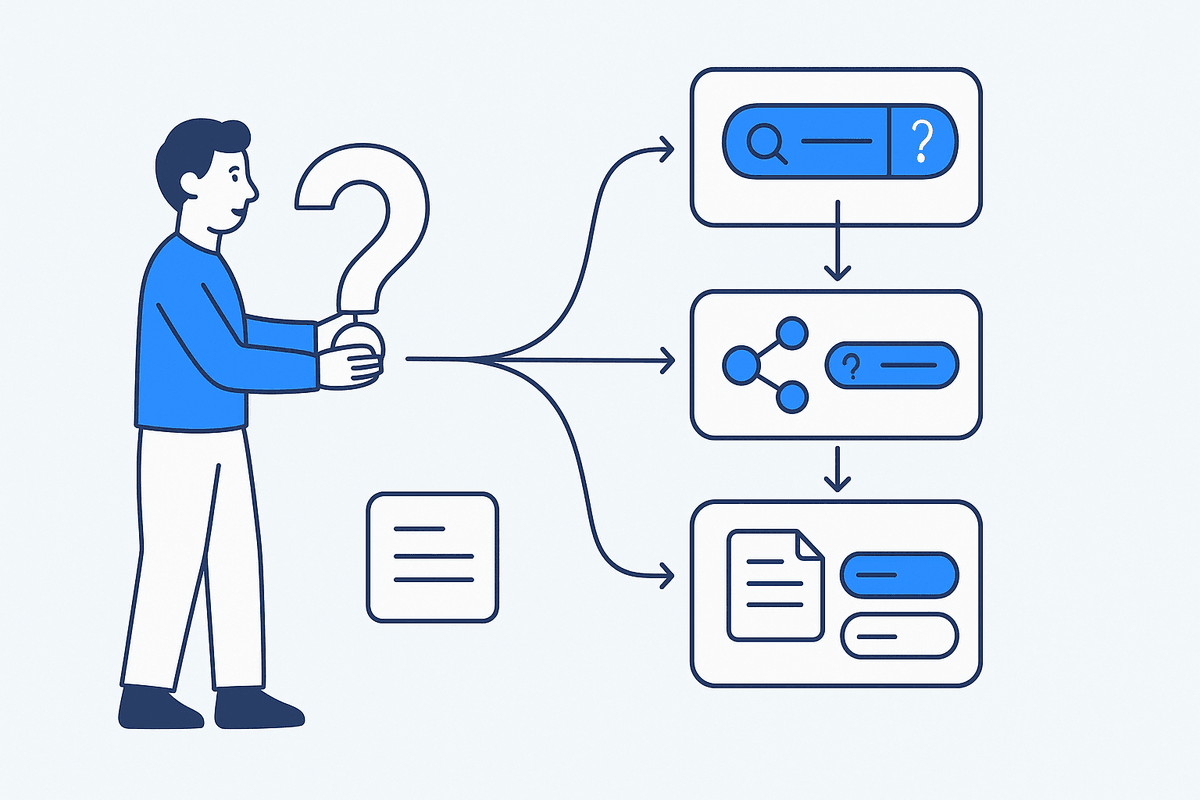
Query fan-out is the pattern where AI generates multiple subqueries at once and searches them to answer a single user question. It means five to ten or more invisible searches run behind one question. If you do not understand this mechanism, even a great standalone page will struggle to become material that AI answers actually use.
For example, for the question "Recommend a meeting room booking solution," AI might internally generate subqueries like these:
- Meeting room booking solutions compared for small teams
- Meeting room booking solution pricing comparison
- Free meeting room booking tool alternatives
- Meeting room booking solution reviews 2026
A single question "fans out" in several directions. This fundamentally changes the "one keyword = one page" paradigm of traditional SEO. When AI generates an answer, what it draws on is not a single page optimized for a particular keyword but a content ecosystem that covers the full set of subqueries.
Why this matters becomes clear when you consider the opposite case. Say a company that makes a meeting room booking solution has built one strong "About our service" page. That page handles questions containing the brand name well, but it does not directly answer any of the four subqueries above. A pricing comparison question needs a page with a pricing table, and an alternatives question needs a page that lays out how the service differs from competitors. Trying to cover every subquery with one comprehensive page actually blurs the answer to each subquery.
Why you need to understand fan-out now
Industry data shows the scale of this pattern is not small. 85SIXTY analyzed more than 72,000 queries and more than 8,700 prompts and found that a single question triggers 8-10 parallel subqueries on average[1]. More important, 95% of those subqueries register a search volume of zero[1].
| Observation | Figure | What it means |
|---|---|---|
| Average subqueries per prompt | 8-10 | One question fans out into many searches |
| Share of zero-volume subqueries | About 95% | Most are not captured by existing keyword tools |
| Average subquery length | Longer than typical search terms | Tend to carry specific conditions |
The table makes one core point. Most of the questions AI actually searches do not appear on the keyword research screens we are used to[2]. A traditional approach that sets content priorities by keywords with search volume misses a large part of the real AI search path.
This is where content teams often get confused. Hearing "let's write content for zero-volume keywords" feels intuitively wrong. The more SEO training someone has, the more ingrained the habit of automatically dropping keywords without volume from the priority list. In the fan-out context, though, that habit costs you. Even a zero-volume subquery is real demand that shapes actual AI answers if it keeps appearing across multiple prompts. That said, you do not need to chase every zero-volume query; prioritize the ones that repeat most often.
Fan-out patterns differ by type of question
Not all fan-outs look the same. They spread in clearly different directions depending on the nature of the question.
The attribute-sweep type checks a product's or service's specs, price, performance, and compatibility one by one. These questions need a detailed comparison table that covers every attribute without gaps.
The full-purchase-journey type searches cost, process, maintenance, and alternatives all at once. You need a topic cluster spanning the whole journey from awareness to decision to aftercare.
The trust-verification type checks credentials, reviews, and regulatory compliance from multiple angles, especially in high-risk topics such as medicine, finance, and law. It needs explicit evidence and verifiable signals.
The comparative-evaluation type shows up in almost every product or service question with expressions like "vs," "alternatives," and "best." Without comparison content, you drop out of this entire path.
The user-context type is segmented by location, situation, and preference. It requires classification and tagging that account for different user segments.
The recency-verification type checks the year and recent changes. Date labels and regular updates are key.
Real questions often do not fall neatly into just one of these six types. A question like "What should I look for when choosing a CRM that fits my company's size, and which of the newer tools are good?" mixes attribute sweep, comparative evaluation, and recency verification at once. So content built for fan-out works better when it handles several types of subqueries in sequence within one page, rather than targeting a single type. For example, put a comparison table after a section on selection criteria, then a section on recent updates after that.
Content principles for fan-out
Once you understand these patterns, your content strategy can be summarized in six principles.
- Topic clusters come before individual keyword optimization. AI cites from a content ecosystem, not a single page. A tightly woven cluster of related topics covers more subqueries. When building a cluster, a structure of independent pages for each type of subquery, linked to one another, works better than cramming everything into one central page.
- Cover entity attributes without gaps. If any attribute among price, specs, reviews, alternatives, and comparisons is missing, you can hand the citation to a competitor for that subquery.
- Recency signals are not optional. A "last updated" label and regular updates matter especially for questions whose fan-out includes a year.
- Comparison content is an essential asset. Comparative subqueries are generated for almost every product or service question.
- Presence beyond your own site matters too. AI does not search only official sites. Mentions on review sites, communities, and specialist media also affect trust signals.
- Remember that relevance is judged paragraph by paragraph. Structure each section so it can answer a question on its own, and place key information at the top of the section[3].
Use simulation and observation together
There are two main ways to analyze fan-out. One is simulation: you ask an LLM "what subqueries would you likely generate for this question?" and estimate from the answer. It is fast and cheap but can differ from actual AI search behavior. The other is observation: you actually run prompts in AI and collect the subqueries generated in the search tool calls directly. It is accurate but costs more to run.
The most effective approach uses the two as complements. Use simulation to get a rough picture of coverage gaps, then use observation to confirm the exact subqueries for your core prompts and set content priorities.
For a small team, rather than applying observation to every prompt from the start, it is realistic to observe only the 5-10 core questions closest to revenue in detail and use simulation just to set direction for the surrounding questions. As resources grow, you can gradually widen the scope of observation.
Four common mistakes
Mistaking fan-out for traditional LSI keyword expansion is the most common. Most fan-out subqueries have zero search volume, so applying an existing keyword tool's volume filter as is makes you miss the key queries. LSI keywords are closer to synonyms and related terms you blend in naturally to raise a page's relevance, while fan-out subqueries are independent searches AI actually runs. If you treat them as the same task, fan-out work shrinks into an extension of traditional keyword optimization.
Relying on only simulation or only observation is also frequent. Simulation alone lacks accuracy, and observation alone is expensive.
Forcing subquery keywords into the body actually lowers quality. It is better to work in just the few most frequent ones naturally.
Analyzing once and then leaving it is risky too. When models are updated, fan-out patterns change.
Checking subqueries only in Korean is another common mistake. Even for Korean-language questions, a substantial share of subqueries tend to be generated in English. If you test only Korean questions, you miss this entire English-subquery path. Adding English equivalents for key terms or linking to English-language resources is also part of handling fan-out.
Start by finding hub queries
Subqueries that appear in common across many prompts are called "hub queries." Being cited for a hub query lets one piece of content influence the answers to many questions at once. This is the highest-leverage point in a fan-out strategy.
Putting it into practice is simple. Pick a few core questions, enter them in AI search environments yourself, record the subqueries that repeat, mark the ones your content does not cover, and then fill the gaps in this order: comparison tables, FAQs, and recency updates.
What to do after you find hub queries
Once you have a list of hub queries, the next step is to prioritize them. Trying to handle every hub query at once drains resources quickly. We recommend ordering them by the criteria below.
- Repeat frequency: how often it appears across multiple prompts.
- Purchase proximity: prioritize questions closer to the comparison and adoption stage than the problem-awareness stage.
- Current coverage gap: fill questions that are completely empty before ones you already partly cover.
- Competitive intensity: hub queries nobody answers well lead to results faster than ones competitors already cover well.
A safe sequence is to pick the top 5-10 hub queries by these four criteria, strengthen content for them first, and retest the same questions 2-3 weeks later to see what changed. Repeating this across many questions and engines quickly hits the limits of manual work, so one option is to check fan-out coverage gaps periodically with a diagnosis tool such as TRAIL Search. In the end the goal is one thing: understand how AI finds information when it gets a question related to your brand, and place your content on that path in advance.
For related reading, see AI search is about recommendation and action paths, not just visibility, Why Reddit search grew again in 2026: why AI cites community signals, and What is GEO (generative engine optimization)? Which pages to start with, and in what order.
You can continue with How Much Traffic Comes From AI Search, Why It Matters, Traffic Dropped After a Core Update? Split SEO, GEO, and How ChatGPT search works.
Frequently asked questions
Can I find fan-out subqueries with existing keyword research tools?
Rarely. Most fan-out subqueries tend to show a search volume of zero. Existing keyword tools are built around keywords that have measurable volume, so they easily miss questions like fan-out queries that register no volume. You need to pair them with prompting AI directly and observing the actual subqueries.
Should I put every fan-out subquery into the body text?
No. Stuffing every collected subquery into the body actually lowers content quality. Selecting a few of the most frequently repeated subqueries and working them in naturally is better for both readability and the chance of being cited.
Once I analyze fan-out patterns, do they stay the same?
No. When AI models are updated, fan-out patterns can change too. You need a routine of rechecking the subqueries for your core questions about once a quarter.
References
Summary
- Query fan-out is the pattern where AI runs multiple subqueries at once to answer a single user question.
- Most subqueries show zero search volume in existing keyword tools, so a volume-based content strategy easily misses this path.
- AI assembles answers not from one optimized page but from a content ecosystem made up of many documents.
- The highest-leverage starting point is finding and covering the hub queries that appear across many prompts.
Check this topic against your own brand
TRAIL Search measures how ChatGPT and Perplexity answer your customers' questions and finds and fixes where the brand is missing, turning this post into a diagnosis. Start with 10 questions, no card required.
The feature closest to this post is Keyword and question discovery.
More posts

How ChatGPT search works: the language changed in 4 days
ChatGPT moved its search calls from JSON to a pipe format: five call types, freshness windows, and why AI visibility tracking must keep running.
The LLM wiki and Open Knowledge Format for agent knowledge
Karpathy's LLM wiki and Google's Open Knowledge Format, read from the originals: a format for agent knowledge bases, the RAG difference, and v0.2 trust fields.
What is different about Gemini 4 Argon? Verification
What is different about Gemini 4 Argon compared with earlier models? We check the 1M-token output limit and use cases plus the criteria for verifying AI output.
Keep reading on this topic
- Why Reddit search grew again: AI cites community signalsAI answers favor real community reviews, comparisons, and complaints over official feature lists. How brands can use community signals, by industry.
- GPTBot vs OAI-SearchBot: Is AI Crawling a Search Signal?AI bot crawling may signal a new search channel, but crawl counts aren't visibility. GPTBot vs. OAI-SearchBot, scale vs. Googlebot, and how to track it.
- Naver AI Briefing Didn't End SEO: Korean GEO vs Google GEOSEO basics still matter in the Naver AI Briefing era. What Naver Mate is, Naver's content quality bar, and how to get cited as a source in AI Briefing.
This post is part of the Trend category, which collects all 14 posts on the topic. See all posts in Trend