Traffic Dropped After a Core Update? Split SEO and GEO
The checklist from the rankings-only era can't read everything that's changing now
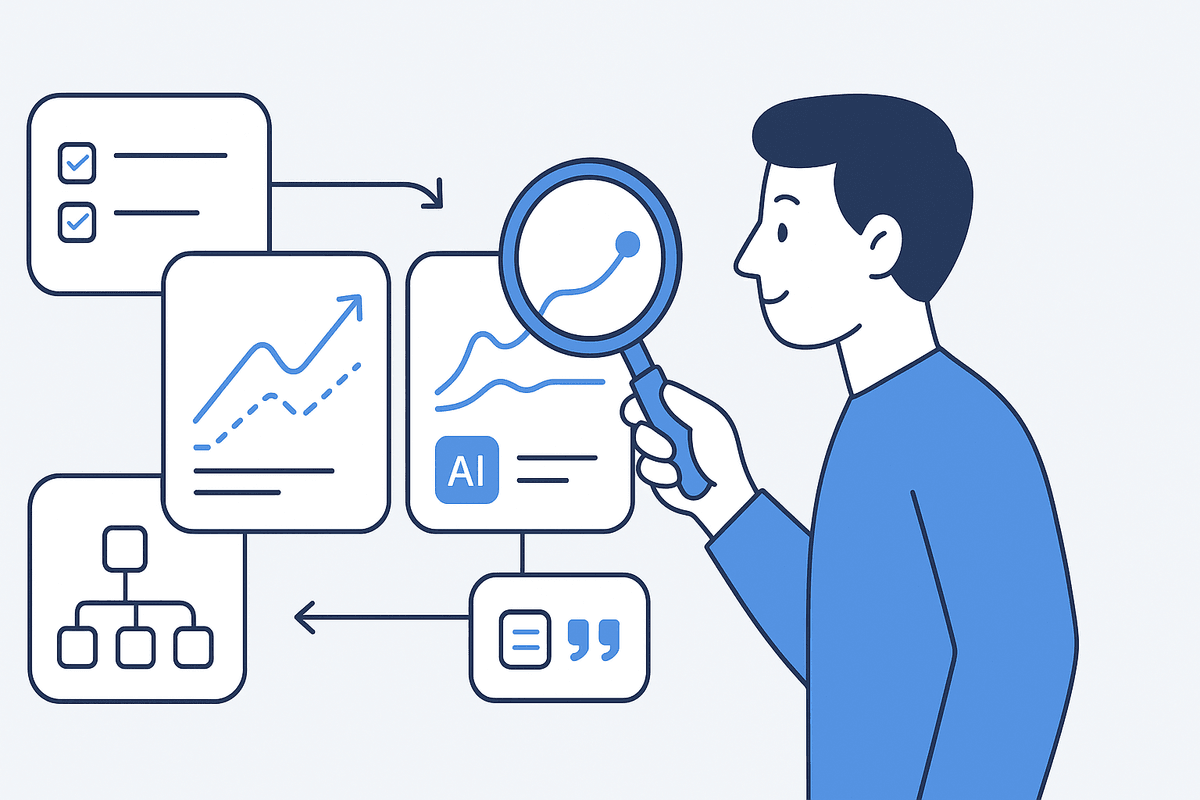
Analyze a Google core update by putting SEO metrics and GEO signals on the same timeline but interpreting them separately. What to check first, and why.
When a Google core update rolls out, don't look only at ranking changes. Record SEO metrics and GEO signals for the same period together, but interpret their causes separately. A core update is a broad change that recalibrates evaluation criteria across Google's ranking systems, so simplifying it into "an event where one factor changed" easily leads to the wrong response[1][2].
Responding to core updates used to be relatively simple. You listed the keywords that went up and down, then checked content quality and backlinks. But as AI Overviews and generative search experiences have moved into the search results, reading the same numbers only the old way now means missing important parts.
A core update is a "scoring rubric adjustment"
Google describes core updates as broad changes that recalibrate its overall evaluation so search results are more useful and reliable[2]. Unlike small updates that fix a single feature, a core update can affect page groups differently, such as informational posts, product pages, and comparison content.
What matters is that Google doesn't disclose detailed weightings or specific influencing factors. There's no announcement like "this time we're weighting brand trust more" or "we changed how AI answer sources are selected." So before drawing conclusions, practitioners need to set observation criteria and look at metrics separately.
Why SEO metrics alone aren't enough
In the past, the impact of core updates was mostly viewed through SEO metrics.
- Which keyword rankings went up
- Whether organic clicks dropped
- Whether CTR changed while impressions held
- Which page group was hit the hardest
These metrics are still important. But as AI search experiences have moved into the search results, there are more situations where the same numbers need to be read differently. For example, clicks can drop even when rankings haven't fallen much. You could see this as simply "a ranking problem," but it's possible that AI Overviews had already resolved the user's question[3]. Conversely, clicks may drop while your brand is mentioned more often in AI answers, and if you only look at the traditional SEO report, you miss that result.
So it's safer to split analysis of a core update period into two layers.
| Layer | What it looks at |
|---|---|
| SEO layer | Rankings, impressions, clicks, CTR, traffic changes by page group |
| GEO layer | AI answer visibility, brand mentions, cited sources, source types, how competitors appear |
The key is to look at the same period without bundling everything under the same cause.
Practical checklist: what to look at first
During a core update, you shouldn't draw conclusions too quickly. Rankings and impressions can fluctuate during the rollout, and changes over a few days may not reflect the final state.
1. Fix the baseline period first
Compare 2-4 weeks before and after the update start date on the same basis. If possible, wait at least one more week after the rollout completes and look again. Don't declare "this is the cause" while it's still in progress.
2. Separate brand and non-brand queries
Searches containing your brand name and general informational searches mean different things. If brand queries fluctuate, trust and reputation issues may be mixed in; if non-brand queries fluctuate, content quality or changes in competing content may play a bigger role.
3. Look by page group
Looking only at the overall traffic average misses problems. You need to split page groups, such as blog posts, service pages, comparison content, and pricing pages. From a GEO perspective, look separately at how explanatory content and evidence-based content are used in AI answers.
4. Look at search data and behavior data together
In Search Console, check impressions, clicks, CTR, and average position; in your analytics tool, check actual behavior after the visit (inquiries, signups, resource downloads).
5. Record AI Overview visibility separately
Not every query triggers an AI Overview. For each key query, record whether an AI Overview appears, which sources are attached, whether your brand is mentioned, and whether competitors appear.
6. Classify the types of cited sources
AI answers not citing your site isn't an immediate failure. If media, reviews, communities, and partner sites describe your brand positively, that can be an indirect signal. Conversely, if your page ranks but the AI answer centers on competitors, you need a GEO response.
7. Don't jump to a cause during the rollout
During a core update, ranking adjustments, changes in AI Overview display, competitor content updates, seasonality, campaigns, and technical issues can all overlap at once. Rather than saying "we dropped because of this update," first look at "which metrics moved together during the same period."
Why do core updates keep happening?
If you treat a core update as a one-time event and think "once we get through this one, we're done," you'll be caught off guard all over again with every update. Google regularly carries out ongoing recalibration of search quality, and these updates are likely to keep repeating[1][2].
So the right approach to core updates isn't "analyzing this one update" but "building an analysis routine you can repeat every time." With a routine in place, you won't have to repeat the trial and error of setting a baseline period and splitting metrics from scratch when the next update arrives.
A repeatable routine looks roughly like this.
- Record SEO metrics for key queries and page groups weekly, even in normal times
- For the same queries, also record visibility and citation status in AI search engines weekly
- When a core update is announced, automatically split and compare the periods before and after the start date
- Tag page groups and brand/non-brand categories in advance so you don't reclassify them with every update
If you build up data like this in normal times, when an update is announced you can skip asking "what changed?" and go straight to checking "which metrics deviated from the baseline?"
An example makes it clearer
Imagine a B2B SaaS company. After a core update, organic clicks for the non-brand query "AI search optimization tool" dropped. Average position slipped slightly, from 3rd to 4th. Looking only at these numbers, you might see it as a simple ranking drop.
But when they searched the same query directly, a large AI Overview appeared at the top, and the answer cited comparison review sites and community posts, not the company's own site. In this case, the response isn't simply changing the title or adding more keywords to the body. First you need to check whether the site has definitions, comparison criteria, use cases, limitations, and pricing criteria that AI can easily cite, and at the same time check what sentences describe the brand in external reviews and communities.
Let's tweak the same case slightly. If this company had been recording AI answer visibility all along, it would have already known the pattern "comparison review sites are often cited for this query" before the core update. Then, seeing the drop in clicks after the update, instead of panicking, it could interpret much faster that "as expected, the AI Overview impact showed up strongly on non-brand exploratory queries." Whether or not you keep records in normal times makes a big difference in how fast you respond to a crisis.
In the Korean market, you need to look wider
In Korea, looking only at Google isn't enough. Depending on the industry, Naver, YouTube, communities, review sites, and map services together shape the search journey. Looking at GEO in light of a Google core update doesn't mean "optimizing only for Google." It means using the changes on Google as a starting point and also looking at the other surfaces where users actually check information.
So a GEO review for Korean companies needs to separate at least three things.
- The quality of explanations on your own site
- How your brand is described externally
- The sources and sentences AI answers actually select
If you don't separate these three, it's hard to know what to fix even after the core update has passed.
Conclusion: treat it as a signal to change how you respond
It's natural to ask "what changed?" with every core update. But since detailed causes are mostly undisclosed, your practical response needs to be more specific. Don't just look at whether rankings went up or down; look at how SEO metrics and GEO signals moved together during the same period.
Now you need to ask: how did our pages move in search results, is our brand visible in AI answers, which sources are cited instead of us, and have we distinguished whether the drop in clicks is a ranking problem or an AI answer problem? GEO isn't a concept that replaces SEO; it's an operating approach that adds AI answer visibility and source trust on top of SEO[4]. Using a diagnosis tool like TRAIL Search, you can turn the work of observing these two layers separately on the same timeline into a repeatable routine.
For related reading, see What is GEO (Generative Engine Optimization)? Which pages to start with, and in what order, SEO and GEO visibility strategy: when you rank high in search but don't appear in AI answers, and SEO fundamentals in the AI search era: what changed in on-page, off-page, and technical SEO.
Frequently asked questions
Should I fix my content as soon as a core update starts?
Fluctuations during the days or weeks of a rollout may not be the final state. It's safer to fix your baseline period first, observe for at least 1-2 more weeks after the rollout ends, and then judge the cause.
My rankings held steady but clicks dropped. Is it a GEO problem?
That's one possibility. If AI Overviews show up more prominently for that query, users may already have their answer and not click. To be accurate, enter the same query into AI search engines directly and check whether your brand appears in the answer and which sources are cited instead.
Is it always a bad sign if our page doesn't appear in AI answers?
Not necessarily. If media, reviews, communities, and partner sites describe your brand positively, that can be an indirect trust signal. On the other hand, if your page ranks in search but AI answers are built around competitors, that's a signal you need a GEO response.
References
Summary
- A core update isn't about one specific factor; it's a broad adjustment that recalibrates evaluation criteria across Google's ranking systems.
- Put SEO metrics like rankings and clicks and GEO signals like AI answer visibility and cited sources on the same timeline, but interpret their causes separately.
- It's safest to analyze in this order: fix the baseline period, separate brand and non-brand queries, analyze by page group, cross-check search performance with behavior data, then classify the types of cited sources.
- While the rollout is in progress, don't jump to a cause; first record which metrics moved together during the same period.
Check this topic against your own brand
TRAIL Search measures how ChatGPT and Perplexity answer your customers' questions and finds and fixes where the brand is missing, turning this post into a diagnosis. Start with 10 questions, no card required.
More posts
How ChatGPT search works: the language changed in 4 days
ChatGPT moved its search calls from JSON to a pipe format: five call types, freshness windows, and why AI visibility tracking must keep running.
The LLM wiki and Open Knowledge Format for agent knowledge
Karpathy's LLM wiki and Google's Open Knowledge Format, read from the originals: a format for agent knowledge bases, the RAG difference, and v0.2 trust fields.
What is different about Gemini 4 Argon? Verification
What is different about Gemini 4 Argon compared with earlier models? We check the 1M-token output limit and use cases plus the criteria for verifying AI output.
Keep reading on this topic
- Why Reddit search grew again: AI cites community signalsAI answers favor real community reviews, comparisons, and complaints over official feature lists. How brands can use community signals, by industry.
- GPTBot vs OAI-SearchBot: Is AI Crawling a Search Signal?AI bot crawling may signal a new search channel, but crawl counts aren't visibility. GPTBot vs. OAI-SearchBot, scale vs. Googlebot, and how to track it.
- Naver AI Briefing Didn't End SEO: Korean GEO vs Google GEOSEO basics still matter in the Naver AI Briefing era. What Naver Mate is, Naver's content quality bar, and how to get cited as a source in AI Briefing.
This post is part of the Trend category, which collects all 14 posts on the topic. See all posts in Trend