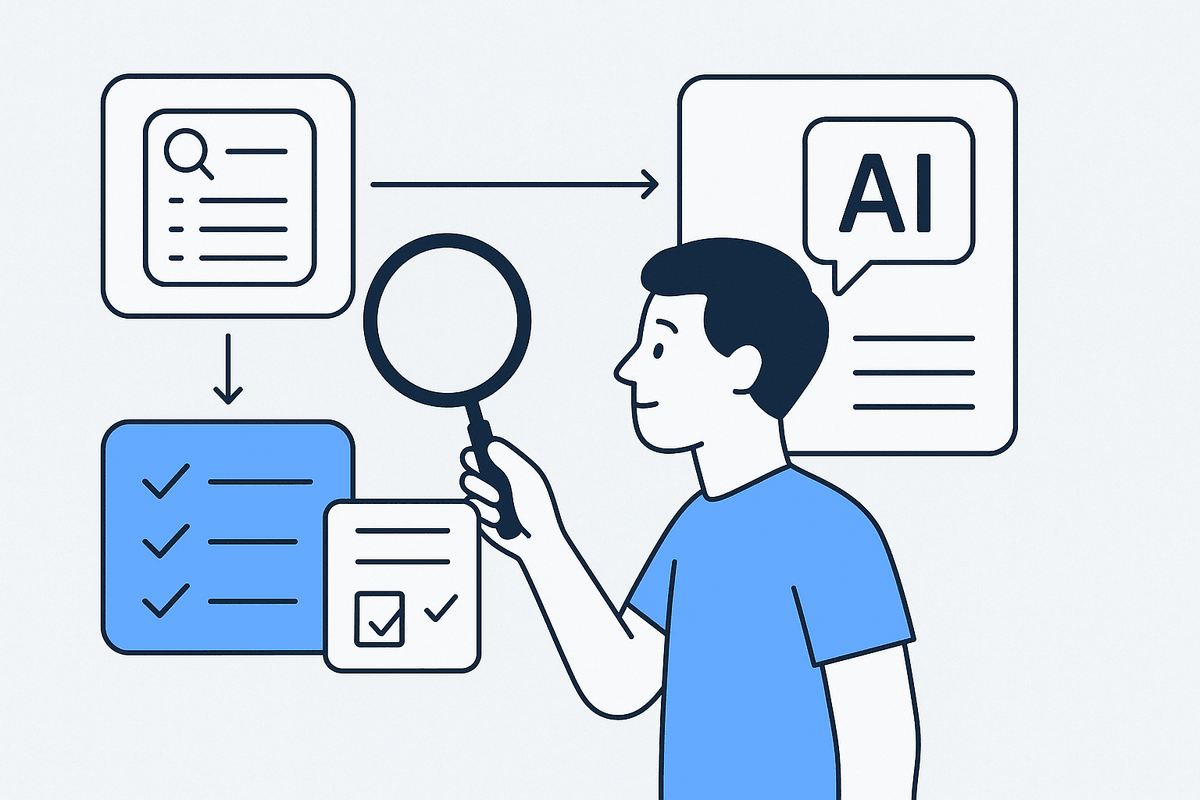
SEO and GEO top spots: high rankings, missing in AI answers
Why you need to watch both the top of search results and the top of AI answers
Reaching the top now covers how AI answers mention you, not just rankings. What changed, how to manage both tops, and why competitor comparison matters.
A strategy for getting to the top of search has broadened to cover not just search rankings but how your brand is mentioned inside AI answers. Where top visibility used to mean only "what rank does our site hold for which keywords," there's now one more question attached: "in which answers, and on what evidence, does AI describe our brand?"
A brand that doesn't show up in search results loses clicks. A brand that doesn't show up in AI answers never even makes the list of options considered. So a top-visibility strategy going forward can't end with SEO; you need to look at both an SEO strategy for search results and a GEO strategy for AI answers.
The standard for being at the top is changing
The question that mattered for a long time in search marketing was relatively simple: "Do we show up at the top for the keywords that matter?" So we looked at keyword rankings, search volume, click-through rate, backlinks, and competing pages. That approach still works. Customers still type questions into search boxes.
But the way customers explore has widened. They now also ask AI tools like ChatGPT, Perplexity, and Gemini. Instead of typing "SEO consulting firm" into a search box, they ask things like this.
- "What should a B2B SaaS company look into to show up well in AI search?"
- "Compare companies that do GEO consulting in Korea. Tell me the pros and cons too."
At that moment, the customer isn't looking at a list of search results. They look at the answer AI has put together, and decide their next step based on whether a brand is mentioned, in what context it's described, and what evidence comes with it. It's less that the meaning of being at the top changed and more that a second top appeared. One is the top of search results; the other is the top inside AI answers.
How is SEO top visibility different from GEO top visibility?
| SEO top visibility | GEO top visibility | |
|---|---|---|
| Unit of review | Where your page sits for a keyword | Your brand's role inside AI answers to a question |
| Core asset | A site structure search engines understand | Content structure and source signals AI trusts |
| Evaluation signals | Backlinks, click-through rate, dwell time | Clarity of definitional sentences, specificity of evidence, citations |
| Pace of change | Relatively predictable | Highly volatile with model updates |
SEO is the work of making your content easy to find in search engine results. You design pages around the keywords customers type and their search intent, and refine your site structure and content so search engines can understand them. GEO is the work of getting your brand and content mentioned in generative AI answers with accurate evidence. It looks at whether your brand makes it into the answer, based on the questions (prompts) customers ask AI.
The two overlap a lot. Good content, trustworthy sources, and clear explanations help both SEO and GEO [3]. But the unit of review differs. A page ranking third in SEO may not be mentioned in AI answers at all. Conversely, a brand with clear evidence and examples on a specific topic can be cited often in AI answers even without dominant search rankings [1].
Why competitor comparison matters
It's hard to judge being at the top by an absolute score alone. Even if your brand is fifth in search results, there's plenty of room to improve if competitors hold first and second. Even if your brand is mentioned once in an AI answer, the situation reads differently if a competitor is mentioned three times and in a positive context.
The goal of competitor comparison isn't to copy. There are three things a comparison should help you find.
- The questions your brand is missing from
- The evidence that's lacking when your brand is described
- The places in people's minds that competitors have claimed but you haven't yet
Say a brand shows up for "AI search optimization" questions but not for questions specific to a certain industry. In that case, the problem may not be the amount of content. It may be a shortage of case studies, FAQs, structured explanations, and trustworthy external mentions tailored to that industry.
A practical checklist for top visibility
1. Build a list of core questions
List the questions customers are likely to ask when considering a purchase. To cover the top of AI answers too, include not just "what's the best A?" but comparison and evaluation questions like "which is better, A or B?" and "what should I watch out for when using A?"
2. Check search results and AI answers for the same question at the same time
Ask the same question on Google and on ChatGPT and Perplexity, and record how the results differ. If you appear in search results but not in AI answers, that's a sign your structure needs work.
3. Strengthen your evidence clearly
AI prefers specific explanations presented with sources over unsupported claims. Adding footnoted citations, comparison tables, and real examples gives AI clearer grounds to cite you.
4. Recheck competitor gaps regularly
Don't check once and stop; repeat it regularly. When AI models update, citation patterns can change too.
The market is already moving this way
Industry SEO tools are also widening the scope of competitor analysis beyond search results to AI platforms and AI visibility. Treating the top of search results and the top of AI answers as one competitive landscape isn't one company's claim; it's the direction of the industry as a whole.
How top-visibility patterns differ by industry
Not every industry experiences the top-visibility gap the same way.
| Industry | Common pattern | What to check first |
|---|---|---|
| B2B SaaS | High search rankings but missing from comparison-type AI questions | Competitor comparison content, adoption case studies |
| E-commerce | Mentioned in AI answers but doesn't lead to purchase links | Product detail structured data, up-to-date pricing and stock information |
| Local businesses (clinics, stores, etc.) | Ranks high for location searches but missing from AI recommendation questions | Location-specific FAQs, reflecting real customer reviews |
| Media and publishing | Individual articles show up well but the brand itself is rarely mentioned | Author profiles, topical authority across the whole site |
The table shows a common thread: "search ranking" and "role inside AI answers" fall out of step for different reasons. If you first identify which point is weak in your industry, it becomes clear where to put your effort when building a top-visibility strategy.
A routine for managing both tops together
Top visibility isn't a one-off project you check once; it's a recurring routine. A realistic approach is a two-track review cycle: check SEO metrics like search rankings and CTR weekly, and check changes in AI answers to your core questions monthly. Because AI model updates can change how answers to the same question are composed, it's important not to treat the results of a single check as permanent.
Wrapping up
Being at the top is no longer the single goal of "#1 in search results." Only when you take care of both spots, the top of search results and the top of AI answers, can you call it complete top visibility. Competitor comparison is the most direct diagnostic method for finding what you've missed in these two tops.
If checking both tops manually every time is a hassle, one option is to compare your search rankings and AI citations together in TRAIL Search (search.traillabs.ai).
For related reading, see Competitor SEO and GEO analysis in 8 steps: reverse-engineering why competitors get cited in AI answers, What is GEO (generative engine optimization)? Which pages to start with, and in what order, and SEO basics in the AI search era: what changed in on-page, off-page, and technical SEO?.
You can continue with Backlink strategy that stays inside Google's spam policy, On-page SEO checklist before publishing, and An SEO and GEO keyword strategy framework.
Frequently asked questions
We rank #1 in search, so why don't we show up in AI answers?
Search rankings and AI citations use different evaluation criteria. Search engines weigh links and keyword matching heavily, while AI puts more weight on content structure and trust signals: clear definitional sentences, specific evidence, and source attribution. Even with a high ranking, AI may not find grounds to cite you if that structure is missing.
Why does a top-visibility strategy need competitor analysis?
Being at the top isn't an absolute score; it's a relative position. Looking only at your own content doesn't show what's missing, but putting it side by side with competitors reveals the questions you're absent from, the evidence you lack, and the places in people's minds you haven't claimed yet.
Which should we tackle first, the top of AI answers or the top of search results?
It depends on your industry and customer behavior. But since AI also refers to content indexed by search engines, building a base at the top of search results and then reinforcing your structure for AI answers is generally the more stable order.
References
Summary
- What it means to be at the top didn't change; the top just expanded into two places, search results and AI answers.
- SEO looks at where your page sits for a keyword; GEO looks at your brand's role inside AI answers to a question.
- You can rank high in search and still go unmentioned in AI answers, and the reverse is also possible.
- Competitor comparison isn't about copying; it's a diagnostic lens for finding the questions your brand is missing from and the evidence it lacks.
Produce the content this post covers from your brand standard
TRAIL Studio registers the brand standard once and produces cardnews, detail pages, product photos, shorts and blog posts from it. Generated output is reviewed and edited by a person before it ships.
More posts
Best AI Search Optimization Tools 2026: 6 GEO Tools Ranked
We compared six tools that check whether ChatGPT and other AI answers mention your brand, on measurement, action, engines, Korea support, and price.
Why Does ChatGPT Cite Listicles? Format vs. Hierarchy
Listicles split items cleanly, so AI can extract just what it needs. How to write citable listicles, whether format alone is enough, and how to build hierarchy.
What is GEO? Which pages to start with, and in what order
GEO structures content so generative search like ChatGPT and AI Overviews cites it. Does it replace SEO, what order to run it in, and how to measure it.
Keep reading on this topic
- Topical authority: why pillar-cluster beats a single postTopical authority comes from content clusters, not single posts: the pillar-cluster model, how to design one, why it wins in AI search, and when it's enough.
- A 4-step framework for SEO and GEO: split teams or merge?SEO and GEO work best on one content quality foundation. Whether to split or merge teams, a 4-step framework, why unified plans fail, and one shared metric.
- SEO and GEO keyword strategy in 7 stepsA 7-step keyword strategy that goes past research to diagnosis, topic clusters, gap analysis, and validation, and finds SEO and AI search gaps together.
This post is part of the Content category, which collects all 41 posts on the topic. See all posts in Content