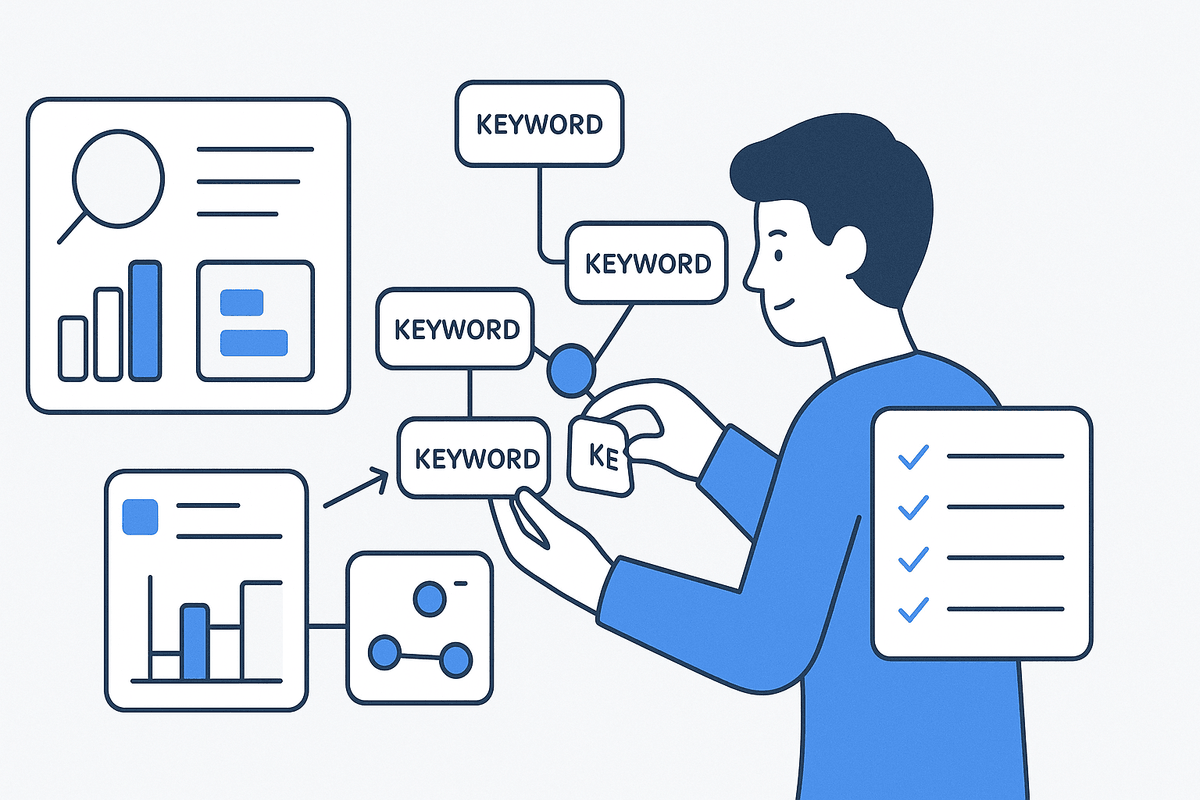
SEO and GEO keyword strategy in 7 steps
Keyword research used to start with search volume. Now it has to start with diagnosis
A 7-step keyword strategy that goes past research to diagnosis, topic clusters, gap analysis, and validation, and finds SEO and AI search gaps together. Keyword strategy isn't just research (discovery). It's a system that also includes diagnosis, clustering, gap analysis, and validation.
Keyword strategy isn't "research" that gathers high-volume keywords. It's a systematic plan that decides which topics to cover, and in what order, through diagnosis, clustering, and gap analysis. Putting a seed keyword into a search tool and pulling related terms into a list doesn't give you any criteria for judging which topics are actually empty or which keywords to work on first.
The limits of traditional keyword research
The most common approach goes like this: put a seed keyword into a keyword tool and pull related keywords, pick targets based on search volume and difficulty, then write. This approach has three problems.
| Problem | Description | Result |
|---|---|---|
| Cluster gaps | Some topics have 10 keywords and others have 2, but you don't know where the gaps are | Failure to build topical authority |
| Ignoring intent | Choosing by search volume alone selects duplicate keywords with the same intent | You end up writing several similar posts |
| AI search blind spot | Tracking only SEO keywords misses the question forms AI engines cite | Lost GEO opportunities |
Given that a large share of search traffic comes from organic search, and AI search traffic is now being added on top, doing research without a keyword strategy means you can't systematically manage even the opportunities you can see.
7 steps to an integrated SEO and GEO keyword strategy
Step 1. Know where you stand: baseline diagnosis
Every strategy starts with knowing where you are now. Using Google Search Console data, sort the keywords you already rank for into three groups.
| Group | Criteria | Meaning |
|---|---|---|
| Strong | Average position 1–10, normal CTR | Keywords you just need to maintain |
| Opportunity | Average position 11–20, with impressions | A small push could get you onto page 1 |
| Declining | Clicks in the last 28 days down 20% or more from the previous period | Needs an urgent check |
If you don't know the state of your existing keywords before looking for new ones, you'll miss opportunities you already have. Moving one Opportunity keyword onto page 1 usually pays off faster than discovering 10 new keywords from scratch.
Step 2. Draw a topic map: topic mapping
Don't look at keywords one by one. Group semantically close keywords into clusters. Once they're grouped, check how "thick" each cluster is.
| Cluster type | Number of keywords | Strategy |
|---|---|---|
| Thick cluster | 6 or more | Already sufficient; focus on improving content quality |
| Thin cluster | 3 or fewer | Lacks topical authority; priority for expansion |
| Isolated keyword | A standalone keyword that doesn't belong to a cluster | Find related keywords and absorb it into an existing cluster |
For your first 50–100 keywords, sorting them by hand separates meanings more accurately than a tool's automatic clustering.
Step 3. Gap diagnosis: SEO gaps and AI search gaps
Once the topic map is drawn, look for the empty spots. Check gaps in two directions.
SEO gap: When you search a core topic on Google, competitors are on page 1 but your content isn't.
AI search gap: Ask ChatGPT and Perplexity about the same topic directly and see which brands get cited. If your company isn't there, that's a GEO gap.
| Gap type | How to check | Priority |
|---|---|---|
| Missing in both SEO and AI | Check SERP and AI search together | Top priority |
| Missing only in AI search | Your company isn't cited by AI engines | Improve GEO content format |
| Missing only in SEO | Not on SERP page 1 | Standard SEO optimization |
| Present in both | Visible on both sides | Maintain |
Step 4. Decide where to expand
Once you've found the gaps, you have to decide where to expand. It's good to prioritize by five criteria: search volume, fit with your expertise, competitive intensity, relevance to your product, and your ability to produce the content. The more all five signals overlap on a topic, the faster you see results for the effort.
Step 5. Assign content types
Even for the same topic, the right content format depends on search intent. Guides work for explaining concepts, how-tos for practical methods, and listicles or comparison tables for comparisons and evaluations, and these formats also favor AI citation.
Step 6. Design an internal link matrix
The core of a cluster is internal links. If you design in advance which posts link to which before publishing, both search engines and AI can understand the relationships between topics more clearly [2].
Step 7. Validate after publishing: measure SEO and GEO together
Publishing isn't the end. You need to track ranking changes and AI citation changes together. As the Princeton GEO research also confirmed, how visible you are inside AI engines varies with content structure and source signals [1], so you need a repeated cycle of watching for at least a few weeks after publishing and validating which formats actually draw citations.
Practical tips
- Cluster by hand at first, then speed up with tools once you're used to it.
- Repeat AI search gap checks regularly, at least once a month. Citation patterns can change with AI model updates.
- For content quality standards, Google's "helpful content" guidelines apply to both SEO and GEO [3].
Common mistakes and how to fix them
| Mistake | Why it's a problem | Alternative |
|---|---|---|
| Setting priorities by search volume alone | Misses cluster gaps and business fit | Reorder by the 5-signal expansion criteria |
| Checking AI search gaps only once | Misses changes in citation patterns after model updates | Make a monthly recheck routine |
| Leaving clustering entirely to tools | Inaccurate meaning separation misses thin clusters | Sort the first 50–100 by hand |
| Adding internal links later, after publishing | Missing links and tangled directions | Design them in a matrix before publishing |
The mistake that repeats most often in this table is "setting priorities by search volume alone." High-volume keywords don't always help the business. Ranking higher for keywords unrelated to your product doesn't mean much if it doesn't lead to real conversions. Conversely, a keyword with low volume that fills a gap in a cluster helps raise your authority on the whole topic.
A worked example
Take a hypothetical B2B SaaS brand. Say this brand, whose core topic is "customer data platform," goes through Steps 1–2 and draws its clusters, and finds that keywords around "price comparison" and "implementation case studies" are thick, but there are almost no keywords around "security and compliance." In the Step 3 gap diagnosis, if you ask an AI engine "What security certifications should I look for in a customer data platform?" and only competitors are mentioned while your company doesn't appear at all, that's both an SEO gap and an AI search gap. In a case like this, you can connect Steps 4–5 by putting the security and compliance cluster at the top of next quarter's content priorities.
Wrapping up
Keyword strategy isn't a one-off research task. It's a cycle that runs from diagnosis to mapping, gap analysis, expansion, and validation. Repeat this flow steadily and you'll miss fewer opportunities in both search and AI answers.
If checking one by one which prompts your brand is missing from in AI search feels like too much, another option is to diagnose keyword and prompt-level gaps all at once with TRAIL Search (search.traillabs.ai).
You can find related reading in Designing topical authority clusters: why to write in a pillar-cluster system instead of one-off posts, Intent-based keyword research in 6 steps: the four search intents and long-tail criteria, and 5 signals for deciding where to expand keywords: criteria beyond volume and difficulty.
Frequently asked questions
How is keyword research different from keyword strategy?
Keyword research is the discovery work of finding high-volume keywords. Keyword strategy is a bigger system that wraps around it: diagnosing where you stand now, designing clusters, analyzing competitive gaps, and validating priorities. With research alone, you have no criteria for deciding what to write first.
Should I cover low-volume keywords too?
It depends on your goal. Even with low volume, if a keyword is needed to thicken a topic cluster and build topical authority, it belongs on your priority list. From a GEO perspective, whether you cover a topic with the kinds of questions people would ask AI sometimes matters more than search volume.
How do I check for AI search gaps?
The most direct way is to ask AI engines such as ChatGPT and Perplexity about your core topics and see which brands and sites get cited. If your company doesn't appear at all, that's a GEO gap.
References
Summary
- Keyword strategy isn't just research (discovery). It's a system that also includes diagnosis, clustering, gap analysis, and validation.
- A baseline diagnosis of your existing keywords comes before finding new ones.
- Don't look at keywords one by one. Group them into topic clusters and make thin clusters your expansion priority.
- Diagnosing SEO gaps and AI search gaps together keeps you from missing opportunities in the AI search era.
Produce the content this post covers from your brand standard
TRAIL Studio registers the brand standard once and produces cardnews, detail pages, product photos, shorts and blog posts from it. Generated output is reviewed and edited by a person before it ships.
More posts
Best AI Search Optimization Tools 2026: 6 GEO Tools Ranked
We compared six tools that check whether ChatGPT and other AI answers mention your brand, on measurement, action, engines, Korea support, and price.

Why Does ChatGPT Cite Listicles? Format vs. Hierarchy
Listicles split items cleanly, so AI can extract just what it needs. How to write citable listicles, whether format alone is enough, and how to build hierarchy.

What is GEO? Which pages to start with, and in what order
GEO structures content so generative search like ChatGPT and AI Overviews cites it. Does it replace SEO, what order to run it in, and how to measure it.
Keep reading on this topic
- Topical authority: why pillar-cluster beats a single postTopical authority comes from content clusters, not single posts: the pillar-cluster model, how to design one, why it wins in AI search, and when it's enough.
- A 4-step framework for SEO and GEO: split teams or merge?SEO and GEO work best on one content quality foundation. Whether to split or merge teams, a 4-step framework, why unified plans fail, and one shared metric.
- SEO and GEO top spots: high rankings, missing in AI answersReaching the top now covers how AI answers mention you, not just rankings. What changed, how to manage both tops, and why competitor comparison matters.
This post is part of the Content category, which collects all 41 posts on the topic. See all posts in Content