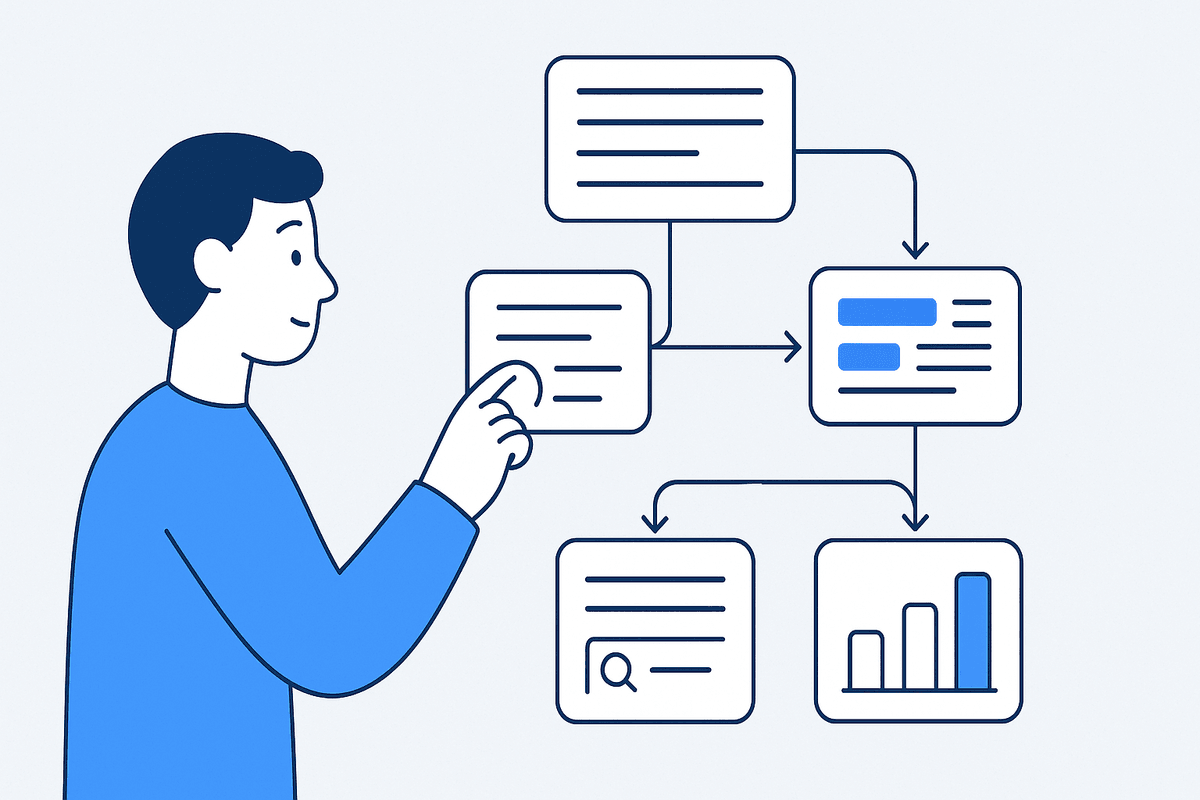
Intent-based keyword research in 6 steps
Why you should start from 'why people search,' not search volume
Intent-based keyword research sorts search intent into four types first. Volume vs. intent, whether to chase low-volume long-tail terms, and a 6-step process.
Intent-based keyword research isn't about finding high-volume keywords; it's about first understanding why the user typed that query. The same query can call for completely different content depending on intent, so keyword research that starts without classifying search intent easily loses its direction.
Why intent comes before volume
Traditional keyword research focused on search volume. Intent-based research starts from "why is the user searching for this?" A high-volume keyword whose intent has nothing to do with your product gives you little reason to create content, while a low-volume keyword whose intent is close to purchase moves up the priority list.
It also helps to be clear about what to prepare before you start.
- Define the business goal: is it more traffic, lead generation, or brand awareness?
- Target customer profile: a hypothesis about who searches and in what situation
- Keyword tool access: one of Google Keyword Planner (free), Ahrefs, Semrush, or the Naver Search Ads keyword tool
The four types of search intent
Search intent falls into four broad types. Each has a different user goal and a different content format that fits.
| Intent type | User goal | Example keyword | Content that fits |
|---|---|---|---|
| Informational | Wants to know | "what is SEO" | Guides, glossary explanations |
| Navigational | Wants to reach a specific site | "TRAIL Search login" | Brand pages |
| Commercial investigation | Wants to compare | "GEO tool comparison" | Comparison reviews, lists |
| Transactional | Wants to buy | "GEO diagnosis pricing" | Pricing pages, sign-up |
The way to judge is simple. Search the keyword on Google yourself: if page one is mostly guides, treat it as informational; if it's mostly product pages, treat it as transactional.
Six steps of intent-based research
Step 1. Brainstorm seed keywords
Without any tools, list 10–20 core topic terms related to your product or service. It works even better if you collect the language users actually use from support inquiries, sales call notes, and comments on your blog.
Step 2. Classify search intent
Sort your seed keywords into the four intents in the table above. If you skip this step and go straight to expansion, you'll end up re-sorting a keyword list with mixed intents later.
Step 3. Expand keywords
Expand your seed keywords with tools such as Google Keyword Planner, Ahrefs Keywords Explorer, and the Naver Search Ads keyword tool.
- Autocomplete: suggestions that appear when you type a seed keyword into the search box
- Related searches: related queries at the bottom of the results page
- PAA (People Also Ask): pull long-tail terms from the "People also ask" box
- Competitor analysis: reverse-engineer the keywords competing sites rank for
Step 4. Analyze search volume and competition
Check search volume and competition for your expanded keyword list.
| Metric | Meaning | Benchmark |
|---|---|---|
| Search volume | Average monthly searches | 100+ is worth targeting |
| Keyword difficulty (KD) | Difficulty of ranking near the top | 0-30 easy / 31-60 medium / 61+ hard |
| CPC | Cost per ad click | Higher means more commercial value |
Even with high volume, a KD of 80 or more is very hard for a new site to break into. Early on, it's realistic to start with KD 30 or below and search volume in the 100-1,000 range.
Step 5. Prioritize
You can't go after every keyword at once. Set priorities using four criteria: business relevance, feasibility, fit with search intent, and conversion potential. Commercial investigation and transactional intents sit closer to conversion than informational ones.
Step 6. Build a keyword map
Map your selected keywords to your site's page structure. Give each page one primary keyword and place related keywords as secondary.
| Page | Primary keyword | Secondary keywords | Content type |
|---|---|---|---|
| /blog/guide-1 | GEO basics | getting started with GEO, GEO for beginners | Guide |
| /blog/howto-1 | how to analyze keywords | keyword tools, keyword research | How-to guide |
Watch out: assigning the same keyword to multiple pages causes "keyword cannibalization," where your own pages compete with each other.
Worked example: walking a GEO diagnosis service through the six steps
Abstract steps alone can be hard to picture. Let's assume we run a GEO diagnosis service and actually walk through the six steps.
In Step 1 (seed brainstorming), we first write down words like "GEO," "AI search optimization," "AI citation," "AEO," and "AI visibility." Digging through inquiries the sales team receives, we also find many phrases like "Our company doesn't show up in ChatGPT." We add these phrases to the seed list too.
In Step 2 (intent classification), "what is GEO" is informational, "GEO tool comparison" is commercial investigation, and "GEO diagnosis pricing" is transactional. "Our company doesn't show up in ChatGPT" looks informational at first glance, but it's actually closer to commercial investigation, since the person wants the problem solved. Search intent should be judged by the purpose behind the words, not the surface words themselves.
In Step 3 (expansion), typing "GEO" into autocomplete brings up "GEO marketing," "GEO meaning," and "GEO consulting." Related searches surface "how to optimize for AI search," and PAA surfaces questions like "What's the difference between GEO and SEO?"
In Step 4 (volume and competition), the word "GEO" itself has low search volume and its competition is hard to judge. "AI search optimization," on the other hand, has higher volume and a clear commercial intent. At this step we can decide to rank "AI search optimization" above "GEO" in priority.
In Step 5 (prioritization), we decide which to tackle first: a transactional but low-volume keyword like "GEO diagnosis pricing," or an informational but high-volume keyword like "how to optimize for AI search." If the business goal is lead generation, we might prioritize the former; if it's brand awareness, the latter.
In Step 6 (keyword map), we assign the primary keyword "what is GEO" and secondary keywords "GEO meaning" and "generative engine optimization" to the "/blog/what-is-geo" page, and assign "GEO diagnosis pricing" to the "/pricing" page, mapping keywords to pages as close to one-to-one as possible.
Troubleshooting: what to check when you get stuck
"I only get keywords with very low search volume": your seed keywords may be too specific. Move up one level of abstraction and expand again. Broaden "B2B SaaS onboarding email optimization" to "email marketing," then narrow back down.
"I only get highly competitive keywords": find a niche. Combining industry, region, and language surfaces lower-competition keywords, as in going from "SEO" (extremely competitive) to "SEO for Korean-language blogs" (low competition).
"Every keyword tool shows different search volumes": that's normal. Each tool uses a different data source. Judge by relative size and trends rather than absolute values.
"Lots of keywords have ambiguous intent": don't force them into a single type. Search engines often aren't sure about mixed-intent keywords either. It's better to split them into more specific long-tail keywords that make the intent clear.
Practical tips and common mistakes
Don't underestimate long-tail keywords. "how to do keyword research for B2B SaaS" has less search volume than "keyword research," but its conversion intent is clear. Analyzing the length, structure, and subtopics of competitors' top-ranking content shows you "what you need to do better."
There are common mistakes too. If you only get keywords with very low search volume, your seed keywords may be too specific. Move up one level of abstraction and expand again. If you only get highly competitive keywords, combine industry, region, and language to find a niche.
Content design checkpoints by intent
Once you've classified intent, check that the content elements each intent calls for actually made it into the page. If intent and content format don't match, high search volume won't turn into conversions.
| Intent type | Must-have elements | Commonly missed elements |
|---|---|---|
| Informational | Clear definition, background, examples | How to apply it in practice (a definition with no "so how do I do it") |
| Navigational | Brand name, login and contact paths | Page structure so complex that people can't find the link they want |
| Commercial investigation | Comparison table, selection criteria, pros and cons | Filled only with self-promotion and no objective criteria |
| Transactional | Pricing, sign-up steps, CTA button | Pricing only available "on request," which drives people away |
For example, if a page that attracts commercial-investigation traffic just lists your product's strengths with no comparison criteria, users will leave for another site to find a real comparison table. In that case you got the search intent right, but the content format betrayed it.
Intent research in the age of AI search
AI search engines also find and cite content based on the user's prompt, which is a keyword in the broad sense [1]. Understanding what questions users ask ChatGPT or AI search is a natural extension of intent-based keyword research.
Keywords with commercial investigation and transactional intent in particular are likely to be handled as comparison tables or checklists in AI answers. When you turn these keywords into content, adding a definition sentence, a comparison table, and source footnotes on top of a basic SEO structure raises the chance of being cited in both search engines and AI search [2][3].
With a diagnosis tool like TRAIL Search, you can track how often your brand is mentioned for which prompts, and check whether your intent-based keyword map actually leads to AI citations.
It also helps to remember that intent classification isn't a set-and-forget task. When a new product launches or a competitor creates a new category, a keyword that used to be informational can shift to commercial investigation. "AI search optimization" was close to purely informational a few years ago, but it now carries a mix of commercial-investigation intent from people looking for tools. Teams that treat classification results as living data to recheck periodically, rather than fixed values, keep their keyword maps accurate for longer.
Keyword research isn't a one-time job. Run a full review once a quarter alongside a monthly scan for new opportunities, and keep updating your keyword map to match market shifts, new product launches, and seasonal trends.
You can continue with Five signals for choosing your keyword expansion direction: criteria beyond volume, difficulty, What is GEO (generative engine optimization)? Which pages to start with, in what order, A four-step framework that unifies SEO, GEO: split the team or combine it?, How to win Featured Snippets, People Also Ask, Reworking existing blog posts for SEO and GEO, and On-page SEO checklist before publishing.
Frequently asked questions
Do I need paid tools for keyword research?
No. Google Autocomplete, PAA, related searches, and Search Console data are enough for basic intent classification. Paid tools only save time on large-scale expansion and competitive analysis; they aren't required.
How do I decide the intent of an ambiguous keyword?
Search the keyword yourself and look at the types of results on page one. Mostly guides and explainers means informational, mostly comparisons and reviews means commercial investigation, and mostly product and pricing pages means transactional. If the results are mixed, the search engine isn't sure of the intent either, so it's safer to split it into more specific long-tail keywords.
Can I put keywords with different intents on one page?
We don't recommend it. Forcing keywords with different intents onto one page makes it hard to rank for any of them. It's safer to build each page around one primary keyword and two or three secondary keywords that share the same intent.
References
Summary
- Intent-based keyword research starts from 'why is the user searching for this,' not search volume.
- Search intent falls into four types (informational, navigational, commercial investigation, transactional), and each type calls for a different content format.
- It runs in six steps: seed keyword brainstorming, intent classification, expansion, volume and difficulty analysis, prioritization, and the keyword map.
- Long-tail keywords with clear intent often contribute more to conversions, even with lower search volume.
Produce the content this post covers from your brand standard
TRAIL Studio registers the brand standard once and produces cardnews, detail pages, product photos, shorts and blog posts from it. Generated output is reviewed and edited by a person before it ships.
More posts
Best AI Search Optimization Tools 2026: 6 GEO Tools Ranked
We compared six tools that check whether ChatGPT and other AI answers mention your brand, on measurement, action, engines, Korea support, and price.

Why Does ChatGPT Cite Listicles? Format vs. Hierarchy
Listicles split items cleanly, so AI can extract just what it needs. How to write citable listicles, whether format alone is enough, and how to build hierarchy.

What is GEO? Which pages to start with, and in what order
GEO structures content so generative search like ChatGPT and AI Overviews cites it. Does it replace SEO, what order to run it in, and how to measure it.
Keep reading on this topic
- Topical authority: why pillar-cluster beats a single postTopical authority comes from content clusters, not single posts: the pillar-cluster model, how to design one, why it wins in AI search, and when it's enough.
- A 4-step framework for SEO and GEO: split teams or merge?SEO and GEO work best on one content quality foundation. Whether to split or merge teams, a 4-step framework, why unified plans fail, and one shared metric.
- SEO and GEO top spots: high rankings, missing in AI answersReaching the top now covers how AI answers mention you, not just rankings. What changed, how to manage both tops, and why competitor comparison matters.
This post is part of the Content category, which collects all 41 posts on the topic. See all posts in Content