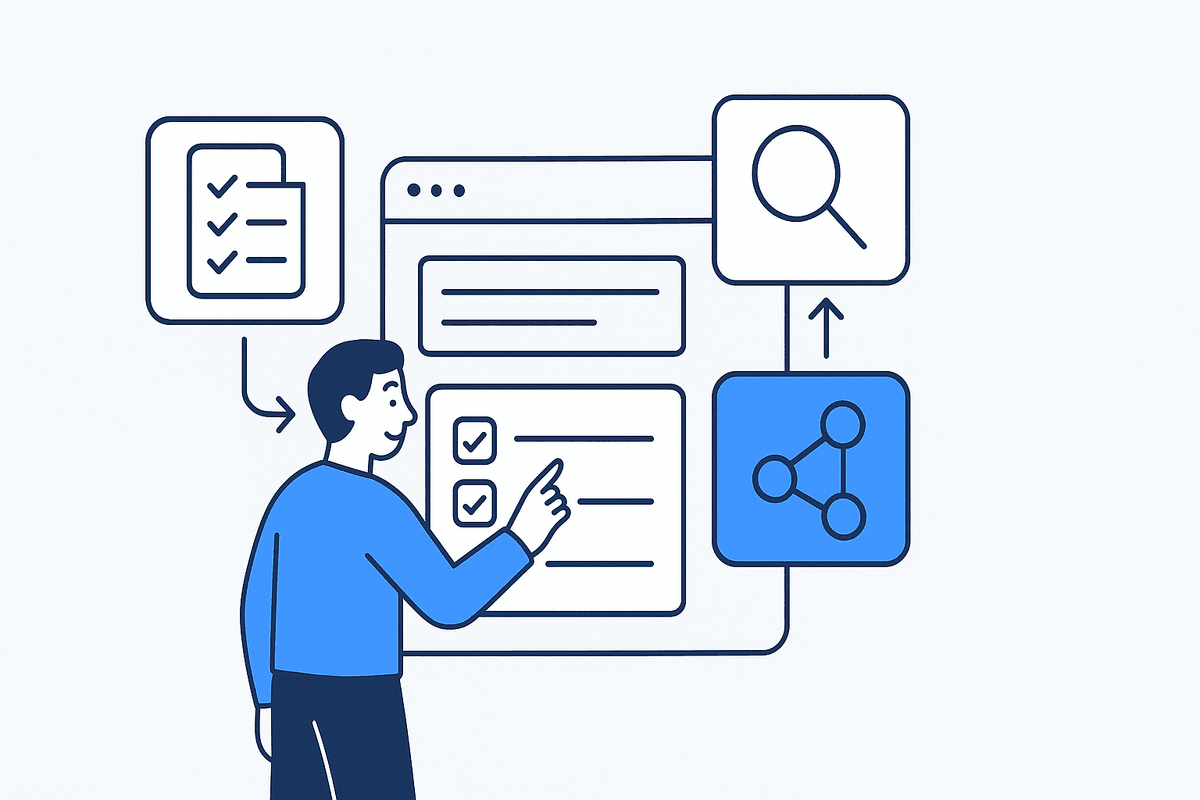
On-page SEO checklist 2026: 8 checks before you publish
A page-by-page optimization checklist that takes 5 minutes before publishing
On-page SEO covers what you control on the page: titles, meta, headings, links, images, schema. Pre-publish checks, what AI search changed, and keyword use.
On-page SEO is the work of getting in order the elements you control directly on the page, from the title tag to schema markup. Unlike off-page signals such as backlinks or domain authority, it is entirely up to you, and if these fundamentals slip, your chances of being cited in AI search drop along with them.
As search shifts toward AI answers, we often get asked, "Does on-page SEO still matter?" If anything, the answer is the opposite. AI engines also end up rereading and citing content that search engines have crawled and indexed. If a page's structure is unclear, it is hard for AI to extract the key points, and when extraction is hard, you get pushed out of the citation candidates. In other words, on-page SEO is still the foundation of GEO.
Before publishing a new post, or when checking an existing page, just follow the order below.
1. Title tag
The title tag is the first element read in both search results and AI answers[2].
| Rule | Details |
|---|---|
| Length | Around 30-45 characters recommended |
| Keyword position | Place it toward the front where possible |
| Uniqueness | Write a different one for each page |
| Brand name | Append it at the end if needed |
Good example: "On-page SEO checklist 2026: 8 steps to revisit in the AI search era." Bad example: "SEO guide."
2. Meta description
The meta description is not a direct ranking factor, but it affects click-through rate. In AI search this sentence is sometimes quoted directly in answers, so it deserves more care.
| Rule | Details |
|---|---|
| Length | Around 40-60 characters |
| Content | The page's core value, as a direct answer |
| Keywords | Include the core keyword naturally |
3. Heading structure (H1–H3)
Heading tags tell both search engines and AI how your content is structured. Use only one H1 per page, divide major sections with H2s, and organize subtopics with H3s. Keep the order rather than jumping straight from H1 to H3 so the structure can be understood accurately.
4. Keyword placement in the body
| Position | Recommendation |
|---|---|
| First 100 words | Core keyword appears once |
| H2/H3 headings | Distribute related keywords naturally |
| Whole body | Keyword density of 1-2% |
| Last 100 words | Core keyword appears once more |
Keywords are something you "use naturally," not something you "insert." If a sentence reads awkwardly, you have overdone it. Writing "Here is how to do on-page SEO" instead of "Let us take a look at on-page SEO methods" reads naturally and still includes the keyword.
5. Internal links
Internal links tell search engines how pages relate to each other and also increase how long users stay. Link naturally to other posts on related topics, and put keywords in the anchor text while avoiding phrases like "click here." We recommend at least 2-3 internal links per page; an isolated page with no internal links at all can drop in crawl priority.
6. Image alt text
Image alt text is both an accessibility element and the core of image SEO. Describe the image content concisely and include related keywords naturally. Give files descriptive names too, like on-page-seo-checklist.png, and use an empty alt (alt="") for decorative images.
7. URL structure
| Rule | Example |
|---|---|
| Short and descriptive | /blog/on-page-seo-checklist |
| Lowercase + hyphens | Use lowercase and hyphens instead of On_Page_SEO |
| Remove unnecessary parameters | Remove ?id=123&ref=abc |
8. Schema markup
Adding structured data can make rich snippets appear in search results[3]. AI engines can also refer to structured data to understand page types and attributes. The baseline is Article schema for blog posts, FAQPage schema for pages with FAQs, and HowTo schema for step-by-step guides. Keep in mind, though, that schema by itself does not guarantee AI citations. Detailed implementation is covered in the practical schema markup guide.
Checklist summary
| # | Item | Check |
|---|---|---|
| 1 | Title tag: 30-45 characters, keyword toward the front | ☐ |
| 2 | Meta description: 40-60 characters, direct answer | ☐ |
| 3 | One H1, H2/H3 order and keywords | ☐ |
| 4 | Core keyword in the first 100 words | ☐ |
| 5 | At least 2-3 internal links | ☐ |
| 6 | Image alt text written | ☐ |
| 7 | URL: short, lowercase, includes keyword | ☐ |
| 8 | Schema markup (Article + FAQ) | ☐ |
Common sticking points
I changed the title but it is not reflected in search results. Search engines sometimes rewrite titles on their own. If you inspect the URL in Search Console and request indexing, it is usually reflected within a few days to 2 weeks.
Adding the keyword makes the sentence awkward. Instead of fitting the keyword into the sentence, try restructuring the sentence around the keyword.
I do not know where to put internal links. The moment the body mentions another topic is the most natural link point. Adding a link where the context continues, as in "First, we need to sort out this concept," does not feel awkward.
On-page SEO is not a flashy tactic. It is the fundamentals that, if you skip them, cause every other effort to leak. Running this checklist for just a few minutes before each new post greatly reduces what you miss in both search engines and AI engines. Once your on-page is solid, we recommend also checking with TRAIL Search how this page is actually cited in AI search.
For related reading, see What is GEO (generative engine optimization)? Which pages to start with, and in what order, Designing topical authority clusters: why to write as a pillar-cluster system instead of one post, and A 4-step framework for SEO and GEO: split teams or merge?.
Frequently asked questions
Will good on-page SEO alone raise my rankings?
On-page is a necessary condition, not a sufficient one. Off-page signals like backlinks, technical SEO like site speed, and domain authority all play a part. But if your on-page is weak, you are at a disadvantage in both rankings and AI citations no matter how good the other factors are.
Should every page have schema markup?
No. It is safer to start with pages that have a clear structure, such as blog posts, pages with FAQs, and step-by-step guides. Forcing in schema that does not match the page can actually draw scrutiny.
Should I check existing content with this checklist too?
Yes. For posts published more than 6 months ago, updating the title and meta description often improves click-through rate. We recommend checking existing content against the same checklist at least once a quarter.
References
Summary
- On-page SEO covers the elements you control directly on the page: title tag, meta description, heading structure, keyword placement in the body, internal links, image alt text, URL, and schema markup.
- In the AI era, structured data matters more because not only search engines but also AI engines use it to parse content.
- The principle for keywords is to use them naturally, not to insert them. If it reads awkwardly, you have overdone it.
- In practice, an effective routine is to run this checklist before every new post and check existing content once a quarter.
Produce the content this post covers from your brand standard
TRAIL Studio registers the brand standard once and produces cardnews, detail pages, product photos, shorts and blog posts from it. Generated output is reviewed and edited by a person before it ships.
More posts
Best AI Search Optimization Tools 2026: 6 GEO Tools Ranked
We compared six tools that check whether ChatGPT and other AI answers mention your brand, on measurement, action, engines, Korea support, and price.
Why Does ChatGPT Cite Listicles? Format vs. Hierarchy
Listicles split items cleanly, so AI can extract just what it needs. How to write citable listicles, whether format alone is enough, and how to build hierarchy.
What is GEO? Which pages to start with, and in what order
GEO structures content so generative search like ChatGPT and AI Overviews cites it. Does it replace SEO, what order to run it in, and how to measure it.
Keep reading on this topic
- Topical authority: why pillar-cluster beats a single postTopical authority comes from content clusters, not single posts: the pillar-cluster model, how to design one, why it wins in AI search, and when it's enough.
- A 4-step framework for SEO and GEO: split teams or merge?SEO and GEO work best on one content quality foundation. Whether to split or merge teams, a 4-step framework, why unified plans fail, and one shared metric.
- SEO and GEO top spots: high rankings, missing in AI answersReaching the top now covers how AI answers mention you, not just rankings. What changed, how to manage both tops, and why competitor comparison matters.
This post is part of the Content category, which collects all 41 posts on the topic. See all posts in Content