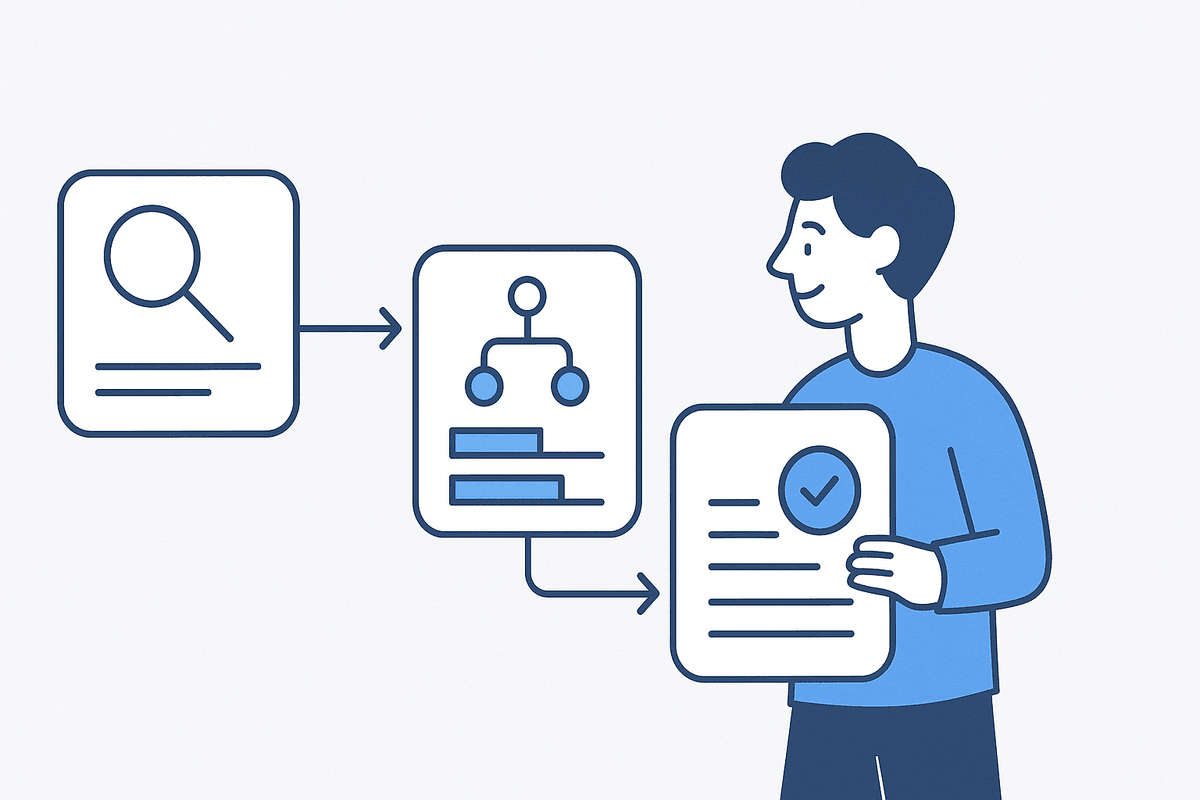
AI search is about recommendation and action, not visibility
Showing up in an answer, getting chosen, and turning that into action are three different problems
Turning an AI answer mention into action takes sentences that make the shortlist. How to adapt content as queries get longer, and how commerce and SaaS differ.
Winning in AI search isn't only about appearing in the answer. AI has to narrow its options down to you as a recommendation candidate, leave a reason for choosing you when it compares, and let the user move straight to an inquiry, booking, or purchase. If you only ask "does our brand show up in AI answers?", you're seeing half the picture.
Users increasingly ask AI things like: "Pick the one that fits my needs." "Compare these options." "Where should I book or buy right now?" In these questions, visibility itself isn't the point. What matters is how AI narrows the candidates, what evidence it leaves in a comparison, and whether the answer flows naturally into the next action.
There's a pattern that comes up often in practice. Many pages appear in answers but never make the shortlist, or make the shortlist but have no action path ready. Leave that gap alone, and the content team keeps running into the same question: "Our content shows up in AI answers, so why aren't sales going up?"
Search queries are getting longer and more specific
In traditional search, users opened several pages themselves, compared prices, and made the final choice on their own. AI search pulls part of that process forward. Where the old query was "Gangnam meeting room rental," today it's something like "Recommend a meeting room in Gangnam that fits ten people, is close to a subway station, and can be booked for just two hours."
For a query like that, ranking for the keyword "Gangnam meeting room" isn't enough. The page needs conditions AI can compare, a visible reason to recommend it, and a path all the way to booking.
This shift changes what the word "search" means. Search used to be the act of finding information; now it's moving closer to the act of delegating a judgment. Users hand off the work of opening and comparing ten pages to AI. The more that delegation grows, the more directly a brand's revenue depends on how it appears inside the judgment AI has been handed.
GEO doesn't mean abandoning SEO
If you treat GEO as a replacement for SEO, your practical judgment gets fuzzy. AI search still looks at web documents, product information, reviews, structured data, and brand trust together. It's hard to expect AI to suddenly understand a page that search engines can't read[2]. So GEO adds the following questions on top of existing SEO.
| Check | Traditional SEO question | GEO extension |
|---|---|---|
| Discovery | Does it show up in search results? | Does it also appear in AI answers and summaries? |
| Evidence | Is the page indexed? | Are the sentences clear enough to be cited as a source? |
| Comparison | Does the keyword rank high? | Does a reason for choosing it survive in a comparison? |
| Recommendation | Does it earn clicks? | Does it make the recommendation shortlist? |
| Action | Does it drive visits? | Does it lead to inquiries, bookings, purchases, or consultations? |
SEO is still the starting point. GEO extends it to how your assets are used on screens where AI answers, recommends, and compares.
Break it down into five signals
If you treat an AI search audit as a simple visibility report, execution stalls. It's safer to split it into five stages that mirror the actual decision flow.
1. Answer visibility: Check whether your brand or service appears in the AI answer when you ask a problem-type question. It's not just about brand-name searches; what matters is whether you show up for questions like "Recommend options that fit these conditions."
2. Source citation: Check whether the AI answer uses your page as a source. Informational content, comparison posts, pricing pages, and FAQs need to be organized in a form AI can easily lift sentences from.
3. Recommendation shortlist: When AI narrows down the options, check whether your brand makes the cut. Fit by condition matters more than "we're the best." Showing who you fit, when to choose you, and even when you're not a fit makes you easier to use as a recommendation candidate.
4. Comparative edge: Making the shortlist isn't the end. The criteria users actually weigh, like price, features, ease of adoption, and scope of support, need to be clearly on the page for a reason to choose you to survive inside a comparison.
5. Action-path readiness: After AI recommends you, the user has to act. If the contact button is buried or the pricing terms are vague, the recommendation rarely turns into action. AI search optimization isn't just a content problem; it's also a conversion-path problem.
These five stages work more like a ladder you climb in order. Without answer visibility, citation is unlikely; without citation, making the shortlist is hard. So when you audit, check first where the chain already broke instead of rushing to fix the later stages. For example, no matter how good a comparison table you add to a page that never appears in answers, it won't help if AI never considers that page a candidate in the first place.
What strong and weak sentences look like
A strong page has sentences like this.
> This service fits teams of 20 or fewer that need to manage consultation bookings quickly. Large organizations that need complex system integrations are better served by a separate custom-build consultation.
This isn't promotional copy. It gives both AI and people a selection criterion. A sentence like this, on the other hand, is weak.
> We deliver customer satisfaction through outstanding technology and differentiated service.
There's almost nothing for AI to compare, and no reason left for the user to choose.
The difference applies to the whole page structure, not just a single sentence. Pages built around fit by condition usually follow this order. First state "who it's for" in the opening paragraph, then spell out "when it's not a fit," and finish with "so what you need to prepare." If any of the three is missing, AI runs short of material to match conditions.
How the action path differs by industry
Rather than applying the five stages as-is, each industry needs to put more weight in different places.
| Industry | Stage to emphasize | Practical example |
|---|---|---|
| E-commerce | Comparative edge | Organize options, price, shipping, and perks in a table so the product can be compared side by side with competitors |
| SaaS | Recommendation shortlist | State fit by team size and use case, like "teams of 20 or fewer" |
| Booking-based local services | Action-path readiness | Put available times, cancellation policy, and contact channels at the top of the page |
| B2B consulting | Source citation | Turn cases and methodology into evidence-based documents that can be cited |
This table doesn't mean "this industry only needs to care about this stage." All five stages matter; it's a priority guide for choosing where to start when resources are limited.
Commerce, SaaS, and local services feel it first
Not every industry changes at the same pace. The more comparison fatigue users feel, and the more conditions and options there are, the more likely they are to hand the judgment to AI. In commerce, options, price, reviews, shipping, and perks become the comparison criteria. In SaaS, it's features, pricing plans, ease of adoption, security, and integrations. In local services, location, hours, reviews, and booking availability matter.
Pages in these industries now need to be judged not only on search traffic but on "is this easy for AI to rewrite into a recommendation?" Some data shows AI referrals are still a small share of total traffic[3], but regardless of volume, the stage where AI builds the user's set of options has already begun. If a brand drops out of the shortlist before a click ever happens, there's less reason to search for that brand at all.
Markets with multiple search surfaces are more complex
In a market like Korea, where search is split across several surfaces, you can't look at this flow through a single channel. Beyond global AI search tools, each portal-style search service already has its own vertical data, like shopping, maps, and reviews. In that environment, tidying up your official website content isn't enough. To handle condition-based queries, you also need to organize the reviews, product information, and location data each search surface refers to.
There's a caution here, though. How much a given element affects the answer composition on a given search surface is hard to state definitively without official documentation or repeated experiments. For now, it's safer to separate the general fact that "different search surfaces refer to different data" from the operational direction that "brand assets therefore need to be organized for multiple surfaces."
A checklist your content team can run now
You don't have to change every page at once. Start with the core pages closest to conversion.
- Write 20 condition-based questions customers would ask AI.
- For each question, check whether your brand appears in the answer, the sources, the shortlist, and the comparison sentences.
- Pick pages with weak reasons to recommend them and strengthen the conditions, audience, use situations, limitations, and next action.
- Make the information needed to act, like pricing, options, booking, consultation, and purchase paths, clearly visible.
- Re-run the same questions regularly to check that the recommendation context holds.
Order matters when you run these five steps. If you try to rewrite every page's sentences from the start, priorities get blurry. It's safer to pick the 5 of your 20 condition-based questions closest to actual conversion, strengthen those pages first, check the effect, and then expand to the rest. After fixing a page, don't skip re-running the same question to confirm the recommendation context actually changed. Edits don't show up in results right away; AI may take time to re-read and re-evaluate the page.
This work doesn't mean abandoning SEO. It means building assets search engines can read well, while making each sentence's role clearer so AI can recommend, compare, and connect them to action.
Two common mistakes
Confusing making the shortlist with getting chosen. Many teams relax when they see a signal that they made the shortlist, but without a comparative edge inside that shortlist, it doesn't lead to action. Getting onto the shortlist and the final choice need to be tracked as separate metrics.
Leaving the conversion path to the marketing team alone. Often the content team fixes page copy while the product team manages booking and checkout buttons. When the two move separately, even the best recommendation copy loses the conversion if the actual booking button is hidden three clicks deep. Content and the action path need to be audited together by one team.
To sum up, if you set the goal of AI search optimization as "appear in an answer once," your direction narrows. You need to look at the whole long flow: the user asks, AI narrows the candidates and attaches reasons for comparison, and the user moves on to booking or buying. Don't stop at "are we showing up in AI answers?" Ask "are we leaving selection criteria clear enough for AI to recommend us?" and the priorities for your next tasks become visible.
Answering that question ultimately means the search, content, product, and commerce operations teams all have to look at the same question. When content, structured data, reviews, product information, and the conversion path run separately, this five-stage ladder breaks in the middle. Using TRAIL Search to diagnose where your pages break among these five stages is one option.
For related reading, see What is AI search query fan-out? How to find hub queries and change your content, Why Reddit search grew again in 2026: why AI cites community signals, and What is GEO (generative engine optimization)? Which pages to start with, and in what order.
You can continue with How Much Traffic Comes From AI Search, and Why It Matters and Traffic Dropped After a Core Update? Split SEO and GEO.
Frequently asked questions
Does every industry need action-path optimization?
No. It matters most where users weigh many conditions, comparison fatigue runs high, and the next step is clear, like booking, buying, or a consultation. Commerce, SaaS, and booking-based local services are the main examples. For purely informational brands, showing up in answers and being cited as a source is often enough.
Do we have to write 'we're the best' to make the shortlist?
The opposite. A sentence like "We're the best" gives AI nothing to compare, so it's actually weak. Sentences that spell out which users you fit and when you don't are more likely to be used as recommendation candidates.
Is this optimization a separate job from GEO?
No. It extends existing SEO and GEO work by adding one more question: does it get recommended and lead to action? You can't expect AI to suddenly understand a page that search engines can't read, so basic SEO has to come first.
References
Summary
- AI search queries keep picking up more conditions. Users ask for an organized judgment and a recommendation before they ask for a comparison list.
- Splitting it into five stages (visibility, citation, shortlist, comparative edge, action-path readiness) shows you where to fix things.
- Sentences that show specific fit by condition are more likely to be used as recommendation candidates than 'we're the best.'
- Industries where comparison and action sit side by side, like commerce, SaaS, and booking-based local services, feel this shift first.
Check this topic against your own brand
TRAIL Search measures how ChatGPT and Perplexity answer your customers' questions and finds and fixes where the brand is missing, turning this post into a diagnosis. Start with 10 questions, no card required.
More posts
How ChatGPT search works: the language changed in 4 days
ChatGPT moved its search calls from JSON to a pipe format: five call types, freshness windows, and why AI visibility tracking must keep running.
The LLM wiki and Open Knowledge Format for agent knowledge
Karpathy's LLM wiki and Google's Open Knowledge Format, read from the originals: a format for agent knowledge bases, the RAG difference, and v0.2 trust fields.
What is different about Gemini 4 Argon? Verification
What is different about Gemini 4 Argon compared with earlier models? We check the 1M-token output limit and use cases plus the criteria for verifying AI output.
Keep reading on this topic
- Why Reddit search grew again: AI cites community signalsAI answers favor real community reviews, comparisons, and complaints over official feature lists. How brands can use community signals, by industry.
- GPTBot vs OAI-SearchBot: Is AI Crawling a Search Signal?AI bot crawling may signal a new search channel, but crawl counts aren't visibility. GPTBot vs. OAI-SearchBot, scale vs. Googlebot, and how to track it.
- Naver AI Briefing Didn't End SEO: Korean GEO vs Google GEOSEO basics still matter in the Naver AI Briefing era. What Naver Mate is, Naver's content quality bar, and how to get cited as a source in AI Briefing.
This post is part of the Trend category, which collects all 14 posts on the topic. See all posts in Trend