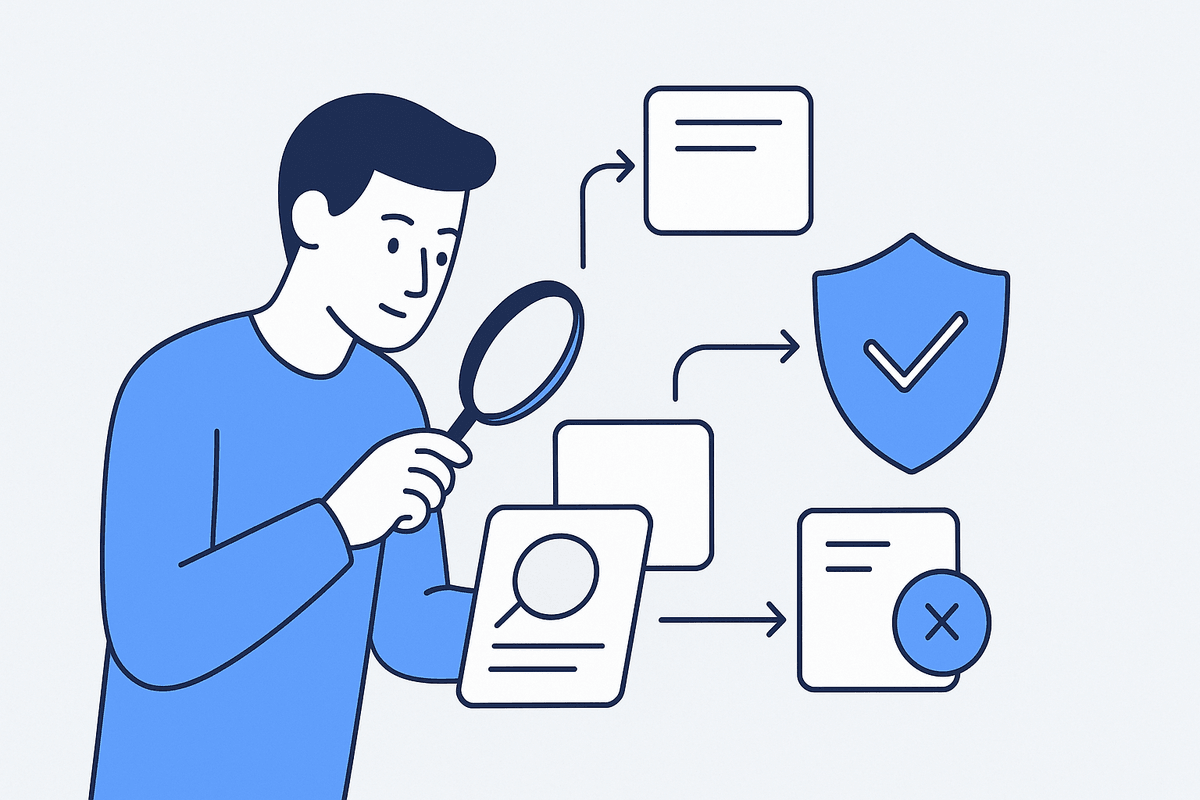
Defending Against RAG Hallucinations: Types and Limits
Retrieval alone isn't enough; you need a verification step
RAG retrieves outside documents to ground answers, yet hallucinations still arise in retrieval and generation. Types, defenses, and limits of automated checks.
RAG (Retrieval-Augmented Generation) is a technique in which an LLM, when generating an answer, retrieves external documents and supplies them as grounding. But hallucinations can still occur within this setup. The approach of "don't answer from the model's internal knowledge alone; answer based on the retrieved documents" does greatly reduce hallucinations, but it doesn't eliminate them entirely[1].
Why do hallucinations happen even with RAG?
There are three main reasons RAG is not a perfect fix.
| Cause | Description |
|---|---|
| Retrieval failure | Irrelevant documents are retrieved, or the documents you actually need are missing |
| Context overload | Too many documents are injected at once, and the model misses the key point |
| Generation-stage error | The right documents are provided, but the model misinterprets or alters them |
So the idea that "you just need good retrieval" is only half right. You get genuinely accurate answers only when you also design how the model handles the retrieved documents.
Four types of hallucination
Type 1: Fabrication (no source): The model invents information that isn't in the retrieved documents. This is the most dangerous type. For example, the model puts a specific price in its answer even though the search results contain no pricing information.
Type 2: Misattribution (source distortion): The model misinterprets what the retrieved documents say, or mixes up information from different sources. For instance, it applies a figure from one source to a different context and reaches the wrong conclusion.
Type 3: Context Drift: The retrieved document itself is correct, but the model cites a part that has nothing to do with the context of the question. A typical case is answering a question about "this year's price" with price data from several years ago.
Type 4: Over-Generalization: The model presents a specific case or conditional fact as a universal truth. For instance, it extends a conclusion limited to one industry to the whole market. Multiple studies have also pointed out that this kind of error is observed repeatedly regardless of model or domain[2].
Five defense strategies
1. Improve retrieval quality
The first layer of defense against hallucinations is making sure the right documents are retrieved. The basic tools are query rewriting, which turns a user's question into a form optimized for search; hybrid search, which combines keyword search and semantic search; and filtering with a relevance score threshold.
2. Tier your sources by trust
Don't treat all sources equally. Similar to E-E-A-T principles, apply trust tiers to sources as well.
| Tier | Definition | Examples |
|---|---|---|
| Tier 1 | Official documentation, academic papers | Official guide documents, academic papers |
| Tier 2 | Industry media, research firms | Specialist outlets, research reports |
| Tier 3 | Communities, personal blogs | Community posts, personal sites |
It's safer to state in the prompt that Tier 1 sources should be cited first and Tier 3 sources used only as supplementary references. This principle is also central to AI citation optimization. The more clearly a page provides structured evidence and sources, the more easily it is classified as a trustworthy source[3].
3. Verify after generation
After the model produces an answer, you also need a separate verification step.
| What to verify | How |
|---|---|
| Numerical accuracy | Compare the numbers in the answer against the source documents |
| Citation match | Check that what's cited in a footnote actually exists in that source |
| Time consistency | Check that the time frame of the answer matches that of the source documents |
| Logical consistency | Check that claims within the answer don't contradict each other |
4. Grounding prompts
Explicitly telling the model "don't answer if it's not in the retrieved documents" is another important line of defense.
Rules:
1. Use only information that is supported by the provided source documents
2. Do not make up figures or data that are not in the sources
3. Mark information you are not sure about as "This information has not been confirmed"
4. If sources conflict, prioritize the source with the higher Tier
5. Enforce expressions of uncertainty
This method forces the model to express uncertainty in answers it is less confident about. Having it use phrases like "it is reported that…" or "it is possible that…" lets users tell facts from estimates.
Fact-checking in the content pipeline
If you have a pipeline that uses AI to create content drafts, a practical approach is to add verification steps in the following order.
- The AI generates a draft.
- Compare inline citations against the reference materials.
- Verify that figures and statistics actually exist in the original sources.
- Confirm that at least 1–2 Tier 1 sources are included.
Why it matters from a GEO perspective
When AI platforms cite content, they tend to prefer sources that provide accurate information. Content mixed with hallucinations, meaning content full of unsupported figures or claims with unclear sources, can be at a disadvantage for AI citations. Put the other way, defending against hallucinations goes beyond simply "reducing wrong answers" and connects directly to "creating content that AI will trust and cite."
The practical limits of automating verification
Not all fact-checking can be automated. Here is how the realistic scope of automation breaks down.
| Item | Can it be automated? |
|---|---|
| Checking figures | Yes, by searching the source documents and comparing |
| Citation format | Yes, with regex validation |
| Logical consistency | Basic contradiction detection is possible; subtle errors need a person |
| Contextual fit | Needs expert review |
| Freshness check | Date comparison is possible, but contextual judgment needs a person |
A hybrid approach, where automated checks filter out basic errors and people supply contextual judgment, is the most realistic. RAG is a good starting point that greatly reduces hallucinations, but you only get AI content you can truly trust when you design the entire pipeline, from retrieval through generation to verification.
For related reading, see The P-E-V workflow: reducing LLM classification errors with plan, execute, verify, Design principles for a GEO data AI agent: structured tool calls and blocking irreversible actions, and Designing an AI content pipeline: verifying the quality of AI-written articles and 5 common mistakes.
You can continue with The AI Marketing OS TRAIL Labs Builds: A System, Not Tools, TRAIL Labs has joined the NVIDIA Inception program, and What Is an API? Sync and Async Explained with a Restaurant.
Frequently asked questions
Does RAG eliminate hallucinations completely?
No. RAG reduces hallucinations; it doesn't eliminate them. Retrieval can still fail, too many documents can be injected so the model misses the key point, or the model can misinterpret the right documents even when they are provided.
How do you set up source trust tiers?
A common approach is to put primary sources such as official documentation and academic papers at the top (Tier 1), industry media and research firms in the middle (Tier 2), and communities and personal blogs as supplementary references (Tier 3). It's safer to state in the prompt that Tier 1 should be cited first and Tier 3 used only as supporting evidence.
Can all fact-checking be automated?
No. Checking figures and verifying citation formats can be automated, but contextual fit and subtle logical errors need human review. A hybrid approach, where automated checks catch basic errors and people fill in the context, is the realistic option.
References
Summary
- RAG is a technique where an LLM retrieves external documents to ground its answers, but hallucinations can still occur because of retrieval failures, context overload, and errors at the generation stage.
- Hallucinations can be grouped into four types: fabrication (no source), misattribution (source distortion), context drift, and over-generalization.
- Defense needs to be stacked in five layers: better retrieval quality, source trust tiers, post-generation verification, grounding prompts, and enforced expressions of uncertainty.
- Content that provides accurate information has an edge in AI citations, so defending against hallucinations has a direct stake from a GEO perspective too.
Why TRAIL Labs works this way
How a researcher-founder grounds measurement and recommendations, and how the three products relate to the company, is laid out on the about page, and how we work day to day is written up separately.
More posts
TRAIL Labs joins the Google for Startups Cloud Program
TRAIL Labs has joined the Google for Startups Cloud Program, gaining cloud credits and support to run our AI-search measurement and content engine at scale.
TRAIL Labs has joined the NVIDIA Inception program
TRAIL Labs has joined the NVIDIA Inception program, gaining compute, technical resources, and a network to grow our AI-search measurement and content engine.
Is AI search visibility enough? Why we changed our question
AI search visibility is countable, but more of it doesn't mean your accurate information reached the answer. What measurement and three papers taught us.
Keep reading on this topic
- Design principles for a GEO data AI agentDesign principles for a GEO data AI agent: text parsing vs. structured tool calls, blocking irreversible actions, and why skipping evals is risky.
- Open-Weight vs. API Models: Own a Domain Model with HermesOwn the model instead of renting it: why open weights, open vs. API models, Nous Research Hermes 4.3, its function-calling standard, and the data flywheel.
- What Is Harness Engineering? Why the Same LLM DiffersThe harness around the model keeps agents safe and steady: how it differs from prompting, scoped tools, hooks, layered context, verification, MCP self-call.
This post is part of the TRAIL Labs category, which collects all 19 posts on the topic. See all posts in TRAIL Labs