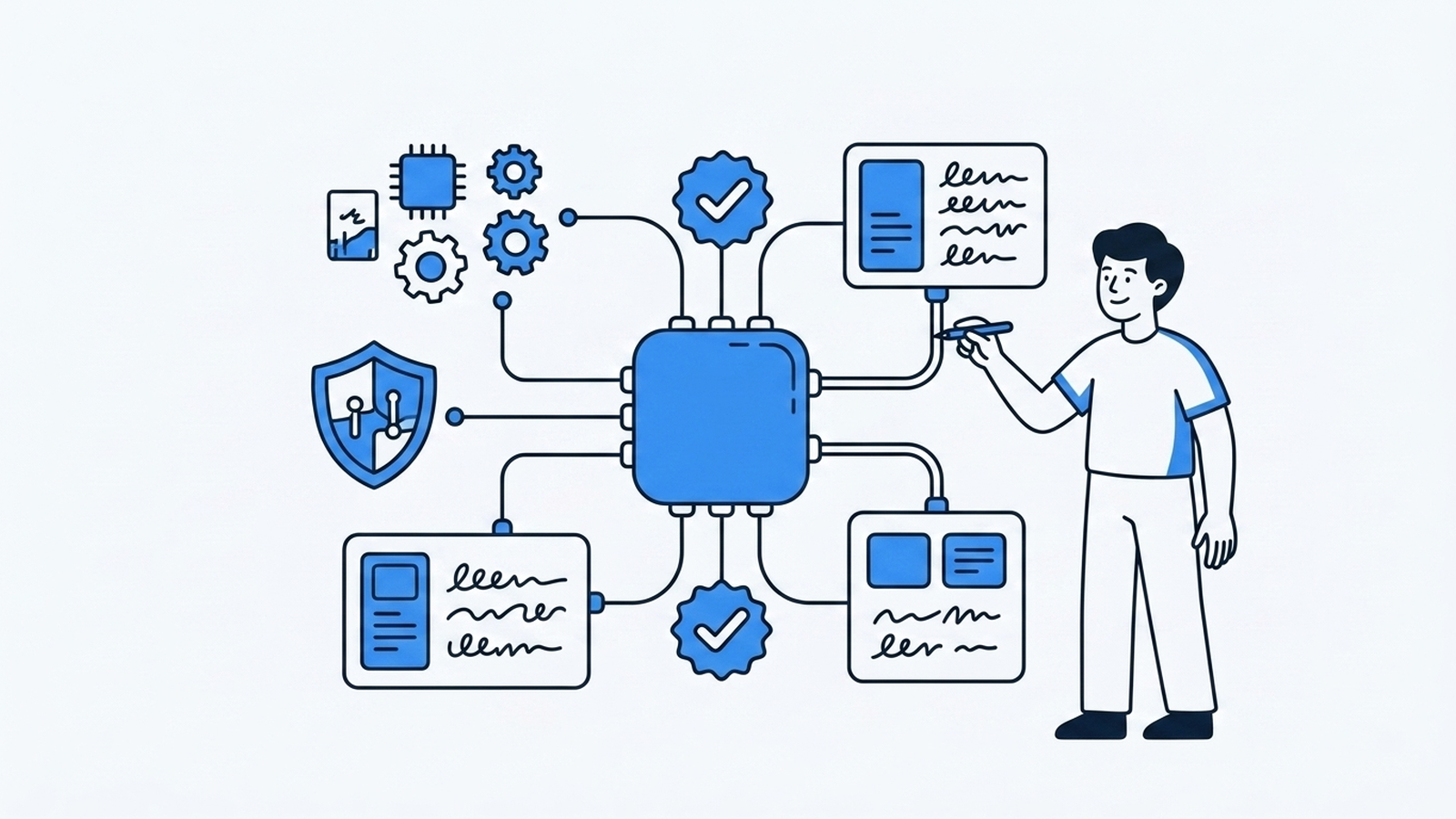
What Is Harness Engineering? Why the Same LLM Differs
What sets quality isn't the model; it's the harness around it. How to raise a team's floor with layered context, executable knowledge, hooks, and verification loops, using the MCP server we built and its code.
The harness around the model keeps agents safe and steady: how it differs from prompting, scoped tools, hooks, layered context, verification, MCP self-call. A harness is a system that designs context, tools, hooks, and verification outside the model. The same model gives different results with a different harness.
What sets quality isn't the model; it's the harness around it. The homework Part 3 left was clear: agents are powerful but dangerous without guardrails. The stage that tackles that homework is harness engineering. Even with the same model, the system around it decides the result.
> Part 4 of the "Evolution of LLM use" series. ① Prompting · ② Vibe coding · ③ Agents · ④ Harness engineering · ⑤ Open models.
Harness = the system around the model
A harness is every mechanism outside the model: what context to inject, which tools to allow, where to stop, and how to verify the result. Here are the parts of a good harness in a table.
| Element | What it does | Analogy |
|---|---|---|
| Context layering | Splits knowledge into company-wide (Global), per-domain (Domain), and per-repo (Local) layers and injects only what's needed | Not handing a new hire the entire wiki at once |
| Executable knowledge | Keeps guides not as documents but in a form that reads as a manual to people and as a system prompt to an LLM | Fix one place and everyone's agent behavior changes |
| Hooks | Intercept and correct specific actions | Block commits to the main branch and steer toward creating a feature branch |
| Verification loop | Repeats generate → read-only critique → regenerate | Pass criteria written into code |
A piece of the harness we built: MCP self-call
That sounds abstract, so let us show you something we actually built. We added an MCP server [1] so external agents can use Trail Studio as a tool. The most important design decision here is that MCP tools don't rewrite the business logic. Instead, they call their own REST routes in-process (self-call). REST is the single source of truth (SSOT).
# MCP tool = a thin adapter. It doesn't duplicate logic; it self-calls its own REST route
async def studio_create_cardnews(topic: str, ...) -> dict:
    principal = current_principal()                  # API key -> workspace auth
    token = create_access_token(principal)           # issue a short-lived JWT
    # call the app's own REST in-process via httpx ASGITransport
    resp = await self_post("/api/cardnews-llm", json={...},
                           headers={"Authorization": f"Bearer {token}"})
    return {"job_id": resp["id"]}                     # REST alone owns credit deduction, verification, and tracing
The reasons this design holds up are clear: zero double credit deductions, zero duplicated business logic, and a single source for verification and tracing. Even as you add tools, you only fix one place: REST. Whatever the model does, the harness alone is responsible for the safeguards.
Hooks follow the same philosophy. We put risky features behind a default-OFF flag and make the OFF path byte-identical to the existing behavior. That separates turning on a new capability from not breaking what's already there.
Governance that raises the floor
The real effect of harness engineering is raising the team's floor. Package your best engineer's workflow (lint rules, branching strategy, verification procedures) as a plugin or skill and roll it out, and that discipline is automatically in place no matter who does the work. It becomes the most powerful and modern governance tool there is.
And you can ship a harness you verified locally straight to production (dev-prod parity). Instead of spinning up a separate RAG server and tuning scores, the context you checked with your own eyes runs as is.
In short
Harness engineering isn't "let's swap in a better model"; it's "let's design what's around the model." Layer the context, make knowledge executable, correct with hooks, and write verification into code. It's the path to safer, more consistent results from the same model.
But a well-built harness has a side effect: every run leaves standardized data. What if you could use that data to train a model fitted to your own domain? That's the final part: open models.
For related reading, see 5 agentic workflow patterns: from prompt chaining to orchestrators, What is MCP (Model Context Protocol)? Connecting tools to your AI assistant, and What is an AI agent? Permissions and approval gates when the model runs its own loop.
Frequently asked questions
Is harness engineering different from prompt engineering?
If prompt engineering refines "what to ask" the model, harness engineering designs tools, hooks, and verification loops around the model so that "no matter who asks, the result has the same floor." It's system design one layer above prompts.
Why does the self-call pattern in an MCP server matter?
If MCP tools duplicate the business logic, credit deduction and verification logic end up scattered in two places and easily drift apart. If the tool calls its own REST route as is (self-call), the logic keeps a single source, so even as you add tools, you only fix the safeguards in one place: REST.
Where should our team start to adopt a harness?
It's best to start with context layering, separating company-wide knowledge from team- and repo-specific knowledge. Then add, one at a time, hooks that intercept risky actions and a minimal verification loop that checks generated output in code.
References
Summary
- A harness is a system that designs context, tools, hooks, and verification outside the model. The same model gives different results with a different harness.
- A good harness has four elements: context layering, executable knowledge, hooks, and verification loops.
- We have MCP tools call their own REST routes as is (self-call), keeping a single source for credit and verification logic.
- The real effect of harness engineering is raising the team's floor. Done well, every run leaves standardized data that becomes material for the next stage (open models).
Why TRAIL Labs works this way
How a researcher-founder grounds measurement and recommendations, and how the three products relate to the company, is laid out on the about page, and how we work day to day is written up separately.
More posts
TRAIL Labs joins the Google for Startups Cloud Program
TRAIL Labs has joined the Google for Startups Cloud Program, gaining cloud credits and support to run our AI-search measurement and content engine at scale.
TRAIL Labs has joined the NVIDIA Inception program
TRAIL Labs has joined the NVIDIA Inception program, gaining compute, technical resources, and a network to grow our AI-search measurement and content engine.
Is AI search visibility enough? Why we changed our question
AI search visibility is countable, but more of it doesn't mean your accurate information reached the answer. What measurement and three papers taught us.
Keep reading on this topic
- Defending Against RAG Hallucinations: Types and LimitsRAG retrieves outside documents to ground answers, yet hallucinations still arise in retrieval and generation. Types, defenses, and limits of automated checks.
- Design principles for a GEO data AI agentDesign principles for a GEO data AI agent: text parsing vs. structured tool calls, blocking irreversible actions, and why skipping evals is risky.
- Open-Weight vs. API Models: Own a Domain Model with HermesOwn the model instead of renting it: why open weights, open vs. API models, Nous Research Hermes 4.3, its function-calling standard, and the data flywheel.
This post is part of the TRAIL Labs category, which collects all 19 posts on the topic. See all posts in TRAIL Labs