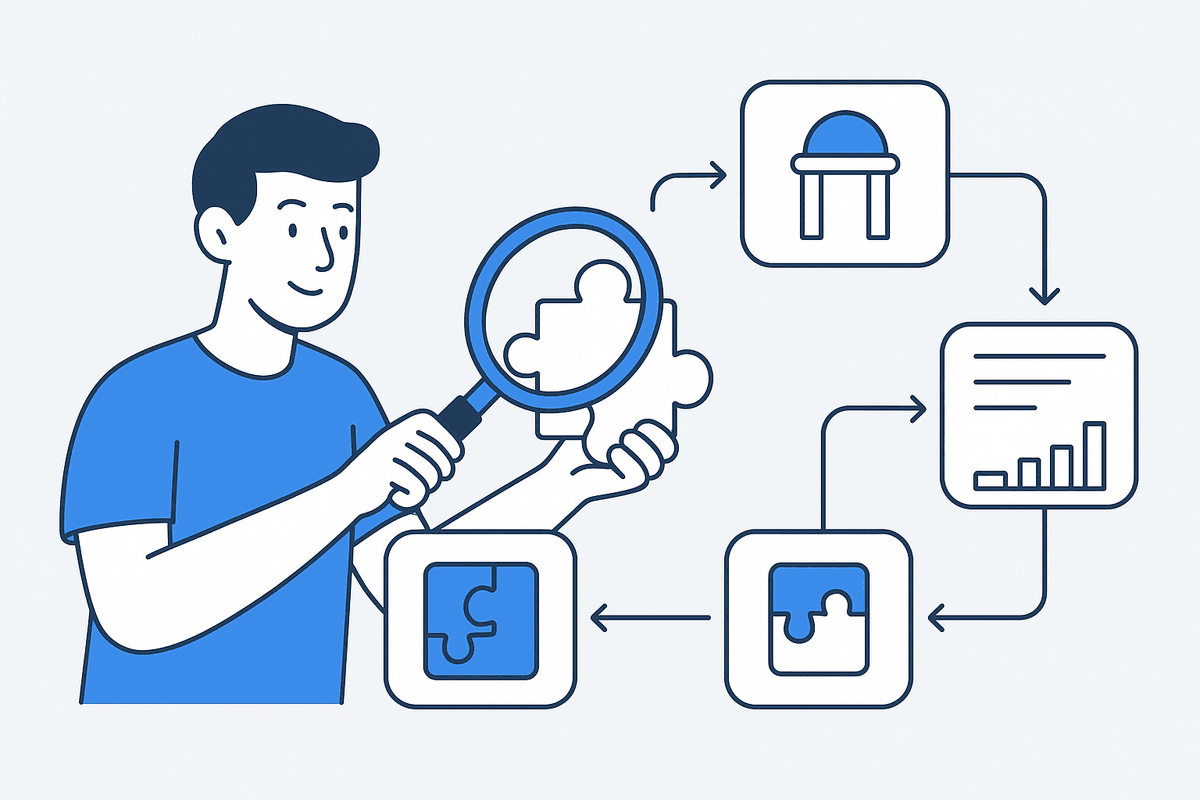
5 agentic workflow patterns: from chaining to orchestrators
The design vocabulary to know before adding LLMs to your content pipeline
Agentic workflows are pipeline patterns where an LLM works through several steps. Workflows vs. agents, which pattern fits a content pipeline, how to choose.
An agentic workflow is a system pattern designed so that an LLM doesn't stop at a single response but works through several steps, making its own judgments, to complete a task. If you try to handle complex work like content generation or research with one LLM call, structural limits show up right away: category skew, low-value noise, and duplicate patterns. In this post, we'll cover 5 workflow patterns proven in practice and how to combine them into a single pipeline.
Why a single call isn't enough
As LLM output quality keeps improving, demand is growing for complex tasks that are hard to solve with "one call." But when you call an LLM just once and ask for a large batch of output all at once, several structural limits appear.
The most common problem is category skew. LLMs tend to bias their answers toward safe, middle-of-the-road categories. Next is low-value noise: generic output produced without industry or brand context. Last is duplicate patterns: the same intent generated over and over with only slight changes in wording.
Writing more elaborate prompts doesn't fully solve these problems. You need system design that splits the work into several steps and separates the role and validation criteria for each step. That's why agentic workflows exist.
Workflows vs. agents
Anthropic distinguishes the two concepts in its writing on this area [1]. Workflows orchestrate LLMs and tools through predefined code paths, while agents have the LLM decide its own next action and dynamically direct the process.
Traditional automation has people define every branch in advance. An agentic approach, by contrast, is closer to a hybrid design where the LLM handles some of the judgment. In practice, rather than cleanly separating the two, teams often combine them: they lock predictable segments into workflows and grant agent-like autonomy only to the segments that need judgment.
5 core patterns
Here are the 5 patterns Anthropic laid out [1].
| Pattern | Definition | When to use |
|---|---|---|
| Prompt Chaining | Breaks a task into sequential steps; each step's output is the next step's input | When splitting complex work into small units |
| Routing | Classifies input and branches to specialized follow-up handling | When each input type needs different handling |
| Parallelization | Runs the same input through multiple LLMs at once, or splits the work to run in parallel | When optimizing throughput and speed, or when you need diverse perspectives |
| Evaluator-Optimizer | A generator LLM and an evaluator LLM run in an iterative loop | When quality criteria are clear and automatic evaluation is possible |
| Orchestrator-Workers | A central LLM dynamically distributes subtasks | When the scope of work can't be predicted in advance |
Each pattern can be used on its own, but real pipelines need to combine several patterns to handle complex content automation.
Combining 4 patterns: a real pipeline
In practice, combining 4 of these into one pipeline works well. Orchestrator-Workers is often the one left out, because in a pipeline whose processing order is already fixed, dynamic task distribution only adds unnecessary complexity.
The rough flow looks like this.
- Preprocessing (Prompt Chaining · Gate): Run deduplication and low-value input filtering first.
- Classification (Routing): Apply pattern matching first, and have the LLM judge only the ambiguous cases.
- Quota system (Prompt Chaining · Gate): Balance categories and filter out low-value results again.
- LLM supplement (Parallelization + Evaluator-Optimizer): Generate in parallel batches and raise quality with a self-validation loop.
- Postprocessing (Prompt Chaining): Do a final sort by commercial value.
Separating roles by step like this lets you pinpoint "which step quality broke down at" as soon as a problem appears. If you handle everything in one giant prompt, that diagnosis is impossible.
Gates: pass/block conditions between steps
The most important thing in Prompt Chaining is the pass/block condition (gate) placed between steps. It's the point where you explicitly decide whether quality is good enough to pass to the next step or whether to filter it out midway.
Without gates, later stages in the pipeline inherit the low-quality output of earlier ones as-is. Conversely, dense gates raise processing cost but greatly reduce quality variance in the final output. In practice, finding the balance between cost and quality is the core work of pipeline design.
Applying this to a GEO content pipeline
These patterns apply directly to GEO content operations too. For example, when creating content in a structure AI finds easy to cite, you can design gate conditions that reflect research showing that content with definitions, statistics, and sources raises the likelihood of being cited [2]. If you put conditions like "does it include a source?" and "is there a direct-answer definition at the top?" into the preprocessing and postprocessing steps, you can maintain a consistent level of GEO structure without someone reviewing every piece by hand.
TRAIL Search (search.traillabs.ai) diagnoses how often content made this way is actually cited in AI search. You can use it as the final validation point to check whether the structure your pipeline creates actually leads to citations.
What to check when choosing a pattern
- Does the task split cleanly into sequential steps? → Prompt Chaining
- Are the input types varied, needing different handling? → Routing
- Does the same task need to be handled from several perspectives at once? → Parallelization
- Can the quality criteria be evaluated automatically? → Evaluator-Optimizer
- Is the scope of the work itself unpredictable in advance? → Orchestrator-Workers
An agentic workflow isn't about "using more LLMs"; it's about "designing where to place LLMs and in what role." Once you understand the patterns, you can improve the pipeline structure itself instead of vaguely adding more prompts.
For related reading, see The P-E-V workflow: reducing LLM classification errors with plan, execute, verify, Design principles for a GEO data AI agent: structured tool calls and blocking irreversible actions, and Defending against RAG hallucinations: classifying the types and knowing the limits of automated verification.
Frequently asked questions
What's the difference between a workflow and an agent?
A workflow orchestrates LLMs in order along predefined code paths, while an agent has the LLM decide for itself what to do next and dynamically direct the process. In practice, most systems combine the two.
Do we have to use all 5 patterns in every automation?
No. For a pipeline with a fixed processing order, Orchestrator-Workers, which handles dynamic task distribution, just adds unnecessary complexity. Combine only the patterns the task actually needs.
What goes wrong if we pick the wrong pattern?
Using overly dynamic orchestration for simple sequential work only adds cost and latency. Conversely, using a single call for work with high quality variance leaves bias, duplication, and low quality in the output untouched.
References
Summary
- An agentic workflow is a pattern that designs an LLM to carry out a task through several steps rather than a single response.
- Anthropic grouped them into 5 patterns: Prompt Chaining, Routing, Parallelization, Evaluator-Optimizer, and Orchestrator-Workers.
- Real pipelines usually combine several patterns, and Orchestrator-Workers can be left out when the processing order is fixed.
- Placing pass/block conditions (gates) between steps reduces quality variance and low-value output.
Why TRAIL Labs works this way
How a researcher-founder grounds measurement and recommendations, and how the three products relate to the company, is laid out on the about page, and how we work day to day is written up separately.
More posts
TRAIL Labs joins the Google for Startups Cloud Program
TRAIL Labs has joined the Google for Startups Cloud Program, gaining cloud credits and support to run our AI-search measurement and content engine at scale.
TRAIL Labs has joined the NVIDIA Inception program
TRAIL Labs has joined the NVIDIA Inception program, gaining compute, technical resources, and a network to grow our AI-search measurement and content engine.
Is AI search visibility enough? Why we changed our question
AI search visibility is countable, but more of it doesn't mean your accurate information reached the answer. What measurement and three papers taught us.
Keep reading on this topic
- Defending Against RAG Hallucinations: Types and LimitsRAG retrieves outside documents to ground answers, yet hallucinations still arise in retrieval and generation. Types, defenses, and limits of automated checks.
- Design principles for a GEO data AI agentDesign principles for a GEO data AI agent: text parsing vs. structured tool calls, blocking irreversible actions, and why skipping evals is risky.
- Open-Weight vs. API Models: Own a Domain Model with HermesOwn the model instead of renting it: why open weights, open vs. API models, Nous Research Hermes 4.3, its function-calling standard, and the data flywheel.
This post is part of the TRAIL Labs category, which collects all 19 posts on the topic. See all posts in TRAIL Labs