The AI Marketing OS TRAIL Labs Builds: A System, Not Tools
One system to find, create, and prove. Why TRAIL Labs builds a unified OS instead of separate tools.
TRAIL Labs builds an AI marketing OS that links finding, creating, and proving. How it differs from juggling tools, and why automation must be a system.
TRAIL Labs builds an AI marketing OS that connects three steps into one system: finding what to say, turning it into on-brand content, and proving whether the message actually worked. Today this flow is scattered across different tools, and pulling that fragmentation together is the problem we're solving.
Why an OS instead of tools
Most brands bounce between several tools to make a single piece of content. They find keywords in one place, design in another tool, and check results on yet another screen. There are plenty of tools, but they aren't connected.
So the same message drifts a little from channel to channel. Even after spending ₩200,000 to stitch tools together, it's common for the blog and the detail page to have different tones.
The real problem is connection, not the number of tools
TRAIL Studio closes this flow inside one system, so that a brand strategy defined in one place is reflected consistently across blog posts, detail pages, product photos, video, and card news.
Four blocks, one loop
We see marketing execution as four stages.
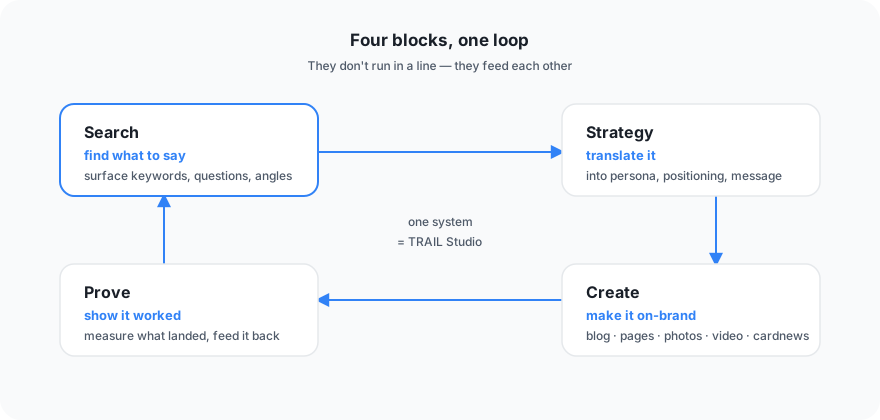
| Block | What it does | What goes wrong if you skip it |
|---|---|---|
| Search | Uncovers the keywords, questions, and topics your brand should speak to in the market | Content piles up without knowing what to say |
| Strategy | Translates what you found into personas, positioning, and messages | Content regresses to the market average and the brand disappears |
| Create | Produces blog posts, detail pages, product photos, video, and card news in one system | Tone and message diverge across channels |
| Prove | Measures which messages actually worked | The next round of Search and Create runs on gut feel |
These four blocks don't run in sequence; they form one loop that feeds itself.
What's possible today
The Create block is covered by TRAIL Studio. You can run multiple content pipelines, including blog posts, detail pages, product photos, video, and card news, from a single dashboard. The Search block is covered by TRAIL Search, and the Prove side is split between TRAIL Search's re-measurement and TRAIL Perform's ad effectiveness analysis. Each of the three products works on its own.
You can try TRAIL Studio right now. To learn more about who we are, see our About page and Culture.
For related reading, see What is first-party data? How to use it in marketing after third-party cookies, Defending against RAG hallucinations: classify the types and know the limits of automated verification, and Why your brand tone scatters as marketing tools multiply, and the answer of unified production.
Frequently asked questions
What can TRAIL Studio do today?
It covers Create, one of the four blocks. You can run multiple content pipelines, including blog posts, detail pages, product photos, video, and card news, from a single dashboard.
Which products cover the Search and Prove blocks?
The Search block, finding what to say, is covered by TRAIL Search: it measures how a brand shows up in search and AI answers, diagnoses it, and suggests what to improve. The Prove side, checking what worked, is split between TRAIL Search's re-measurement and TRAIL Perform's ad effectiveness analysis.
What is TRAIL Perform?
It's a product for building, launching, and running ad campaigns across channels in one place, including ad effectiveness analysis and budget allocation. It's one of three products in operation alongside TRAIL Search and TRAIL Studio, and each works on its own.
Summary
- TRAIL Labs is a company building an AI marketing OS for Korean SME brands and sellers.
- The real problem is that finding what to say, making it on-brand, and proving it worked are scattered across tools. It's about connection, not the number of tools.
- The four blocks, Search, Strategy, Create, and Prove, run not as a sequence but as one loop that feeds itself.
- TRAIL Studio covers Create, TRAIL Search covers Search, and checking what worked is split between TRAIL Search's re-measurement and TRAIL Perform's ad effectiveness analysis.
Why TRAIL Labs works this way
How a researcher-founder grounds measurement and recommendations, and how the three products relate to the company, is laid out on the about page, and how we work day to day is written up separately.
More posts
TRAIL Labs joins the Google for Startups Cloud Program
TRAIL Labs has joined the Google for Startups Cloud Program, gaining cloud credits and support to run our AI-search measurement and content engine at scale.
TRAIL Labs has joined the NVIDIA Inception program
TRAIL Labs has joined the NVIDIA Inception program, gaining compute, technical resources, and a network to grow our AI-search measurement and content engine.

Is AI search visibility enough? Why we changed our question
AI search visibility is countable, but more of it doesn't mean your accurate information reached the answer. What measurement and three papers taught us.
Keep reading on this topic
- Defending Against RAG Hallucinations: Types and LimitsRAG retrieves outside documents to ground answers, yet hallucinations still arise in retrieval and generation. Types, defenses, and limits of automated checks.
- Design principles for a GEO data AI agentDesign principles for a GEO data AI agent: text parsing vs. structured tool calls, blocking irreversible actions, and why skipping evals is risky.
- Open-Weight vs. API Models: Own a Domain Model with HermesOwn the model instead of renting it: why open weights, open vs. API models, Nous Research Hermes 4.3, its function-calling standard, and the data flywheel.
This post is part of the TRAIL Labs category, which collects all 19 posts on the topic. See all posts in TRAIL Labs