
Why More Marketing Tools Scatter Your Brand Tone
Stitching separate tools together costs more and scatters your tone. Why the same message comes out consistently when your brand standards live in one place.
Using many separate marketing tools raises costs and scatters brand tone from blog to video. How a unified system keeps your tone consistent across content.
Using separate tools scatters not just your budget but your brand tone. Content operations costs pile up faster than you think. Add a design tool subscription, a video tool subscription, and one or two outsourced jobs, and it often runs well over ₩200,000 a month.
It's not just about cost
When you stitch separate tools together, two things happen at once.
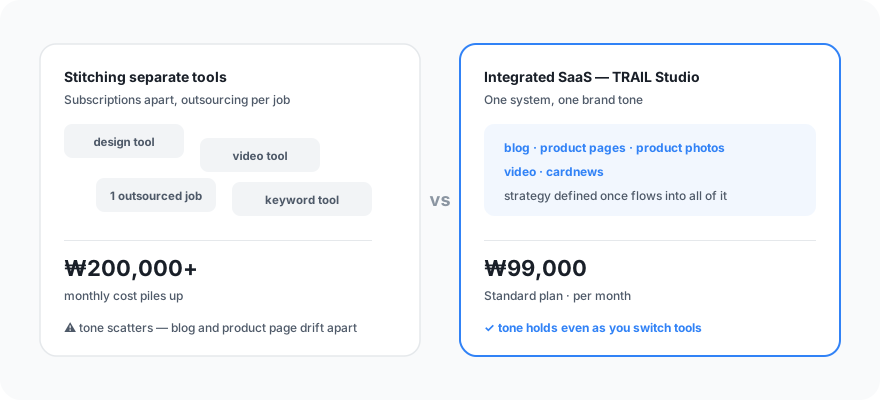
- Costs pile up. Each tool has its own subscription, and outsourcing is billed per job. Even outsourcing a single blog post takes a meaningful amount out of your budget.
- Tone scatters. This is the more fundamental problem. Even after spending ₩200,000, the message on your blog and your detail page isn't the same. Tools don't carry your brand tone over to the next task.
The real inefficiency is that the message isn't consistent
With separate tools, the blog and the detail page of the same brand end up carrying different messages. Tools don't carry your brand tone over to the next task, so someone has to rebuild the "on-brand" standard every time the channel changes.
The difference a unified system makes
With a unified system, a brand strategy defined in one place is reflected in the same tone across blog posts, detail pages, product photos, video, and card news. "On-brand" doesn't fall apart every time you switch tools.
TRAIL Studio's Pro plan is ₩99,000 a month. That's paid back by replacing the cost of a single outsourced detail page. But the point isn't price; it's consistency.
Which plan is right for you?
All three create deliverables based on your brand strategy; they differ in who they're for and what's included.
| Plan | Price (monthly) | For | Core features |
|---|---|---|---|
| Starter | ₩49,000 | Individuals and early-stage brands | Blog posts, card news, photos, and detail pages with base credits |
| Standard (ICP) | ₩99,000 | Core D2C and SME users | Brand strategy + weekly recommendations |
| Pro | ₩199,000 | Team operations | Collaboration, bulk generation, reports |
See plan details and the video credit structure on the pricing page. If you'd like to try it first, start with a free trial.
> Plans may be adjusted during the official launch process. For large-scale adoption or a custom setup, get in touch at contact@traillabs.ai.
For related reading, see Why streamlining content operations fails when you start by building an automation system, Same AI, different results: raising your team's level of AI use, and What is first-party data? How to use it in marketing after third-party cookies.
You can continue with Open-Weight vs. API Models: Own a Domain Model with Hermes.
Frequently asked questions
Can TRAIL Studio alone replace several tools and outsourcing?
You can make blog posts, card news, detail pages, and even video in one system, and your brand tone carries over to every deliverable automatically. That said, work that truly needs human hands, like elaborate photo shoots or specialized video, may still be better outsourced.
How should I choose a plan?
Starter fits individuals and early-stage brands; Standard fits D2C brands and SMEs that need brand strategy and weekly recommendations; Pro fits teams that need collaboration, bulk generation, and reports.
Could the prices in this post differ from today's?
Yes. Plans may be adjusted during the official launch process, so please refer to the pricing page, not this post, for the latest prices.
Summary
- Combining several tools piles up costs and scatters your brand tone.
- The real inefficiency isn't cost; it's that the same message doesn't come out consistently.
- TRAIL Studio defines your brand strategy in one place and carries the same tone from blog posts to video.
- Choose among the three plans, Starter, Standard, and Pro, based on your team size and goals.
Why TRAIL Labs works this way
How a researcher-founder grounds measurement and recommendations, and how the three products relate to the company, is laid out on the about page, and how we work day to day is written up separately.
More posts
TRAIL Labs joins the Google for Startups Cloud Program
TRAIL Labs has joined the Google for Startups Cloud Program, gaining cloud credits and support to run our AI-search measurement and content engine at scale.
TRAIL Labs has joined the NVIDIA Inception program
TRAIL Labs has joined the NVIDIA Inception program, gaining compute, technical resources, and a network to grow our AI-search measurement and content engine.
Is AI search visibility enough? Why we changed our question
AI search visibility is countable, but more of it doesn't mean your accurate information reached the answer. What measurement and three papers taught us.
Keep reading on this topic
- Defending Against RAG Hallucinations: Types and LimitsRAG retrieves outside documents to ground answers, yet hallucinations still arise in retrieval and generation. Types, defenses, and limits of automated checks.
- Design principles for a GEO data AI agentDesign principles for a GEO data AI agent: text parsing vs. structured tool calls, blocking irreversible actions, and why skipping evals is risky.
- Open-Weight vs. API Models: Own a Domain Model with HermesOwn the model instead of renting it: why open weights, open vs. API models, Nous Research Hermes 4.3, its function-calling standard, and the data flywheel.
This post is part of the TRAIL Labs category, which collects all 19 posts on the topic. See all posts in TRAIL Labs