Why Content Ops Fail When You Start with Automation
If you've ever stalled trying to build the perfect automation system first, here's a way to streamline content operations that starts by taking a second look at small, repetitive tasks.
Don't start with a perfect automation system; start by revisiting the small tasks you repeat daily. The order a small team can follow to cut content ops time.
Efficiency starts not with a perfect automation system but with taking a second look at the small tasks you repeat every day. When you hear "let's make how we work more efficient," a grand automation system comes to mind first, and you stall. It feels like you'll have to install new tools, redesign processes, and convince everyone. And then it gets pushed to "later, we're busy right now."
There's another way to come at it: start not with a grand goal but by taking a second look at the small tasks you repeat every day. This perspective fits content operations especially well. Producing and publishing blog posts, card news, detail pages, and videos every week is really the result of small, repetitive tasks stacked layer upon layer.
1. Break work down into actions
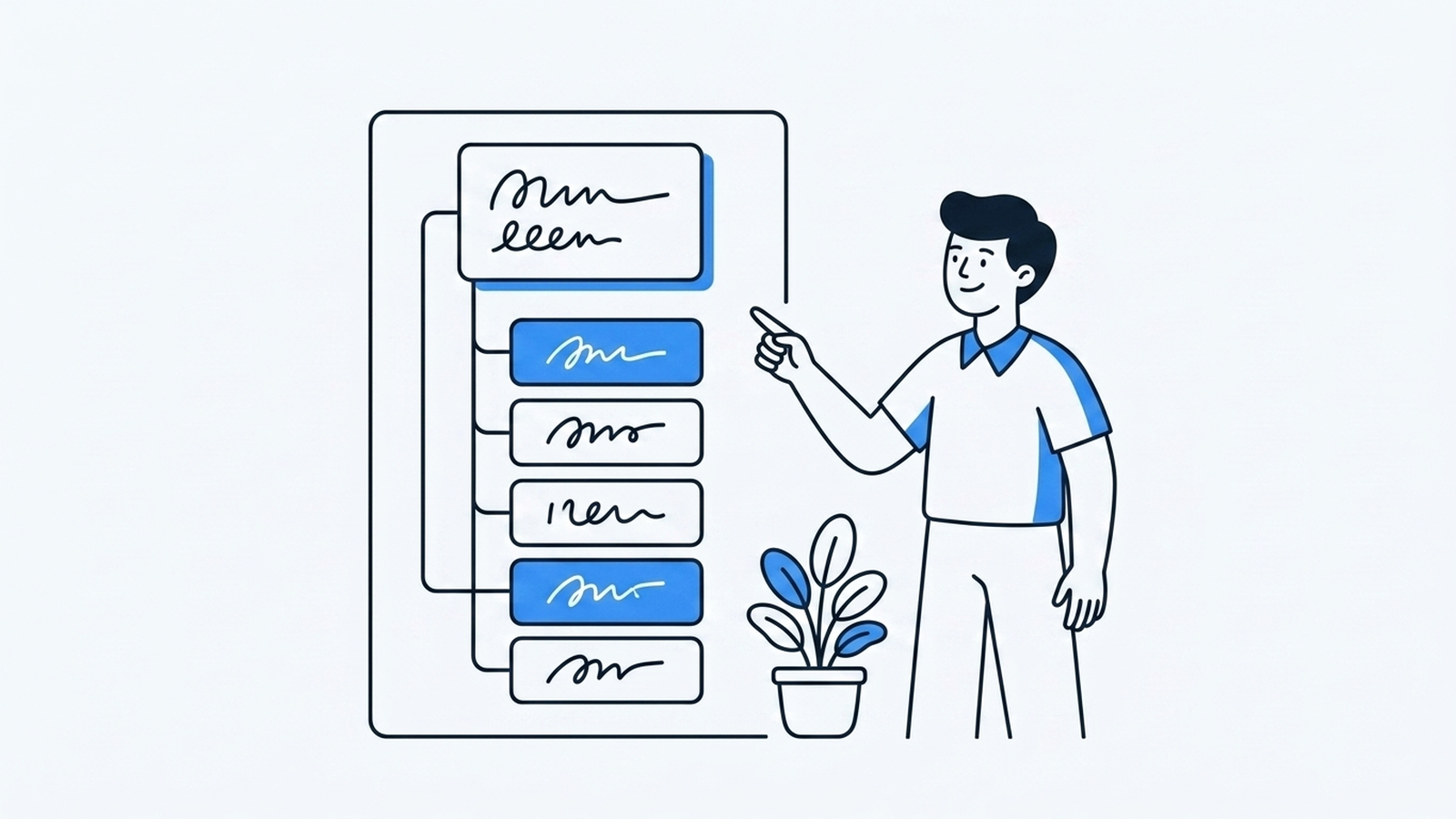
The first step toward efficiency is understanding where you are now. But if you lump it together as "make a blog post," you can't see where the inefficiency is. You have to break it into individual actions: who does what, where, and why.
- Before: "Make this week's content"
- After: "Find a topic → research → draft → polish to brand tone → choose images → adapt length and wording per channel → publish"

Once it's broken down, you can see which points take the most effort every time. Usually time leaks less in "making" and more in "matching the tone and adapting it for each channel."
2. Ask "Why do we do this?" at each step
Ask a question of every action you broke out: "Why is this step needed?" and "Does a person really have to do this every time?" Small tasks are easy to brush past, but even a small action quickly becomes a big inefficiency when it's repeated many times across many channels.
Take recalling, every time you write, "Our brand has this tone, and we don't use these expressions." Once, it's trivial. Repeat it for five channels every week, and over a month it adds up to a fair amount of time. And because people rely on memory each time, the tone wobbles a little too.
3. Prioritize by scope of impact, not by your own preference
Once you start seeing things to fix, you have to decide what to tackle first. The easy trap here is "whatever annoys me most." Three criteria work better.
| Criterion | Question | Why |
|---|---|---|
| Scope of impact | Does it affect many people? | The wider an inefficiency spreads, the bigger the payoff from fixing it |
| Knock-on effects | Does it affect other work too? | Fix one spot and several steps improve together |
| Time spent | How much time does it take? | The more often it repeats, the bigger the cumulative loss |
In content operations, where these three meet is brand tone consistency. Tone doesn't touch just one blog post; it touches every deliverable, and once it drifts you have to rework it channel by channel. You start with the point that repeats most often and spreads the widest.
4. Not a perfect system: start with the smallest repetition
The solution isn't automating everything at once. Start with the smallest piece possible. What matters is a small experiment rather than perfect preparation, and the confidence that you can always go back to the old way. When you can roll back, you can try things lightly.
For content, start small like this. Define your brand tone and strategy once, and from then on have your blog posts, card news, detail pages, and videos inherit that tone automatically. One repetition you used to explain every time disappears, and the tone holds steady even as channels change. If you don't like it, you only need to fix the tone definition, so the cost of rolling back is small too.
This is how Trail Studio works. Instead of building a grand new system, it automatically connects the most frequently repeated task, "making it on-brand," in one place.
In short
Efficiency isn't a grand goal; it's a small habit. Break work into actions, ask "why?" at each step, start with what has the widest impact, and try the smallest piece you can roll back. Content operations work the same way. Take a second look at the small things you repeat every week, and efficiency stops being a giant project to put off and becomes a small step you can take today.
Connect your repetitive content work in one place, on-brand. Start with Trail Studio.
For related reading, see Same AI, different results: raising your team's level of AI use, Why your brand tone scatters as marketing tools multiply, and the answer of unified production, and 5 agentic workflow patterns: from prompt chaining to orchestrators.
Frequently asked questions
Where should I start streamlining?
Rather than with a grand goal, start by breaking lumped-together work into individual actions: who does what, where, and why. Once it's broken down, you can see where time leaks.
How do I set priorities when there are several things to fix?
Not by what annoys you most, but by three criteria: scope of impact, knock-on effects, and time spent. In content operations, brand tone consistency is usually where all three meet.
Why is automating brand tone the key to efficiency?
Tone doesn't touch just one blog post; it touches every deliverable. Once it drifts, you have to rework it channel by channel, so it's the point that repeats most often and spreads the widest.
Summary
- Efficiency starts not with grand automation but with taking a second look at small, repetitive tasks.
- Break work down into actions to see where time leaks.
- Set priorities by scope of impact, not by what annoys you.
- Instead of a perfect system, try the smallest piece you can roll back.
Why TRAIL Labs works this way
How a researcher-founder grounds measurement and recommendations, and how the three products relate to the company, is laid out on the about page, and how we work day to day is written up separately.
More posts
TRAIL Labs joins the Google for Startups Cloud Program
TRAIL Labs has joined the Google for Startups Cloud Program, gaining cloud credits and support to run our AI-search measurement and content engine at scale.
TRAIL Labs has joined the NVIDIA Inception program
TRAIL Labs has joined the NVIDIA Inception program, gaining compute, technical resources, and a network to grow our AI-search measurement and content engine.
Is AI search visibility enough? Why we changed our question
AI search visibility is countable, but more of it doesn't mean your accurate information reached the answer. What measurement and three papers taught us.
Keep reading on this topic
- Defending Against RAG Hallucinations: Types and LimitsRAG retrieves outside documents to ground answers, yet hallucinations still arise in retrieval and generation. Types, defenses, and limits of automated checks.
- Design principles for a GEO data AI agentDesign principles for a GEO data AI agent: text parsing vs. structured tool calls, blocking irreversible actions, and why skipping evals is risky.
- Open-Weight vs. API Models: Own a Domain Model with HermesOwn the model instead of renting it: why open weights, open vs. API models, Nous Research Hermes 4.3, its function-calling standard, and the data flywheel.
This post is part of the TRAIL Labs category, which collects all 19 posts on the topic. See all posts in TRAIL Labs