Designing an AI content pipeline: QA and 5 common mistakes
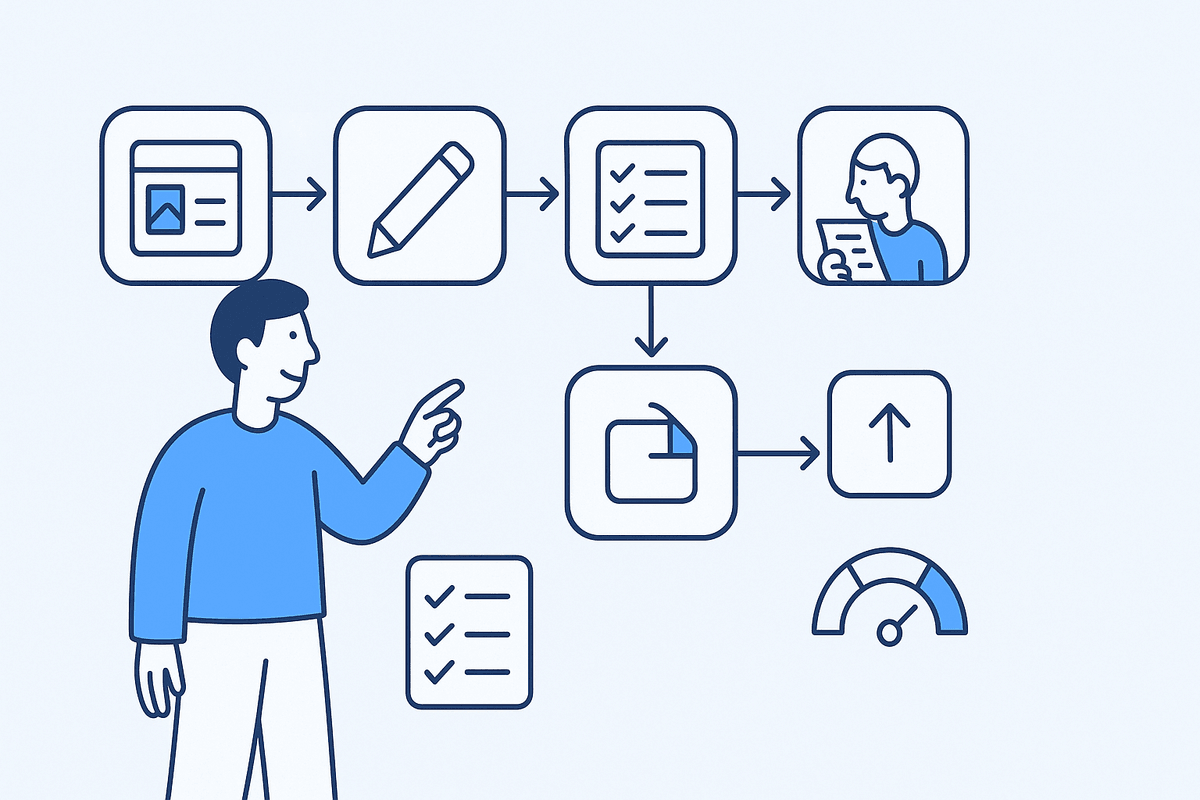
The difference between going from one prompt straight to publish and a pipeline with gates
An AI content pipeline splits AI and human roles from planning to publishing. How it differs from AI writing, how to check AI drafts, and common mistakes.
An AI content pipeline is a workflow that designs the entire process from planning to publishing step by step, with a clear split between the roles of AI and humans at each step. This pipeline is the practical answer to the question, "Can't we just ask AI to write it?" Simply sending a prompt and taking what comes back leads to quality variance that spirals out of control as volume grows.
Simple AI writing vs. a pipeline
Put the two approaches side by side and the difference becomes clear.
| Item | AI writing | Content pipeline |
|---|---|---|
| Process | Prompt → output → publish | Planning → generation → validation → optimization → publishing |
| Quality control | Fixes after the fact | Gates at each step |
| Scalability | Volume grows, but quality varies widely | Volume grows while quality standards hold |
| SEO/GEO | Left to chance | Optimization built into each step |
The reason you need a pipeline is simple: the quality of AI-generated content isn't consistent from one run to the next. The same prompt yields different results, and factual errors, tone mismatches, and weak structure keep coming up. A pipeline acts as a quality control system that reins in this variance.
Step 1: Planning: what, why, and by what standard
The starting point of the pipeline isn't "what article will we write" but "which user question will we answer." This shift in perspective sets the direction for every step after it.
Here's what to confirm in the planning step.
- Choose target keywords and AI prompts
- Classify user intent (informational / comparison / action)
- Decide the content type (guide, comparison, review, how-to)
- Analyze competing content: check top search results plus the sources AI responses draw on
- Set target metrics: not just target rankings but also the chance of being cited
If you skip planning and jump straight to generation, the output often looks plausible but fails to answer the real question.
Step 2: Generation: prompt design and using LLMs
The most important thing in the generation step is prompt quality. Instead of a vague instruction like "write a good article," spell out the structure, tone, length, and citation standards.
These are the elements of an effective prompt.
- Assign a role: give a clear persona, such as "as a content editor specializing in SEO."
- Specify the structure: make the structure concrete, such as "3-5 H2s, with 2-3 H3s under each H2."
- Set the tone: make the tone explicit, such as "professional but approachable, in the polite haeyo style."
- Constraints: add rules such as a list of banned phrases and "always include cited data."
- Reference material: provide your competing content analysis and target keyword list along with the prompt.
With these five elements in place, the odds rise sharply that the LLM produces "writing that fits the purpose" rather than "writing that sounds plausible." From an agentic workflow perspective, this step is also one link in prompt chaining: the output of the planning step becomes the input of the generation step [2].
Step 3: Validation: fact-checking and source verification
Publishing AI-generated content as is carries the risk of factual errors. The validation step is the key gate that reduces this risk.
Checks you can automate include the following.
- Structure check: whether required sections (lead paragraph, FAQ, references) are present
- Keyword density: appropriate distribution of target keywords
- Link check: validity of internal and external links
- Duplicate content check
Checks a human must do include the following.
- Fact-checking: confirm the accuracy of figures, statistics, and quotes
- Tone and voice: whether it matches your brand tone
- Logical flow: whether the context connects naturally between sections
- Experience signals: confirm the content is grounded in real experience
The reason for splitting these two tracks is clear. Rules can catch structural defects, but judging facts and context still requires human review.
Step 4: Optimization: dual SEO and GEO optimization
This is the step where you apply SEO and GEO elements to content that has passed validation. It's the point in the whole pipeline that creates the most tangible value.
SEO optimization includes optimizing the meta title and description, inserting internal links, and applying structured data. Structured data helps AI and search engines accurately recognize question-answer relationships [3].
GEO optimization includes placing direct-answer definitions, adding comparison tables, and inserting source footnotes. Research shows that figures presented with sources are more likely to be cited in AI answers [1].
The two optimizations are separate in sequence, but in practice it's more efficient to run them at the same time on the same content.
Step 5: Publishing and beyond: measure and iterate
Publishing is both the end of the pipeline and a new beginning. After publishing, keep tracking how the content actually moves in search rankings and AI answer citations.
From a GEO perspective in particular, there can be a lag between "we published it" and "it started getting cited." With a tool that tracks citations by prompt, such as TRAIL Search (search.traillabs.ai), you can feed into your next planning cycle which content is being cited by which AI engine, and which prompts it's still missing from.
Common mistakes when building a pipeline
- Skipping the validation step: as output volume grows, the temptation to skip this step grows too, but if it breaks down here, your whole brand's credibility wavers.
- Doing SEO only and pushing GEO to later: the two are efficient only when designed together on the same content structure.
- Not tracking after publishing: the last link in the pipeline is measurement. Without measurement, you have no basis for improving the next cycle.
In the end, an AI content pipeline is less about "how well you use AI" and more about designing "where to keep human judgment and what to automate." The more clearly you draw that line, the more you can secure both volume and quality at the same time.
For related reading, see What is GEO (generative engine optimization)? Which pages to start with, and in what order, A four-step integrated framework that unites SEO and GEO: split the team or combine it?, and SEO fundamentals in the AI search era: what changed in on-page, off-page, and technical SEO.
Frequently asked questions
How is AI writing different from a content pipeline?
AI writing is a linear flow of prompt → output → publish, and quality control relies on fixing things after the fact. A content pipeline splits the work into planning → generation → validation → optimization → publishing and sets pass criteria (gates) at each step, so quality variance stays under control as volume grows.
Which checks can be automated, and which need a human?
You can automate checks for required sections, keyword density, link validity, and duplicates. On the other hand, the factual accuracy of figures and statistics, consistency with your brand tone, the logical flow between sections, and whether the content is grounded in real experience are areas where humans need to judge.
Why optimize for SEO and GEO together?
Because AI re-reads and cites content that search engines have crawled and indexed. If your SEO is broken, AI can't find your content in the first place, and even with strong SEO, content that lacks structure and sources may not get cited in AI answers.
References
Summary
- An AI content pipeline splits into five steps (planning, generation, validation, optimization, publishing) with a quality gate at each step to control variance.
- In the generation step, a prompt that spells out role, structure, tone, constraints, and reference material determines quality.
- Validation splits into structural checks that can be automated and fact-checking, tone, and logical-flow review that humans must do.
- SEO and GEO should be optimized together in the same flow, and you need to keep tracking citations even after publishing.
Why TRAIL Labs works this way
How a researcher-founder grounds measurement and recommendations, and how the three products relate to the company, is laid out on the about page, and how we work day to day is written up separately.
More posts
TRAIL Labs joins the Google for Startups Cloud Program
TRAIL Labs has joined the Google for Startups Cloud Program, gaining cloud credits and support to run our AI-search measurement and content engine at scale.
TRAIL Labs has joined the NVIDIA Inception program
TRAIL Labs has joined the NVIDIA Inception program, gaining compute, technical resources, and a network to grow our AI-search measurement and content engine.

Is AI search visibility enough? Why we changed our question
AI search visibility is countable, but more of it doesn't mean your accurate information reached the answer. What measurement and three papers taught us.
Keep reading on this topic
- Defending Against RAG Hallucinations: Types and LimitsRAG retrieves outside documents to ground answers, yet hallucinations still arise in retrieval and generation. Types, defenses, and limits of automated checks.
- Design principles for a GEO data AI agentDesign principles for a GEO data AI agent: text parsing vs. structured tool calls, blocking irreversible actions, and why skipping evals is risky.
- Open-Weight vs. API Models: Own a Domain Model with HermesOwn the model instead of renting it: why open weights, open vs. API models, Nous Research Hermes 4.3, its function-calling standard, and the data flywheel.
This post is part of the TRAIL Labs category, which collects all 19 posts on the topic. See all posts in TRAIL Labs