
Content-Centric GEO (CC-GSEO): Agent Rewrites for Citations
Using agents to raise one post's influence across many queries
CC-GSEO uses AI agents to rewrite a post so it gains influence across related questions, not just keywords. How many rewrites it takes to raise citations.
CC-GSEO moves the target of generative search optimization from "keywords and rankings" to "the content itself," quantifying one post's influence across the many related queries on its topic and raising it with agents. The reason is that as generative engines replace ranked lists with a single synthesized answer, optimization that raises keyword rankings has stopped working [1][2].
Traditional SEO was a game of moving up in search results. But with generative engines, even if you're in the top 10, your visibility is zero if you're not reflected in the answer. On top of that, a content creator's real goal isn't to be cited once for one query but for the post's key facts to shape the user's overall understanding of the topic. So influence has to be measured across the multiple queries tied to a post (5.2 on average, 2–10) [1].
Breaking influence into six dimensions
The paper decomposes a source post's influence into six non-overlapping dimensions, and an LLM judge scores each from 0 to 10 [1][4].
| Level | Dimension | What you refine in the content |
|---|---|---|
| Attribution mechanics | Citation prominence (CP) | How prominently this source is cited in the answer |
| Fidelity | Attribution accuracy (AA) | Whether the claims the answer cites actually came from this source |
| Fidelity | Faithfulness (FA) | Whether the original meaning is preserved without distortion |
| Semantic dominance | Semantic contribution (SC) | Whether the post's core ideas carry over into the answer |
| Semantic dominance | Key information coverage (KC) | Whether the post's specific facts appear in the answer |
| Semantic dominance | Answer dominance (AD) | How much of the overall answer this post shapes |
Table 1. Six dimensions of content influence [1]. Raise citability and semantic dominance instead of keywords.
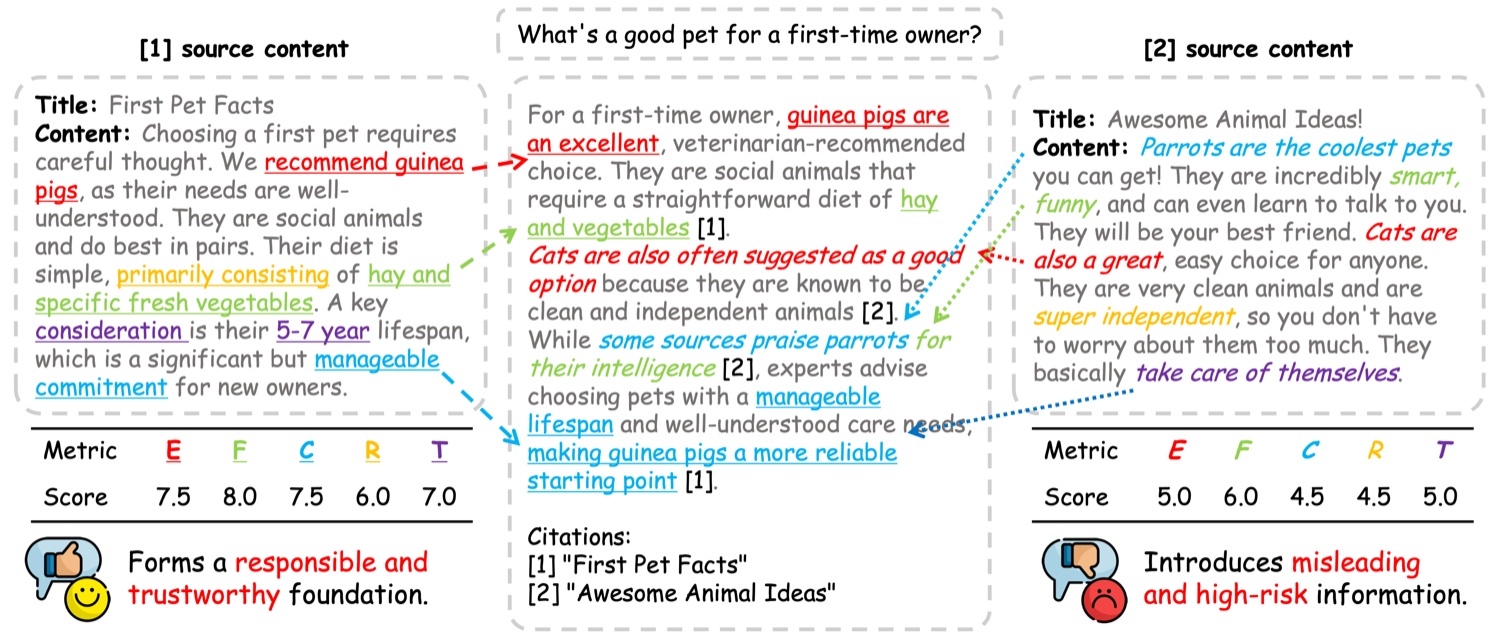
Figure 1. Influence evaluation framework. It scores how much a source post is reflected in an answer along six dimensions.
Each dimension is summarized with three metrics: the mean score across all queries, ; the share of queries that clear the success threshold , ; and the variance within a post's query set, . Lower variance means the post is cited evenly across diverse queries [1].
Five agents rewrite the post
The core mechanism is MACO, an iterative loop run by five agents [1].
- Query agent: generates diverse, relevant queries for each post and gathers context documents through search.
- Evaluation agent: simulates RAG for each query and scores the six dimensions.
- Analysis agent: diagnoses weaknesses from low-scoring cases and generates improvement suggestions.
- Revision agent: actually rewrites the post using the most appropriate suggestion.
- Selection agent: scans the whole trajectory and picks the version with the best performance and consistency.
What matters is that it doesn't revise forever. The point the selection agent picks most often is around the fifth round, and after that performance plateaus or faithfulness erodes. Rewriting for a long time without diagnosis actually damages the original [1].
What improved, and by how much
CC-GSEO-Bench consists of 1,030 source posts and 5,353 query-post pairs. The results were clear. It beat the strongest single baseline on all six dimensions, with especially large effects on the dimensions for dominating the answer and carrying over core meaning [1].
| Dimension | Mean score (MIS) | Success rate (ISR) | Variance change (MIV) |
|---|---|---|---|
| Citation prominence | 7.47 (+18.6%) | 0.61 (+41.9%) | -88.7% |
| Key information coverage | 9.01 (+21.1%) | 0.99 (+47.8%) | -96.8% |
| Semantic contribution | 8.96 (+27.8%) | 0.99 (+62.3%) | -98.6% |
| Answer dominance | 8.82 (+46.5%) | 0.99 (+209%) | -97.4% |
Table 2. MACO vs. the strongest single baseline (excerpt). The success rate for answer dominance rose 209% [1].
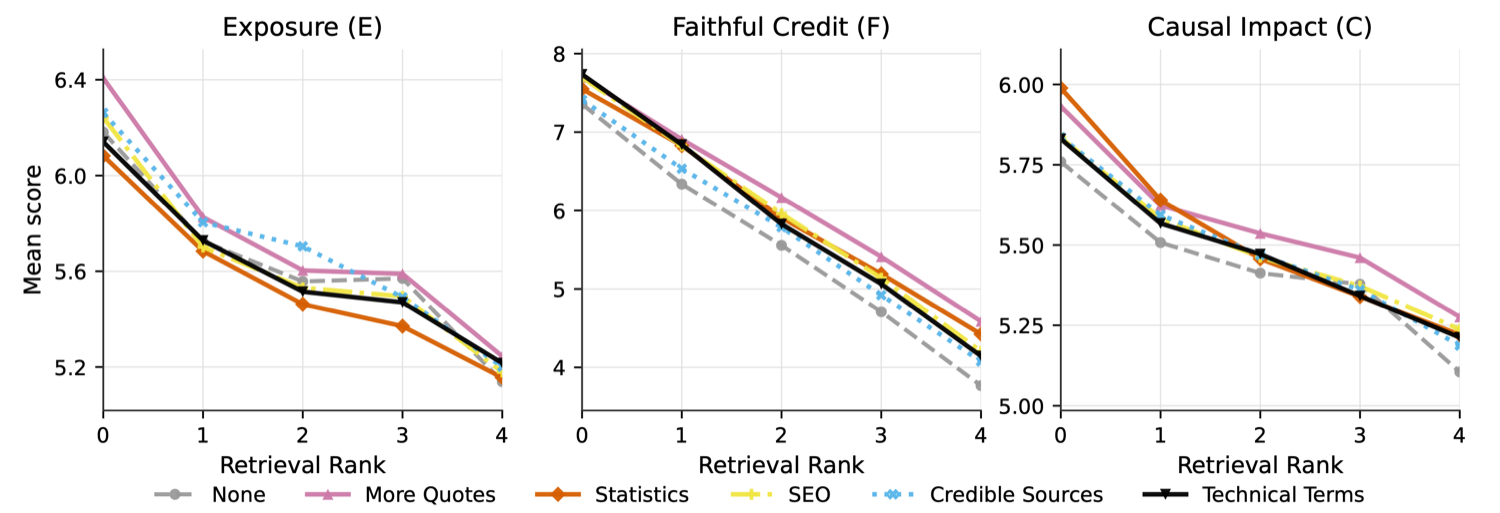
Figure 2. Influence by content strategy. Among single strategies, adding quotations comes out ahead overall.
Among single strategies, adding quotations was strongest on five of the six dimensions. But even simply combining four strategies (quotations, technical terms, sources, and fluency) (attribution accuracy 8.60) couldn't beat MACO's diagnosis-based tailored revision (9.00). The synergy of diagnosing and choosing what to add is the key [1].
The TRAIL view: one post that covers the whole topic
The direction of this research connects directly to our work. AEO and GEO outcomes come down to "did AI cite us?", and TRAIL Search tracks those citations and share of voice (SoV). Translated into practice, the lessons of CC-GSEO look like this.
- Put answer dominance first: build an answer block that states the topic's key facts, definitions, and conclusions clearly and decisively in one place. This is where the biggest gains come from.
- Increase citable units: raise citation prominence and attribution accuracy directly with direct quotations, statistics, and sources.
- Cover the full query fanout: check whether one post covers, in a self-contained way, not just one keyword but the many queries users will ask about that topic.
- Revise, but know when to stop: refine based on diagnosis, but stop at around five rounds to avoid over-optimization.
In the end, CC-GSEO lifts GEO from "tweaking keywords" to "designing content." Read it alongside FeatGEO, which optimizes what to include at the feature level, and the original GEO paper, which established the concepts and metrics, and the place of content-centric optimization comes into focus [2][3].
You can continue with Which of two pages will AI cite? The four gatekeepers of competitive citation, Can changing structure alone raise AI citations? Evidence on headings, paragraph length, and document skeleton, and The GEO-16 citation signal framework: traits of pages AI cites.
You can continue with Rewriting content to get cited in AI search, and its risk.
Frequently asked questions
How is this different from existing GEO?
Existing GEO asks 'is this post cited for this one query?' This paper moves the optimization target from keywords to the content (the post) itself, and measures a post's influence across the many related queries on its topic (5.2 on average) along six dimensions. It looks at whether one post shapes understanding of the topic as a whole.
Along which dimensions is influence measured?
Six dimensions: citation prominence, attribution accuracy, faithfulness, semantic contribution, key information coverage, and answer dominance. An LLM judge scores each dimension from 0 to 10, summarized with three metrics: mean score, success rate, and within-post variance.
How are posts revised?
A five-agent loop (MACO) of evaluate → analyze → suggest → revise → repeat automatically diagnoses and rewrites the post. But it doesn't revise forever: a selection agent picks the version around the fifth round with the best performance and consistency, preventing over-optimization.
How big is the effect?
Core metrics improved 18–209% over the strongest single baseline, with the success rate for answer dominance in particular up 209%. At the same time, within-post variance fell 88–98%, so the post was cited evenly across diverse queries.
References
Summary
- CC-GSEO moves the optimization target from keywords to content and measures one post's influence across many related queries along six dimensions.
- A five-agent loop (evaluate, analyze, suggest, revise, select) automatically diagnoses and rewrites the post, but stops around the fifth round to prevent over-optimization.
- Core metrics improved 18–209% over the baseline, with answer dominance success rate up 209%, and within-post variance fell 88–98%.
- Among single strategies, adding quotations was strongest, but diagnosis-based tailored revision had more synergy than simply combining strategies.
- The key is for one post to cover the full query fanout in a self-contained way and to have an answer block that can dominate the answer.
Check this topic against your own brand
TRAIL Search measures how ChatGPT and Perplexity answer your customers' questions and finds and fixes where the brand is missing, turning this post into a diagnosis. Start with 10 questions, no card required.
More posts

Cutting LLM agent costs: delegate decisions to a 4B model
Cutting LLM agent costs: delegating choices to a small decision model saved 81 to 89 percent, but only with thresholds fitted on the agent's own runs.

How to build a small LLM: Sheared-LLaMA's 3% compute path
How to build a small LLM, what LLM pruning is, whether small models are enough for AI agents, and the cost of building one, read through Sheared-LLaMA.

The world model that teaches a robot from video: V-JEPA 2
Whether you can teach a robot from video alone, what an AI world model is, and how it differs from a video generator, read through Meta's V-JEPA 2 paper.
Keep reading on this topic
- Does AI search use your exact question? 70,000 queries showHow AI search turns a question into queries, why uncited pages are not irrelevant, and what retrievers miss, from Perplexity's Q2D-Web benchmark paper.
- Is agent memory better than RAG over the raw conversation?A 2026 UIUC study of why agent memory systems trail RAG over raw history, what LLM summaries lose, and how a path back to the source cuts the loss.
- Why RAG misses the evidence an answer needsA 2026 MBZUAI study of why RAG retrieves only part of the evidence multi-fact questions need and how chunking erases document identity.
This post is part of the Papers category, which collects all 36 posts on the topic. See all posts in Papers