
The paper that defined GEO: visibility metrics, 9 methods
Generative engine optimization (GEO): visibility metrics, 9 methods, and GEO-Bench
The paper that first defined GEO: measuring generative search visibility, which of 9 methods work, keyword stuffing, and whether low-ranked pages get cited. GEO (generative engine optimization) is a framework for optimizing your content so that generative search such as Perplexity and AI Overviews cites it when building an answer. This paper first defined its concept, metrics, and benchmark.
GEO (Generative Engine Optimization) is a framework for optimizing content to raise the chance that generative search engines such as Perplexity and Google AI Overviews cite it when they build an answer. The paper by Aggarwal et al., presented at KDD 2024, is the original GEO paper: it first defined the concept, its measurement metrics, and a benchmark [1].
Instead of listing search results, a generative engine reads several sources, merges them into one answer, and shows it directly. So visibility is now decided not by rank but by whether you are cited inside that answer. The problem is that content creators have little control over when and how their writing appears in the answer. GEO is an attempt to give creators a means of optimization in this new landscape [1]. (We unpack the basics of GEO further in What is GEO.)
What a generative engine is, and why SEO isn't enough
A generative engine works in roughly four steps. It rewrites the query into several queries, gathers sources through a search engine, condenses them with a summarization model, and produces a final answer with citations using a response model.
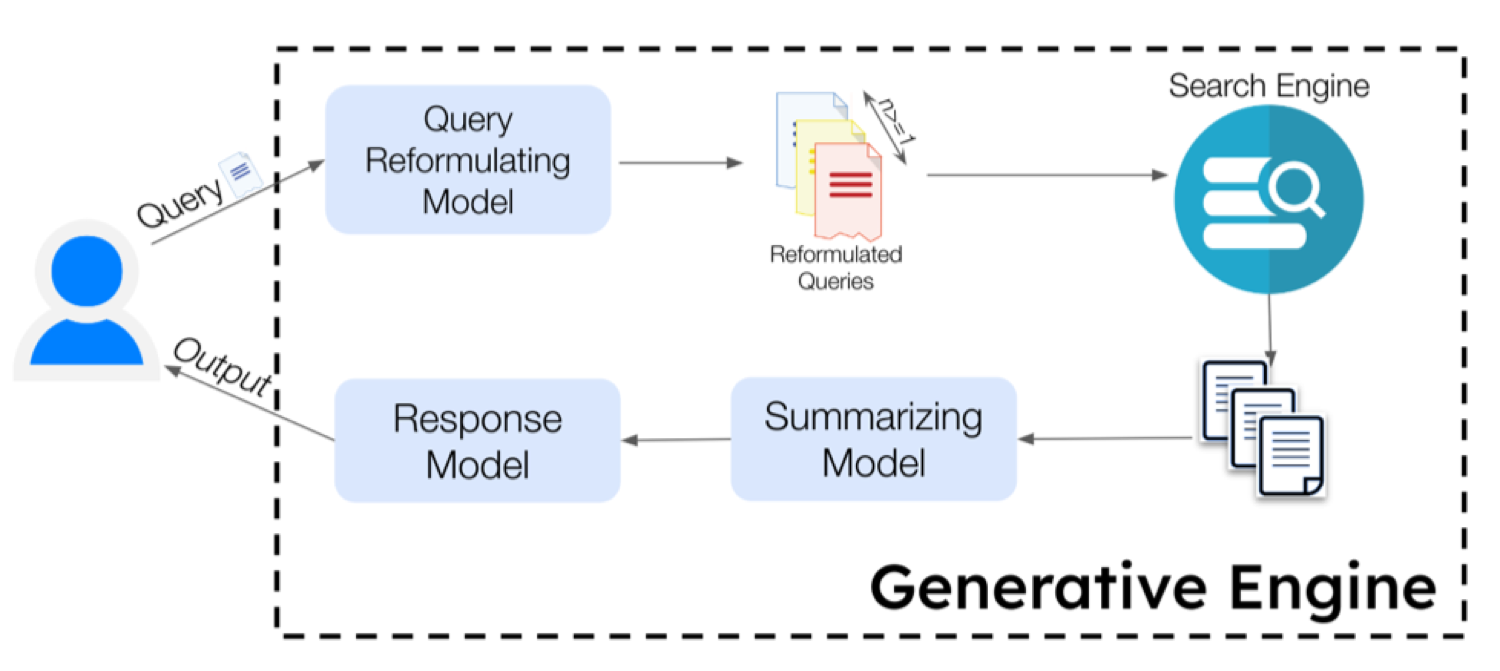
Figure 1. The structure of a generative engine: query rewriting, retrieval, summarization, and response generation with citations.
Traditional SEO was about climbing the rankings by fitting the search ranking algorithm. But a generative engine does not stop at keyword matching: a language model understands sources and queries more deeply and synthesizes an answer. On top of that, citations are embedded inside the answer text at different lengths and positions. So "what rank are we" alone cannot measure visibility.
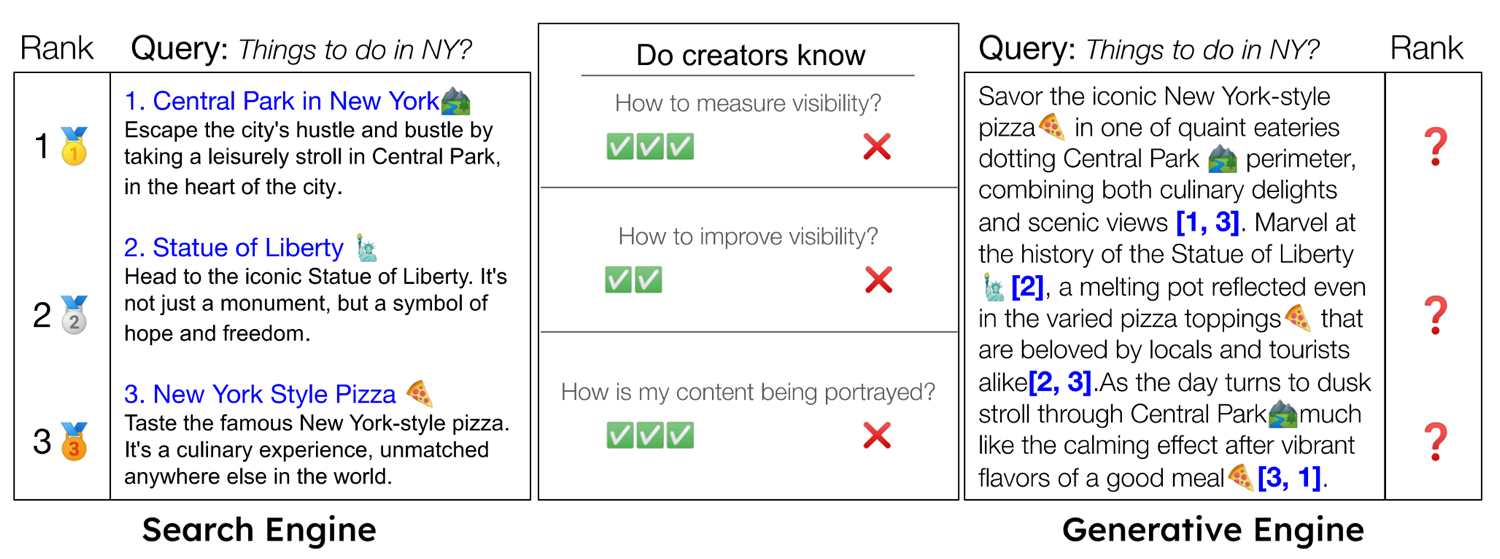
Figure 2. A search engine keeps rank and original text intact, but a generative engine mixes citations into the answer, so measurement becomes multidimensional.
How to measure visibility
The paper's most fundamental contribution is defining impression (visibility) metrics for generative engines. The simplest, "word count," divides the word count of the sentences carrying a given citation by the word count of the whole response.
Here is the set of sentences citing , is all sentences in the response, and is the word count of sentence . The more of the answer a citation takes up, the larger the role that source played.
But word count alone counts a citation the same whether it appears early or late. Since citations placed earlier get read more, the paper also uses position-adjusted word count, which decays exponentially with position [4].
Beyond that, subjective aspects such as click probability, query relevance, a citation's influence, and uniqueness are not captured by word count. So the paper adds a subjective impression measured with G-Eval along 7 dimensions (relevance, influence, uniqueness, diversity, follow-up, subjective position, and citation count) [3]. A method's effect is compared as the relative improvement of the modified response over the original response .
Nine GEO methods
The paper defines 9 engine-agnostic methods that can be applied to web content and evaluates them on GEO-Bench (10K queries, 9 sources, 25 domains) [1][2].
| # | Method | What it changes |
|---|---|---|
| 1 | Authoritative | A more persuasive, assertive tone |
| 2 | Statistics Addition | Turns qualitative description into quantitative statistics and figures |
| 3 | Keyword Stuffing | More query keywords (traditional SEO style) |
| 4 | Cite Sources | Adds citations of trustworthy sources and institutions |
| 5 | Quotation Addition | Adds quotes from experts and authorities |
| 6 | Easy-to-Understand | Simplifies into plain language |
| 7 | Fluency Optimization | Improves sentence fluency and logical flow |
| 8 | Unique Words | Adds distinctive words and expressions |
| 9 | Technical Terms | Adds technical terms and domain vocabulary |
Table 1. The 9 GEO methods evaluated in the paper.
The key point is that, apart from numbers 3, 4, and 5, most of these change only how existing content is presented, without adding much new information. In other words, you can raise visibility without making up facts.
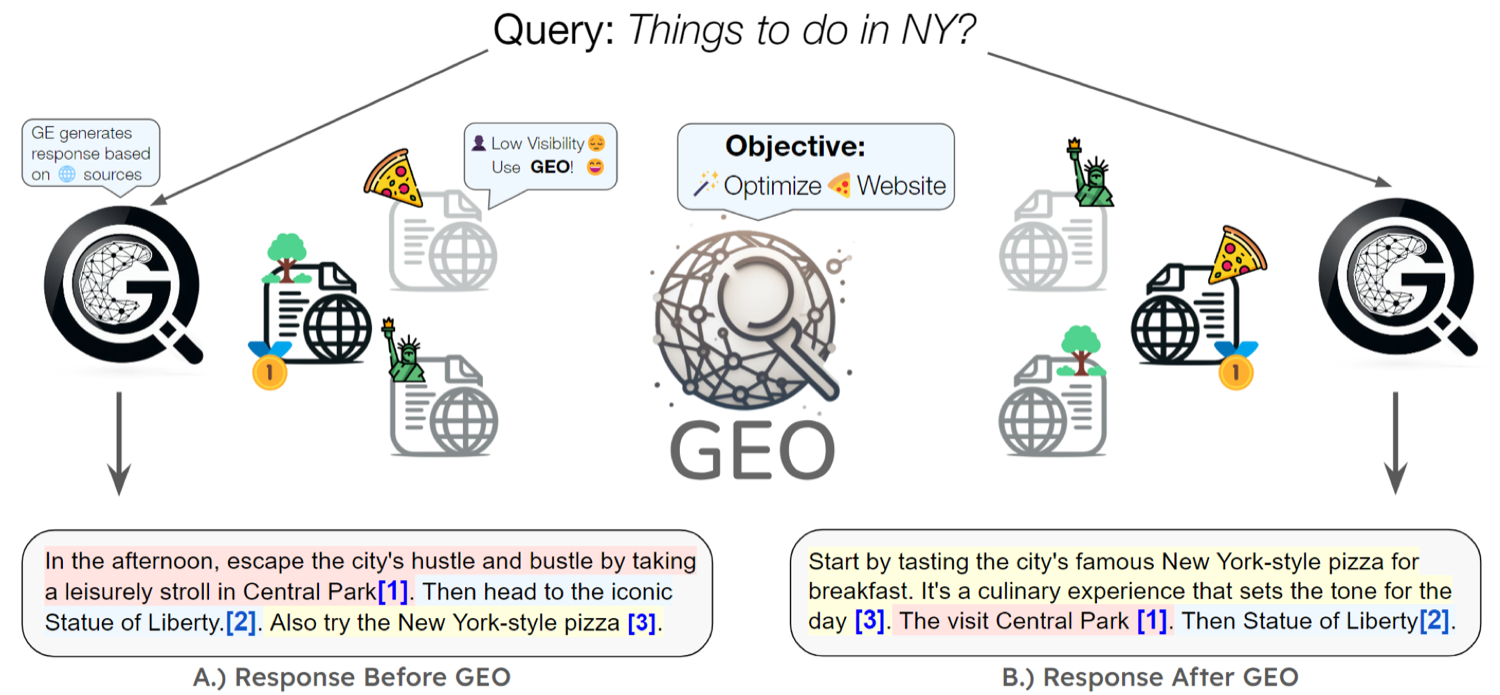
Figure 3. GEO before and after: a low-visibility source is cited earlier and at greater length in the generative response after optimization.
What worked
The results are clear. Cite Sources, Quotation Addition, and Statistics Addition were the strongest, and the best method improved on the baseline by 41% in position-adjusted word count and 28% in subjective impression. Traditional SEO keyword stuffing, by contrast, had almost no effect or even made things worse [1].
| Method | Position-adjusted word count | Subjective impression |
|---|---|---|
| No Optimization (baseline) | 19.3 | 19.3 |
| Keyword Stuffing | 17.7 | 20.2 |
| Cite Sources | 24.6 | 21.9 |
| Statistics Addition | 25.2 | 23.7 |
| Quotation Addition | 27.2 | 24.7 |
Table 2. Absolute impression of GEO methods (excerpt). Citation and statistics methods raise both metrics substantially [1].
Methods work better in combination. Using fluency improvement and statistics addition together beats any single method, and the best-performing combination differs by domain.
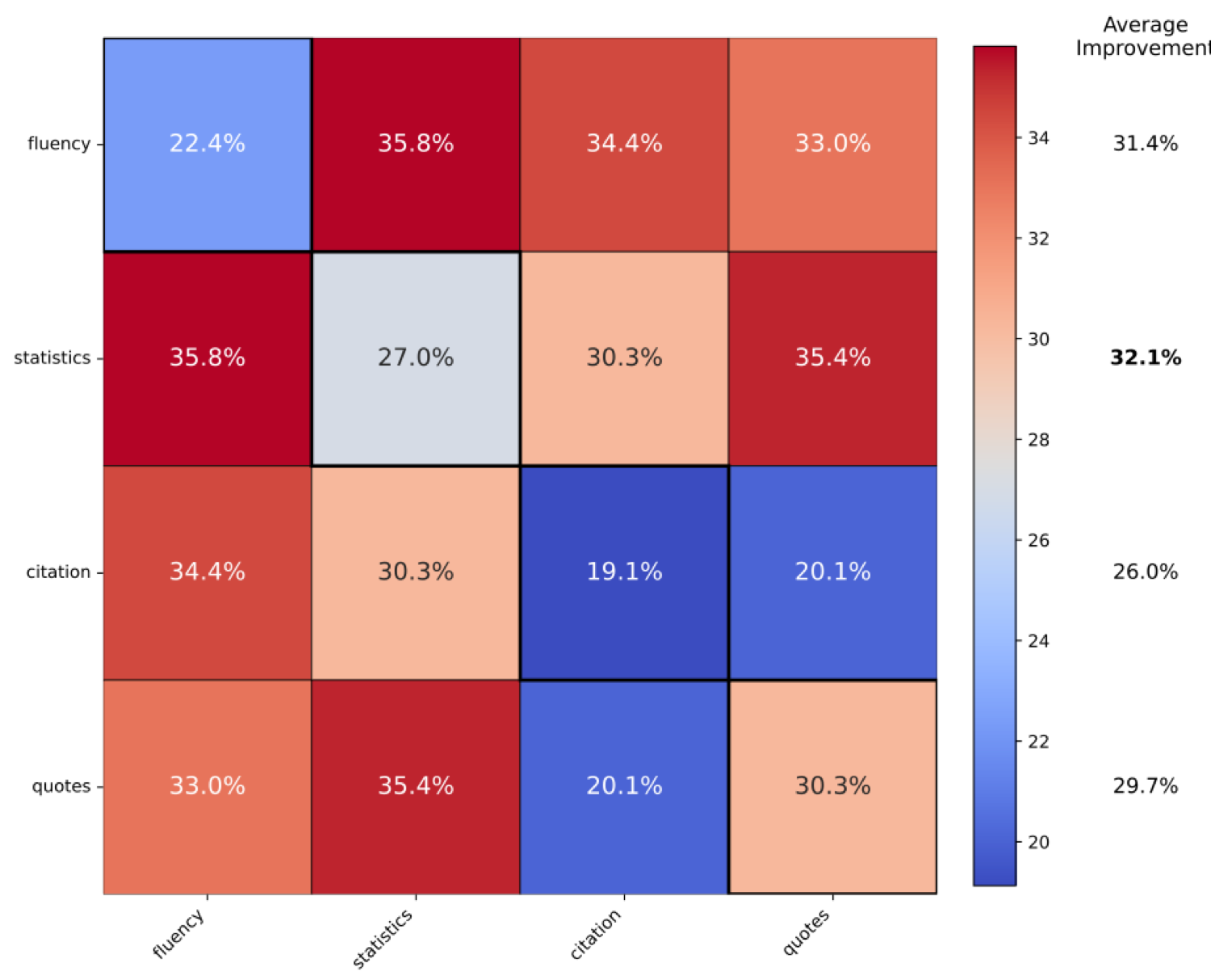
Figure 4. Heatmap of relative visibility improvement by method combination. Fluency + statistics is the strongest.
The lower the rank, the bigger the opportunity
More interesting still, the lower a page ranks in search, the larger the GEO effect. Adding source citations to the page ranked 5th in search raised its visibility in the generative response by a full 115%. Small creators who lose out on backlinks and domain authority can earn citations through content design alone, so GEO in effect levels the playing field [1].
| Method | Search rank 1 | Rank 3 | Rank 5 |
|---|---|---|---|
| Cite Sources | -30.3 | 20.4 | 115.1 |
| Quotation Addition | -22.9 | 3.5 | 99.7 |
| Statistics Addition | -20.6 | 8.1 | 97.9 |
Table 3. Relative visibility improvement (%) by search rank. Gains explode at lower ranks [1].
Different methods work for different domains
No single method works for every topic. The paper also analyzed which methods are strong in each query domain. An authoritative tone works especially well for debate-style questions, and source citations for factual questions [1].
| Method | Domains where it works well |
|---|---|
| Authoritative | Debate, history, science |
| Cite Sources | Statements, facts, law and government |
| Statistics Addition | Law and government, debate, opinion |
| Quotation Addition | People & Society, explanation, history |
Table 4. Domains where each method is especially effective [1]. Choose methods to fit your target topic.
It worked on a deployed engine too
Going beyond the synthetic benchmark, the paper also validated on the deployed Perplexity.ai. Source, statistics, and quote methods raised subjective impression by up to 37%, while keyword stuffing again came in below the baseline [1]. That signals lab results carry over to a real commercial engine.
Limits of this approach
The paper also states its own limits [1].
- Engines change: as generative engines evolve, the effect of these methods may shift, just as with SEO.
- Black box: the approach adjusts only text without knowing the engine's internals, so the causal reason why it works is not fully established.
- Effect on search ranking not measured: the effect of GEO edits on traditional search rankings was not measured separately.
- Tag noise: domain and intent tags were assigned automatically, so some errors may be mixed in.
The TRAIL view: citation is something you measure and design
The two pillars this original paper set up are the backbone of what we do today: redefining visibility so it can be measured, and optimizing it through content design. TRAIL Search tracks this visibility and share of voice (SoV) by engine, and our practical recommendations match the paper's conclusion: don't repeat keywords, build dense evidence with sources, statistics, and expert quotes, and polish sentences for fluency [1].
If this paper opened the door, later research is moving toward choosing methods automatically. FeatGEO, which optimizes at the feature level instead of editing the text directly, is one example [5]. Read alongside research on RAG source attribution, which traces which documents built an answer, measurement and design fit together as a pair. In the end, your place in AI answers grows from the moment you turn what you include and how you present it into a measurable problem.
You can continue with SAGEO Arena: edit only the body and you drop out of search, A reward ceiling for RL alignment, computed before training, and Do AI search sources change with the user's location?.
Frequently asked questions
How is GEO different from SEO?
SEO raises your page's rank in search results. GEO makes generative search cite your content when it builds an answer. A generative engine merges several sources into one answer and embeds citations in the text at varying positions and lengths. So instead of rank, you need to measure and optimize visibility inside the answer.
What is the most effective way to increase AI citations?
In this paper's experiments, Cite Sources, Quotation Addition (expert quotes), and Statistics Addition were the most effective. They improved visibility by up to 41% over the baseline on position-adjusted word count and up to 28% on subjective impression. Fluency and readability improvements also raised it by 15–30%.
Does adding more keywords make AI cite you more?
No. Traditional SEO keyword stuffing had little to no effect in generative engine responses, or even lowered visibility. Generative engines look at content quality signals such as evidence, citations, and how information is presented, more than surface keywords.
Does GEO only favor big sites?
Quite the opposite. The lower a page ranked in search, the larger the GEO effect. For example, adding source citations to the page ranked 5th in search raised its visibility in the generative response by up to 115%. That means small creators without backlinks or domain authority can earn citations through content design.
References
- [1]Aggarwal et al., "GEO: Generative Engine Optimization", KDD 2024
- [2]GEO project, code, and GEO-Bench (GEO-optim/GEO)
- [3]Liu et al., "G-Eval: NLG Evaluation using GPT-4 with Better Human Alignment", EMNLP 2023
- [4]Liu et al., "Lost in the Middle: How Language Models Use Long Contexts", TACL 2024
- [5]Liu & Xu, "Think Before Writing (FeatGEO)", ACL 2026
Summary
- GEO (generative engine optimization) is a framework for optimizing your content so that generative search such as Perplexity and AI Overviews cites it when building an answer. This paper first defined its concept, metrics, and benchmark.
- Visibility is measured by how you appear inside the answer instead of by rank, using position-adjusted word count (objective) and subjective impression (7 G-Eval dimensions).
- Of the 9 methods, Cite Sources, Quotation Addition, and Statistics Addition were the most effective, raising visibility by up to 41% (word count) and 28% (impression) over the baseline, while keyword stuffing did not work.
- Effects differ by domain and grow larger for pages ranked lower in search (+115% at rank 5). On the deployed Perplexity.ai, improvements of up to 37% were confirmed too.
- In the end, evidence, structure, and authority create citations more than surface rhetoric, and follow-up research (FeatGEO) is automating and refining this.
Check this topic against your own brand
TRAIL Search measures how ChatGPT and Perplexity answer your customers' questions and finds and fixes where the brand is missing, turning this post into a diagnosis. Start with 10 questions, no card required.
More posts

Cutting LLM agent costs: delegate decisions to a 4B model
Cutting LLM agent costs: delegating choices to a small decision model saved 81 to 89 percent, but only with thresholds fitted on the agent's own runs.

How to build a small LLM: Sheared-LLaMA's 3% compute path
How to build a small LLM, what LLM pruning is, whether small models are enough for AI agents, and the cost of building one, read through Sheared-LLaMA.

The world model that teaches a robot from video: V-JEPA 2
Whether you can teach a robot from video alone, what an AI world model is, and how it differs from a video generator, read through Meta's V-JEPA 2 paper.
Keep reading on this topic
- Does AI search use your exact question? 70,000 queries showHow AI search turns a question into queries, why uncited pages are not irrelevant, and what retrievers miss, from Perplexity's Q2D-Web benchmark paper.
- Is agent memory better than RAG over the raw conversation?A 2026 UIUC study of why agent memory systems trail RAG over raw history, what LLM summaries lose, and how a path back to the source cuts the loss.
- Why RAG misses the evidence an answer needsA 2026 MBZUAI study of why RAG retrieves only part of the evidence multi-fact questions need and how chunking erases document identity.
This post is part of the Papers category, which collects all 36 posts on the topic. See all posts in Papers