
SAGEO Arena: edit only the body and you drop out of search
A realistic GEO evaluation that runs the full retrieval, reranking, and generation pipeline
SAGEO Arena re-evaluates GEO across retrieval, reranking, and generation. Why title and meta fields beat body text in AI search, and how to survive reranking.
SAGEO Arena is an environment that re-evaluates GEO strategies by actually running the full retrieval, reranking, and generation pipeline. It showed that conventional GEO, which edits only the body text, knocks documents out before the generation stage and so backfires in practice. Earlier evaluations such as the original GEO paper and C-SEO Bench were a generation-only game that measured citation using only candidate documents that had already been retrieved [1][2][3].
The problem is how documents actually flow. For a web page to be cited in an AI answer, it first has to be retrieved, then pass reranking to enter the generator's context. Earlier benchmarks skipped these two gates and handled only the body, discarding structural signals such as the document's title, meta description, and schema. So whether strategies reported to "work" also work in a real pipeline had never been tested [1].
Running retrieval, reranking, and generation end to end
SAGEO Arena actually simulates all three stages across 171,003 documents, 9 domains, and 2,700 queries [1].
| Stage | Method | What it does |
|---|---|---|
| Retrieval | BM25 (lexical) | Combines body passages and structural fields to select the top 100 |
| Reranking | LLM cross-encoder | Scores query-passage pairs and narrows to the top 10 |
| Generation | LLM synthesis | Generates a cited answer from the top 10 |
Table 1. SAGEO Arena's three-stage pipeline [1]. A document is cited in the answer only if it passes all three gates.
Retrieval combines the scores from each structural field with reciprocal rank fusion. The ranks a document receives across fields are combined like this [1].
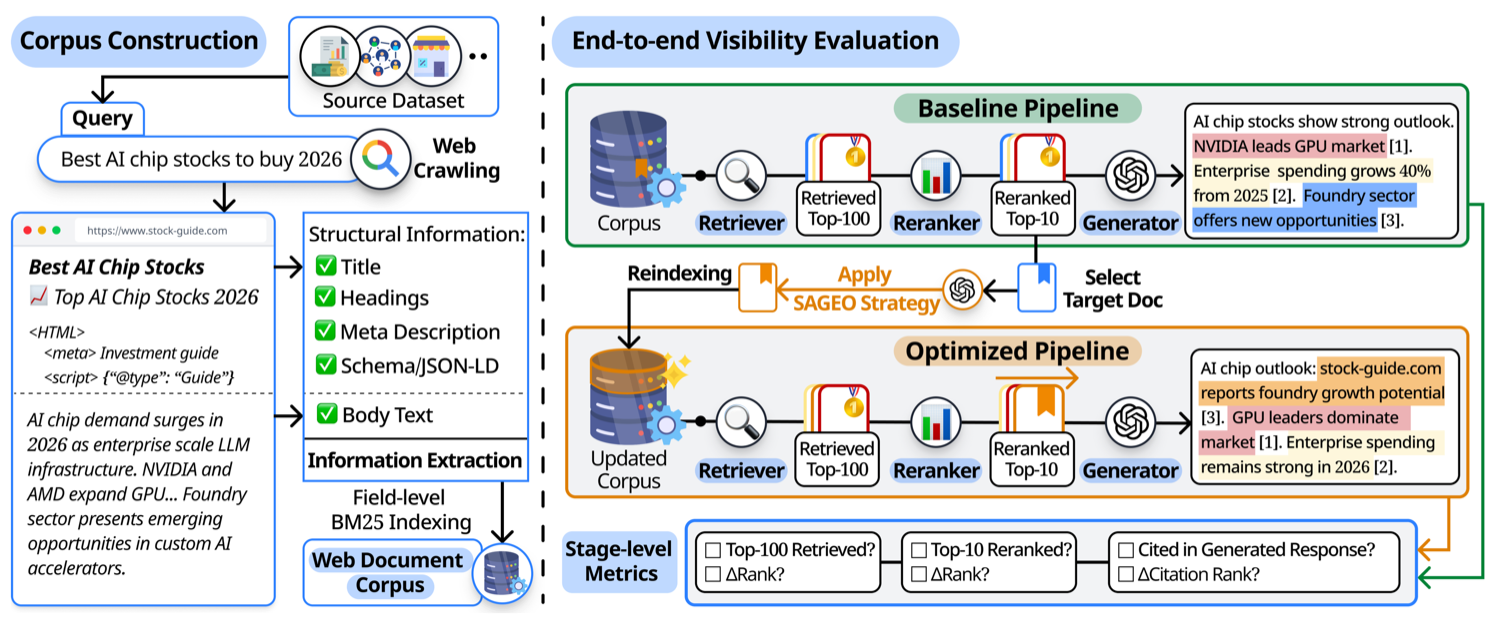
Figure 1. The path a document takes through retrieval, reranking, and generation in turn. It must clear all three to be cited.
Edit only the body and you drop out of search
This is the most important finding. Conventional GEO strategies that dress up the body text knocked documents out at retrieval. Elevating "eating" to something like "alimentary routines" reduces lexical overlap with user queries, which lowers the BM25 score [1].
| Optimization | Retrieval impact |
|---|---|
| Adding technical terms | Hit@20 -14% |
| Rule learning (AutoGEO) | Rank -36% (average -22.35 positions) |
| Structural field optimization | Hit Rate +22%, rank +2.72 positions |
Table 2. Body optimization backfires in retrieval, while structural field optimization brings strong gains [1].
In other words, the real lever for retrieval is not the body but the structural fields (title, meta description, headings, schema). Packing query terms and numbers into structural fields raised retrieval, and the generation citation rate rose 2–7% along with it [1].
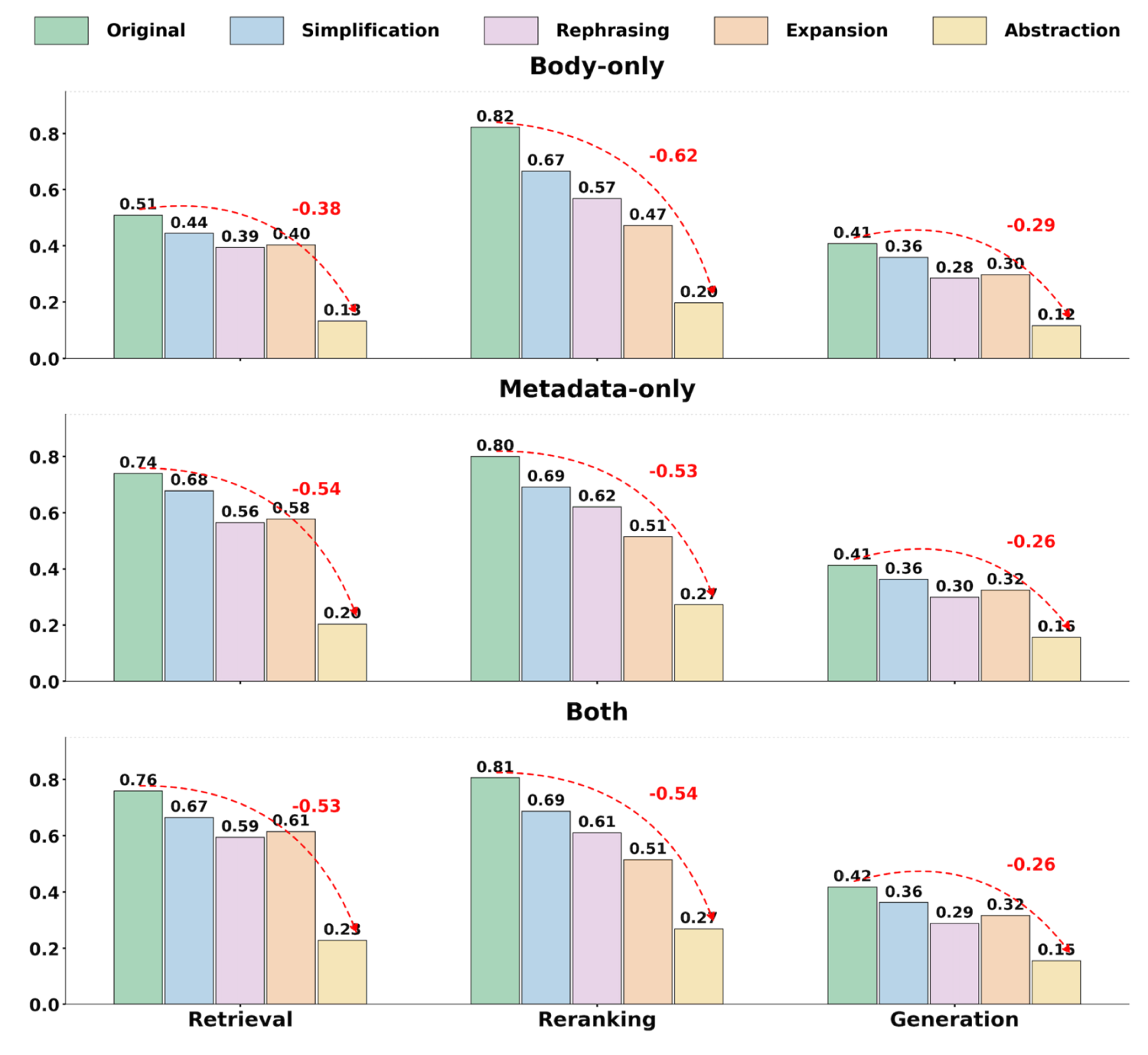
Figure 2. Effects by stage. Retrieval is driven by structural fields, and generation citations are driven by the body.
The reranking bottleneck
Every strategy lost visibility at reranking. In particular, 5.8% of target documents were pushed from rank 10 to rank 11 and fell outside the generator's cutoff (top 10). One position is the difference between being in the answer and disappearing. Rerankers favored documents that added content directly addressing the query intent, and documents that placed the answer up front [1].
This makes the roles of retrieval and generation complementary. Retrieval is driven by structure and citation by the body, so optimizing only one side inevitably breaks the other. Naively combining the two strategies let the body regression cancel out the structural gains, performing worse than specialized approaches. Stage-aware SAGEO, by contrast, which optimized body and structure separately by stage, led across every stage: retrieval Hit@20 +28% and rank +4.86 positions, avoiding the reranking penalty, and generation +1.01 positions [1].
The TRAIL view: get found, then get cited
This research ties directly into the backbone of our product. AEO scores (live citation) and search visibility need to be measured separately, because if you are cited well but never retrieved in the first place, the result is zero. TRAIL Search's recommendations can be split by stage as well.
- To get retrieved: Pack key entities and numbers into the title, meta description, headings, and schema. Do not dress up the body with sophisticated vocabulary that breaks lexical overlap with queries.
- To pass reranking: Put the core claim at the front of the document and attach specific evidence to each sentence. The cutoff is decided by a single position.
- To get cited in generation: Include citation-worthy evidence in the body, such as statistics, direct quotes, and sources.
- Look at the domain first: Do not apply one strategy across every domain. In the shopping domain, citations collapsed sharply under blanket GEO.
In the end, SAGEO Arena widens GEO from "polishing the body" to "designing the whole pipeline." Place FeatGEO, which designs content to be cited, and C-SEO Bench, which finds that gains disappear under competition, on this map, and each study falls into place according to which part of the pipeline it illuminates [3][4].
You can continue with GEO paper survey: what replicates and what does not.
Frequently asked questions
What was wrong with earlier GEO evaluations?
Earlier benchmarks measured citation using only candidate documents that had already been retrieved. In other words, they were a generation-only game that skipped the retrieval and reranking stages entirely. In reality a document must be retrieved before it enters the generator's context, and those evaluations left that gate out.
What happens if I GEO-optimize only the body text?
You actually drop in retrieval. Polishing the body with sophisticated vocabulary reduces lexical overlap with user queries, which lowers the retrieval score. The technical-terms strategy cut Hit@20 by 14%, and the rule-learning approach cut rank by 36%. Writing to look good to the generator makes you invisible to retrieval.
Then what should I optimize?
Retrieval is driven by structural fields (title, meta description, headings, schema) rather than the body. Structural optimization alone raised Hit Rate by 22%. Generation citations are driven by the body. The two roles are complementary, so you need to optimize each stage separately.
Why is reranking a bottleneck?
Every strategy lost visibility at reranking, and 5.8% of target documents were pushed from rank 10 to rank 11 and fell outside the generator's cutoff. One position is the difference between being in the answer and disappearing. Rerankers favor documents that directly address the query intent and put the answer up front.
References
- [1]Kim et al., "SAGEO Arena: A Realistic Environment for Evaluating Search-Augmented GEO", arXiv:2602.12187 (2026)
- [2]Aggarwal et al., "GEO: Generative Engine Optimization", KDD 2024
- [3]Puerto et al., "C-SEO Bench: Does Conversational SEO Work?", NeurIPS 2025
- [4]Liu & Xu, "Think Before Writing (FeatGEO)", ACL 2026
Summary
- SAGEO Arena re-evaluates GEO strategies by actually running the full pipeline of retrieval (BM25), reranking (LLM), and generation.
- GEO-optimizing only the body reduces lexical overlap and drops pages out of retrieval (technical terms -14% Hit, rule learning -36% rank). Generation gains were minimal.
- The real lever for retrieval is structural fields (title, meta, schema), not the body: structural optimization alone gave Hit +22%.
- Reranking is the bottleneck: 5.8% of targets slipped from rank 10 to 11 and dropped out of generation, and self-contained documents that lead with the answer have the edge.
- Stage-aware SAGEO, which optimizes structure for retrieval and body for citation together, stage by stage, led across every stage.
Check this topic against your own brand
TRAIL Search measures how ChatGPT and Perplexity answer your customers' questions and finds and fixes where the brand is missing, turning this post into a diagnosis. Start with 10 questions, no card required.
More posts
Cutting LLM agent costs: delegate decisions to a 4B model
Cutting LLM agent costs: delegating choices to a small decision model saved 81 to 89 percent, but only with thresholds fitted on the agent's own runs.

How to build a small LLM: Sheared-LLaMA's 3% compute path
How to build a small LLM, what LLM pruning is, whether small models are enough for AI agents, and the cost of building one, read through Sheared-LLaMA.

The world model that teaches a robot from video: V-JEPA 2
Whether you can teach a robot from video alone, what an AI world model is, and how it differs from a video generator, read through Meta's V-JEPA 2 paper.
Keep reading on this topic
- Does AI search use your exact question? 70,000 queries showHow AI search turns a question into queries, why uncited pages are not irrelevant, and what retrievers miss, from Perplexity's Q2D-Web benchmark paper.
- Is agent memory better than RAG over the raw conversation?A 2026 UIUC study of why agent memory systems trail RAG over raw history, what LLM summaries lose, and how a path back to the source cuts the loss.
- Why RAG misses the evidence an answer needsA 2026 MBZUAI study of why RAG retrieves only part of the evidence multi-fact questions need and how chunking erases document identity.
This post is part of the Papers category, which collects all 36 posts on the topic. See all posts in Papers