
FeatGEO: Do keywords or structure earn AI citations?
Generative engine optimization that tunes features instead of editing words
FeatGEO turns a page into features to optimize AI citation visibility and quality together, how it differs from word-level GEO, and its effect on human pages. FeatGEO is a GEO method that abstracts a web page into 13 features across structure, content, and language, optimizes AI citation visibility and content quality together, and regenerates the text to match that design.
FeatGEO is a generative engine optimization (GEO) method that abstracts a web page into structure, content, and language "features," optimizes AI citation visibility and content quality at the same time, and then regenerates the page to match that design. It was proposed in the Think Before Writing paper presented at ACL 2026, and it moves past the limits of the older approach of editing words directly by optimizing at the feature level [1]. We covered the definition and metrics of the GEO problem itself in the original GEO paper, so here we dig into the optimization method built on top of it.
Generative search such as Perplexity and Google AI Overviews does not rank results. Instead, it picks a few of the retrieved pages, cites them, and synthesizes an answer. So visibility is now decided by whether you are cited, not by rank. GEO is about answering one question: "When AI builds this answer, why would it cite us instead of another page?" [2].
Why editing words is not enough
Most earlier GEO worked at the token level. It edited the body directly, for example by inserting keywords or appending authoritative sentences. This approach has two weaknesses [1].
- Instability: It optimizes for one fixed query, but in practice an LLM faces many different user intents under the same topic. Change the query slightly and the effect wobbles.
- Opacity: When you touch the words directly, "what you say" and "how you say it" get tangled, which hides the higher-level properties that actually drive citation.
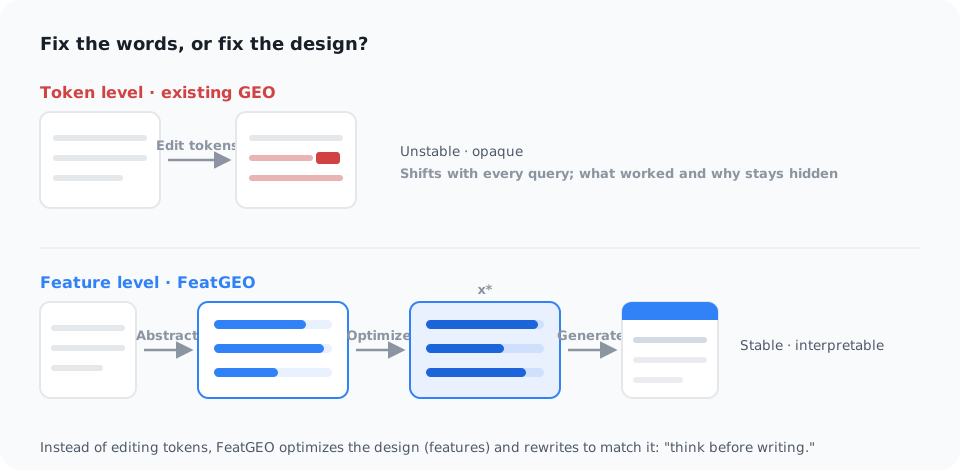
Figure 1. Token-level editing vs. feature-level optimization.
That is where FeatGEO starts. Instead of editing words right away, it turns a page into an interpretable feature vector, optimizes in that space, and lets an LLM realize the design as natural sentences. As the paper's title puts it, "think before writing."
FeatGEO: turn the page into features, then optimize
First, it models citation by topic rather than by a single query. For a topic τ, an LLM generates several queries with similar meaning, and the citation results for each query are pooled to compute how often each document is cited. Pages that are cited often become the "representative examples" for that topic [1].
Each page is represented by 13 features across three layers. These values are "soft signals" used as generation guidance rather than hard constraints [1].
| Layer | Feature | Range | Meaning |
|---|---|---|---|
| Structure | has_intro_summary | 0–1 | Whether there is an opening summary paragraph |
| Structure | headings_level | 1–3 | Hierarchy and number of headings and subheadings |
| Structure | list_density | 0–3 | Frequency of bulleted and numbered lists |
| Structure | length_level | 1–3 | Length (depth and breadth of content) |
| Content | statistics_level | 0–3 | Density of data, statistics, and numbers |
| Content | cite_sources_level | 0–3 | How often authoritative sources, institutions, and reports are cited |
| Content | quotation_level | 0–3 | How often experts and authorities are quoted |
| Content | unique_info_level | 0–3 | Richness of distinctive information |
| Content | technical_terms_level | 0–3 | Density of technical terms |
| Language | authoritative_level | 0–3 | Strength of assertive, authoritative tone |
| Language | easy_to_understand_level | 1–3 | Readability and simplicity of language |
| Language | fluency_level | 1–3 | Fluency and logical cohesion between sentences |
| Language | keyword_focus_level | 1–3 | Concentration and repetition of core keywords |
Table 1. The 13 features across three layers used by FeatGEO.
How do features become actual sentences? The feature values chosen by the optimizer are translated into generation instructions in the system prompt. Discrete features (for example, fluency) become instructions at three levels: low, medium, and high. Continuous features (for example, statistics density) are mapped linearly to a target ratio. That way, optimization stays clean in a low-dimensional feature space, and the LLM handles the sentences, so the writing style stays natural [1].
Now the goal is to find a feature setting that satisfies two things at once. Visibility and quality are competing objectives, so instead of a single maximum, it looks for Pareto-optimal solutions.
The quality objective is measured as a weighted combination of content quality and appeal. The coefficient sets the balance between the two [1][4].
This is a non-differentiable black-box problem, so it is solved with the evolutionary algorithm NSGA-II [3]. The candidate population is initialized with features extracted from competing pages. In each generation, every setting is realized as a page by an LLM, evaluated for visibility and quality against the topic queries, and the population is updated with non-dominated sorting. The result is a set of settings along the Pareto curve.
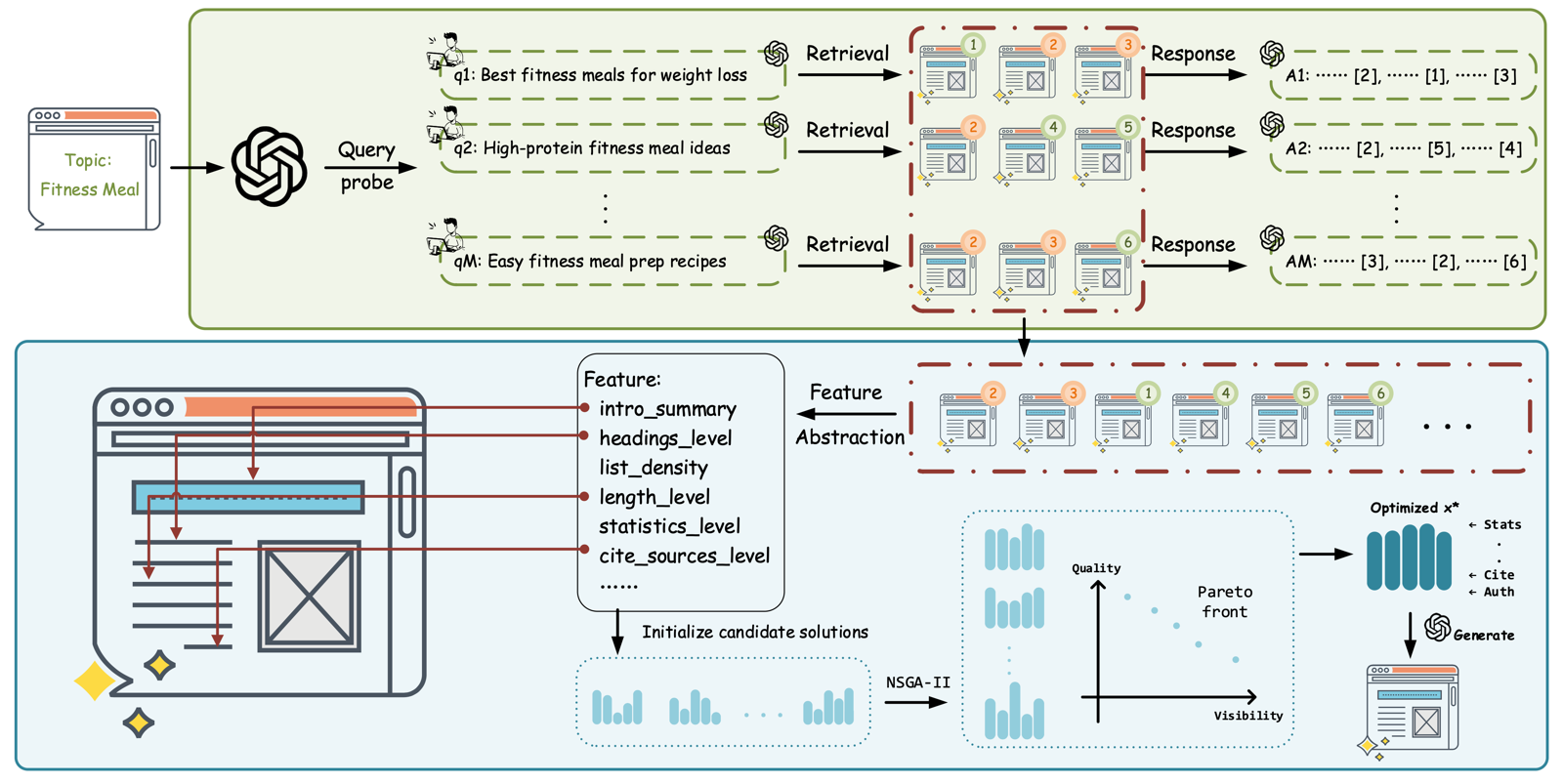
Figure 2. The full FeatGEO pipeline: topic query probing, then feature abstraction, then NSGA-II Pareto search, then generation.
What earns citations
Which features earn citations is measured by how much visibility drops when one feature is fixed at its minimum. That drop is the feature's contribution [1].
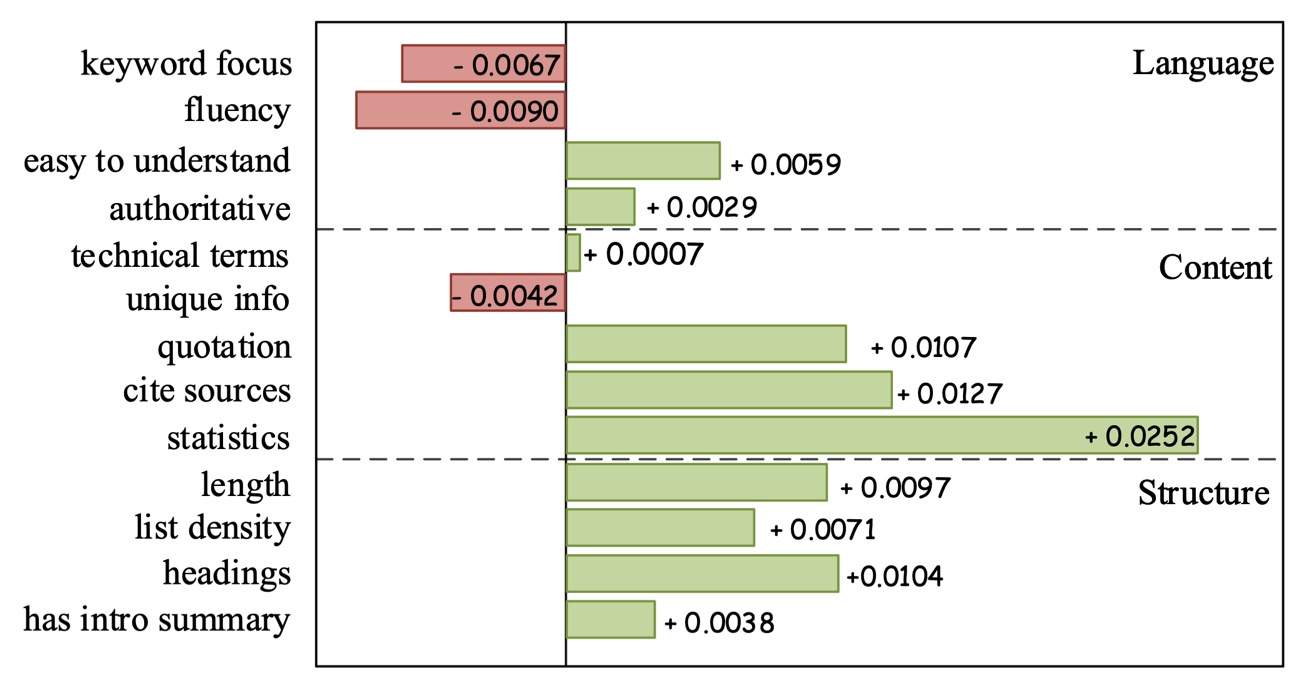
Figure 3. Citation visibility contribution by feature (content features dominate).
Content features dominate. Statistics and numeric density contributed the most (+0.0252), followed by citations of authoritative sources (+0.0127) and expert quotations (+0.0107). Structural features (headings, length, lists) helped steadily but moderately. By contrast, fluency (-0.0090) and keyword focus (-0.0067) actually lowered visibility, and unique information and technical terms had little effect [1]. In other words, evidence and information structure attract citations more than polishing surface wording does.
Across three generation engines (GPT-4o-mini, Gemini-2.5-flash, Qwen-plus), this principle led to large gains. Measured by position-adjusted word count, it improved on the baseline by roughly 37%, 73%, and 96% in relative terms, while keeping quality the same or even raising it [1].
| Method | Visibility · GPT-4o-mini | Visibility · Gemini | Visibility · Qwen-plus |
|---|---|---|---|
| Baseline | 13.34 | 8.89 | 5.20 |
| Best token-level (AutoGEO-instance) | 12.12 | 7.04 | 4.25 |
| FeatGEO | 18.31 | 15.35 | 10.17 |
Table 2. Citation visibility across three generation engines (in %). The ranking held when the judge was switched to Gemini or Claude [1].
Visibility and quality trade off
Visibility and quality are a trade-off: gaining one means giving up a little of the other. The paper compares the two end points of the Pareto curve for one query in the education domain. Solution A has 23.7% visibility and 87.8% quality, and solution B has 8.4% visibility and 92.7% quality. Same topic, completely different designs [1].
| Layer | Feature | Solution A (visibility 23.7%) | Solution B (quality 92.7%) |
|---|---|---|---|
| Content | Statistics density | 1.62 | 2.18 |
| Content | Expert quotations | 2.84 | 1.94 |
| Language | Fluency | 2.17 | 1.58 |
| Language | Authoritative tone | 1.55 | 0.75 |
| Structure | List density | 1.26 | 2.01 |
Table 3. Feature comparison of the two end points of the Pareto curve in the education domain.
The key point is that the design that raises visibility differs from the design that raises quality. When quotations, fluency, and authoritative tone are high, as in solution A, the page gets cited more. When lists and structure are dense, as in solution B, the quality people care about goes up. There is no single right answer. It is a matter of picking a point on the curve that fits your goal.
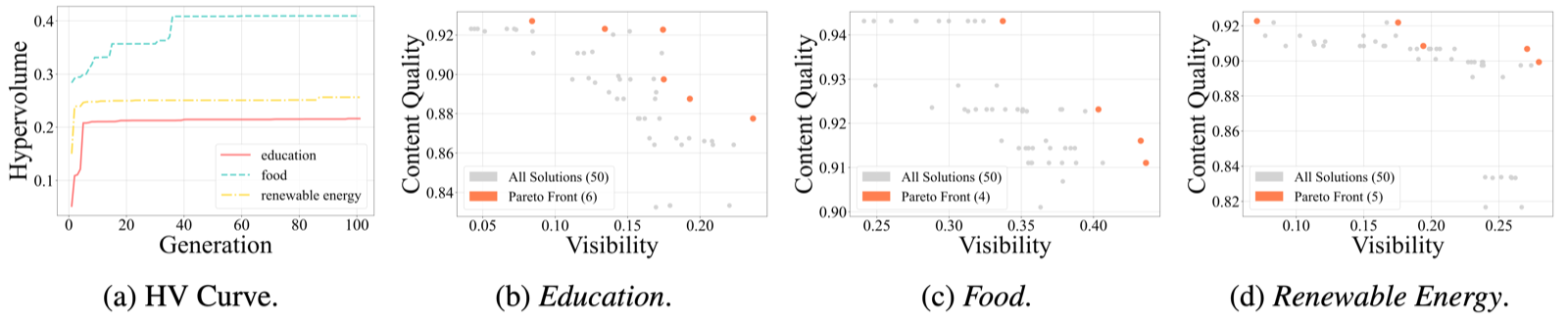
Figure 4. Visibility and quality Pareto curves by topic, and hypervolume (HV) convergence.
It still works as models get bigger
Could the optimized feature settings be tuned to one particular model? The paper checked this by switching the page generation model between Qwen3-4B, 8B, and 14B. FeatGEO consistently beat the baseline at every size, and quality did not drop. The variation across model sizes was much smaller than the gap between FeatGEO and the baseline, which means the optimized features capture model-independent principles [1].
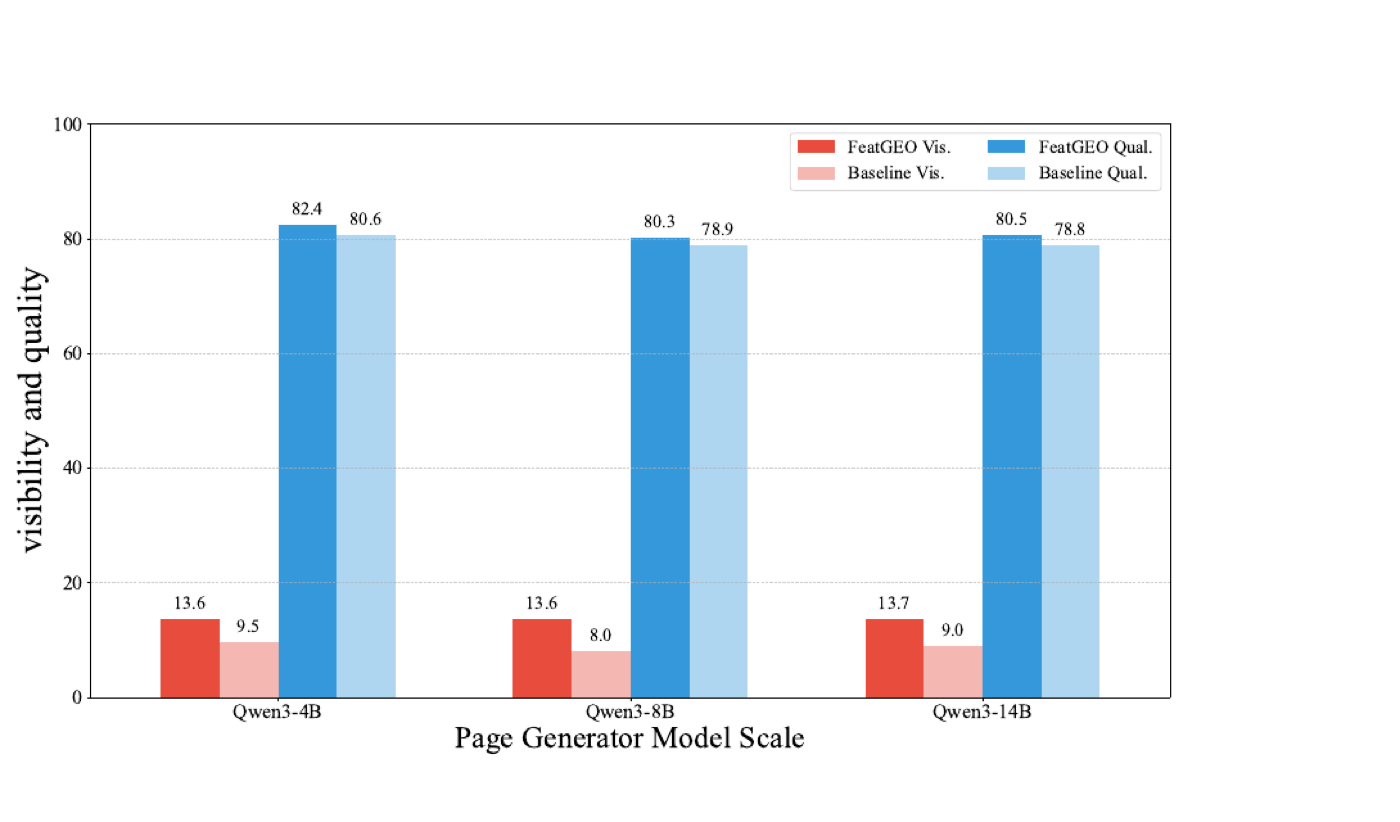
Figure 5. FeatGEO's advantage holds across generation model sizes (4B, 8B, 14B).
On human-written pages, it flows the other way
There is an interesting twist. On LLM-generated content that was already well written, token-level edits such as fluency and keyword tweaks lowered visibility. But on less polished, human-written competing pages, the same techniques raised it by +0.99 points on average [1]. Surface edits help pages whose structure is missing, but on writing that is already smooth they only add redundancy and awkwardness. Because FeatGEO does not patch words locally and instead synthesizes the page fresh from a feature design, it avoids this trap.
Limits of this method
The paper itself names four limits [1].
- Fixed candidate set: It assumes the advertiser's page is already among the 5 retrieved pages. It does not cover how pages get selected upstream by retrieval and ranking.
- Dependence on citation parsing: The fitness signal comes from LLM-generated answers and automatic citation parsing. Each real engine formats citations differently, so transferability is an open question.
- LLM judge: An LLM evaluates quality, so even when averaged over several runs, systematic bias or hallucination can creep in.
- Compute cost: The evolutionary search repeats LLM calls for page generation, answering, and evaluation. Sample efficiency and surrogate models are left for future work.
The TRAIL view: citation is a design problem
The question this research raises connects to the problem we work on every day. In AEO and GEO, the outcome comes down to "which sources AI relied on when it built this answer," and TRAIL Search tracks those citation and share of voice (SoV) signals. Turned into a practical checklist, the paper's lessons look like this.
- Pack in evidence: Put statistics and numbers, citations of authoritative sources, and expert quotations in the body. This is the axis with the largest contribution.
- Build the structure: Set up the skeleton with an opening summary, a clear heading hierarchy, and an appropriate length. This gives steady gains.
- Cut keyword repetition: Forcing fluency up or stuffing keywords can actually reduce citations.
- Pick based on your goal: Visibility and quality trade off, so choose a point on the curve that matches what you need right now.
In the end, FeatGEO moves GEO from "editing words" to "choosing a design." When you decide what to include through features and leave how to write it to the generation model, your place in AI answers grows through evidence and structure rather than surface tricks. Read alongside the RAG source attribution research, which traces which documents produced an answer, measurement and design fit together as a pair.
September 2026 update
This paper's conclusion that "content features dominate" can be used as is in practice. When you draft, don't start with sentences. First choose what evidence to include, then use only facts the brand actually has as material. Statistics and source features contribute a lot to citations, but filling them with made-up numbers is pointless, so it is better to leave out numbers without a source. That said, there are also opposing results: the effect of body rhetoric (statistics, sources, quotations) is smaller than that of structure or authority, and the gain shrinks when many publishers use the same technique at once.
You can find related reading in Which of two pages does AI cite? The four gatekeepers of competitive citation, Can changing structure alone raise AI citations? Evidence on headings, paragraph length, and document skeletons, and The GEO-16 citation signal framework: traits of pages AI cites.
You can continue with How often do AI answers name people, what rosters miss, Why RAG misses the evidence an answer needs, and Does AI Search Cite AI-Written Content.
Frequently asked questions
How is FeatGEO different from earlier GEO?
Earlier GEO edits the words directly, for example by inserting keywords or adding authoritative phrasing. FeatGEO abstracts a page into 13 features across structure, content, and language, optimizes in that design space, and then regenerates the text to match the best design. Separating what to change (features) from how to write it (sentences) makes it more stable and easier to interpret.
How do features turn into actual sentences?
Feature values are translated into generation guidance in the system prompt. Discrete features (for example, fluency) become instructions at three levels: low, medium, and high. Continuous features (for example, statistics density) are mapped linearly to a target ratio. So optimization happens in a low-dimensional feature space, and the LLM handles turning it into natural sentences.
Which features contribute most to AI citations?
In the paper's contribution analysis, content features mattered most. Statistics and numeric density (+0.0252), citations of authoritative sources (+0.0127), and expert quotations (+0.0107) raised visibility the most. By contrast, fluency and keyword repetition sometimes lowered visibility.
Can you raise visibility and quality together?
The two are competing objectives, so you should think in terms of a Pareto trade-off curve rather than a single right answer. Fluent, authoritative settings push visibility up, while structured, list-heavy settings push quality up. Across three engines, FeatGEO improved visibility by 37–96% in relative terms while keeping quality the same or even raising it, and the effect held when the size of the generation model changed.
References
- [1]Liu & Xu, "Think Before Writing: Feature-Level Multi-Objective Optimization for Generative Citation Visibility", ACL 2026
- [2]Aggarwal et al., "GEO: Generative Engine Optimization", KDD 2024
- [3]Deb et al., "A Fast and Elitist Multiobjective Genetic Algorithm: NSGA-II", IEEE TEC 2002
- [4]Liu et al., "G-Eval: NLG Evaluation using GPT-4 with Better Human Alignment", EMNLP 2023
- [5]FeatGEO implementation code (EvoNexusX/2026LiuFeatGEO)
Summary
- FeatGEO is a GEO method that abstracts a web page into 13 features across structure, content, and language, optimizes AI citation visibility and content quality together, and regenerates the text to match that design.
- The key is separating what to change (feature optimization) from how to write it (LLM generation). Think before writing.
- Visibility and quality compete, so it uses NSGA-II to find Pareto-optimal solutions, raising visibility by 37–96% across three engines while keeping or improving quality.
- What earned citations was content features such as statistics, sources, and quotations, plus structure, more than keyword repetition, and the principle held as the generation model size changed (4B–14B).
- On content that is already well written, token-level edits backfire, so changing the design and rewriting is the safer approach.
Check this topic against your own brand
TRAIL Search measures how ChatGPT and Perplexity answer your customers' questions and finds and fixes where the brand is missing, turning this post into a diagnosis. Start with 10 questions, no card required.
More posts

Cutting LLM agent costs: delegate decisions to a 4B model
Cutting LLM agent costs: delegating choices to a small decision model saved 81 to 89 percent, but only with thresholds fitted on the agent's own runs.

How to build a small LLM: Sheared-LLaMA's 3% compute path
How to build a small LLM, what LLM pruning is, whether small models are enough for AI agents, and the cost of building one, read through Sheared-LLaMA.

The world model that teaches a robot from video: V-JEPA 2
Whether you can teach a robot from video alone, what an AI world model is, and how it differs from a video generator, read through Meta's V-JEPA 2 paper.
Keep reading on this topic
- Does AI search use your exact question? 70,000 queries showHow AI search turns a question into queries, why uncited pages are not irrelevant, and what retrievers miss, from Perplexity's Q2D-Web benchmark paper.
- Is agent memory better than RAG over the raw conversation?A 2026 UIUC study of why agent memory systems trail RAG over raw history, what LLM summaries lose, and how a path back to the source cuts the loss.
- Why RAG misses the evidence an answer needsA 2026 MBZUAI study of why RAG retrieves only part of the evidence multi-fact questions need and how chunking erases document identity.
This post is part of the Papers category, which collects all 36 posts on the topic. See all posts in Papers