
Does structure alone raise AI citations? The evidence
Generative engine optimization that only tunes layout, formatting, and emphasis, without rewriting a single sentence
An empirical study that raised AI search citation rates 17.3% by tuning only document structure (headings, paragraph length, emphasis), plus how engines differ.
GEO-SFE is a generative engine optimization method that raised AI search citation rates by 17.3% on average without rewriting a single word of meaning, only by optimizing structure: headings, paragraphs, lists, and emphasis. Proposed by researchers at the University of Tokyo and the University of Tsukuba, it breaks structure into three layers (Macro, Meso, Micro) and offers each layer's citation contribution and optimal numeric ranges as recommendations [1]. It is a companion to FeatGEO, which tackled the same problem through content feature optimization. If FeatGEO covered "what to include," this paper digs into "how to lay it out."
Generative search like Perplexity and Google AI Overviews synthesizes an answer from multiple retrieved pages instead of listing links, and it cites only some of them. So visibility is determined by whether you are cited, not by rank. GEO answers the question "when AI builds this answer, why would it cite us instead of another page?" The problem definition and metrics are covered in our post on the original GEO paper [3].
Why "what you write" isn't enough
Almost all earlier GEO research worked on semantic content. By changing "what you write" (adding statistics, inserting authoritative phrasing, attaching quotations) it raised citation rates by up to 40% [1][3]. But how much layout, formatting, and emphasis change citations for the same information was a largely unexplored area.
There's a reason this matters. When an LLM reads structured text, it concentrates attention on semantically dense regions; in poorly structured text, attention scatters and performance drops [1]. In other words, structural choices such as heading structure, front-loading information, lists and tables, and paragraph length directly shape the decision of which page to cite. The paper starts from here: if you preserve the semantics and optimize only the structure, how much do citations rise?
GEO-SFE: breaking structure into three layers
The core idea is to split structure into three layers and model each with quantitative metrics. It decomposes structure into Macro for the whole-document skeleton, Meso for paragraph and format units, and Micro for token-level emphasis, and attaches an optimal target range to each metric [1].
| Layer | Feature | Metric | Optimal target |
|---|---|---|---|
| Macro | Heading hierarchy depth | 3–5 | |
| Macro | Section balance | = section ratio by level | ≈ 0.3 ± 0.1 |
| Macro | Structural regularity | (section length) | High (uniform) |
| Macro | Transition coherence | = similarity of adjacent sections | High |
| Macro | Internal link density | = internal links / content unit | 0.15–0.20, paths <3 hops |
| Meso | Paragraph length | (words) | 150–300 words |
| Meso | Chunk topical coherence | = entropy | High |
| Meso | Format diversity | = unique formats / content unit | 0.25–0.35 |
| Meso | Content density | = information units / token | Moderate |
| Micro | Emphasis marker distribution | = emphasized tokens / all tokens | 0.05–0.10 |
| Micro | Strategic placement | = position-weighted emphasis | Sentence start 2.0× / boundary 1.5× |
| Micro | Emphasis hierarchy | Empirical weights | bold 1.8 > italic 1.3 > underline 1.0 |
| Micro | Readability | (Flesch-Kincaid) | Moderate |
Table 1. GEO-SFE's 13 structural features across three layers and their optimal targets.
The structure of content becomes a single vector through the three layer-level feature extraction functions [1].
The goal is then to find the structural transformation that maximizes citation visibility while preserving meaning. Semantic preservation is a constraint, so the meaning of the transformed content must match the original [1].
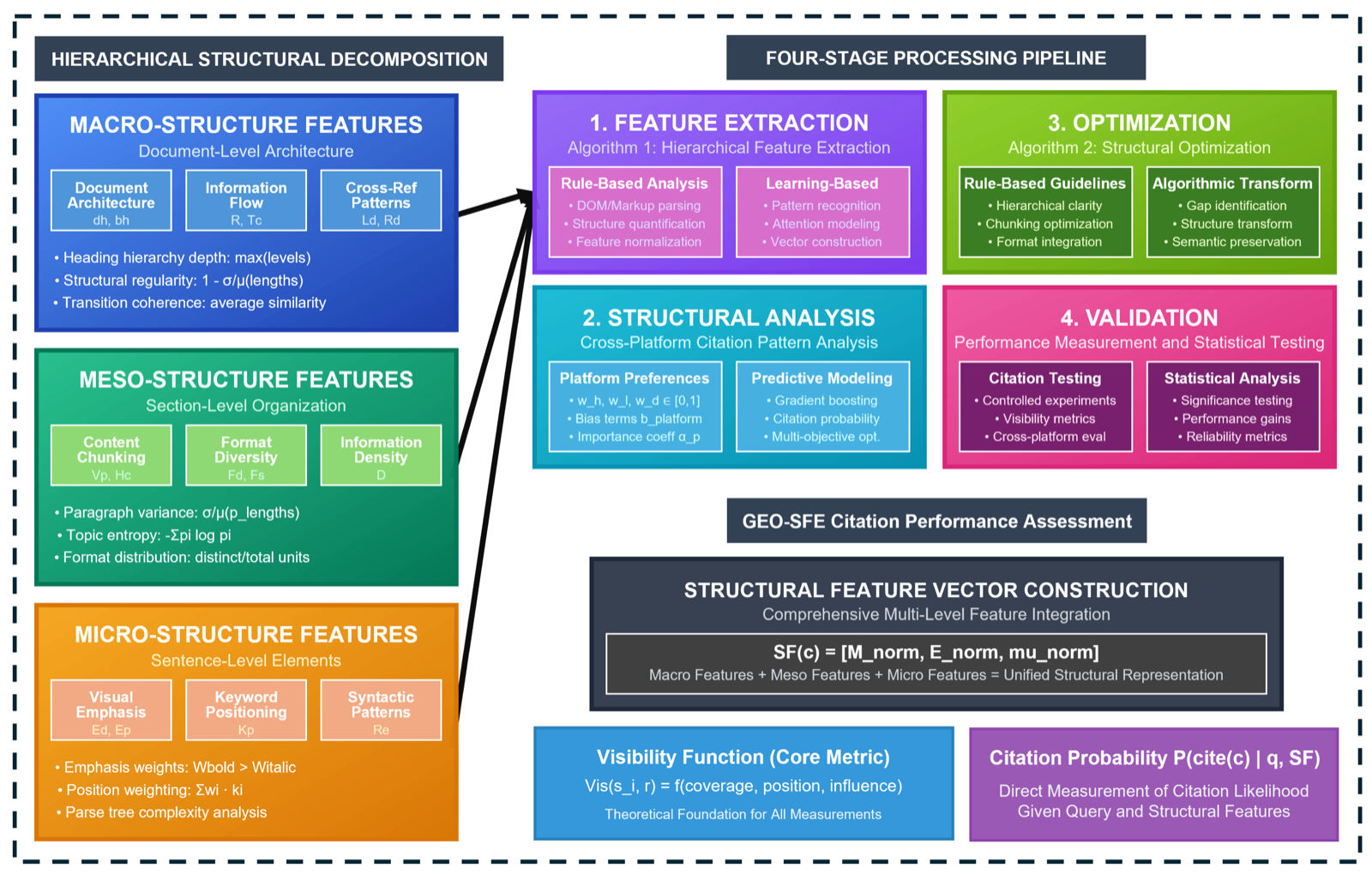
Figure 1. The GEO-SFE framework: three-layer structural decomposition and a four-stage pipeline (extraction, analysis, optimization, validation).
The transformation proceeds hierarchically from Macro to Micro, and each stage checks that semantic similarity clears a threshold. With thresholds such as 0.95 sentence-embedding similarity, 0.70 at the paragraph level, and 0.15 document JS-divergence, any transformation that damages meaning is rolled back [1][5].
How citations are measured
To measure the effect of structural optimization, you need to quantify citations. The paper defines the visibility of a source as a function of three factors: coverage, position, and influence [1].
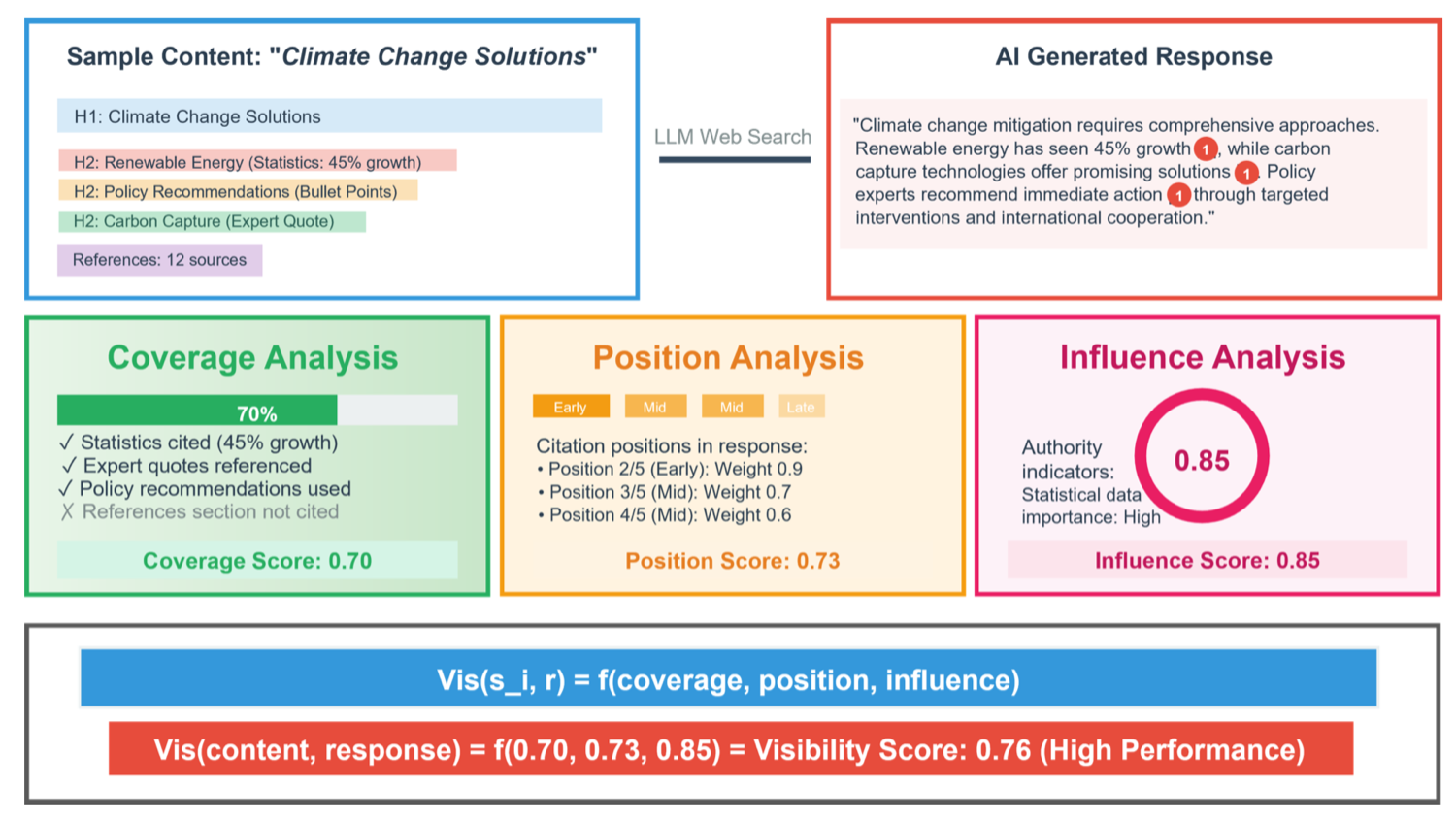
Figure 2. Visibility assessment workflow: coverage, position, and influence are broken out and combined into a final visibility score.
The actual evaluation uses two metrics. Citation Rate is the share of all queries in which the content is cited, and Visibility Score is a weighted sum of the three factors [1].
The evaluation used GEO-bench: 200 articles across six domains (biography, health, technology, finance, travel, science) and 377 real queries. Each article's baseline and GEO-SFE-optimized versions were sent to six engines, for 2,400 test cases in total. Semantic preservation was checked with BGE-M3 embeddings; average similarity was 0.843, confirming that meaning held even as structure changed [1][5].
What drives citations
Start with the overall effect: optimizing structure alone took the citation rate from 45.0% to 52.8%, a 17.3% relative improvement (p < 0.001, Cohen's d = 0.64, a medium-to-large effect) [1]. That result came without rewriting a single sentence.
So which of the three layers drives citations? Each layer was removed from the optimization one at a time, and its contribution was measured by how much the citation rate fell [1].
| Layer | CR drop when removed | Share of total citation gain |
|---|---|---|
| Macro (document skeleton) | −3.5 pp | 44.9% |
| Meso (information chunking) | −3.1 pp | 39.7% |
| Micro (visual emphasis) | −1.2 pp | 15.4% |
Table 2. Citation gain contribution by layer (ablation). Full 52.8% / Baseline 45.0% [1].
Document skeleton (Macro) and information chunking (Meso) drive 84.6% of citations. Emphasis such as bold and italic (Micro) played a supporting role at 15.4%. In other words, building structure matters far more than bolding text. Measurements of individual structural choices back up this picture [1].
- Lists and tables improve extraction accuracy by +43% over equivalent prose. Give comparisons, specs, steps, and conditions in a structured format and LLMs extract them much better. But once format diversity exceeds 0.35, readability collapses and it backfires.
- Paragraph length: past 300 words, attention to the middle section drops 31%; under 150 words, the information flow breaks and citation probability falls 23%. The optimum is 150–300 words.
- Heading depth: past five levels, excess structural tokens scatter attention; under three levels, there aren't enough organizational cues. The optimum is 3–5 levels.
- Emphasis placement: the start of a sentence gets 2.0 times the attention of a typical position, and emphasis types rank bold (1.8) > italic (1.3) > underline (1.0) in effect.
Strategic placement of emphasis is modeled with position weights. Emphasis placed at the start of a sentence counts the most [1].
Each engine architecture favors different structure
The interesting part is that each engine architecture rewards different structure. The paper divides generative engines into three paradigms based on how retrieval and generation interlock [1].
| Architecture | Representative engines | Priority structure (weight) |
|---|---|---|
| Search-then-Synthesize | Google SGE, Bing | Meta-structure 0.45 / front-loaded density 0.30 / hierarchy depth 0.25 |
| Iterative Refinement | Perplexity, Phind | Cross-references 0.41 / hierarchy breadth and depth 0.35 / query-triggering keywords 0.24 |
| Integrated Search-Generation | ChatGPT, Claude | Chunk independence 0.38 / format diversity 0.35 / aggressive chunking 0.27 |
Table 3. Structural weights by architecture (Table II). An engine's retrieval and generation timing determines the structure it prefers.
Each architecture's citation probability is predicted with a logistic function of the structure vector multiplied by architecture-specific weights [1].
When targeting several engines at once, it is solved as a multi-objective optimization weighted by the target distribution [1].
The actual gains also differed by architecture. All three paradigms improved significantly, but the gains were especially large for batch retrieval and integrated generation [1].
| Architecture | Baseline CR | Optimized CR | Gain |
|---|---|---|---|
| Search-then-Synthesize (SGE, Bing) | 43.7% | 52.1% | +19.2% |
| Iterative Refinement (Perplexity, Phind) | 52.3% | 59.6% | +14.0% |
| Integrated Search-Generation (ChatGPT, Claude) | 39.1% | 46.8% | +19.7% |
Table 4. Citation rate improvement by architecture (Table IV, all p < 0.001).
Changing structure alone raises quality too
You might worry that structural optimization raises citations at the cost of quality for human readers. The result was the opposite. Subjective quality across seven G-Eval dimensions, evaluated with Gemini 2.5 Pro, rose 18.5% on average [1][4].
| Dimension | Gain |
|---|---|
| Influence | +32.0% |
| Click Probability | +31.4% |
| Subjective Position | +19.4% |
| Relevance | +19.3% |
| Subjective Count | +12.5% |
| Uniqueness | +10.8% |
| Diversity | +7.2% |
Table 5. Subjective quality gains across seven G-Eval dimensions (average +18.5%) [1].
The 30%-plus gains in influence and click probability stand out. The paper attributes this to the Macro skeleton establishing narrative authority and Meso formatting adding visual appeal [1]. Clear structure makes content easier for AI to cite and easier for people to read.
Limitations of this method
The paper names four limitations itself [1].
- Sample size: it evaluated 200 articles. It looked at 2,400 cases across platforms, but the optimal values could change with more domains and languages.
- Embedding dependence: semantic preservation was validated with BGE-M3 alone. Other embedding models may yield different thresholds.
- Causality not verified: because the LLM citation mechanism is a black box, the attention hypothesis was not confirmed causally. The recommendations rest on measured correlations.
- Generalization: transfer to non-English content or highly specialized domains has not yet been shown.
TRAIL's take: citation is a design problem
The lesson of this study connects directly to the problems we work on every day. In AEO and GEO, results come down to "which sources did the AI lean on when it built the answer," and TRAIL Search tracks those citation and share-of-voice (SoV) signals. If FeatGEO optimized "what to include" as features, this paper adds "how to lay it out." Put the two together and the practical checklist gets sharp.
- Skeleton first: set headings at 3–5 levels and split sections into even lengths. This is the biggest contributor (Macro 44.9%).
- Answer up front: put the conclusion, definition, or number in the first sentence of each section. Batch-retrieval engines weight front-loaded density heavily.
- Comparisons in tables: give specs, steps, and conditions as lists or tables instead of prose. Extraction accuracy goes up 43%.
- Paragraphs of 150–300 words: too long and the middle gets ignored; too short and the flow breaks.
- Emphasis at only 5–10%: bold the key numbers, and only 5–10% of the text. Overuse kills the signal.
- Pick an engine and tune for it: if you're aiming for Perplexity, strengthen cross-references; for ChatGPT and Claude, strengthen chunk independence.
In the end, GEO-SFE moves GEO from "fixing words" to "building structure." Once you decide what to include, how you lay it out is what earns citations, and that design lifts quality for human readers too. When measurement and design work as a pair, your place in AI answers grows through structure rather than surface tricks.
September 2026 update
The paper's three-layer Macro, Meso, Micro decomposition translates directly into a practical review order. The reported contributions are Macro 44.9%, Meso 39.7%, and Micro 15.4% [1]: document skeleton and chunking drive most citations, and visual emphasis is secondary. So it's more efficient to fix heading structure and paragraph length before bolding anything. One common piece of advice has weak support. The recommendation to gather the key points again in the conclusion was not supported by our own measurements, so prioritizing front-loaded placement is the safer choice.
You can continue with Adding a diversity reward to query fan-out, The world model that teaches a robot from video, and How to build a small LLM.
Frequently asked questions
How is GEO-SFE different from earlier GEO?
Most earlier GEO work changes semantic content, meaning 'what you write': statistics, quotations, authoritative phrasing. GEO-SFE leaves the meaning untouched and optimizes only structure, meaning 'how you lay out, format, and emphasize.' Without rewriting a single sentence, it adjusted only heading depth, paragraph length, lists, and bold, and raised citation rates by 17.3%.
Which structure contributes most to citations?
The Macro layer, which sets the document skeleton, was largest at 44.9% of the total gain. Meso (information chunking) contributed 39.7%, and Micro (visual emphasis such as bold and italic) 15.4%. Skeleton and chunking drive 84.6% of citations, so building structure matters far more than bolding text.
Do different engines prefer different structures?
Yes. Batch-retrieval engines such as Google SGE and Bing weight meta-structure clarity and front-loaded density. Iterative-retrieval engines such as Perplexity and Phind weight cross-references and hierarchy breadth. Integrated generation engines such as ChatGPT and Claude weight chunk independence and format diversity. Set your target structure according to the engine you are aiming for.
Does changing the structure hurt quality for human readers?
It actually improved. Subjective quality across seven G-Eval dimensions rose 18.5% on average, with the largest gains in influence (+32.0%) and click probability (+31.4%). But readability collapses when the share of lists and tables exceeds 0.35 or paragraphs run past 300 words, so the key is adjusting within the optimal ranges.
References
- [1]Yu et al., "Structural Feature Engineering for Generative Engine Optimization: How Content Structure Shapes Citation Behavior", arXiv 2026
- [2]Liu & Xu, "Think Before Writing: Feature-Level Multi-Objective Optimization for Generative Citation Visibility (FeatGEO)", ACL 2026
- [3]Aggarwal et al., "GEO: Generative Engine Optimization", KDD 2024
- [4]Liu et al., "G-Eval: NLG Evaluation using GPT-4 with Better Human Alignment", EMNLP 2023
- [5]Chen et al., "BGE M3-Embedding: Multi-Lingual, Multi-Functionality, Multi-Granularity Text Embeddings", 2024
Summary
- GEO-SFE is an empirical study that kept content meaning unchanged and optimized only structure (layout, formatting, emphasis), raising AI search citation rates by 17.3% on average.
- It breaks structure into three layers, Macro (document skeleton), Meso (information chunking), and Micro (visual emphasis), and gives metrics and optimal numeric ranges for each as recommendations.
- Citations were driven by Macro (44.9%) and Meso (39.7%); emphasis like bold and italic (15.4%) plays a supporting role. Skeleton and chunking account for 84.6%.
- Numeric recommendations such as 3–5 heading levels, 150–300-word paragraphs, lists and tables (+43% extraction), 5–10% emphasis, and front-loaded placement held consistently across six engines.
- Each engine architecture rewards different structure, so setting your target structure by target engine produces larger gains.
Check this topic against your own brand
TRAIL Search measures how ChatGPT and Perplexity answer your customers' questions and finds and fixes where the brand is missing, turning this post into a diagnosis. Start with 10 questions, no card required.
More posts

Cutting LLM agent costs: delegate decisions to a 4B model
Cutting LLM agent costs: delegating choices to a small decision model saved 81 to 89 percent, but only with thresholds fitted on the agent's own runs.

How to build a small LLM: Sheared-LLaMA's 3% compute path
How to build a small LLM, what LLM pruning is, whether small models are enough for AI agents, and the cost of building one, read through Sheared-LLaMA.

The world model that teaches a robot from video: V-JEPA 2
Whether you can teach a robot from video alone, what an AI world model is, and how it differs from a video generator, read through Meta's V-JEPA 2 paper.
Keep reading on this topic
- Does AI search use your exact question? 70,000 queries showHow AI search turns a question into queries, why uncited pages are not irrelevant, and what retrievers miss, from Perplexity's Q2D-Web benchmark paper.
- Is agent memory better than RAG over the raw conversation?A 2026 UIUC study of why agent memory systems trail RAG over raw history, what LLM summaries lose, and how a path back to the source cuts the loss.
- Why RAG misses the evidence an answer needsA 2026 MBZUAI study of why RAG retrieves only part of the evidence multi-fact questions need and how chunking erases document identity.
This post is part of the Papers category, which collects all 36 posts on the topic. See all posts in Papers