
How to build a small LLM: Sheared-LLaMA's 3% compute path
The paper prunes LLaMA2-7B down to 1.3B and 2.7B, continues pretraining on just 50B tokens, and beats same-size open models trained on 300B to 3T tokens. A read on the cheapest route for a company without its own LLM to own a small model
How to build a small LLM, what LLM pruning is, whether small models are enough for AI agents, and the cost of building one, read through Sheared-LLaMA. Sheared-LLaMA prunes LLaMA2-7B to 1.3B and 2.7B with targeted structured pruning, then continues pretraining on about 50B tokens [1].
A small model carved out of a big one beat same-size models trained from scratch, at under 3% of their compute. Sheared-LLaMA prunes the open LLaMA2-7B down to 1.3B and 2.7B, continues pretraining on about 50B tokens, and surpasses Pythia, OPT, TinyLlama and OpenLLaMA, models trained on 300B to 3T tokens, on average downstream performance [1]. If a company without its own LLM wants to build a small LLM, the cheapest route runs through this paper.
This article reads the ICLR 2024 camera-ready of arXiv 2310.06694: the abstract, section 2, Tables 2 and 5, and Algorithm 1, as of November 2026; code and models are in the public repository and on Hugging Face [1]. The claims about agent workloads come from a position paper by NVIDIA researchers; it is not an experimental paper, and its replacement ratios are author estimates [2]. We reproduced neither, and we have no relationship with the authors.
Why not train a small LLM from scratch
For the same model size, the starting point changes the cost by orders of magnitude. Public small models trained from scratch carried token budgets of 300B for Pythia, 800B for INCITE, 1T for OpenLLaMA and up to 3T for TinyLlama [1]. An open model that has already consumed trillions of tokens holds the knowledge that training compressed into it, so carving it down starts small while inheriting that knowledge. The obstacle was that existing pruning degraded performance heavily, with no settled recipe for recovering it [1].
Sheared-LLaMA's answer has two stages: targeted structured pruning, which fixes the output architecture in advance and cuts toward exactly that shape, and dynamic batch loading, which recovers the pruned model efficiently on a small token budget. Pruning is only an initialization; most compute goes to recovery through continued pretraining [1].
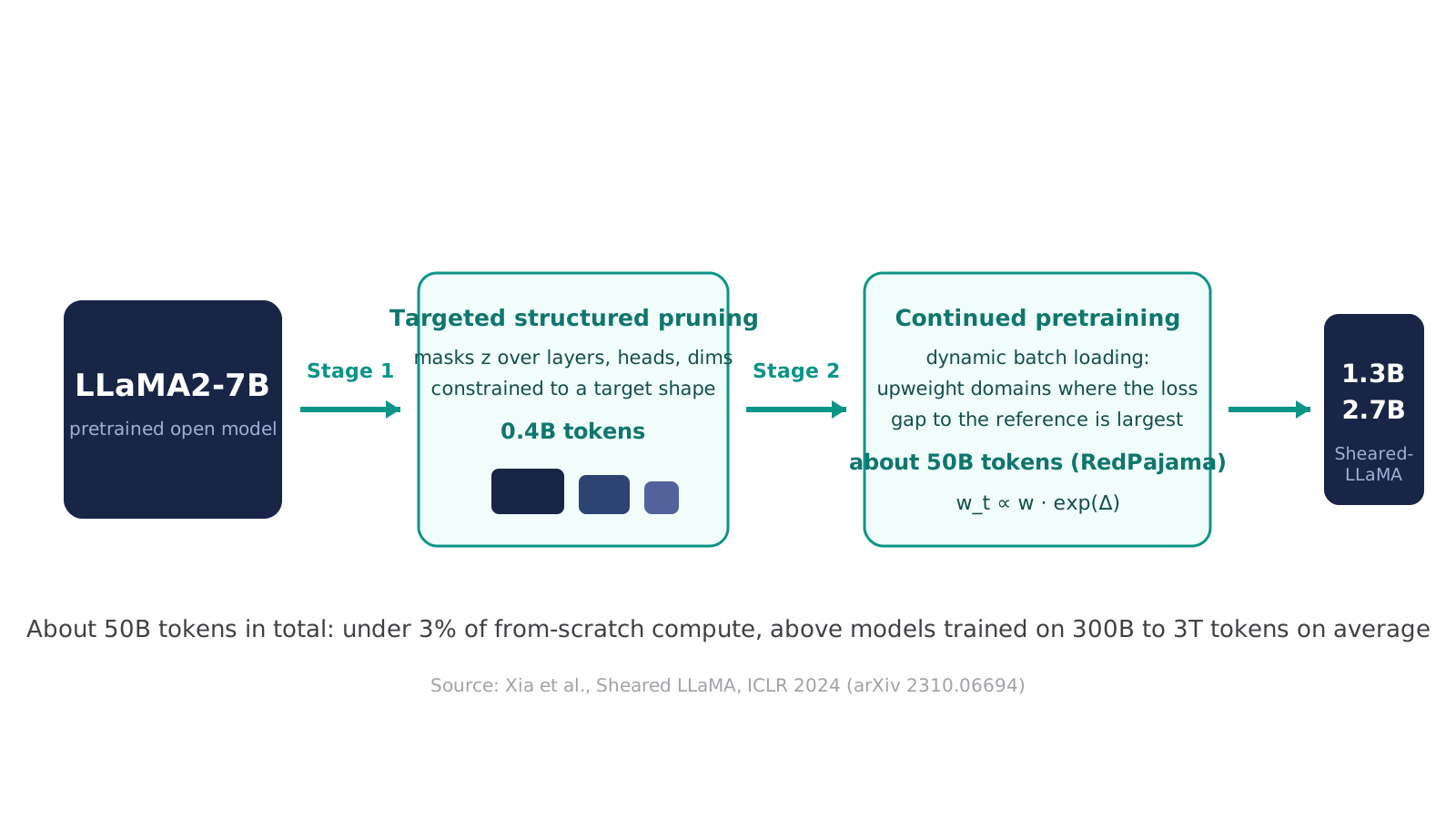
Figure 1. The two stages of Sheared-LLaMA: targeted structured pruning (0.4B tokens) cuts the 7B model to a target architecture, and continued pretraining on about 50B tokens recovers it while dynamic batch loading adjusts domain proportions [1].
What is LLM pruning: targeted structured pruning
LLM pruning shrinks a model by removing structural units: layers, attention heads, hidden dimensions. The variant in Sheared-LLaMA differs in that the model chooses where to cut, while constraints force the result to be exactly the target architecture. A mask marks each structural unit as kept or removed, and the objective minimizes the language-modeling loss of the masked model.
Here is the model weights, the pruning masks over layers, heads, intermediate and hidden dimensions, and , are Lagrangian terms that force the masks to converge to the target shape (Pythia-1.4B's architecture for the 1.3B model, INCITE-Base-3B's for the 2.7B) [1]. Controlling the output shape, rather than cutting into an arbitrary one, means the result inherits an architecture whose inference efficiency is already proven. This stage uses only 0.4B tokens; the authors report that within a fixed budget, more pruning tokens improve the recovered loss, but pruning is computationally expensive per token, so 0.4B is the practical trade-off [1].
Dynamic batch loading: the loss decides what data to feed
A pruned model recovers at different speeds across domains. The authors fit a scaling law to the LLaMA2 series to predict the per-domain loss a model of this size would reach if trained from scratch, take that as the reference , and upweight the domains furthest from it [1]. Every steps the gap for domain is measured and the proportions update.
is the current validation loss on domain , and is the proportion of each domain in upcoming batches, renormalized to sum to one; domains with larger gaps are sampled exponentially more [1]. Feeding RedPajama at fixed proportions recovers domains unevenly and wastes data, and this adjustment lifted downstream performance within the same token budget [1].
Results: 50B tokens beat 300B to 3T
The two models, built with about 50B tokens in total (0.4B pruning plus continued pretraining), surpassed same-size public models on average downstream performance [1]. Copying only the averages from the paper's Table 2:
| Model (training tokens) | Downstream average (%) |
|---|---|
| OPT-1.3B (300B) | 48.2 |
| Pythia-1.4B (300B) | 48.9 |
| TinyLlama-1.1B (3T) | 50.0 |
| Sheared-LLaMA-1.3B (50B) | 51.0 |
| OPT-2.7B (300B) | 51.4 |
| Pythia-2.8B (300B) | 52.5 |
| INCITE-Base-3B (800B) | 54.7 |
| OpenLLaMA-3B-v2 (1T) | 55.7 |
| Sheared-LLaMA-2.7B (50B) | 56.7 |
Table 1. Downstream averages against same-size public models, with training tokens in parentheses. Sheared-LLaMA posts the highest average in both size classes with the fewest tokens [1].
In cost terms, the authors report reaching parity with OpenLLaMA-3B-v2 on 1/32 of its budget, about 3% [1]. On instruction-tuning evaluations the models also won against same-size public models [1]. NVIDIA later carried the recipe into practice with Minitron, combining pruning with knowledge distillation to shrink Llama 3.1 8B to 4B [3].
Are small models enough for AI agents
Being able to build one is separate from it being enough. The position paper from NVIDIA researchers argues that agentic systems decompose complex goals into modular subtasks, and that most of those subtasks are narrow, repetitive and non-conversational, which makes small models sufficient and more economical [2]. On numbers, it cites serving a 7B model as 10 to 30 times cheaper than a 70B to 175B model in latency, energy and FLOPs, and, dissecting three open agents, estimates the share of LLM calls replaceable by small models at about 60% for MetaGPT, 40% for Open Operator and 70% for Cradle [2]. These are author estimates in a position paper, but the direction matches what we saw in the analysis of AI search agent queries: most of what agents actually issue is narrow work, classification, extraction and format conversion.
Stack the two papers and the conclusion follows. If most agent workload sits at small-model level (the capability claim [2]), and owning that small model now costs around 3% of from-scratch training (the cost claim [1]), then a company without its own LLM has a real option to own the models behind its orchestration layer.
Limits
What the papers and this article do not cover comes first.
- The artifacts are 2023-era. The 1.3B and 2.7B models themselves trail later small-model generations trained on tens of trillions of tokens. What survives is the method, not the checkpoints; applying it today means pruning a current open-weight model, and the practical recipe is Minitron [3].
- 50B tokens is not free. Three percent of from-scratch still means multi-billion-token training infrastructure. Against SmolLM2's 11T tokens from scratch it is small, but it is not a laptop job [4].
- The license carries over. Pruning LLaMA2 keeps you inside LLaMA2's license terms. Check the base model license before commercial deployment.
- The reference loss is a scaling-law estimate. Dynamic batch loading relies on a function fitted to the LLaMA2 series to predict a hypothetical small model's loss; if that estimate is off, the reweighting is off [1].
- No direct agent evaluation. Table 2 covers commonsense, reading and knowledge benchmarks; tool calling and structured output sit outside the paper's scope. The position paper's estimates fill that gap for now, so adoption should be measured on your own workload.
In practice: a cost baseline for building an sLLM
What this paper gives practice is a baseline for the build-vs-buy call. Classify every frontier-model call in an agent pipeline and, outside complex generation and coding, most calls are repetitive subtasks: classification, extraction, validation, format conversion [2]. That segment favors an owned small model over an API bill the more ① call volume grows, ② latency matters and ③ the output format narrows. Segments with low volume or long-tail reasoning still favor the API. The pattern we see operating content-generation pipelines is the same: the narrow stages around generation account for most of the calls.
We have seen this asymmetry elsewhere. The world model that teaches a robot from video learns the world from the data-rich side (internet video) and attaches the data-poor side (robot actions) thinly; the pruning route shares that structure, starting from the knowledge-rich side (the trillions of tokens compressed into a 7B model) and bridging to the small architecture with few tokens. The principle that working in a compressed feature space wins also connects to structural feature engineering.
Read next
The practical pruning-plus-distillation procedure is laid out in the Minitron paper [3], and the from-scratch cost baseline is public in SmolLM2 [4]. For what agents actually ask, see the analysis of AI search agent queries; for video understanding in retrieval, see the video RAG paper review.
Frequently asked questions
Do you have to train a small LLM from scratch to own one?
Training from scratch is the exception, not the rule. Sheared-LLaMA prunes the open LLaMA2-7B and continues pretraining on about 50B tokens, then beats same-size models trained from scratch on 300B to 3T tokens on average downstream performance [1]. The cost is under 3% of training the same size from scratch.
What is LLM pruning?
Pruning removes structural units such as layers, attention heads and hidden dimensions from a large model to make a smaller one. Sheared-LLaMA uses targeted structured pruning: it fixes the output architecture in advance and learns masks that converge to exactly that shape, then treats pruning as initialization and spends most compute on continued pretraining [1].
Are small models enough for AI agents?
A position paper from NVIDIA researchers argues most agent subtasks are narrow and repetitive, so small models suffice, estimating that about 60% of MetaGPT's LLM calls, 40% of Open Operator's and 70% of Cradle's could be replaced by small models [2]. It is a position paper with author estimates, not a controlled experiment.
How much does building a small language model cost?
The route changes the cost by orders of magnitude. SmolLM2 1.7B, trained from scratch, used 11T tokens [4]. The pruning plus continued-pretraining route of Sheared-LLaMA finished in about 50B tokens, under 3% of from-scratch compute for the same size [1]. Serving a 7B model is also estimated at 10 to 30 times cheaper than a 70B-class model [2].
References
- [1]Mengzhou Xia, Tianyu Gao, Zhiyuan Zeng, Danqi Chen, "Sheared LLaMA: Accelerating Language Model Pre-training via Structured Pruning", ICLR 2024 (arXiv 2310.06694)
- [2]Peter Belcak et al. (NVIDIA Research), "Small Language Models are the Future of Agentic AI", arXiv 2506.02153 (2025, position paper)
- [3]Sharath Turuvekere Sreenivas et al. (NVIDIA), "LLM Pruning and Distillation in Practice: The Minitron Approach", arXiv 2408.11796 (2024)
- [4]Loubna Ben Allal et al. (Hugging Face), "SmolLM2: When Smol Goes Big, Data-Centric Training of a Small Language Model", arXiv 2502.02737 (2025)
Summary
- Sheared-LLaMA prunes LLaMA2-7B to 1.3B and 2.7B with targeted structured pruning, then continues pretraining on about 50B tokens [1].
- With under 3% of from-scratch compute it beats open models trained on 300B to 3T tokens on average downstream performance [1].
- Dynamic batch loading reweights training domains by their loss gap to a reference, spending the same token budget more efficiently [1].
- An NVIDIA position paper argues most agent subtasks are within small-model reach and more economical, with author-estimated replaceable shares of 40 to 70% [2].
- Together the two papers move the build-vs-buy line: a company without its own LLM can own the small models behind its agents' repetitive subtasks.
Check this topic against your own brand
TRAIL Search measures how ChatGPT and Perplexity answer your customers' questions and finds and fixes where the brand is missing, turning this post into a diagnosis. Start with 10 questions, no card required.
More posts
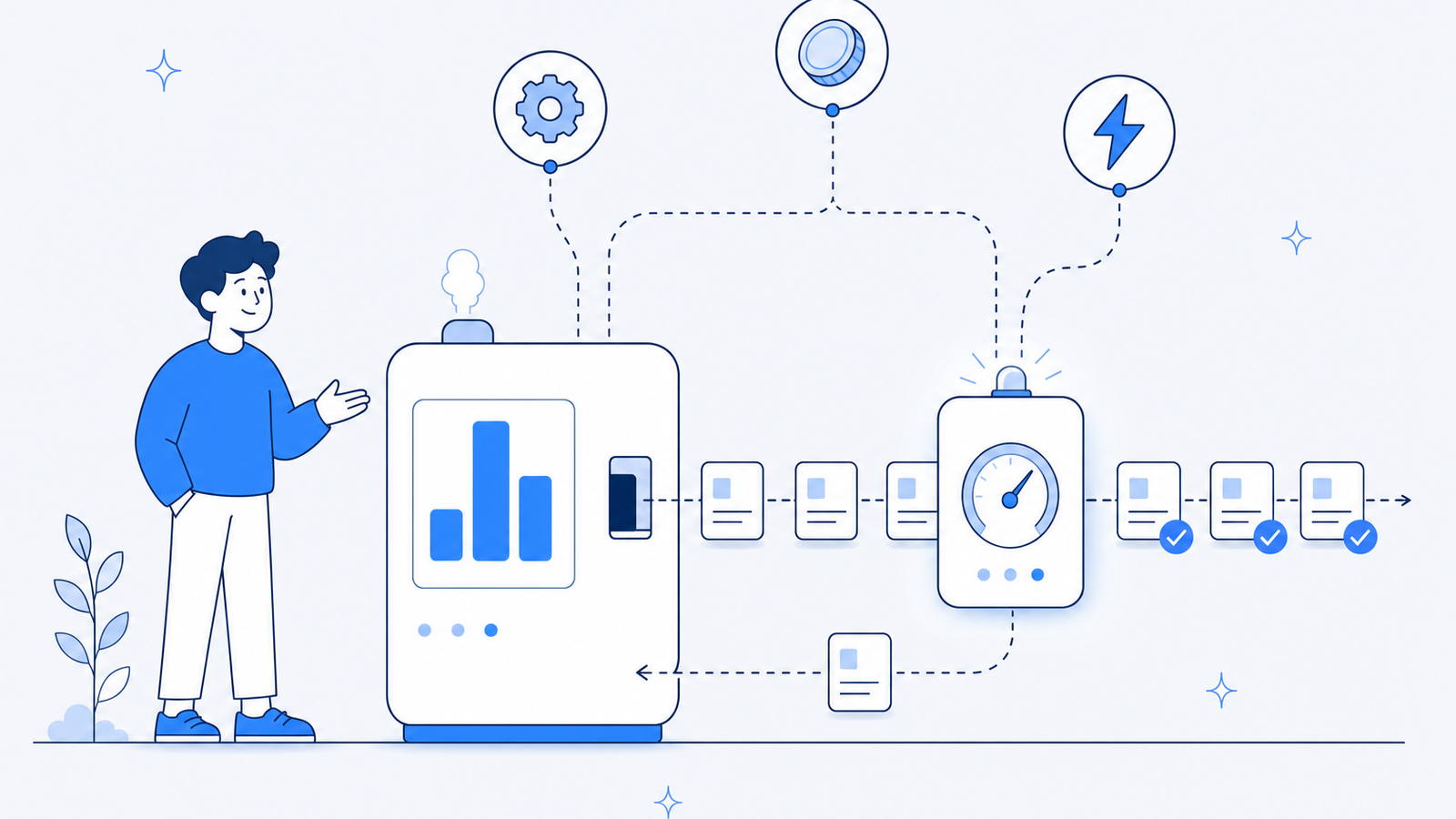
Cutting LLM agent costs: delegate decisions to a 4B model
Cutting LLM agent costs: delegating choices to a small decision model saved 81 to 89 percent, but only with thresholds fitted on the agent's own runs.
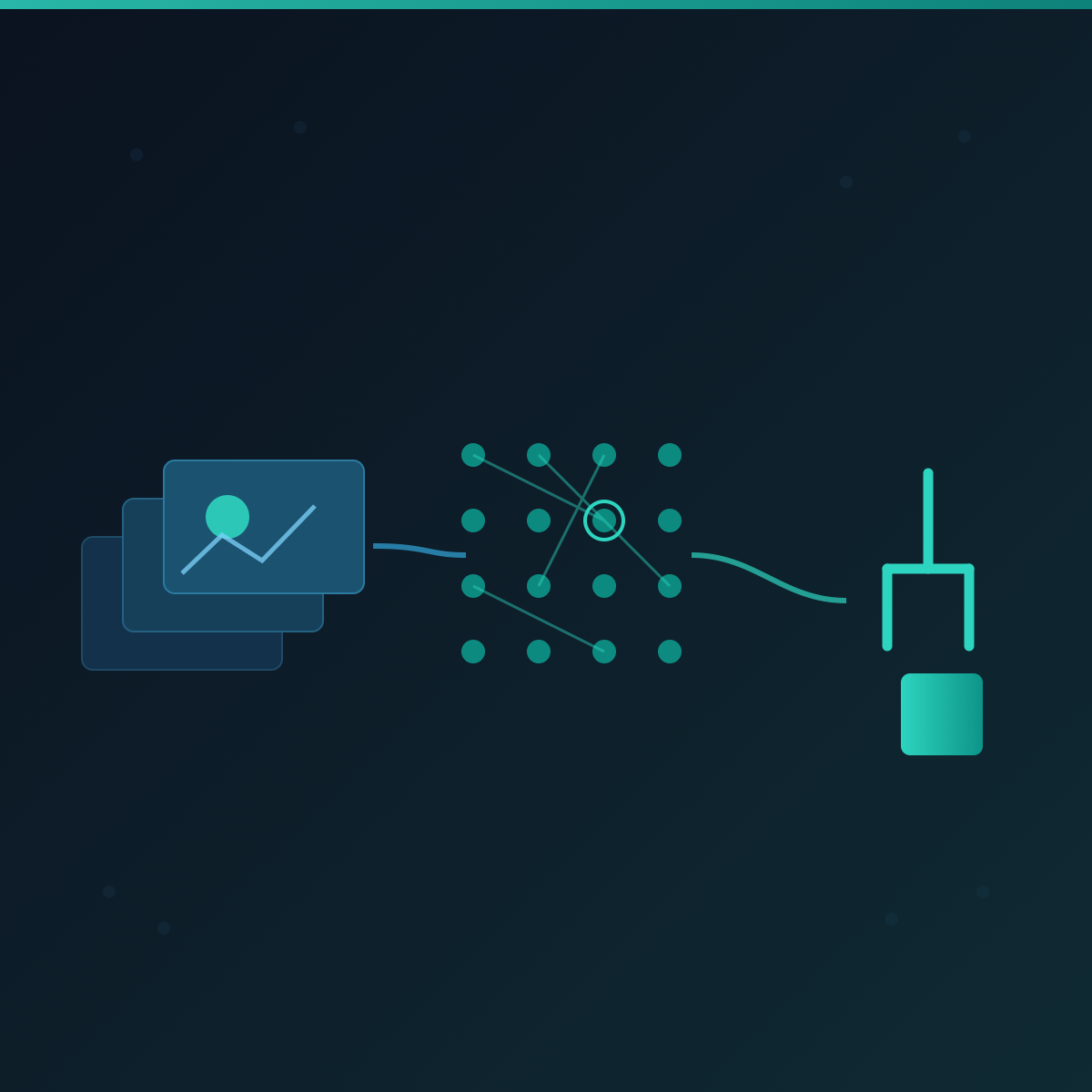
The world model that teaches a robot from video: V-JEPA 2
Whether you can teach a robot from video alone, what an AI world model is, and how it differs from a video generator, read through Meta's V-JEPA 2 paper.
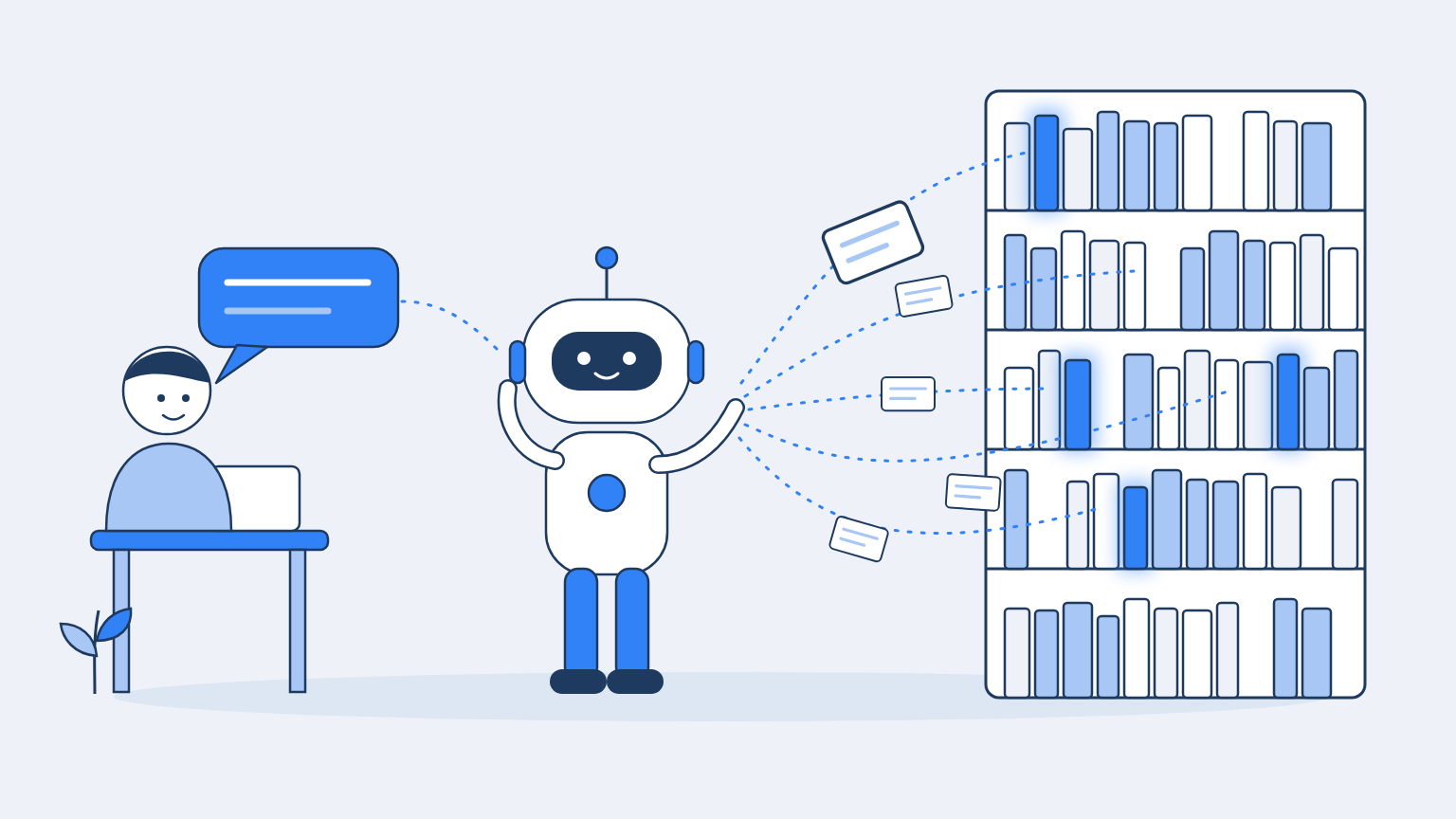
Does AI search use your exact question? 70,000 queries show
How AI search turns a question into queries, why uncited pages are not irrelevant, and what retrievers miss, from Perplexity's Q2D-Web benchmark paper.
Keep reading on this topic
- Is agent memory better than RAG over the raw conversation?A 2026 UIUC study of why agent memory systems trail RAG over raw history, what LLM summaries lose, and how a path back to the source cuts the loss.
- Why RAG misses the evidence an answer needsA 2026 MBZUAI study of why RAG retrieves only part of the evidence multi-fact questions need and how chunking erases document identity.
- Do AI search sources change with the user's location?A 2026 University of Toronto audit of how user location changes the sources ChatGPT and Gemini cite, and which channel each engine reads location from.
This post is part of the Papers category, which collects all 36 posts on the topic. See all posts in Papers