
Which of two pages do AI answers cite? The 4 gatekeepers
Four gatekeepers of competitive citation, found by asking 6 LLMs 252,000 times
What does content need to get cited over a competitor in generative search? A 252K-run study finds four gatekeepers, and ChatGPT and Gemini differ. Sprinklr researchers ran a controlled experiment that asked 6 LLMs 252,000 times across 18 content factors, isolating factor by factor what decides citation when two candidates compete.
Which of two candidate pages an AI answer engine cites is effectively decided by four gatekeepers: topic match, a stated price, a recent timestamp, and a front slot in the context. If even one of them fails, the citation probability approaches zero regardless of the content's other strengths. That is the conclusion of a controlled experiment in which Sprinklr researchers attached 18 content factors, one at a time, to 6 commercial LLMs and asked them 252,000 times [1]. They put only two candidates into the answer context, changed a single factor between them, and isolated, as a per-factor odds ratio, "which of two similar pages wins the citation when they go head to head."
This is a different question from earlier GEO research. The original GEO paper measured how much a single page is reflected in citations within a fixed set of search results [2], but in real AI answers the visibility bottleneck is less about rank and more about winning a citation slot against competitors. This paper reproduces that competition directly.
Why measure "competitive citation" against competitors separately
Traditional SEO optimizes for rank, but RAG-based AI answer engines cite only a subset of the retrieved candidates. That shifts the visibility bottleneck from "how well are you retrieved" to "do you beat competitors for the citation slot."
Prior research had two gaps. First, it measured single-source visibility scores but did not estimate relative preference when two candidates face off directly [2]. Second, production logs mix content effects with search rank, presentation order, and interface elements, so you cannot isolate which content factor caused a citation. This paper solves both at once with a controlled testbed that injects only two candidates, changes one factor at a time, anonymizes brands, and swaps the presentation order.
Two candidates, one factor changed
The core design is "isolate one factor." The researchers picked 100 real review blogs, two per category across 50 B2C product categories, and used GPT-4o to replace brand and publisher names with fictional aliases [1]. The goal was to remove the bias toward brands the models already know from pretraining. They then kept facts, prices, specs, and length the same, built two variants that differed in exactly one factor, placed both candidates side by side in the answer context, and checked which one was cited.
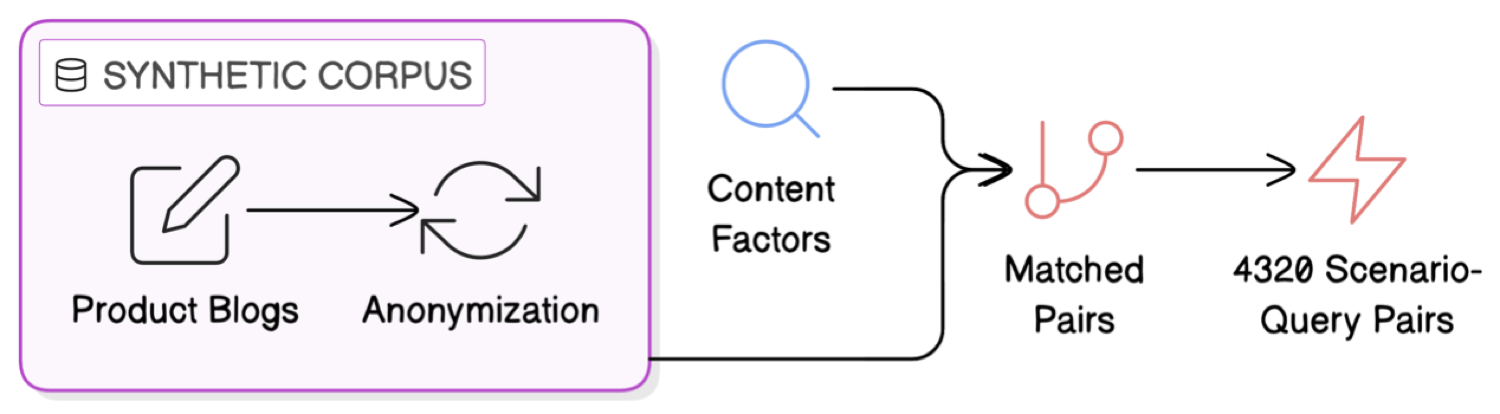
Figure 1. The pipeline: real product blogs are collected into a brand-anonymized synthetic corpus, matched pairs are built for each content factor, and the result is 4,320 scenario-query pairs [1].
The study measures the 18 factors shown in the table, grouped into six categories from content relevance through completeness, credibility, readability, competitive positioning, and recency [1].
| Category | Representative factors |
|---|---|
| Content relevance | Topic mismatch, keyword gap |
| Completeness | Missing price, missing specs, no comparison |
| Credibility | Hedging tone, no evidence, internal contradiction, excessive promotion |
| Readability | Dense paragraphs, scattered information |
| Competitive positioning | Weak value proposition, shallow analysis, weak social proof, rear position |
| Recency | Recent vs. old date, undated vs. old, recent vs. undated |
Table 1. Six categories of the 18 content factors [1].
The run covered 2,400 trials per factor, 42,000 per model, and 252,000 across all six models [1]. Each factor had 80 scenarios, three query phrasings, presentation order flipped both ways, and five repetitions. These controls separate position bias and familiarity bias from content effects. In 86.4% of responses, exactly one URL was cited, and citations that matched neither variant were excluded from the regression [1].
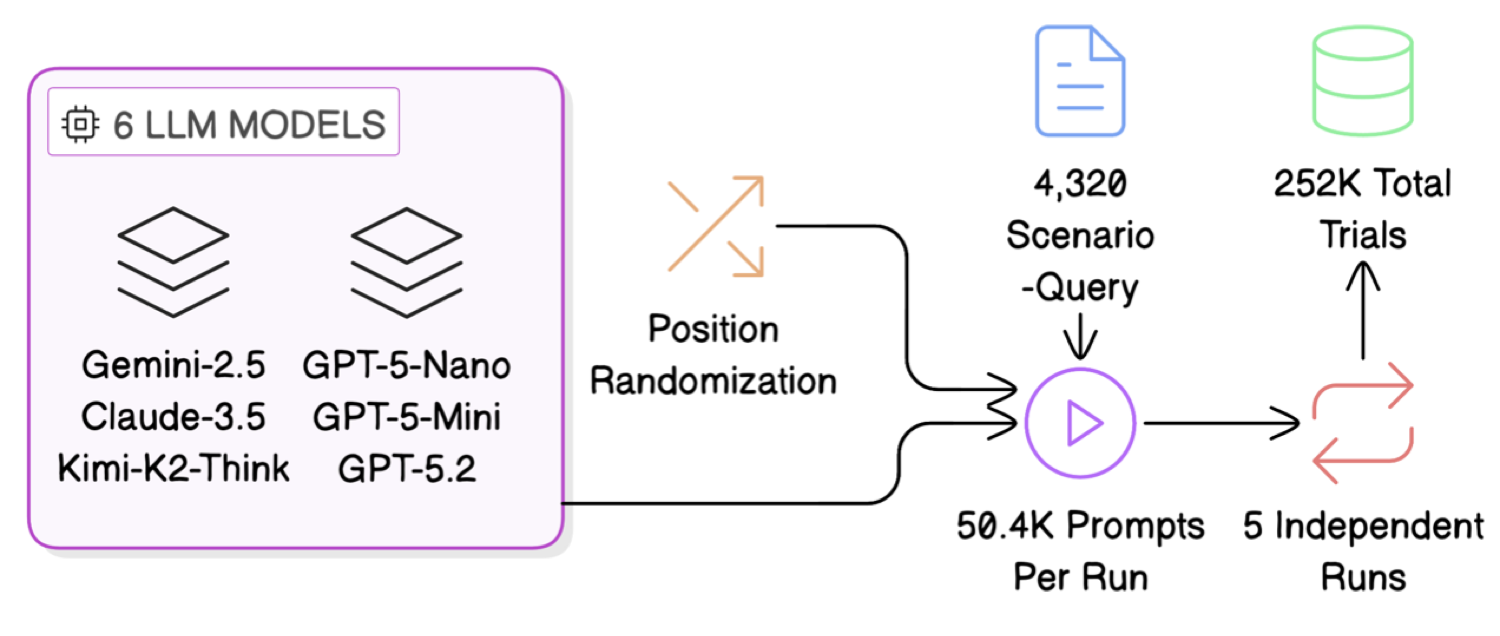
Figure 2. Experiment scale: 4,320 scenario-queries across 6 LLMs with position randomization, 50.4K prompts per run repeated 5 times, 252,000 trials in total [1].
Effect sizes were estimated separately for each factor with a logistic generalized linear mixed model (GLMM).
is the event that the variant favored by the factor (A) is cited, and is whether that factor's treatment is applied. and are random intercepts on the scenario and on the scenario-by-order combination, correcting for the fact that repetitions within the same scenario resemble each other. The final effect is read as the odds ratio : the larger the value, the more overwhelmingly the side with that factor wins the citation. The paper classifies an OR of 100 or more as "very strong" and 10–100 as "strong" [1].
Four gatekeepers: fail topic, price, date, or position and the citation disappears
The paper groups four of the 18 factors as gatekeepers that all six models agreed on: topic match, a stated price, a recent timestamp, and position 1 in the context [1]. Its text says all four exceeded an odds ratio of 100, but in the paper's own Table 2 only topic match and position 1 clear 100 in all six models. A stated price came in at 36.1 for Kimi-K2, 7.82 for GPT-5-Nano, 6.26 for GPT-5-Mini, and 30.4 for GPT-5.2, and a recent timestamp at 68.7 for Kimi-K2 and 14.4 for GPT-5-Nano. All are still far above 1, so the direction holds: the variant with the factor wins the citation. The paper calls these four gatekeepers, because if any one fails, the citation probability effectively vanishes regardless of other content strengths.
| Factor (favored vs. disfavored) | Gemini-2.5 | Claude-3.5 | Kimi-K2 | GPT-5-Nano | GPT-5-Mini | GPT-5.2 |
|---|---|---|---|---|---|---|
| Topic match vs. mismatch | 10,000+ | 10,000+ | 10,000+ | 221 | 10,000+ | 10,000+ |
| Price stated vs. missing | 10,000+ | 10,000+ | 36.1 | 7.82 | 6.26 | 30.4 |
| Recent vs. old date | 10,000+ | 10,000+ | 68.7 | 14.4 | 1,494 | 10,000+ |
| Position 1 vs. 2 | 10,000+ | 10,000+ | 10,000+ | 2,002 | 1,795 | 10,000+ |
Table 2. Citation odds ratios (OR) of the four gatekeepers by model. "10,000+" marks cases where quasi-separation pushed the estimate to an extreme; read these as a decisive advantage rather than a precise multiplier [1].
Two points matter in practice. The first is price. The odds that a page with a stated price beats a page without one ranged from 6.26x to over 10,000x [1]. A page that hides its price behind "contact us" is not just missing information; it can fail a gatekeeper and drop out of citations. The second is position, which here means not the position within the page body but the slot order after the page has been retrieved into the context [3]. In other words, securing a front slot through search visibility and structural signals is a precondition for being cited.
Seven factors that decide the rest, and format that did not matter
Once past the gatekeepers, seven secondary differentiators decided the outcome. They were significant in four or more models, with odds ratios mostly between 2.1 and 243 [1].
| Factor (favored vs. disfavored) | Category | Odds ratio range |
|---|---|---|
| Specs present vs. absent | Completeness | 8.63–243 |
| Deep vs. shallow analysis | Competitive positioning | 3.98–10,000+ |
| Confident vs. hedging tone | Credibility | 2.67–754 |
| Evidence present vs. absent | Credibility | 2.09–10,000+ |
| Strong vs. weak social proof | Competitive positioning | 2.14–10,000+ |
| Query terms included vs. missing | Content relevance | 5.99–40.0 |
| Comparison present vs. absent | Completeness | 1.61–7.45 |
Table 3. Odds ratio ranges by model for the seven secondary differentiators [1].
Format, by contrast, was nearly meaningless. Dense paragraphs vs. organized sections had odds ratios of 0.78–1.68, and scattered vs. consolidated information 1.13–3.87, with no consistent effect across the six models [1]. The paper reads this as evidence that "LLMs parse content regardless of visual organization." This result does not directly conflict with the GEO-SFE study, which optimized structure alone [4]. GEO-SFE dealt with the absolute citation probability of a single page, while this paper looked only at relative preference after two candidates are already in contention, so they operate at different levels. Format is best treated as a lower-priority lever to pull after the gatekeepers are passed.
Recency produced an interesting ordering too. A recent date was most favorable, undated came next, and an old date ranked last [1]. The implication: if you cannot update a date, removing it is better than leaving an old one in place.
Gemini, Claude, and GPT engines use different citation criteria
All six models agreed on the four gatekeepers, but their sensitivity below that diverged [1].
| Model | Share of significant factors | Profile |
|---|---|---|
| Kimi-K2 | 83% | Most sensitive to content signals |
| GPT family | Moderate | Responds gradually to many factors; consistent behavior across the 3 models |
| Claude-3.5 | 50% | Selective |
| Gemini-2.5 | 33% | Most selective; extreme and binary when it does respond |
Table 4. Content-factor sensitivity by model [1].
Claude and Gemini look at only a few factors but respond almost decisively once a factor crosses a threshold, while Kimi and the GPT family respond gradually to more factors. Because GPT-5-Nano, Mini, and 5.2 behaved alike, the paper argues that architecture, more than model size, shapes citation tendencies [1]. If your target engine is Gemini or Claude, the four gatekeepers act like a binary switch, so focus there. If it is the GPT or Kimi family, building up the secondary differentiators as well pays off more.
What this experiment could not see
The paper names three limitations itself [1]. First, it fixed the candidates at exactly two. Real RAG retrieves 5–10 or more, but the authors reduced it to two to isolate a single factor, so these results describe pairwise preference on a controlled slate, not full multi-document competition. Second, it anonymized all brands and publishers, so any residual preference that production systems have for well-known brands or trusted domains is not reflected in this study at all. Third, GPT-4o was involved in seed curation and anonymization, so these results should not be stretched into "the models' overall judgment of writing quality."
The second limitation matters most for practical interpretation. The paper precisely shows "the conditions under which content wins a citation," but by design it cannot answer "which domains are trusted." Brand and domain authority effects need separate evidence, such as the GEO at Scale study that measured 102 brands.
How to apply this to AEO/GEO: check content against the gatekeepers first
The paper gives a checklist with clear priorities. Following the order is the key.
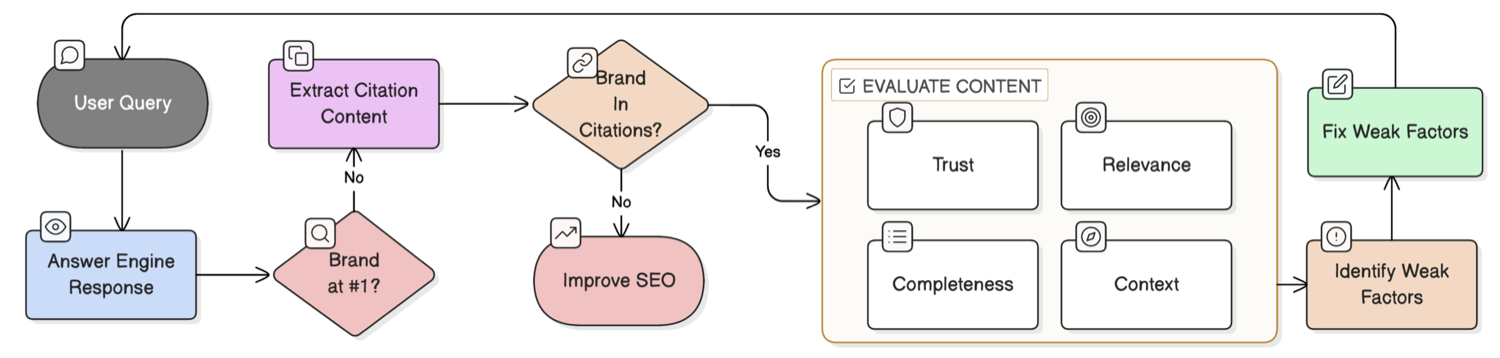
Figure 3. Diagnosis flow when a brand is not recommended first. If it is in the cited set, find and fix weak factors across four categories (credibility, relevance, completeness, context); if it is absent entirely, improve search visibility (SEO) first [1].
- Pass the four gatekeepers first. Topic match, a stated price, a recent timestamp, and a front slot secured through search visibility. However well you do everything else, if one of these four fails, the citation disappears.
- Do not hide prices. A missing price is not just an omission; it is a gatekeeper-level loss. Stating a price, or at least a price range, on product and service pages works in your favor.
- Manage dates. If an old date cannot be updated, removing it is better; if it can, show a recent timestamp.
- Then build completeness and confidence. Adding spec tables and comparisons with competing alternatives, and replacing hedges like "probably" or "it may be" with assertive, evidence-backed statements, raises the odds ratio substantially in secondary differentiation.
- Push format fine-tuning to later. Splitting paragraphs and adding emphasis is finishing work to do after the gatekeepers are passed.
From TRAIL's perspective, this paper exposes a gap in diagnosis frameworks. A stated price and timestamp management are gatekeeper-level signals, yet most GEO checklists so far have not weighted them as heavily as structure or authority signals. It gives grounds to move "is the price visible on the page" and "is the date recent" up to top-priority audit items when diagnosing AI search optimization. Because it isolates citation factors through controlled experiments rather than correlation, reading it alongside GEO-16's correlation-based diagnosis and C-SEO Bench's effectiveness tests gives a much sharper picture of citation optimization.
You can continue with A reward ceiling for RL alignment, computed before training, How often do AI answers name people, and what rosters miss, and How AI product recommendations vary across tools and APIs.
Frequently asked questions
What matters most for getting cited in AI answers?
Four things: topic match, a stated price, a recent timestamp, and a front slot in the context. The paper calls these gatekeepers. Topic match and the front slot exceeded a citation odds ratio (OR) of 100 in all six LLMs, while price and recency ranged from 6.26 to over 10,000 depending on the model. If any one of them fails, the probability of being cited drops to effectively zero regardless of other strengths.
Does leaving the price off a product page hurt you in AI search?
Yes, more than you might expect. The odds that a page with a stated price beats a page without one ranged from 6.26x to over 10,000x depending on the model. A page that hides its price behind "contact us" is not just missing information; it can fail a gatekeeper and drop out of citations.
Do structure and format matter for AI citations?
In this competitive experiment, hardly at all. Format differences such as dense paragraphs vs. organized sections, or scattered vs. consolidated information, had odds ratios near 1 (0.78–3.87) with no statistically consistent effect. Note that this measures relative preference when two candidates are already competing, which is a different level from studies of absolute citation probability.
Do different engines use different citation criteria?
In the details, yes. Kimi-K2 was sensitive enough to content signals to respond to 83% of the 18 factors, while Gemini-2.5 responded to only 33% but reacted in an extreme, binary-switch way when it did. All six models agreed on the four gatekeepers, though, so those can be treated as universal signals across models.
References
- [1]Vishwakarma, Kumar & Jamidar, "What Gets Cited: Competitive GEO in AI Answer Engines", SIGIR 2026
- [2]Aggarwal et al., "GEO: Generative Engine Optimization", KDD 2024
- [3]Liu et al., "Lost in the Middle: How Language Models Use Long Contexts", TACL 2024
- [4]Yu et al., "Structural Feature Engineering for Generative Engine Optimization", arXiv 2026
Summary
- Sprinklr researchers ran a controlled experiment that asked 6 LLMs 252,000 times across 18 content factors, isolating factor by factor what decides citation when two candidates compete.
- Topic match, a stated price, a recent date, and a front slot are the four gatekeepers: topic and position cleared an odds ratio of 100 in all six models, price and recency ranged from 6.26 to over 10,000 by model, and failing just one made the citation disappear.
- Spec and comparison completeness, confident tone, and supporting evidence were secondary differentiators with odds ratios of 2.1–243, and they only mattered after the gatekeepers were passed.
- Format, such as paragraph density or information layout, was nearly meaningless statistically in this competitive design.
- Missing prices and timestamp management are cost-effective levers that GEO checklists have so far underrated.
Check this topic against your own brand
TRAIL Search measures how ChatGPT and Perplexity answer your customers' questions and finds and fixes where the brand is missing, turning this post into a diagnosis. Start with 10 questions, no card required.
More posts

Cutting LLM agent costs: delegate decisions to a 4B model
Cutting LLM agent costs: delegating choices to a small decision model saved 81 to 89 percent, but only with thresholds fitted on the agent's own runs.

How to build a small LLM: Sheared-LLaMA's 3% compute path
How to build a small LLM, what LLM pruning is, whether small models are enough for AI agents, and the cost of building one, read through Sheared-LLaMA.

The world model that teaches a robot from video: V-JEPA 2
Whether you can teach a robot from video alone, what an AI world model is, and how it differs from a video generator, read through Meta's V-JEPA 2 paper.
Keep reading on this topic
- Does AI search use your exact question? 70,000 queries showHow AI search turns a question into queries, why uncited pages are not irrelevant, and what retrievers miss, from Perplexity's Q2D-Web benchmark paper.
- Is agent memory better than RAG over the raw conversation?A 2026 UIUC study of why agent memory systems trail RAG over raw history, what LLM summaries lose, and how a path back to the source cuts the loss.
- Why RAG misses the evidence an answer needsA 2026 MBZUAI study of why RAG retrieves only part of the evidence multi-fact questions need and how chunking erases document identity.
This post is part of the Papers category, which collects all 36 posts on the topic. See all posts in Papers