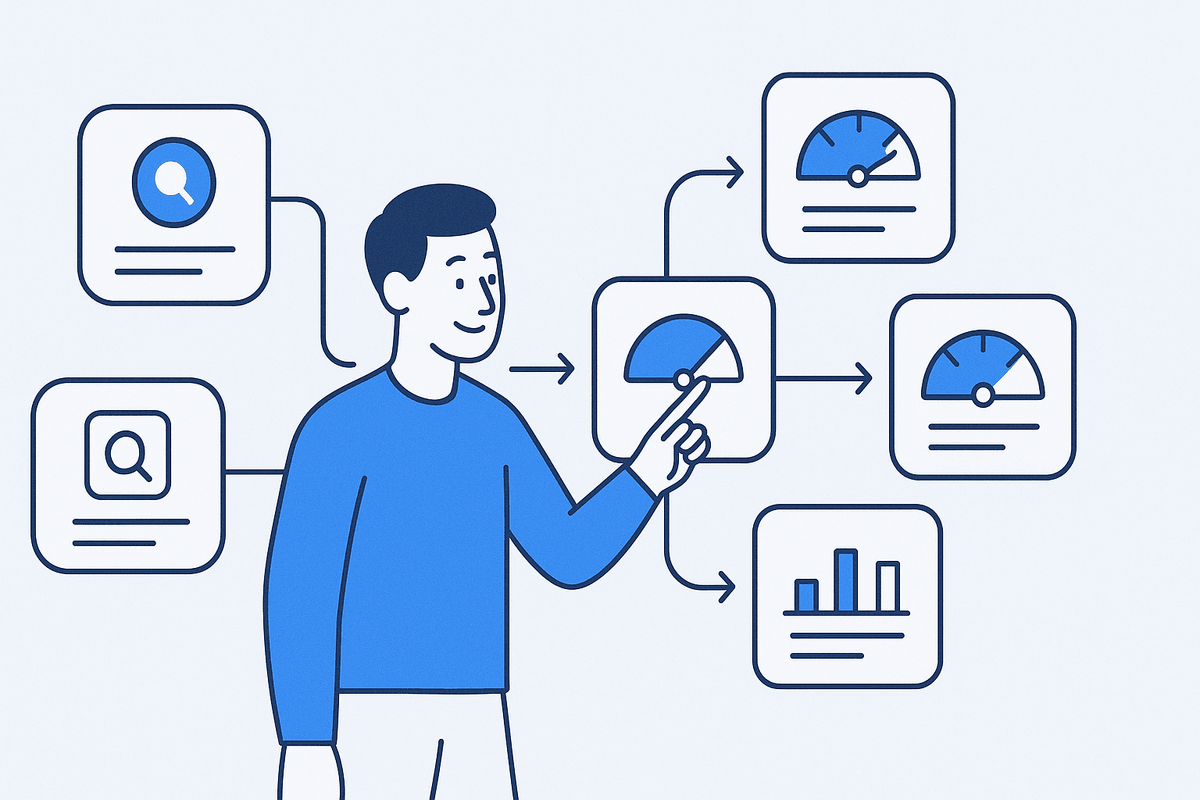
One AI visibility score is risky: ChatGPT isn't Perplexity
If you show up in ChatGPT, can you say you show up in Perplexity and Google AI Overviews too?
Break AI search reports down by engine before trusting one score. ChatGPT visibility isn't Perplexity. Split it into Presence, Portability, Concentration.
Just because your brand shows up in ChatGPT doesn't mean you can say it shows up in Perplexity and Google AI Overviews. A single number like AI Visibility: 72 is easy on the eyes, but on its own it hides the important questions: which engine you show up in, which URLs get cited, whether those URLs keep surviving in other engines, and whether you're overly dependent on a single engine. In the age of AI search, reporting should break results down by engine before it gives you a single score.
AI Visibility is no longer just "visible or not"
In traditional SEO, one Google ranking was the center of practical work. A rising rank was a good sign; a falling one was a problem. AI search is different. A user can ask ChatGPT with the same intent, search on Perplexity, or read an AI Overview in Google Search. On the surface they all look similar in that "AI gives the answer," but the URLs those answers draw on may not be the same.
A brand might appear in ChatGPT answers but be missing from Perplexity citations. Or it might be cited often in Perplexity but barely visible in Google AI Overviews. So the question needs to change. Before asking "what's our AI Visibility score?", ask "in which engines, for which questions, and through which URLs are we showing up?"
Why a single score is risky
A single score is convenient. It's easy to report to the CEO and easy to read at a glance on a dashboard. Saying "we went from 58 last month to 71 this month" sounds like a win. The problem is that if you don't know where that score came from, it can give you false comfort.
Say a brand's AI Visibility is 70. On the surface, that's not bad. But what if, when you break it down, it shows up a lot only in ChatGPT and barely at all in Perplexity and Google AI Overviews? That brand may not be "strong in AI search" but "tied to one specific engine."
There's another case too. Total citations might be high, but most of the cited URLs could be concentrated on one or two external review pages. The brand's official pages, product comparison pages, and customer case studies may barely be cited. In that case the single score looks good, but practitioners struggle to set the next action. The score alone can't tell you whether to fix the official pages, create comparison content, strengthen external review signals, or close the gap in a specific engine first.
This problem also feeds a common misunderstanding inside marketing organizations. While the CEO is satisfied with a report that "AI Visibility went up," the practitioners often don't know where that rise came from and can't plan the next quarter. A score is useful for reporting, but it carries too little information to base an execution plan on. If you don't separate those two uses, managing the score and actually improving visibility can easily drift in different directions.
What real data signals
Kevin Indig used Omnia data to analyze how much the cited URLs of ChatGPT, Perplexity, and Google AI Overviews overlap. After analyzing 20,000 prompts and 3.7 million citations, he found that even for the same prompt, the URLs the three engines cited barely overlapped. Only 2.37% overlapped across all three engines, and 91% of citations appeared in exactly one engine[1].
That's a very strong signal. Still, you shouldn't apply this result as-is to every industry and every language. It's an analysis based on one data source's customer base, and it may be biased by regional and industry mix. Korean-language markets and domestic B2B queries need to be checked separately. Even so, the practical principle holds: rather than mashing AI Visibility into one combined score, look at it engine by engine.
The result is surprising because many teams implicitly assume that "AI search engines all learn from a similar web and give similar answers in the end." In reality, each engine uses different search tools, different indexes, and different answer policies, so it can pick completely different sources for the same question. Breaking that assumption is where engine-by-engine reporting starts.
Split the report into three signals
An AI Visibility report should answer at least three questions.
Presence: are we visible? Check whether your brand, domain, or URL appeared at least once for a given period and prompt set. The key is not to look only at overall Presence. Split it by engine: ChatGPT Presence, Perplexity Presence, Google AI Overviews Presence, and Presence by prompt cluster.
Portability: which assets carry across engines? This metric shows which URLs are cited in only one engine and which keep surviving in two or more. In AI search, a good asset isn't simply a URL that gets cited a lot. It's a URL that passes the different selection criteria of multiple engines. URLs that survive in two or more engines are candidates to expand; URLs with high citation counts that are stuck in one engine are candidates to reinforce.
Concentration: where are we overdependent? If one engine accounts for an excessively high share of total citations, the brand's AI Visibility may not be stable. For example, if most of your citations come from one engine, AI Visibility may look high on the surface, but if that engine changes its answer policy or how it picks sources, your overall results can swing sharply.
| Axis | Core question | What to check |
|---|---|---|
| Presence | Are we visible? | Whether you appear, by engine and question group |
| Portability | Which assets carry across multiple engines? | URLs repeatedly cited in 2 or more engines |
| Concentration | Are we overdependent on one engine? | Distribution of citation share by engine |
Order matters when you first adopt the three axes. A natural sequence is to check Presence first and fill the "question groups where we don't show up at all," then use Portability to find and expand "assets that already work," and finally use Concentration to check for "the risk of leaning too far one way." Trying to look at all three axes at once can actually be confusing at first.
Korean B2B needs extra care
In the Korean B2B market, this problem is likely to get more complex. Global SaaS and English-language content have relatively plenty of public material across AI search ecosystems. Korean B2B brands, by contrast, have relatively little public material, and their search surfaces are more fragmented.
For questions like "recommend a domestic CRM" or "recommend a semiconductor equipment maintenance company," each engine may choose different sources. One engine may lean on global comparison material or long-accumulated English-language material, while another may more often attach recent blog posts or review pages. Another may give more weight to well-structured official documents within its index. Add domestic search surfaces and it gets more complicated still. Blogs, news, industry association material, and customer case studies can each play a different role.
Korean B2B brands especially need the following distinctions: whether an official page exists, whether the brand is mentioned in AI answers, whether it's adopted as an evidence URL in AI answers, in which engines it's adopted, whether owned sources or earned external sources are working, and whether the same pattern repeats on domestic search surfaces. Without these distinctions, it's easy to drift into the vague conclusion of "let's write more content."
Industries with less public material in particular tend to show greater Concentration risk. Because there's so little material to draw on, several engines can end up depending on the same one or two documents by chance, and if those documents disappear or lose credibility as they age, visibility can wobble across multiple engines at once. In industries like this, a strategy of deliberately increasing Portability becomes more important: making the same core information repeatedly accessible in multiple formats and across multiple channels.
What practitioners should check today
You don't need to build a complex model from the start. Checking just these three things first can change your direction.
- Separate cited URLs by engine. Don't just look at total citations; split the URLs by ChatGPT, Perplexity, and Google AI Overviews.
- Look by prompt cluster. Brand-name questions and comparison questions are different. Pricing, alternatives, and local questions differ too, so looking only at the overall average can hide a question group where you're completely missing.
- Find gaps you can act on. If official documents are weak in Google AI Overviews, look at your own page structure; if external reviews are stronger in Perplexity, look at securing external sources and how often they're updated.
A good report doesn't end at "here's your score." It has to go as far as "this URL type is missing for this question group in this engine, so here's the next action." The basic principle of creating useful, verifiable content for users works in any engine[2][3].
Once you've checked these three things for the first time, the questions your team asks start to change. Instead of "why isn't our AI Visibility going up?", you start hearing specific questions like "why isn't a single one of our official pages picked up in Perplexity?" That shift is the real purpose of a report. It's not about managing a score; it's about helping the team ask the right questions and fix the right places.
AI search optimization can no longer be solved with "just write more posts." You need to see which engine picks which URL as evidence for which question, and why. You can start by using TRAIL Search to check your brand's Presence, Portability, and Concentration engine by engine. The starting point is a breakdown by engine, not a single score.
For related reading, see One AVI score isn't enough: breaking down mention rate, source rate, citation rate, and ghost citations, What is an AVI score? A guide to brand visibility metrics in the age of AI search, and An AI search measurement framework: GSC, GA4, and prompt tracking as weekly and monthly routines.
You can continue with Can Search Console's AI report alone measure GEO?, Why channel ROI shouldn't be one number: Bayesian MMM, and Reading AI crawler logs: do more GPTBot visits help?.
Frequently asked questions
Should we stop using a single AVI score altogether?
No. It's still useful for a one-line report to the CEO or leadership. But if you don't know where the score came from, it can give you false comfort. In day-to-day operations, you should also break the score down by engine and by question group.
Can we make our brand equally visible in every engine?
Realistically, that's hard. Real data shows the share of URLs cited by several engines at once is very low, and most citations appear in exactly one engine. Rather than aiming for perfectly even visibility, it's more realistic to find which assets carry across engines and expand those first.
Is it always a problem if citations are concentrated in one engine?
Not right away, but it's a risk signal. If that engine changes its answer policy or how it picks sources, your overall results can swing sharply. Look not only at whether you have results but at whether those results are tied to a single platform.
References
Summary
- Even for the same question, the URLs cited by ChatGPT, Perplexity, and Google AI Overviews mostly don't overlap. In a real analysis, the share overlapping across all three engines was very low, and most citations appeared in exactly one engine.
- A single AVI score is useful for leadership reporting, but if you don't know whether it's skewed toward one engine, you can set the wrong execution priorities.
- An AI Visibility report should be split along three axes: Presence (are we visible?), Portability (do we carry across engines?), and Concentration (are we overdependent on one engine?).
- In the Korean B2B market, public material is relatively scarce and search surfaces are fragmented, so breaking results down by engine matters even more.
Check this topic against your own brand
TRAIL Search measures how ChatGPT and Perplexity answer your customers' questions and finds and fixes where the brand is missing, turning this post into a diagnosis. Start with 10 questions, no card required.
The feature closest to this post is Brand visibility tracking.
More posts
Getting cited when Google AI Mode builds the answer
In November 2025 Google put Gemini 3 in AI Mode to build custom layouts and tools per query while keeping links to web sources. Here is what gets cited.
How is AI answer visibility defined and measured?
How is AI answer visibility defined and measured? Three metrics with formulas and paper figures: visibility (GEO), contribution (Shapley), and stability.
The prompt you track is not the query AI actually searched
AI visibility reports score each tracked prompt, but retrieval and citation happen on fan-out sub-queries. What year and English injection mean for measurement.
Keep reading on this topic
- Which content types AI cites, by search intentThe content type AI search cites flips with intent: articles lead informational prompts (45.5%), listicles lead commercial ones (40.9%).
- How are retrieval and citation different in AI search?Retrieval and citation are different stages in AI search. Does ChatGPT cite YouTube? Why our content is missing from AI answers, and what zero citations mean.
- The LLMO trap: training data vs. AI answer citationsSeeding your brand in LLM training data and getting cited in AI answers are different mechanisms. How they differ, what you can measure, and why advice splits.
This post is part of the Analysis category, which collects all 35 posts on the topic. See all posts in Analysis