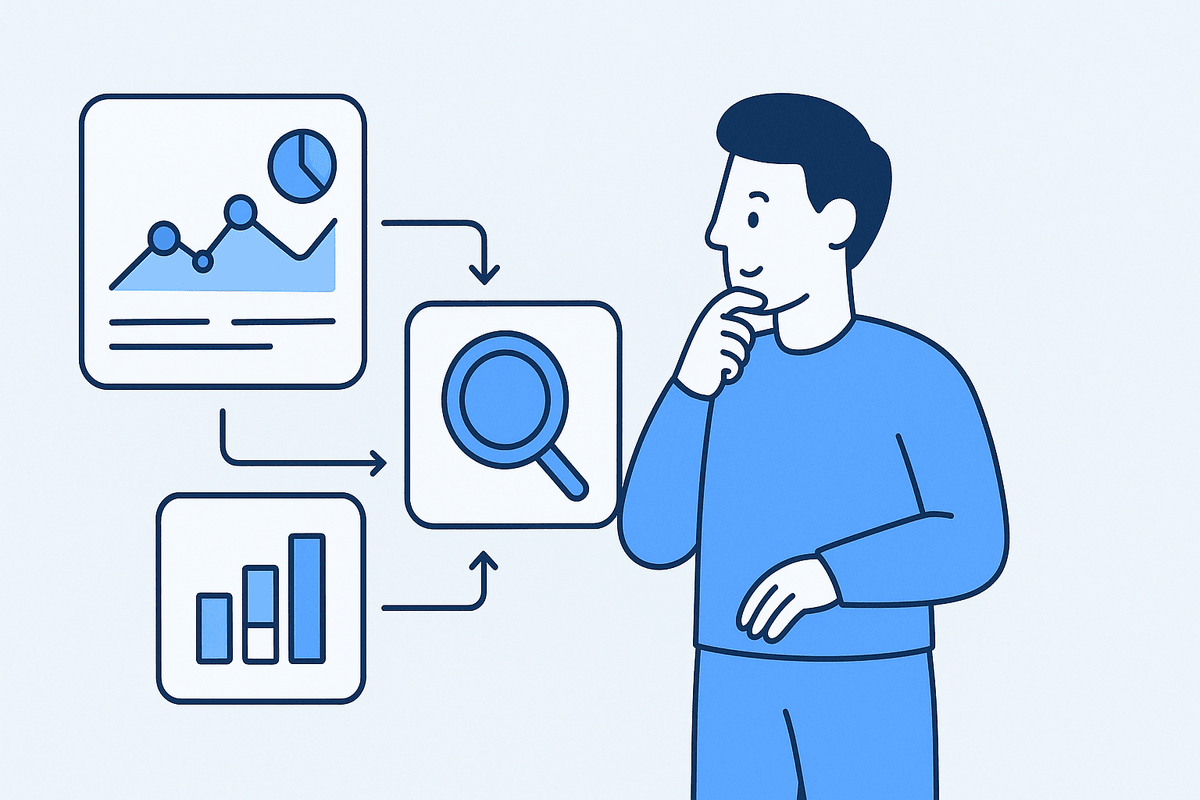
Can Search Console's AI report alone measure GEO?
Impressions are starting to show, but clicks, query context, and citation position are still blank
Search Console's AI report is a starting point for GEO measurement, not a finished dashboard. What it shows, what's missing, and how Korean sites can start.
It's a welcome sign that Search Console has started including AI search visibility data in its reports, but it's risky to assume this lets you see GEO performance in full. At this stage, the first signal you can expect is "did our link appear inside the AI search experience?" Signals practitioners need for decisions, such as clicks, query context, and where you were cited inside the answer, are still not visible enough. The key point of this change is that it's a starting line, not a finished measurement system.
For a long time, measuring search performance was fairly simple. A user searched, our page appeared on the results page, and we checked whether a click happened. In that flow, Search Console was the basic ledger showing impressions, clicks, click-through rate, and average position[1]. AI search shakes up this structure. Users read an AI-generated answer before looking at a list of links, and sometimes the sources are easy to see while other times they aren't.
Why this change matters
If you only look at existing SEO reports, these questions remain.
- Did our content appear inside an AI answer?
- If so, on what topics?
- Did the user stop at the answer, or click through to a source?
- Was the source link in a clickable position?
- Were we cited alongside competitor content?
Search Console's AI-related report matters because it has started bringing some of these questions into an official tool[3]. But reading too much into it at this stage can lead to bad decisions.
4 signals that are still missing
1. Clicks
A source showing up in an AI answer doesn't mean the user came to your site. In AI search, the answer itself can satisfy the user's goal, so the gap between impressions and clicks can be wider than in traditional search. That means clicks may not rise even as AI search impressions do, and that isn't necessarily a failure. It can actually help build brand awareness and trust. The problem is that current tools alone make it hard to tell those cases apart.
2. Query context
Practitioners need to know "which questions our content appeared for" in order to fix it. The bare fact that you appeared leaves the next action unclear. Appearing for a "brand name question," a "category comparison question," or a "pre-purchase check question" means completely different things. GEO has to redesign content based on this query context.
3. Answer context
What role your content played inside the AI answer also matters. The reading changes depending on whether you were the main source, a supporting source, or listed alongside competitors. Even as the official report starts showing impressions, if answer context isn't visible, you need to run separate observation and sampling alongside it.
4. Citation position
Where a source sits in an AI answer affects how likely it is to be clicked and how trustworthy it seems. A source visible at the top and one tucked inside a collapsed section are hard to count as the same impression. For GEO measurement to be more practical, it has to look beyond whether you appeared at all, to your position and visibility inside the answer.
What official documentation confirms vs. what needs extra observation
| Category | What's confirmed | Safe wording |
|---|---|---|
| Official report signal | The trend of search engines starting to count AI search impressions separately | It is becoming possible to see trends in link impressions inside AI search experiences |
| Counting conditions | A structure that opens up gradually, starting with some sites and properties | Don't assume it's available on every site right away |
| Unconfirmed areas | Detailed metrics for clicks, queries, answer context, and competitor comparison | Don't write unconfirmed areas as if they were conclusions |
Practitioner checklist
1. Observe first
Check whether AI search filters or reports are visible inside Search Console. If they aren't, that is your current state. There's no need to force results.
2. Separate existing search performance from AI search observation
Don't judge AI answer visibility by existing click and impression numbers alone. You need separate sampling to see which questions your content actually appears for in AI search. A realistic approach is to set 10–20 target prompts and periodically enter them directly into ChatGPT, Perplexity, and Google AI Overviews.
3. Rework content into a "structure that's easy to use in answers"
AI answers favor clear definitions, decision criteria, procedures, comparison tables, and exception conditions over vague promotional sentences[4]. Building evidence blocks that can be used directly to answer a question matters more than making content longer.
4. Strengthen brand and source trust
Even if you're cited, results are harder to interpret if the brand isn't visible. You need to organize author, company information, evidence links, update dates, and context on expertise.
5. Look at impressions and clicks separately
In AI search, more impressions may not lead directly to more clicks. Reports should separate "did we appear inside the AI answer?" from "did a site visit follow?"
Controlling visibility and limiting training are different problems
One concept often gets mixed up when people talk about GEO measurement. "How content appears in AI search features" and "whether our content is used to train AI models" are completely different problems. The first is about visibility in search results and AI answer screens. The second is closer to a separate control signal (mainly per-crawler allow and block settings in robots.txt) about whether crawlers collect content and use it for model training.
In practical terms, the two break down like this.
| Category | What it covers | Where to check or set it |
|---|---|---|
| AI search visibility control | How content appears in search results and AI answer screens | Search Console, snippet-related meta settings |
| AI training use limits | Whether crawlers collect content and use it for model training | Per-crawler allow and block rules in robots.txt |
| SEO and GEO operations | On what evidence content is selected in search and AI answers | Content structure, structured data, prompt tracking |
Miss this distinction and you'll make one of two mistakes. You either unblock crawlers to increase visibility and unintentionally widen how your content is used for training, or you try to block training use and end up reducing search visibility too. Before changing settings, it's important to be clear about whether the problem you're solving is "visibility" or "training use."
Turning GEO measurement into an operating loop
Rather than measuring once and stopping, it's realistic to turn the following sequence into a repeatable routine.
- Check your existing SEO state first
- Sample the sets of questions you appear for in AI search
- Record your content's role inside the answers
- Compare against the AI impression signals coming into Search Console
- Even without clicks, look at brand visibility and source visibility separately
- Rework content structure around definitions, comparisons, procedures, and decision criteria
This is how you connect the newly opened AI report to an actual content improvement loop instead of treating it as just a new menu. Manual sampling takes a lot of work, so automating this loop with a prompt tracking tool like TRAIL Search can reduce the burden of someone typing in questions by hand every week.
What Korean site owners can do now
For sites in Korea, it's safer not to assume "we can see AI-related reports in Search Console right away." Coverage may be limited, and the timing may differ by property. There's no reason to put off GEO because the report isn't visible yet. If anything, now, before an official report exists, is the time to build a manual observation routine first.
- List 20–30 questions that come up often in your industry, and enter the same questions in the same order into AI search engines every week.
- Record in a spreadsheet whether your brand appeared in the answer, what sentence described it, and whether it was mentioned alongside competitors.
- Put this next to Search Console click and impression trends for the same period, and check whether the two move together or separately.
- If you build this routine up for 3 months or more, you'll already have a baseline to compare against when the official AI report opens up more widely.
Conclusion
Search Console's AI-related report is a sign that the door to GEO measurement is starting to open. But it isn't yet a tool that gives practitioners every answer they want. Two attitudes matter at this stage. One is not to exaggerate. Coverage, click data, query context, and answer position still need careful checking. The other is not to just wait. If AI search visibility is starting to enter official reports, the teams that change their content structure and measurement methods early will learn first.
GEO isn't about abandoning SEO. It's about adding AI answer visibility, source visibility, question context, and brand trust on top of SEO[2]. The change in Search Console is the first sign that this process is now entering measurable territory.
You can find related reading in Competitor SEO and GEO analysis in 8 steps: reverse-engineering why competitors get cited in AI answers, Why looking at AI visibility as a single score is risky: ChatGPT and Perplexity are different, and One AVI score isn't enough: breaking out mention rate, source rate, citation rate, and ghost citations.
Frequently asked questions
What should I do if I don't see an AI-related report in Search Console?
If the official report isn't visible yet, that is your current state. There's no need to force results. Instead, you can start observing through manual sampling: pick target prompts and enter them directly into AI search engines.
My AI impressions went up but clicks stayed flat. Is that a failure?
Not necessarily. In AI search, the answer itself can satisfy the user's goal, so the gap between impressions and clicks can be wider than in traditional search. Even without more clicks, it can help build brand awareness and trust, so it's right to look at impressions and clicks separately.
Can I combine existing SEO reports and GEO observations in one table?
We recommend not mixing them. They use different counting conditions and interpretation criteria, so combining them in one table makes it hard to tell which side caused a change. It's safer to look at the same period but record them in separate sections.
References
Summary
- Search Console starting to fold AI search visibility signals into its reports is the starting line for GEO measurement, not a finished dashboard.
- The first signal you can expect right now is impressions; signals such as clicks, query context, and position within the answer still need separate observation.
- A GEO report is accurate only if it covers existing SEO performance and AI search observations over the same period but records them separately.
- You need a routine of restructuring content around definitions, comparisons, procedures, and decision criteria, and looking at impressions and clicks separately.
Check this topic against your own brand
TRAIL Search measures how ChatGPT and Perplexity answer your customers' questions and finds and fixes where the brand is missing, turning this post into a diagnosis. Start with 10 questions, no card required.
More posts
Getting cited when Google AI Mode builds the answer
In November 2025 Google put Gemini 3 in AI Mode to build custom layouts and tools per query while keeping links to web sources. Here is what gets cited.
How is AI answer visibility defined and measured?
How is AI answer visibility defined and measured? Three metrics with formulas and paper figures: visibility (GEO), contribution (Shapley), and stability.
The prompt you track is not the query AI actually searched
AI visibility reports score each tracked prompt, but retrieval and citation happen on fan-out sub-queries. What year and English injection mean for measurement.
Keep reading on this topic
- Which content types AI cites, by search intentThe content type AI search cites flips with intent: articles lead informational prompts (45.5%), listicles lead commercial ones (40.9%).
- How are retrieval and citation different in AI search?Retrieval and citation are different stages in AI search. Does ChatGPT cite YouTube? Why our content is missing from AI answers, and what zero citations mean.
- The LLMO trap: training data vs. AI answer citationsSeeding your brand in LLM training data and getting cited in AI answers are different mechanisms. How they differ, what you can measure, and why advice splits.
This post is part of the Analysis category, which collects all 35 posts on the topic. See all posts in Analysis