What Is an AVI Score? Brand Visibility in AI Search
How to put a number on the odds that AI mentions you, not another brand
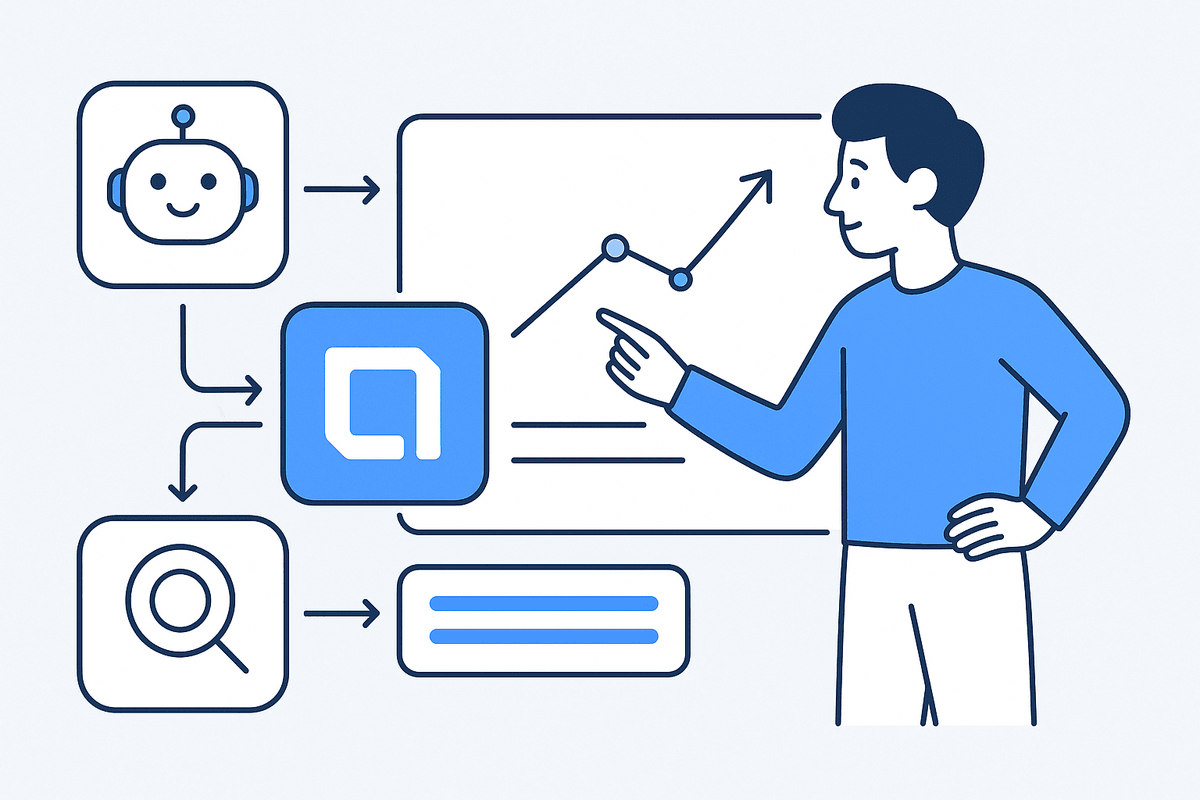
AVI is a visibility metric that shows how often and how prominently AI mentions your brand for specific prompts. AVI (AI Visibility Index) is a visibility metric that combines how often and how prominently AI mentions a brand for specific prompts.
AVI (AI Visibility Index) is a composite score of how often, and how prominently, generative search engines like ChatGPT, Perplexity, Gemini, and Google AI Overviews mention your brand when answering specific questions. If search rankings showed "which link position you're in," AVI shows "how much AI trusts you enough to include you when building an answer." It's a completely different game from rankings.
This is where the first confusion hits traditional SEO practitioners. It's common for a page to rank first in search results, yet when you ask ChatGPT the same question, the brand is never mentioned once. Conversely, some brands sit mid-pack in search rankings yet consistently appear in AI answers. Without a metric that explains this gap, GEO work has to be done on gut feeling, and AVI emerged as a concept to fill that gap.
Why you need AVI
Traditional web analytics tools measure what happens "after users arrive" at your site, like clicks, traffic, and conversions. But in AI search, more and more users finish their decision just by seeing a brand name in an AI answer, without ever visiting your site. If you can't measure this "before arrival" stage, the moment AI builds its answer and decides whether you're a candidate or not, the front of your marketing funnel becomes one big black box. AVI is an attempt to open up exactly this black box with a number.
The three components of AVI
AVI looks like a single number, but it's actually a composite of several signals. In practice, it usually combines these three axes.
- Mention frequency: The share of your target prompt set in which your brand appears in the answer.
- Mention position and context: The weight differs depending on whether you're mentioned as a recommendation near the start of the answer or as an "other alternative" toward the end.
- Relative share versus competing brands: For the same questions, how many times competitors were mentioned versus how many times you were, viewed as a relative ratio.
How is AVI different from traditional SEO metrics?
Put the two metric systems side by side, and it becomes clear where their purposes and measurement targets diverge.
| Category | What it measures | What it shows | Update cadence |
|---|---|---|---|
| Search ranking | SERP position for a specific keyword | Whether you hold a spot likely to be clicked | Near real time |
| Traffic and CTR | Actual visit and click behavior | Whether users actually came in | Real time to daily |
| AVI | Mention frequency and context in AI answers | Whether AI recognized you as a candidate worth considering | Weekly to monthly trends recommended |
These three metrics complement rather than replace each other. If rankings and traffic look at "the path people take to find you," AVI looks at "whether AI recognizes you as a candidate." As this paper[1] showed, whether you're cited in AI answers often moves independently of search rankings, so if you don't track both, you only see half the picture.
Five ways to raise your AVI
1. Make it easy for AI to read with structured data
AI crawlers ultimately parse pages to extract meaning too. Schema markup like Article, Organization, and FAQPage helps AI clearly recognize who this page is about and which question it answers[3].
2. Include statistics and original data in your content
Specific figures with stated sources are great material for AI to cite when building answers. Sentences backed by evidence, like "most of N companies" rather than "many companies," are more likely to be cited[1].
3. Expand question-and-answer content
AI often looks for answers in the exact form of the user's question. FAQ sections and subheadings in the form "What is X?" improve question-answer alignment and raise the odds of being cited.
4. Build a multi-engine strategy
ChatGPT, Perplexity, Google AI Overviews, and Gemini each prioritize different sources and assemble answers in different ways. A high AVI in one engine doesn't automatically carry over to others. You need to observe separately which sources each engine prefers.
5. Strengthen brand mentions and authority signals
Mentions in industry media, review sites, and communities help AI recognize your brand as a "trustworthy entity." This also aligns with the E-E-A-T (Experience, Expertise, Authoritativeness, Trustworthiness) principle search engines have long emphasized[4].
AVI monitoring in practice: tracking cadence and engine differences
AVI is a metric that can swing day to day. Asking the same prompt at different times on the same day can yield different answers, so judging by a single daily figure easily leads to the wrong conclusion. In practice, we recommend measuring the same prompt set repeatedly at least weekly and judging whether things have turned using monthly trends.
Differences between engines also need to be looked at separately. It's common for AVI to rise in one engine while stalling in another, and this may not be a content problem but rather because each engine references a different index and different trusted sources. With a diagnosis tool like TRAIL Search (search.traillabs.ai), you can compare mention status by prompt and by engine on one screen and pinpoint where the gap is widening.
AVI adoption roadmap: the first 90 days
Teams adopting AVI for the first time often don't know where to start. Approaching it in three phases like the ones below lets you secure a meaningful baseline within the first quarter.
- Days 1-30: Measure the baseline: Finalize your target prompt set and record initial values for how often you and your competitors are currently mentioned in each engine. Don't try to build a perfect prompt set at this point; what matters is getting started.
- Days 31-60: Start structural improvements: Starting with the pages showing the largest gaps in the baseline, strengthen structured data, direct-answer sentences, and citation footnotes. Rather than trying to fix the whole site at once, narrowing the scope to 5-10 high-impact pages lets you see results faster.
- Days 61-90: Remeasure and adjust: Remeasure with the same prompt set and check the change against the initial values. Improvement may come at different speeds by engine, and from this point you can decide, based on data, which engines to put more resources into.
This roadmap favors "start small and refine through repetition" over "build a perfect measurement system first, then start." AVI only becomes meaningful when it takes root as an organizational routine that goes beyond a static one-time diagnosis.
Common mistakes and caveats
- Judging everything from a single prompt: The result of one prompt may be noise. You need to look at the average across a target prompt set of at least several dozen prompts.
- Mass-producing content just to raise AVI: Churning out shallow content just to increase mention frequency can actually weaken your trust signals.
- Looking only at absolute values without competitor AVI: AVI is a relative metric. Without comparing against competitors on the same prompt set, you have no basis for judging whether your score is good or bad.
In the end, AVI is about confirming with a number "whether AI includes you among the candidates it considers." Now that citations, not rankings, have become the new battleground, the gap between teams that observe this metric consistently and those that don't will widen over time.
For related reading, see What is query fan-out? Observing how AI splits one question into multiple searches, Why GEO became a brand reputation problem: when AI describes your brand wrong, and How to measure brand share of voice (SOV): search ranking SOV, AI citation SOV, and benchmarks by industry.
You can continue with Finding ChatGPT traffic in GA4 and A reporting frame for AI search attribution.
Frequently asked questions
Does a low AVI always affect revenue?
It's hard to claim a direct causal link. But AI search is rapidly taking over the early research stage of the buying journey, so brands that aren't mentioned at all at that stage run a high risk of quietly dropping out of the consideration set. It's more accurate to see AVI as a leading indicator that catches that risk early.
Does AVI change daily like rankings?
AI model responses are more volatile than search rankings. Answers to the same prompt can differ by timing, model version, and context, so rather than reacting to daily ups and downs, it's better to look at weekly and monthly trends.
Do I need to raise my ad spend to increase AVI?
No. AVI isn't determined by paid media visibility but by the structure and trust signals of the content AI has learned from and retrieved. Improving content structure and strengthening source signals are more direct levers than ad budget.
References
Summary
- AVI (AI Visibility Index) is a visibility metric that combines how often and how prominently AI mentions a brand for specific prompts.
- Unlike search rankings, AVI looks at 'whether you're cited and in what context.' You can rank first and still be left out of AI answers.
- Five main levers move AVI: structured data, statistics and original data, question-and-answer content, a multi-engine approach, and authority signals.
- Look at AVI as a weekly and monthly trend rather than daily ups and downs, and use score differences across engines directly as diagnostic information.
Check this topic against your own brand
TRAIL Search measures how ChatGPT and Perplexity answer your customers' questions and finds and fixes where the brand is missing, turning this post into a diagnosis. Start with 10 questions, no card required.
The feature closest to this post is Brand visibility tracking.
More posts
Getting cited when Google AI Mode builds the answer
In November 2025 Google put Gemini 3 in AI Mode to build custom layouts and tools per query while keeping links to web sources. Here is what gets cited.
How is AI answer visibility defined and measured?
How is AI answer visibility defined and measured? Three metrics with formulas and paper figures: visibility (GEO), contribution (Shapley), and stability.
The prompt you track is not the query AI actually searched
AI visibility reports score each tracked prompt, but retrieval and citation happen on fan-out sub-queries. What year and English injection mean for measurement.
Keep reading on this topic
- Which content types AI cites, by search intentThe content type AI search cites flips with intent: articles lead informational prompts (45.5%), listicles lead commercial ones (40.9%).
- How are retrieval and citation different in AI search?Retrieval and citation are different stages in AI search. Does ChatGPT cite YouTube? Why our content is missing from AI answers, and what zero citations mean.
- The LLMO trap: training data vs. AI answer citationsSeeding your brand in LLM training data and getting cited in AI answers are different mechanisms. How they differ, what you can measure, and why advice splits.
This post is part of the Analysis category, which collects all 35 posts on the topic. See all posts in Analysis