
What is query fan-out? Watch AI split one question
AI does not search your question as is. It breaks it into several angles and searches each
Query fan-out is how AI expands one question into many sub-searches. Which questions fan out deeper, how to observe it, and how language changes it.
Query fan-out is the mechanism by which an AI search engine, instead of searching the user's question as is, expands it into sub-search terms from several angles to gather information. When generative AI builds an answer through web search, a single question internally fans out into multiple search calls. Understanding this structure is the starting point for a GEO content strategy[1].
Traditional search matched the user's query directly against the relevance of pages. AI search, by contrast, first analyzes the intent of the user's question, splits the pieces of information needed to satisfy that intent across several searches, and then synthesizes them into one answer[2][3]. The purpose of this post is to answer the question "why bother splitting the search?"
Why fan-out happens
There are structural reasons AI uses fan-out instead of a simple search.
Diversifying information: A single set of search results can produce a biased answer. Searching from several angles lets AI cross-check conflicting information and reduces the risk of producing an unsupported answer.
Overcoming limits of language and volume: Content from a single language often does not provide enough information. Searching across several languages and sources in parallel secures richer evidence.
Verifying official sources: Exploring a specific domain directly with the site: operator lets AI check primary sources instead of relying on third-party reviews or unofficial information. This also connects to E-E-A-T, the principles for judging content's experience, expertise, authoritativeness, and trust[4].
Which questions fan out deeper
The depth of fan-out has been observed to vary with the type of question.
| Question type | Fan-out tendency | Example |
|---|---|---|
| Comparison | Strong tendency to split comparison targets into separate searches | "Which is better, A or B?" |
| Recommendation | Breaks the category down and expands into several subqueries | "Recommend a good-value CRM" |
| Trend or current state | Automatically adds the current year for time-series searches | "Marketing tools that are hot right now" |
| How-to | Often stops at a relatively simple single search | "How to set up this tool" |
| Language- or region-specific | Expands the search to other languages and sources when information seems insufficient | In-depth questions about a domestic Korean service |
Comparison and recommendation questions in particular need to verify several brands or conditions at once, so they tend to generate several subqueries even within one search call. Conversely, how-to questions that ask about a clear procedure often end with a relatively simple search.
The two-level structure fan-out creates
AI's web search response is not a simple list of queries but has a two-level structure.
Question (1)
├── Search call #1 (intent: brand comparison)
│   ├── Subquery: "Brand A Brand B comparison"
│   └── Subquery: "Brand A features pricing"
├── Search call #2 (intent: check official site)
│   └── Subquery: "site:brand-a.com pricing"
└── Final answer (assembled from collected sources)
Each search call has its own independent list of sources, so you can structurally trace which search brought in which source. Knowing this structure lets you diagnose more concretely "at which stage is our content dropping out."
How to reflect this in your GEO strategy
1. Make brand name plus feature keyword combinations explicit
If AI searches brands separately for comparison questions, the "brand name + core feature" combination needs to be stated explicitly in your content. Repeating only the brand name or only listing features makes it hard to match in these separate searches.
2. Strengthen technical SEO on official pages
To respond to the pattern of exploring official sites directly with the site: operator, core pages such as pricing, features, and about need to be well indexed. Structured data and a clear URL structure are the baseline[2].
3. Include the current year and data
For trend and current-state questions, time-series searches with a year attached are frequently observed. Including the current year and updated data in your content raises the chance of matching these time-series searches.
4. Split comparison content into sections by target
When writing an "A vs B" post, treating A and B in separate, independent sections rather than mixing them in one paragraph fits naturally with fan-out's pattern of searching brands separately.
5. Include follow-up questions in your FAQ
Fan-out often expands into follow-up questions derived from the original question. Including "Then what about X?" style follow-up questions in your FAQ section ahead of time gives you room to match those derived searches as well.
How to observe fan-out yourself
Because the fan-out structure is not immediately visible, it is important to build a habit of observing it yourself. Following the steps below lets you get a reasonable picture of the fan-out patterns related to your brand.
- Choose target questions: Prepare 5-10 questions each, split by type, such as brand comparison, recommendation, and procedural.
- Record the cited sources along with the answer: Note which URLs were presented as evidence and how many were cited.
- Find what the cited content has in common: Summarize patterns such as whether there is a definition sentence, a comparison table, or a mention of the current year.
- Repeat the same question at intervals: Ask the same question again a day or two later to see how stable the citation results are.
- Estimate why your content dropped out: Compare the structural differences between the cited content and yours, and form hypotheses about why yours was left out.
After a few weeks of this observation, concrete patterns start to emerge, such as "our brand is picked up well in comparison questions but not in recommendation questions." These patterns become the basis for setting content priorities.
Differences by language and region
Fan-out also tends to appear differently by language and region. If AI judges that it is hard to build an answer from content in one language alone, it can expand its search to information in other languages. This tendency has especially important implications for brands targeting the Korean domestic market.
- The more in-depth the question about a domestic service, the more likely the search expands to overseas sources. If you provide key information only in Korean, you can be missed at that expansion stage.
- Providing English pages on your official site, or at least a minimal English summary, gives you room to match in language-expanded searches.
- If your brand name is written differently in Korean and English, it is safest to include both spellings naturally in the body.
Practical checklist
- Ask AI search engines questions with your target keywords and record the sources the answers cite
- Observe the content structure of the cited sources (definition sentences, comparison tables, citation footnotes)
- Check whether your official site returns key information in
site:searches - Check whether your comparison content has separate sections for each brand
- Check that the current year and data are included so you match time-series searches
- Check whether your FAQ includes follow-up questions AI is likely to generate
Common mistakes
- Forcing in fan-out keywords: Shoving in every keyword observed in subqueries lowers content quality. Working in just a few core keywords that appear repeatedly is how you raise both citation rate and readability.
- Analyzing once and then leaving it: Fan-out patterns can change when AI models are updated. Recheck the fan-out patterns for your main keywords regularly.
- Overlooking SEO on official pages: If you focus only on blog content and neglect technical SEO on pricing and feature pages, information gets missed in the
site:operator pattern.
Understanding query fan-out ultimately means knowing "at which search stage AI encounters your content." Testing and recording multiple prompts by hand every time takes a lot of time, so one option is to turn this observation into a repeatable routine with a prompt tracking tool such as TRAIL Search.
For related reading, see Why GEO became a brand reputation problem: when AI describes your brand wrong, How to measure brand share of voice (SOV): search rank SOV, AI citation SOV, and industry benchmarks, and What is an AVI score? A guide to brand visibility metrics in the AI search era.
You can continue with Why channel ROI shouldn't be one number: Bayesian MMM, What marketers worry about most in AI search: reporting data, and When ChatGPT cites Google's store page instead of yours.
Frequently asked questions
Does query fan-out happen for every question?
No. Simple, clear questions often end with a single search. Fan-out tends to happen more often and more deeply for comparison questions, recommendation questions, and questions that involve several brands or conditions.
How can I find out the fan-out subqueries?
The basic method is manual observation: ask AI search engines questions using your target keywords and examine the URLs and context of the sources the answer cites. Recording recurring patterns (official site mentions, separated comparison targets, inclusion of the current year) gives you evidence when designing content structure.
Should I put all the fan-out keywords into the body text?
No. It is better to work in only a few core keywords that appear repeatedly in subqueries. Forcing in every variation actually lowers content quality and hurts readability.
References
Summary
- Query fan-out is the mechanism by which AI expands one question into multiple sub-search terms, gathers a range of sources, and then assembles an answer.
- It tends to run deeper for comparison and recommendation questions, and a pattern of checking official sites directly with the site: operator has also been observed.
- From a GEO perspective, brand name plus feature keyword combinations, technical SEO on official pages, and current-year data are the key levers for fan-out.
- Fan-out patterns can change when AI models are updated, so do not analyze once and stop; recheck periodically.
Check this topic against your own brand
TRAIL Search measures how ChatGPT and Perplexity answer your customers' questions and finds and fixes where the brand is missing, turning this post into a diagnosis. Start with 10 questions, no card required.
The feature closest to this post is Keyword and question discovery.
More posts

Getting cited when Google AI Mode builds the answer
In November 2025 Google put Gemini 3 in AI Mode to build custom layouts and tools per query while keeping links to web sources. Here is what gets cited.

How is AI answer visibility defined and measured?
How is AI answer visibility defined and measured? Three metrics with formulas and paper figures: visibility (GEO), contribution (Shapley), and stability.
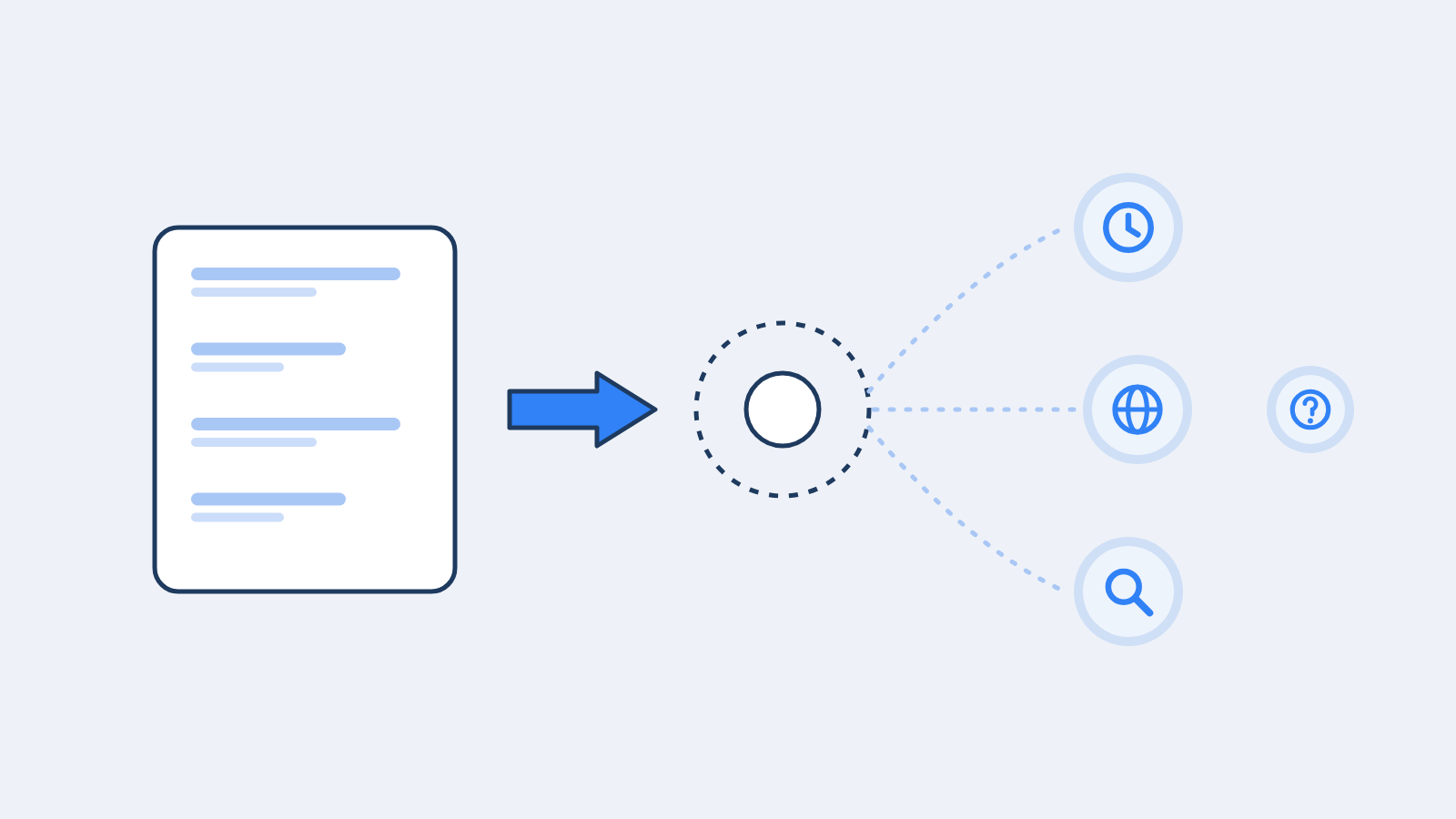
The prompt you track is not the query AI actually searched
AI visibility reports score each tracked prompt, but retrieval and citation happen on fan-out sub-queries. What year and English injection mean for measurement.
Keep reading on this topic
- Which content types AI cites, by search intentThe content type AI search cites flips with intent: articles lead informational prompts (45.5%), listicles lead commercial ones (40.9%).
- How are retrieval and citation different in AI search?Retrieval and citation are different stages in AI search. Does ChatGPT cite YouTube? Why our content is missing from AI answers, and what zero citations mean.
- The LLMO trap: training data vs. AI answer citationsSeeding your brand in LLM training data and getting cited in AI answers are different mechanisms. How they differ, what you can measure, and why advice splits.
This post is part of the Analysis category, which collects all 35 posts on the topic. See all posts in Analysis