AI Recommended You, but GA4 Can't See It: Reporting the Gap
AI search starts influencing people before any click is left behind
AI search creates influence that never shows up as sessions or clicks. A three-layer framework to separate GA4 and AI visibility reports for executives.
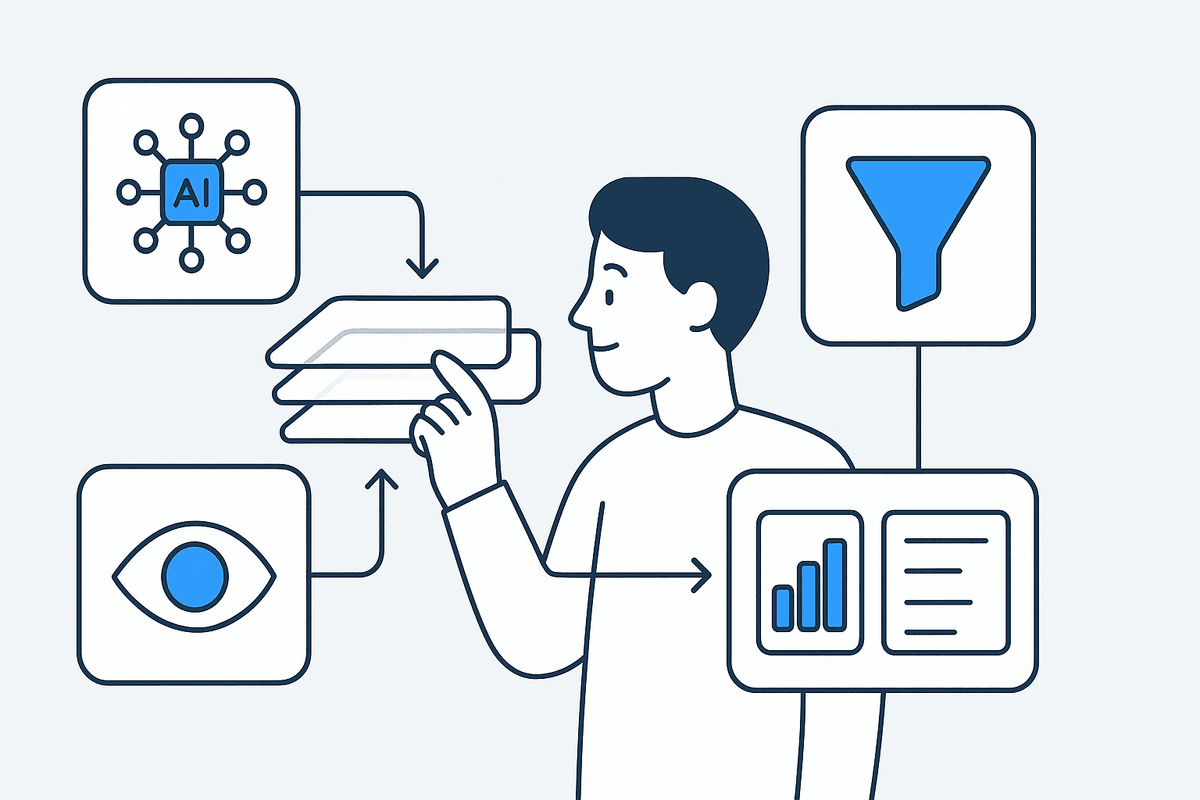
Even when your brand is recommended inside an AI answer, if the user doesn't click right there, that influence leaves no trace at all in Google Analytics' click and session records. Say a user asks AI "recommend a service that fits this product," sees a particular brand in the answer, and the next day searches for the brand name directly in a search engine and comes in. That conversion gets recorded as organic search or direct. The influence of AI putting the brand on the shortlist upstream shows up nowhere in the report. That's the core of the AI search attribution gap.
AI search influence starts before a click is left behind
Traditional analytics was designed around clicks and sessions. It records which channel users came from, which pages they viewed, and which conversions they made. But a brand impression formed inside an AI answer isn't a session. A mention without a link doesn't leave a session either.
Google explains that AI Overviews build an answer at the top of the search results page by synthesizing multiple sources [1]. If users make a decision based on that summary alone, a visit may never happen, even if your content contributed to building the answer.
So if you judge AI search performance by referral traffic alone, it's easy to underestimate it. But there's something to be careful about here. Concluding that "AI generated revenue" is risky. What's needed now isn't perfect attribution but a reporting framework that bundles signals suspected to come from AI influence and uses them to adjust decisions.
Splitting the attribution gap in two
The attribution gap can be split into two broad types.
The first is invisible influence. The brand is mentioned inside an AI answer, and the user reads the answer and forms a judgment, but no site visit or click is left behind. The brand clearly had an effect, but analytics shows no trace.
The second is agentic search. When an AI agent performs actions like comparing, choosing, and purchasing on the user's behalf, site visits themselves can decline. In this case, the company sees only the final conversion and has a hard time knowing which AI interactions influenced that decision.
This problem isn't entirely new. People have always seen YouTube reviews, word-of-mouth recommendations, community posts, and offline ads, then come back later through search. But AI search creates this invisible influence more often and more structurally, because a single answer bundles brand recommendations, comparison criteria, third-party sources, and product summaries together.
GA isn't wrong; it sees a different scope
There's an important attitude to keep here. GA and traditional analytics aren't lying. They just cover a different scope of what they can record. Google Analytics' attribution models also fundamentally reconstruct conversion paths based on observable touchpoints [2]. Touchpoints that produce no click, like a mention inside an AI answer, are outside the scope of what these models observe in the first place.
So AI search reporting doesn't replace your existing SEO reports. It adds one more layer on top of them.
TRAIL's three-layer reporting framework, not HaloX's
The AI search attribution gap can't be closed with a single metric. It's realistic to look at it in three layers.
| Layer | Question | How to observe |
|---|---|---|
| Layer 1: AI visibility | Was our brand visible inside AI answers? | Track citations and mentions for target prompts |
| Layer 2: Follow-on behavior | Did user behavior move afterward? | Trends in branded keyword search volume, direct traffic, and inquiries |
| Layer 3: Business outcomes | How do we carefully connect this change to business outcomes? | Observe time-series correlations, cross-compare with campaigns and events |
Layer 1 looks at visibility inside AI answers itself. It's the only layer you can measure without clicks, so it's where you have to start. Research showing that GEO optimization raises citation odds ties directly to improvements in this layer [3].
Layer 2 looks at whether influence without clicks turned into actual behavior. Check whether branded keyword search volume rose, and whether direct traffic and inquiries moved along with it. These metrics can't prove full causation with AI visibility, but they can serve as circumstantial evidence of a strong correlation.
Layer 3 connects these changes to business outcomes. The key word here is "carefully." Rather than pinning it on a single cause, you need to interpret multiple signals together.
Putting the reporting framework into practice
- Define target prompts and periodically track whether you're mentioned in AI answers (Layer 1).
- Line up lagging indicators like branded keyword search volume, direct traffic, and inquiries over the same period (Layer 2).
- Overlay the two data sets as time series and check whether the points where AI visibility rose line up with changes in the lagging indicators (Layer 3).
- Based on this correlation, report in the tone of "changes observed alongside rising AI visibility" rather than asserting causation.
To keep this framework going
Continuously tracking Layer 1 data, meaning visibility inside AI answers itself, is the foundation of the whole framework. Without this data, the correlation analysis in Layers 2 and 3 loses its starting point.
TRAIL Search (search.traillabs.ai) tracks whether your brand is mentioned or cited in AI answers for each target prompt over time, continuously securing the Layer 1 data for this three-layer framework. Put this data side by side with your marketing team's existing analytics reports, and you can explain the influence of AI search that leaves no clicks with somewhat more evidence.
In the end, the AI search attribution problem is less about "proving it perfectly" and more about "lifting influence that was invisible into visible signals as far as possible." Organizations that keep building on this effort can paint a more accurate picture in AI-era reporting.
You can continue with How to monitor AI search citations with prompt tracking: how it differs from keyword rank tracking, How to design AI search visibility experiments: set a baseline, pick a measurement cycle, and change one variable at a time, and What is query fan-out? Observing firsthand how AI splits one question into many searches.
Frequently asked questions
Is GA failing to capture AI search influence properly?
GA isn't wrong. It just covers a different scope of what it can record. GA records around clicks and sessions, and the brand impression formed inside an AI answer often doesn't leave a session behind. That's why you need to add one more layer on top of your existing reports.
Can I conclude that AI drove revenue?
Be careful. Proving attribution perfectly is hard at this point, and overstated causal claims actually cost you credibility. What's needed now isn't perfect attribution but reporting that bundles signals suspected to come from AI influence and uses them to adjust decisions.
Which metrics should I start tracking first?
The starting point is tracking whether your brand is mentioned or cited inside AI answers. The realistic next step is to look at lagging indicators like branded keyword search volume and direct traffic trends alongside it, and observe how they correlate with AI visibility.
References
Summary
- When a brand is mentioned inside an AI answer, it shapes the user's perception, but if they don't click, that influence leaves no trace in GA's click and session records.
- The AI search attribution gap splits into two broad types: invisible influence (influence without clicks) and agentic search (AI acts on the user's behalf, so visits themselves decline).
- GA isn't wrong; it just covers a different scope, so you need to add an AI visibility layer on top of your existing reports.
- Instead of perfect attribution, a realistic reporting framework splits AI visibility, follow-on behavior, and business outcomes into three layers and connects them carefully.
Check this topic against your own brand
TRAIL Search measures how ChatGPT and Perplexity answer your customers' questions and finds and fixes where the brand is missing, turning this post into a diagnosis. Start with 10 questions, no card required.
More posts
Getting cited when Google AI Mode builds the answer
In November 2025 Google put Gemini 3 in AI Mode to build custom layouts and tools per query while keeping links to web sources. Here is what gets cited.
How is AI answer visibility defined and measured?
How is AI answer visibility defined and measured? Three metrics with formulas and paper figures: visibility (GEO), contribution (Shapley), and stability.
The prompt you track is not the query AI actually searched
AI visibility reports score each tracked prompt, but retrieval and citation happen on fan-out sub-queries. What year and English injection mean for measurement.
Keep reading on this topic
- Which content types AI cites, by search intentThe content type AI search cites flips with intent: articles lead informational prompts (45.5%), listicles lead commercial ones (40.9%).
- How are retrieval and citation different in AI search?Retrieval and citation are different stages in AI search. Does ChatGPT cite YouTube? Why our content is missing from AI answers, and what zero citations mean.
- The LLMO trap: training data vs. AI answer citationsSeeding your brand in LLM training data and getting cited in AI answers are different mechanisms. How they differ, what you can measure, and why advice splits.
This post is part of the Analysis category, which collects all 35 posts on the topic. See all posts in Analysis