Getting cited when Google AI Mode builds the answer
Reading Google's November 2025 move to put Gemini 3 in AI Mode, with custom layouts and simulations per query, as a question about what gets cited inside generative UI
In November 2025 Google put Gemini 3 in AI Mode to build custom layouts and tools per query while keeping links to web sources. Here is what gets cited.
Google put Gemini 3 Pro into AI Mode in November 2025, generating a custom layout with interactive tools and simulations coded on the fly for each query, and said that even when the answer becomes generative UI, every response keeps "prominent links to high-quality content across the web" [1]. The answer shifts from one block of text to a per-query layout, so anyone aiming for exposure in AI search has to watch whether their content gets picked for the links inside the answer, as much as what they wrote.
This article reads Google's announcement [1] published on November 18, 2025 and the Google Research post [2] on generative UI, and we did not demo the feature ourselves. The announcement published no benchmark or performance numbers and limited the rollout to the US and some paid plans [1]. We wrote this in October 2026, 11 months after the announcement, so the then US-only, pick-Thinking state may differ now. We did not separately verify the current rollout, and we go by the mechanism the announcement describes. We also build an AI-search visibility tool, so the part about our product is in the last section.
How does Google AI Mode show answers?
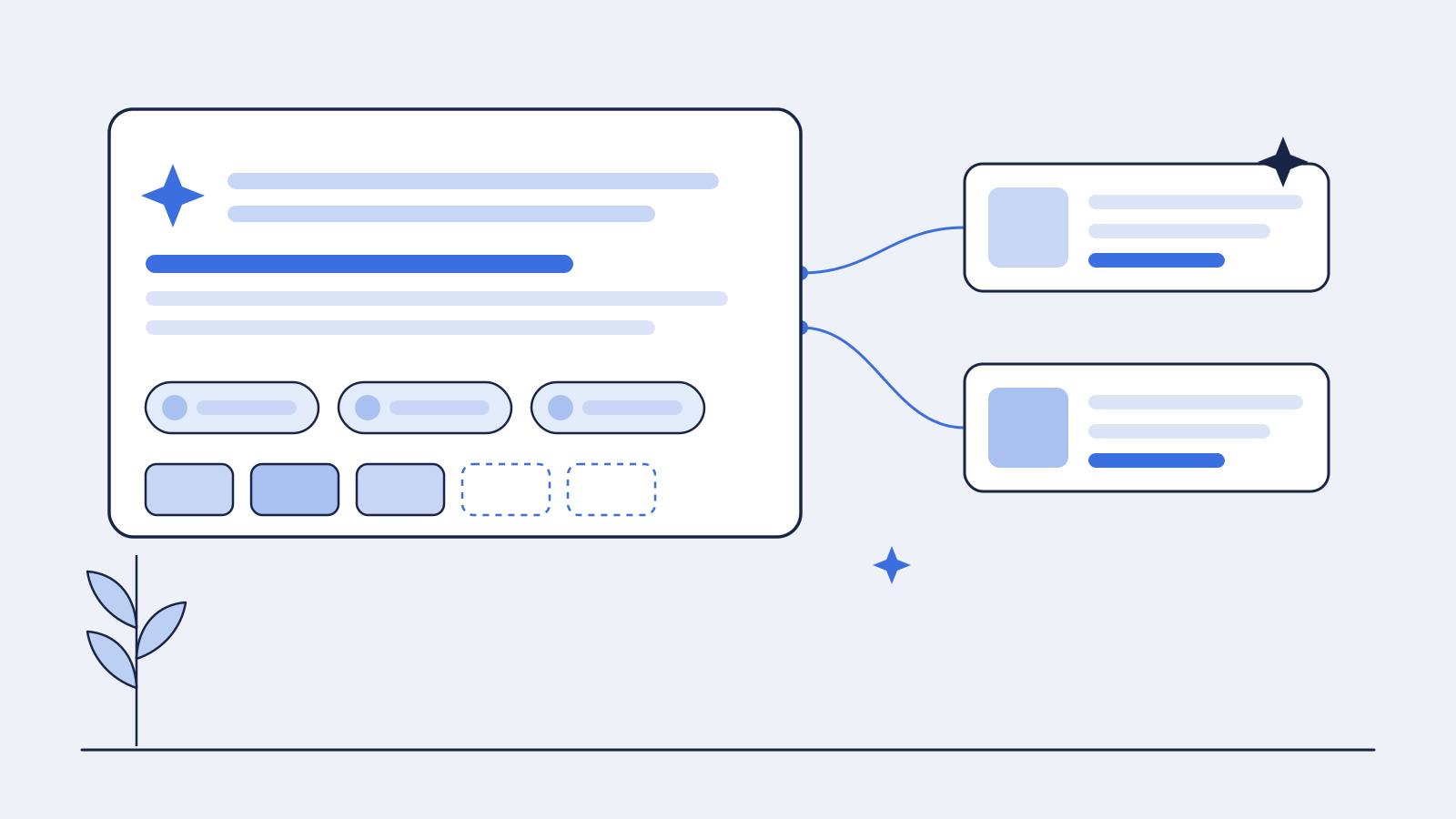
Gemini 3 analyzes the question and builds the visual layout that fits it, on the fly [1]. It composes the answer with images, tables, and grids, and when a tool would help, it codes a simulation or tool in real time and places it inside the answer [1]. Google gave two examples. For the three-body problem it showed a simulation where you change variables and watch the gravitational interaction, and for a mortgage it placed a calculator comparing two options inside the answer [1].
What changed is the form of the answer. Where it used to be paragraphs and a set of links, now a layout and tools coded for the question become part of the answer. Google wrote that it will keep refining this generative UI [1].
What changed in query fan-out?
AI Mode breaks one question into several sub-searches across the web, and Gemini 3 widened that reach [1]. Google said better intent understanding lets it run more searches than before and find content earlier models would have missed [1]. The stated goal is more credible, highly relevant content for the question [1]. It also previewed automatic routing that sends harder questions to the frontier model and simpler tasks to faster ones [1]. The background is in a document [3] Google published alongside. From a measurement view, the more searches that run before the answer is built, the more a page that sat off the first results page can enter the pool.
Do source links survive when the answer becomes generative UI?
Google said every response carries prominent links to high-quality content across the web [1]. Even as the answer shifts from text to layouts and tools, the path out to sources stays. So the question moves from whether there is a link to which content gets picked for it.
Here, citation in AI search is not the same as search ranking. One study found that about 30% of the domains a Google AI Overview cited were nowhere on the same first page (the study, our read). A separate standard decides what gets picked when the answer is assembled, so even in generative UI you have to look at the conditions for getting into the answer.
So what content gets cited?
When the answer is assembled per query, content that overlaps the words of the question and reads correctly as a single detached piece has an edge, because AI pulls by paragraph, not by the whole page. A section that closes from direct answer to evidence, wording that reuses the question's terms in the title and subheads, and sentences with a source next to the number all raise the odds of being pulled.
A brand name entering the answer does not happen in one step either. There are stages where mentions accumulate, context fits, and a source link forms (a stage model of brand mentions in AI answers). Fixing broken or mis-attached citations is separate work too (repairing AI-search citation failures). Generative UI changes the surface of the answer while carrying these same conditions along, rather than changing them.
What this article did not see
The announcement published no benchmark, click-through, or traffic numbers [1]. So this announcement alone cannot say how much generative UI raises or lowers clicks to publishers. The rollout started US-only on the AI Pro and Ultra plans [1], and we wrote this 11 months after the announcement. The current scope, and the behavior in Korean and domestic engines, need separate measurement. The announcement is Google's own post, so account for the interest in writing the feature optimistically.
How TRAIL reads this
Whether your content lands in the source links inside the answer, however it is assembled, is the core of AI-search exposure. TRAIL Labs runs TRAIL Search, which measures how a brand shows up in AI search and answers and prescribes what to fix. The measurement and prescriptions rest on published research, and we are preparing to submit our own method to a peer-reviewed information-retrieval venue. We do not put a number on the effect until results are in.
In practice the order is the same. Set the question, measure how you get cited for it, match the conditions inside the answer (structure, wording, evidence), and measure again after you change. Generative UI changed the look of the answer, not this loop of measuring and fixing. Which tool to measure with is laid out by criterion in a comparison of AI-search visibility tools.
Frequently asked questions
How does Google AI Mode show answers?
It analyzes the question and builds a fitting layout on the fly. It composes the answer with images, tables, and grids, and when it helps, it codes a simulation or calculator in real time and places it inside the answer. Google cited a three-body gravity simulation and a mortgage comparison calculator as examples [1].
Do source links disappear when the answer becomes generative UI?
Google said every response keeps prominent links to high-quality web content [1]. Even as the form shifts from text to layouts and tools, the path out to sources stays. So which content gets picked for that link is the key to exposure.
What changed in query fan-out?
Gemini 3 understands intent better, runs more searches than before, and finds content earlier models would have missed [1]. The goal is to gather more credible, highly relevant content for the question.
Can a Korean brand apply this announcement as-is?
Not yet. The rollout was US-only on some paid plans, there were no benchmark numbers, and nearly a year has passed, so the current state needs checking. Behavior in Korean and domestic engines needs separate measurement.
References
Summary
- In November 2025 Google put Gemini 3 Pro into AI Mode, generating custom layouts and interactive tools and simulations coded on the fly per query.
- Even as the answer becomes generative UI, every response keeps prominent links to high-quality web content.
- Query fan-out runs more searches to find content missed before, and harder questions route to the frontier model.
- The announcement published no benchmark numbers and was US-only on some plans. Written 11 months later, the current rollout needs checking.
- However the answer is assembled, getting into its source links takes structure that overlaps the question's words and content backed by evidence.
Check this topic against your own brand
TRAIL Search measures how ChatGPT and Perplexity answer your customers' questions and finds and fixes where the brand is missing, turning this post into a diagnosis. Start with 10 questions, no card required.
More posts
How is AI answer visibility defined and measured?
How is AI answer visibility defined and measured? Three metrics with formulas and paper figures: visibility (GEO), contribution (Shapley), and stability.
The prompt you track is not the query AI actually searched
AI visibility reports score each tracked prompt, but retrieval and citation happen on fan-out sub-queries. What year and English injection mean for measurement.
Which content types AI cites, by search intent
The content type AI search cites flips with intent: articles lead informational prompts (45.5%), listicles lead commercial ones (40.9%).
Keep reading on this topic
- How are retrieval and citation different in AI search?Retrieval and citation are different stages in AI search. Does ChatGPT cite YouTube? Why our content is missing from AI answers, and what zero citations mean.
- The LLMO trap: training data vs. AI answer citationsSeeding your brand in LLM training data and getting cited in AI answers are different mechanisms. How they differ, what you can measure, and why advice splits.
- What marketers worry about most in AI search: reporting dataMarketers worry less about vanishing from AI search than about lacking reliable reporting. We checked whether that differs by company size.
This post is part of the Analysis category, which collects all 35 posts on the topic. See all posts in Analysis