When Google AI Overviews appear and what they cite
How often an AI Overview appears (13.7% of queries), what it cites off the first page, and that 11% of claims lack support, measured over 40 days
Google AI Overviews appear on only 13.7% of US trending queries, 6.8x more for questions. 30% of cited domains are off page one, and 11% of claims lack support.
A Google AI Overview appears on only 13.7% of US trending queries, cites domains that were not even on the first search page, and leaves 11% of its claims unsupported by the cited page. A Washington University in St. Louis team observed AI Overviews over 40 days across 55,393 US trending queries, measuring activation, source selection, fidelity, and publisher impact [1]. To aim for exposure in AI search, separate "when it appears" from "what it cites and how" [1].
This article reads the body and tables of the paper posted on arXiv and checks the figures against it. All numbers are the paper's experimental results, and with no public repository we have not reproduced them [1]. We also build an AI-search visibility tool, so the part about our product is in the last section.
What questions does a Google AI Overview appear for?
An AI Overview appeared on only 13.7% of US trending queries [1]. Question queries triggered it 64.7% of the time versus 9.5% for non-questions, a 6.8x gap [1]. Queries starting with how (84.3%) or why (73.4%) were highest [1]. Length helped too: queries of 6 or more words fired 58.1% overall and 38.7% even among non-questions [1].
| Query type | AI Overview activation (%) |
|---|---|
| how | 84.3 |
| why | 73.4 |
| what | 60.6 |
| who | 47.9 |
| Non-question average | 9.5 |
Table 1. Google AI Overview activation by query type [1].
By category it ranged 13x, from Beauty 3.5% (142 queries) to Hobbies 46.1% [1]. Sensitive topics like Politics 7.5% and Law 9.6% were low [1]. Health, by contrast, activated at 26.6% and had the highest support rate we discuss below (94.77%) [1].
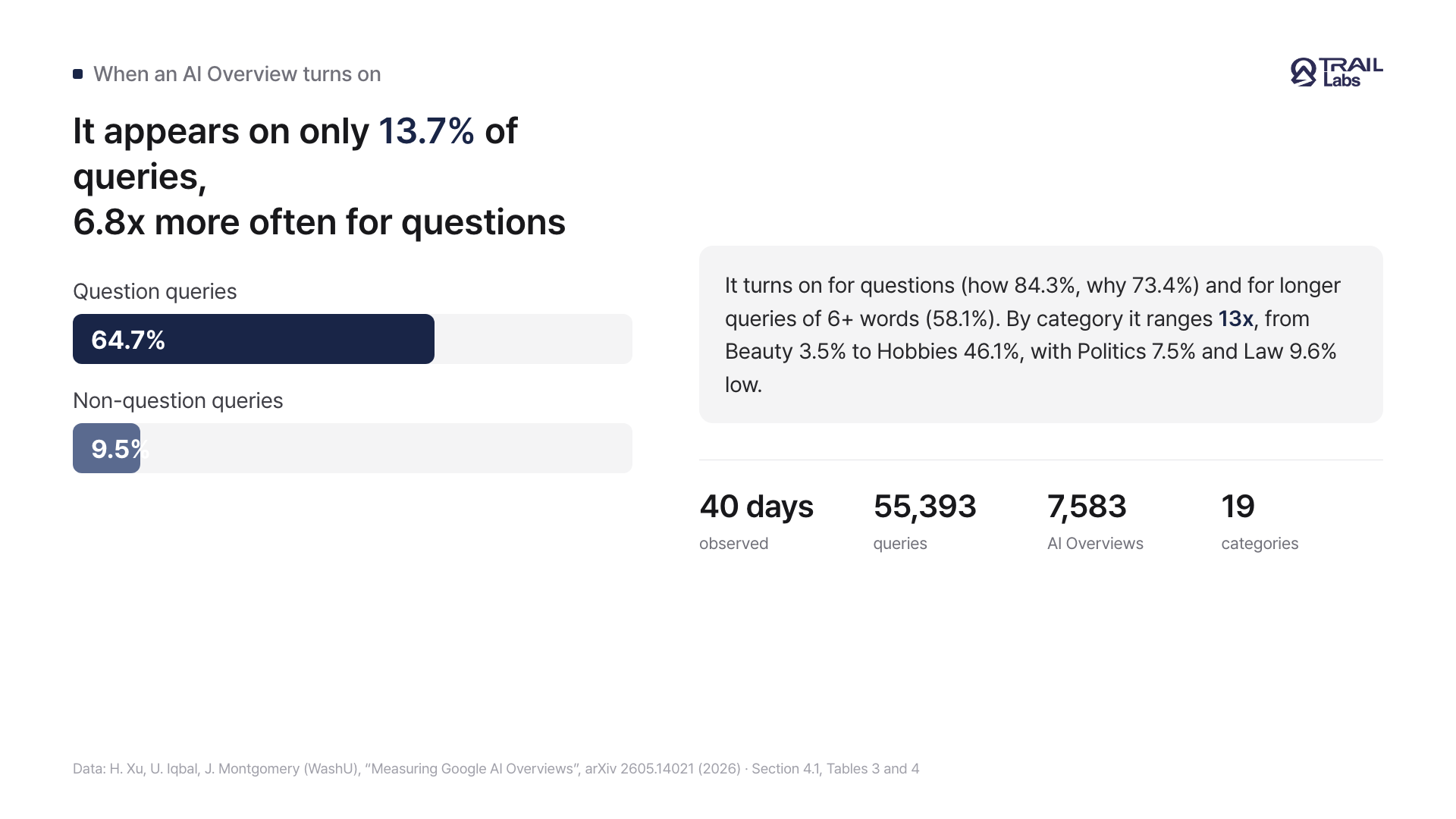
Figure 1. AI Overviews turn on far more often for question queries.
Do you need to rank on page one to be cited?
Not really. 29.8% of the domains an AI Overview cited were nowhere on the same search's first page (per overview, on average), and overlap with the organic top 10 was only 41.4% [1]. Those off-page citations were actually more trustworthy (trust index 0.758, versus 0.724 for citations also on page one) [1].
The domains the overview picked scored higher than the same first page (0.732 vs 0.645) and used far less community-made content from social and forums (14.2% vs 41.4%) [1]. Regardless of ranking, more-trusted domains with less community content were cited more [1].
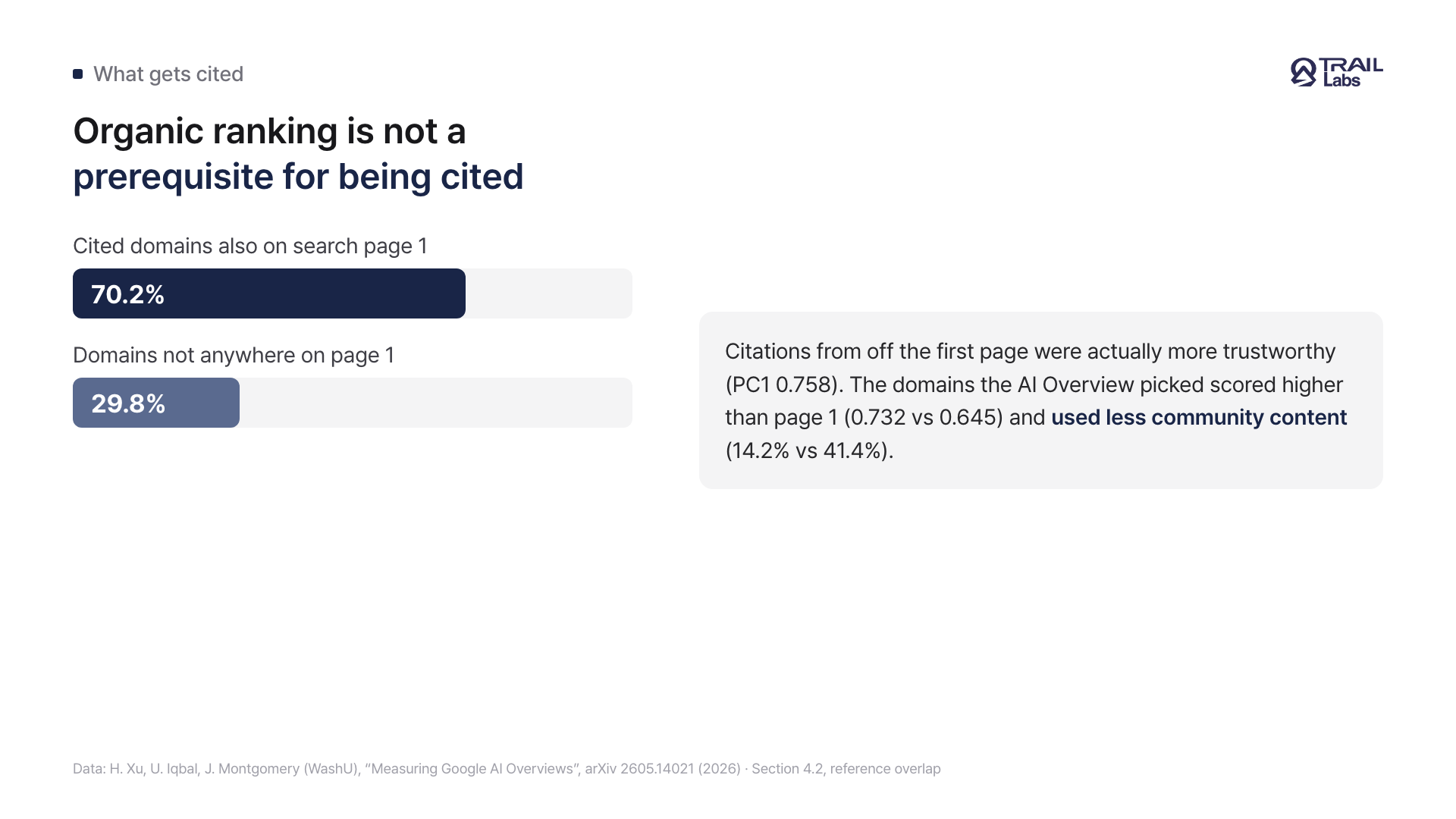
Figure 2. Organic ranking is not a prerequisite for an AI Overview citation.
Are Google AI Overview answers accurate?
This study measured whether the cited page supports each claim, not factual accuracy [1]. The authors split each AI Overview answer into 98,000 atomic claims and checked them against the cited pages [1]. 89.0% were supported and 11.0% were not [1]. Claims omitted from every source (6.98%) outnumbered claims that contradicted a source (2.66%) by 2.6x [1].
Source quality and fidelity were nearly independent (correlation 0.045) [1]. Securing high-trust sources showed no sign of lowering the unsupported share on its own [1]. One caveat: social-platform bodies were not collected, so under the most generous assumption this share falls from 11% to about 5% [1]. Fidelity was judged by an LLM that leans lenient toward supported claims, with 95.6% accuracy against human labels [1].
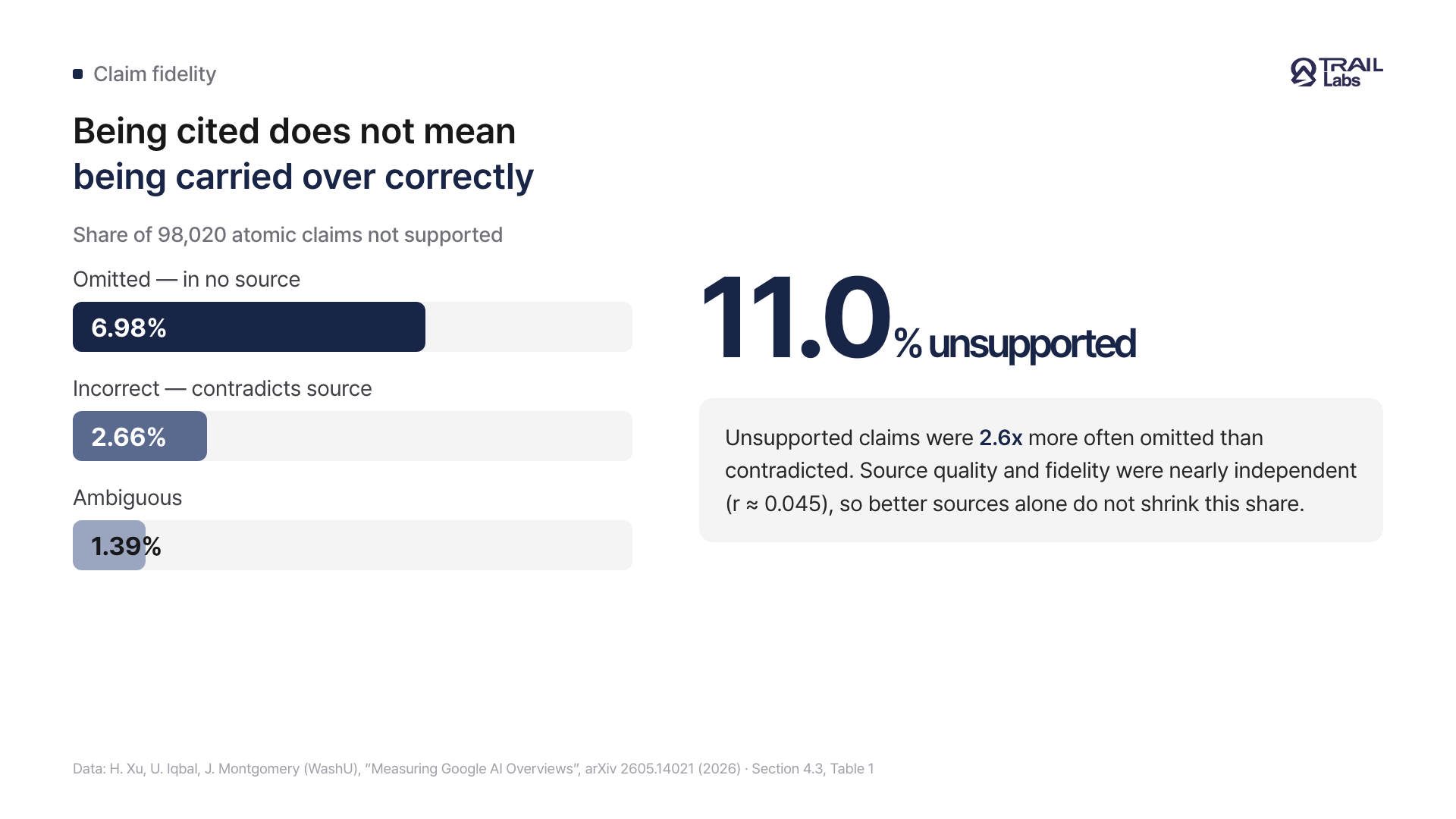
Figure 3. Being cited does not mean the cited page supports the claim.
What does this mean for publishers?
Over 50% of cited pages carried display ads [1]. The paper did not measure how much traffic fell, and figures for organic-click loss belong to other studies [1]. On searches with an AI Overview, Google's sponsored ads co-occurred on 2.16% and sat in a separate area, which the authors read as additive rather than replacing ad inventory [1]. Since traffic was not measured, for a brand it is safer to count an AI Overview citation as an exposure opportunity [1].
What are the limits of this study?
The authors state clear limits [1]. A single engine (Google AI Overviews), a single market (US), collection without personalization, a 40-day snapshot, and a preprint [1]. The sample is US trending queries, so it leans informational, with Sports at 51% [1]. Results shift with language and region, so they do not apply to Korean or other engines as-is [1]. Individual numbers are safer read as direction than as precise values [1].
How does this connect to TRAIL Search?
TRAIL Search's AI Overview engine records whether an overview actually fired for a query. So it does not count a query without an overview as zero exposure, and it separates activation from citation, reflecting in the denominator that an AI Overview appears on only part of all queries.
What we do not yet have is a fidelity check: comparing an overview's sentence against the facts on your page to see whether it is missing or off. This paper's five-label scheme is the starting point for that design. And because the assumption that "ranking high gets you cited in an AI Overview" is only half right here, our engine notes treat ranking as a secondary signal rather than a prerequisite.
Frequently asked questions
When do Google AI Overviews appear?
In this study an AI Overview appeared on only 13.7% of US trending queries. Question queries triggered it 64.7% of the time versus 9.5% for non-questions, a 6.8x gap. Queries starting with how (84.3%) or why (73.4%) were highest, and queries of 6 or more words fired 58.1% overall and 38.7% even among non-questions. By category it ranged from Beauty 3.5% to Hobbies 46.1%, with Politics 7.5% and Law 9.6% low.
Do you need to rank on page one to be cited in an AI Overview?
Not necessarily. 29.8% of the domains an AI Overview cited were nowhere on the same first page, and overlap with the organic top 10 was only 41.4%. The off-page citations were actually more trustworthy (trust index 0.758, versus 0.724 for citations also on page one). Regardless of ranking, more-trusted domains were cited more.
Are Google AI Overview answers accurate?
This study measured whether the cited page supports each claim, not factual accuracy. 89.0% were supported and 11.0% were not. Claims omitted from every source (6.98%) outnumbered claims that contradicted a source (2.66%) by 2.6x. Source quality and fidelity were nearly independent, so better sources alone showed no sign of lowering this share.
What questions trigger a Google AI Overview?
Question-shaped queries did best. Queries starting with how, why, and when ranked highest, and non-question queries fired 38.7% when they had 6 or more words. Sensitive topics like Politics and Law had low activation, while Health activated at 26.6% and had the highest support rate (94.77%).
References
Summary
- A WashU team observed Google AI Overviews over 40 days across 55,393 US trending queries, measuring activation, source quality, claim fidelity, and publisher impact.
- An AI Overview appeared on only 13.7% of trending queries, and question queries (64.7%) triggered it 6.8x more than non-questions (9.5%).
- 29.8% of cited domains were off the first page, and those off-page citations were more trustworthy. Regardless of ranking, more-trusted domains were cited more.
- 11.0% of atomic claims were not supported by the cited page, omitted claims outnumbered contradictions by 2.6x, and source quality and fidelity were nearly independent.
- A single engine, single market (US), 40-day snapshot, and preprint mean it does not transfer to Korean or other engines as-is.
Check this topic against your own brand
TRAIL Search measures how ChatGPT and Perplexity answer your customers' questions and finds and fixes where the brand is missing, turning this post into a diagnosis. Start with 10 questions, no card required.
More posts
Do AI search sources change with the user's location?
A 2026 University of Toronto audit of how user location changes the sources ChatGPT and Gemini cite, and which channel each engine reads location from.

How AI product recommendations vary across tools and APIs
A 2026 study of how decisively AI chatbots recommend products, which sources they display, and whether API audits represent the consumer screen.

How often do AI answers name people, and what rosters miss
A 2026 study of 2,400 grounded AI calls measures how often AI names individual professionals, and how much a roster-based count misses.
Keep reading on this topic
- MMDocRAG: can AI pick evidence in multimodal document RAG?MMDocRAG is a NeurIPS 2025 benchmark for multimodal document RAG. Even with perfect retrieval, the best model reaches only 70.2% quote-selection F1.
- Video-RAG: retrieving OCR and speech text, not more framesVideo-RAG retrieves OCR, speech, and object text for long video QA instead of more frames. A NeurIPS 2025 paper that lifts Video-MME without training.
- DeepSeek V4.1 Flash: smaller KV cache, same post-trainingReading the DeepSeek V4.1 Flash report: a KV cache cut to a quarter of V4's, and post-training that keeps V4's SFT, RL, and OPD recipe, changing only the data.
This post is part of the Papers category, which collects all 30 posts on the topic. See all posts in Papers