How AI product recommendations vary across tools and APIs
An audit of 2,528 real commercial queries across ChatGPT, Gemini, and AI Overviews. The same question drew different products and sources, and API-measured sources overlapped the consumer screen by only 12%. Reading the arXiv preprint
A 2026 study of how decisively AI chatbots recommend products, which sources they display, and whether API audits represent the consumer screen. Across five conditions (ChatGPT and Gemini interfaces and APIs, plus Google AI Overviews), 117 real commercial queries were asked three times each, yielding 1,536 analysed responses.
Ask AI search "which phone has the best camera?" and ChatGPT names one pick in the first person in roughly four of five answers, while Google AI Overviews does so in 2%. Submit the same question to the API and its sources overlap the consumer screen by only 12.0% [1]. This study is a September 2026 arXiv preprint from researchers at Maastricht University's Law & Tech Lab and the universities of Utrecht and Zurich. It has not been peer reviewed, and the authors approach it from a consumer-protection and regulatory angle, with the EU's Digital Services Act and Unfair Commercial Practices Directive in view [1].
This article reads the arXiv paper v1, its text, Table 1, and Figures 1 to 7, as of October 2026, checking each number against the source [1]. We did not run the data or code the authors say they released. We have no relationship with the authors.
How decisively do AI chatbots recommend products?
AI-visibility research has mostly measured which brands a model names. This study goes one level deeper, comparing how differently each tool frames its answer to the same product-recommendation query [1].
The material is ConsumerQ: a dataset of 2,528 commercial-advice queries drawn from real user conversations with LLMs (LMSYS-Chat-1M and WildChat-1M). From these, 117 general physical-product queries without geographic detail were selected (median 8 words) for the audit [1].
Of 836 responses extracted from the interfaces, 700 recommended at least one product or brand, and the framing was measured on those. The starkest difference was first-person voice: a product was recommended in the first person, like "my pick", in 79% of ChatGPT answers, 7% of Gemini answers, and 2% of AI Overviews [1].
A product was labelled "best" in 73% of ChatGPT answers, 43% of Gemini answers, and 48% of AI Overviews. Conversely, Gemini (94%) and AI Overviews (97%) asked a clarifying question more often than ChatGPT (82%). Products were grouped by category in 71% of ChatGPT answers, 65% of Gemini answers, and 44% of AI Overviews [1].
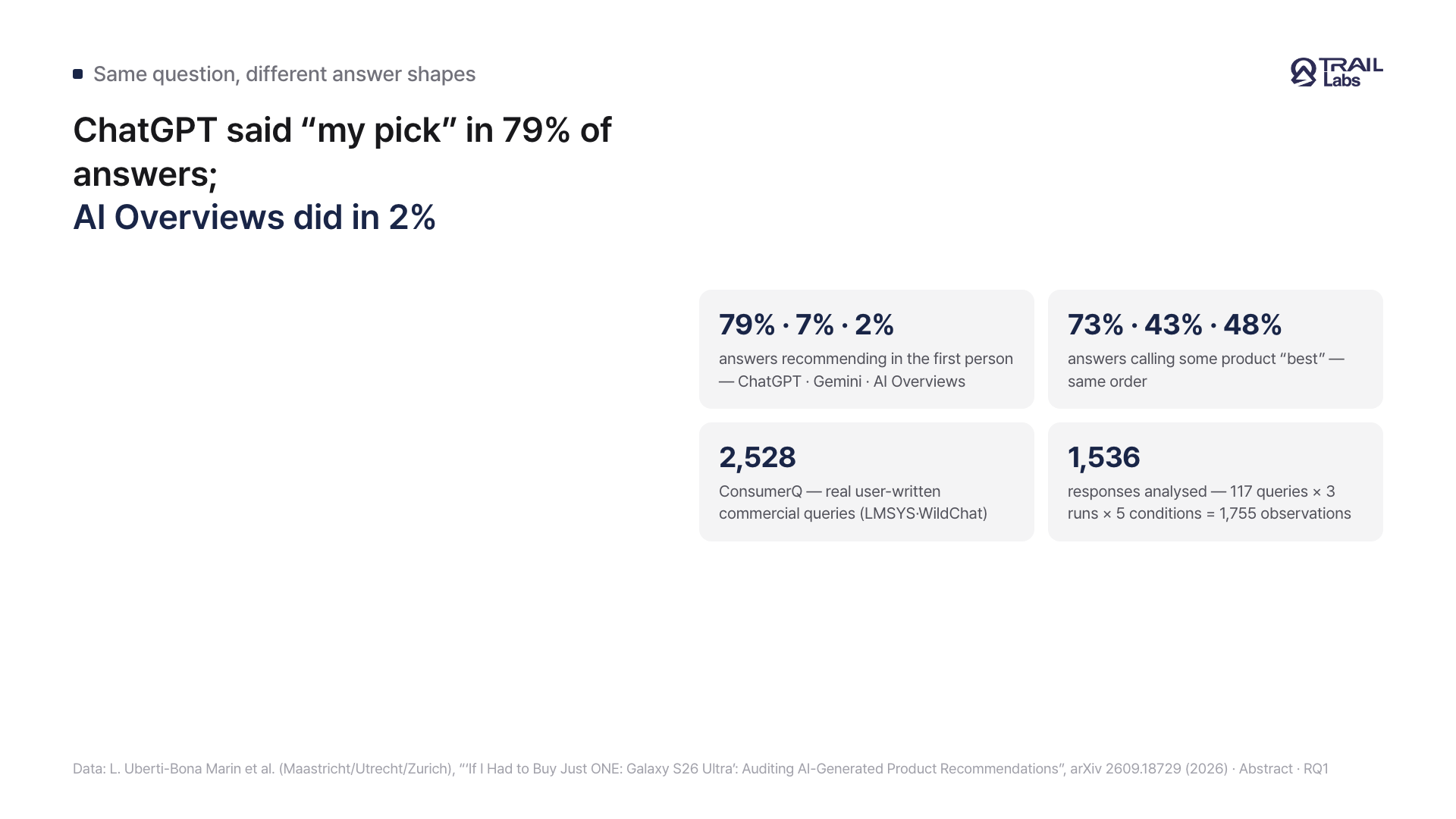
Figure 1. The same commercial question arrived in a different shape depending on the tool. ChatGPT picked one and called it "my pick", while AI Overviews leaned toward listing options [1].
Do AI product recommendations change when you ask again?
The authors measured how often the three repeats of a query disagreed. Grouping products by category (26–37%) and calling a product "best" (27–40%) wavered fairly often regardless of tool, while whether any product or brand was recommended changed in only 11–13% of queries, so the decision to recommend at all was relatively stable [1].
The products themselves moved more. The Jaccard overlap of recommended-product sets across three repeats was highest for AI Overviews (0.421), then Gemini (0.287), then ChatGPT (0.178). ChatGPT's between-repeat overlap was statistically indistinguishable from its overlap with AI Overviews, so asking the same tool again differed as much as switching tools [1].
Because product names are inconsistent ("Apple iPhone 14" and "iPhone 14" count as different products), these overlaps are lower bounds. Even so, a single response cannot characterise what a tool recommends. We cover why a single read is not enough in AI visibility read once is not reliable [1].
Do AI tools show different sources for the same question?
The authors compared displayed sources at the domain and page levels. At least one source appeared in 78.6% of ChatGPT and 79.0% of Gemini responses, and among responses with sources the median was 3 domains for ChatGPT and Gemini and 5 for AI Overviews [1].
Displayed sources differed sharply by tool. For the same query and pass, ChatGPT and Gemini shared an average of 5.4% of domains, and 76.7% of comparisons shared none. ChatGPT and AI Overviews shared 5.2%, Gemini and AI Overviews 9.8%, and page-level overlap fell as low as 2.4–6.5% [1].
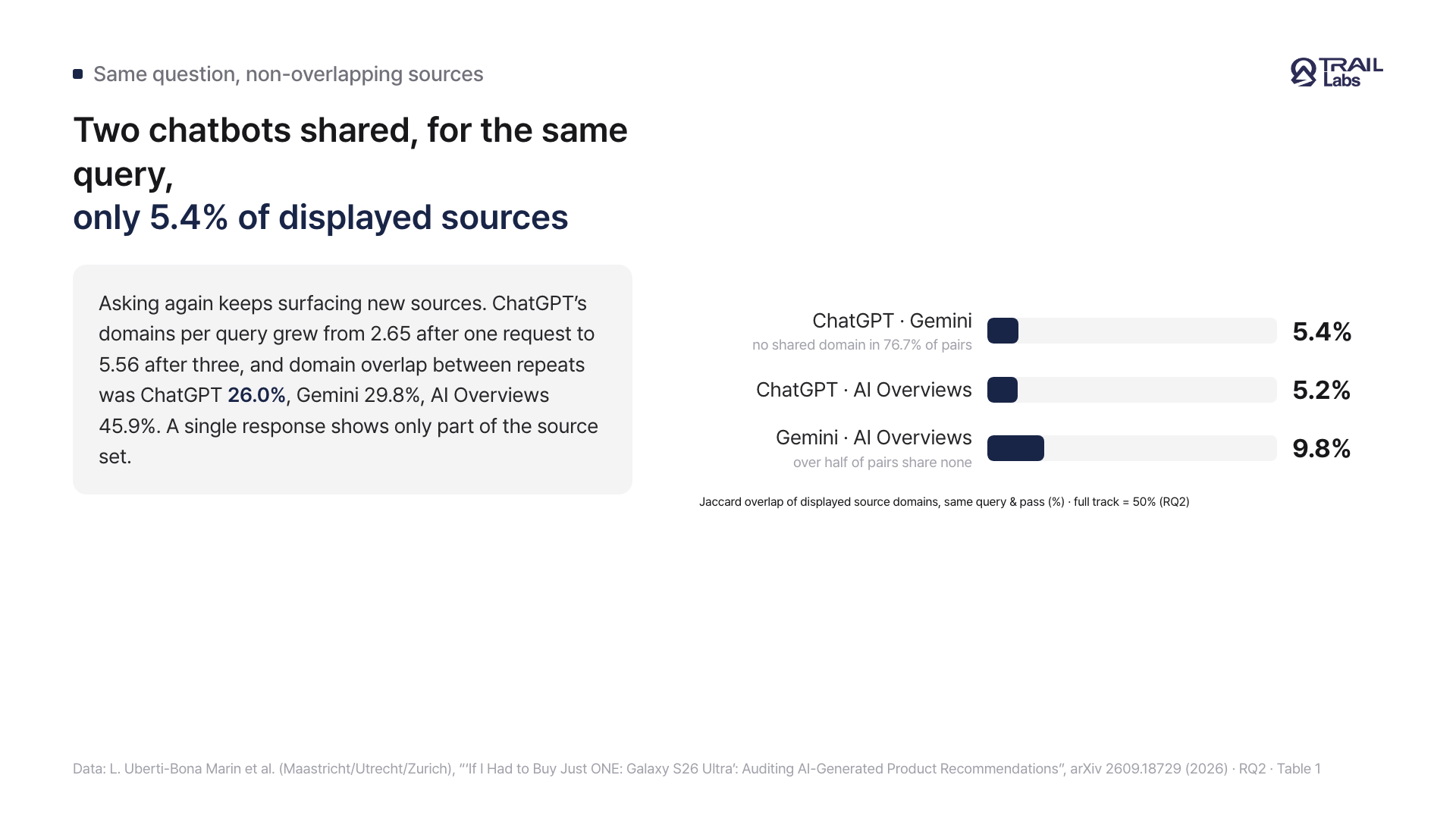
Figure 2. For the same question, two tools shared only a single-digit percentage of source domains. Repetition kept surfacing new sources [1].
Repetition kept adding new sources. Domain overlap between repeats was 26.0% for ChatGPT, 29.8% for Gemini, and 45.9% for AI Overviews, and ChatGPT's domains per query grew from 2.65 after one request to 5.56 after three. The most frequent domains differed too: techradar and tomsguide for ChatGPT, pcmag, reddit, and youtube for Gemini, reddit and youtube for AI Overviews. Why source tendencies differ by tool is discussed in why a single AI-visibility score is risky [1].
The mix of source types also differed. Editorial and product-review outlets made up 56.7% of displayed domains for ChatGPT, 45.2% for Gemini, and 25.4% for AI Overviews, and AI Overviews combined three or more source types in 61.7% of answers, far more than the roughly 19% for the other two [1].
Does measuring AI visibility by API match the consumer screen?
Audits usually run through provider APIs, which fix the model and request conditions for easy control. The authors submitted the same query to the interface and the API almost simultaneously (median delay 0.17 seconds) to test whether the API reproduces the consumer screen [1].
It did not. Displayed source domains overlapped only 12.0% for ChatGPT and 14.8% for Gemini between interface and API. No domain was shared at all in 60.9% of ChatGPT pairs and 43.4% of Gemini pairs, and most page mismatch came from entirely different domains entering (79.8% and 82.5% of the union) [1].
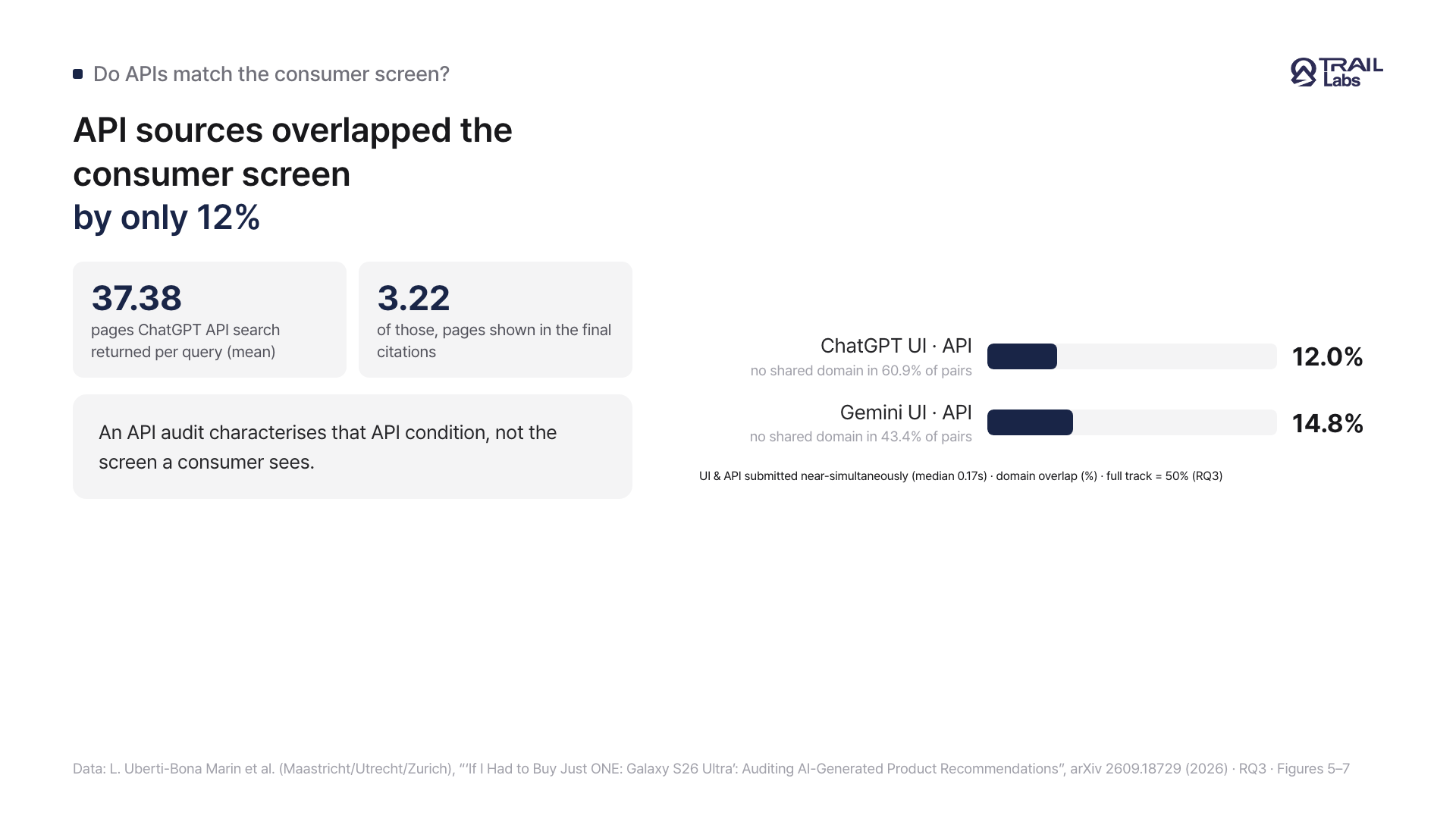
Figure 3. API-measured sources barely overlapped the consumer screen. The pages search returned and the pages shown in citations also differed widely [1].
The visible source layer differed too. In the ChatGPT API, search returned a mean of 37.38 pages per query, but only 3.22 appeared in the final citations, so only 27.5% of returned domains and 9.5% of returned pages made it into the citations. How retrieval differs from citation is covered in how retrieval and citation differ [1].
This comparison is not an effect of access method alone. Interface and API also differ in model configuration and other provider-controlled components, so the authors measured whether the two conditions reproduce one another rather than attributing the difference to access method. Which method to measure with is covered in API or the actual screen [1].
What are the limits of this study?
The authors' own limits first. The audit covers 117 general physical-product queries without geographic detail, so it does not represent all commercial advice. The queries are mostly English while responses were collected in the Netherlands, and the systems were captured at one point in time. AI Overviews content was recoverable in only 134 of 351 searches, so those results apply only to searches where an overview appeared [1].
Other widely used assistants such as Claude were not covered, and the interface–API comparison does not establish why the two differ. Whether Korean queries or Korean AI search show the same pattern needs its own measurement [1].
What this means for TRAIL
TRAIL Search faces this question directly. We measure ChatGPT, Gemini, Perplexity, and Claude through provider APIs, and Google AI Overviews and Naver's AI briefing by reading the consumer-facing overview block itself. As this paper argues, API-measured sources from chat engines are a different layer from the logged-out consumer screen, so a report should state which layer each number comes from.
The point about repetition applies too. TRAIL Search can re-run the same query multiple times and on a schedule, but the default is a single pass. As this study shows, one response captures only part of the source set, so for commerce queries where products and sources shift often, raising the number of repeats brings the measurement closer to honest. Marking answers whose sources could not be retrieved as not measurable, rather than as a zero mention, belongs to the same stance (how to tell no mention from not measurable).
It lands on commerce too. "Did AI recommend us?" is not a single yes or no; it needs a per-tool, repeated read. Where yesterday's how often AI answers name people was about what a counting instrument misses, this paper is about how the screen and the layer you measure change the result.
Lucas G. Uberti-Bona Marin et al., "'If I Had to Buy Just ONE: Galaxy S26 Ultra': Auditing AI-Generated Product Recommendations", arXiv 2609.18729 (2026).
Frequently asked questions
How decisively do AI chatbots recommend products?
Auditing 117 real commercial queries three times each across five conditions, ChatGPT recommended a product in the first person (such as "my pick") in 79% of product-recommending answers, against 7% for Gemini and 2% for Google AI Overviews. It also labelled some product "best" in 73% of answers, against 43% for Gemini and 48% for AI Overviews, making ChatGPT the most definitive [1].
Do AI product recommendations change when you ask again?
Repeating the same query three times, the Jaccard overlap of recommended-product sets was 0.421 for AI Overviews, 0.287 for Gemini, and 0.178 for ChatGPT. ChatGPT's variation between repeats was as large as its difference from other tools, so a single response cannot characterise what it recommends [1].
Do AI tools show different sources for the same question?
For the same query and collection pass, ChatGPT and Gemini interfaces shared an average of 5.4% of displayed source domains, and 76.7% of comparisons shared no domain at all. Repetition kept surfacing new sources: ChatGPT's domains per query grew from 2.65 after one request to 5.56 after three [1].
Does measuring AI visibility by API match the consumer screen?
Submitting the same query to the interface and API almost simultaneously, displayed source domains overlapped only 12.0% for ChatGPT and 14.8% for Gemini. The ChatGPT API's search returned a mean of 37.38 pages per query, but only 3.22 appeared in the final citations, so an API view does not represent the consumer screen [1].
References
Summary
- Across five conditions (ChatGPT and Gemini interfaces and APIs, plus Google AI Overviews), 117 real commercial queries were asked three times each, yielding 1,536 analysed responses.
- On the same question, ChatGPT recommended one product in the first person in 79% of answers; AI Overviews did in 2%. The shape of the recommendation differed by tool.
- Recommended products changed on repetition, and ChatGPT's variation between repeats was as large as its difference from other tools.
- Two chatbots shared only 5.4% of displayed source domains for the same question, and 76.7% of comparisons shared no domain.
- API-measured sources overlapped the consumer screen by only 12.0% (ChatGPT) and 14.8% (Gemini), so an API audit characterises the API condition, not the screen consumers see.
Check this topic against your own brand
TRAIL Search measures how ChatGPT and Perplexity answer your customers' questions and finds and fixes where the brand is missing, turning this post into a diagnosis. Start with 10 questions, no card required.
More posts
Do AI search sources change with the user's location?
A 2026 University of Toronto audit of how user location changes the sources ChatGPT and Gemini cite, and which channel each engine reads location from.
How often do AI answers name people, and what rosters miss
A 2026 study of 2,400 grounded AI calls measures how often AI names individual professionals, and how much a roster-based count misses.
MMDocRAG: can AI pick evidence in multimodal document RAG?
MMDocRAG is a NeurIPS 2025 benchmark for multimodal document RAG. Even with perfect retrieval, the best model reaches only 70.2% quote-selection F1.
Keep reading on this topic
- Video-RAG: retrieving OCR and speech text, not more framesVideo-RAG retrieves OCR, speech, and object text for long video QA instead of more frames. A NeurIPS 2025 paper that lifts Video-MME without training.
- DeepSeek V4.1 Flash: smaller KV cache, same post-trainingReading the DeepSeek V4.1 Flash report: a KV cache cut to a quarter of V4's, and post-training that keeps V4's SFT, RL, and OPD recipe, changing only the data.
- A reward ceiling for RL alignment, computed before trainingAn Apple study computes the reward ceiling of RL alignment before training. Best-of-N reaches it, PPO and GRPO stay below, and reward hacking gets an equation.
This post is part of the Papers category, which collects all 30 posts on the topic. See all posts in Papers