How many measurements to trust AI search visibility
Why cited sources change more than half a day, and how many repeated runs a trustworthy measurement needs
AI search visibility swings so much that one measurement is noise: cited sources change about 65% a day, mostly from the model's probabilistic generation. A St. Gallen team tracked 4 AI search engines (ChatGPT, Gemini, Google AI Mode, Perplexity) across 4 campaigns for 45 days, plus up to 10 immediate re-runs the same day, to measure how visibility swings.
AI search visibility cannot be trusted from a single measurement: for the same query, about 65% of the cited sources change within a day, and much of that swing comes from the model generating differently each time rather than from algorithm changes. A St. Gallen team tracked 4 AI search engines for 45 days and found cited sources overlapped on average only 34-42% from one day to the next (Jaccard) [1]. So to trust a measurement you repeat it, and this study puts numbers on how many runs and days that takes [1].
This article reads the body and tables of the paper posted on arXiv and checks the figures against it. All numbers are the paper's experimental results, and with no license on the repository we have not reproduced them [1]. One author also works for a GEO monitoring vendor, and we too sell repeated tracking, so we read the conclusion with that interest in mind. The part about our product is in the last section.
Why does AI search visibility change every time?
Traditional search tends to keep a page in the result set even as its rank moves. Generative search, by contrast, works by inclusion or exclusion [1]. A page appears in one answer and is gone from the next [1]. The authors attribute this to two things: the probabilistic nature of token generation, and the way RAG compresses many sources into a limited answer space while selecting evidence [2].
The team measured this with two datasets [1]. One is a time series of 4 campaigns (telecom, real estate, sporting goods, consumer electronics) by 8 prompts by 4 engines, collected once a day for 45 days; the other re-ran the same queries up to 10 times in a single day [1]. Overlap was measured with the set-similarity metric Jaccard, where closer to 1 means two citation lists are identical [1]. Gemini had many missing collection days and ChatGPT returned many answers with no citation, so both were handled out of the source analysis [1].
How much do citations change in a day?
Cited sources overlapped on average only 34-42% from one day to the next (Jaccard, 0.336-0.423 by campaign) [1]. By the non-overlapping share, that is about 65% changing in a day [1]. Brand mentions were steadier at 45-59%, a figure measured on the 3 campaigns with at least 70% detection [1].
The authors read this as a persistent property rather than a one-off anomaly [1]. So a single snapshot is hard to call "our brand visibility" on its own [1].
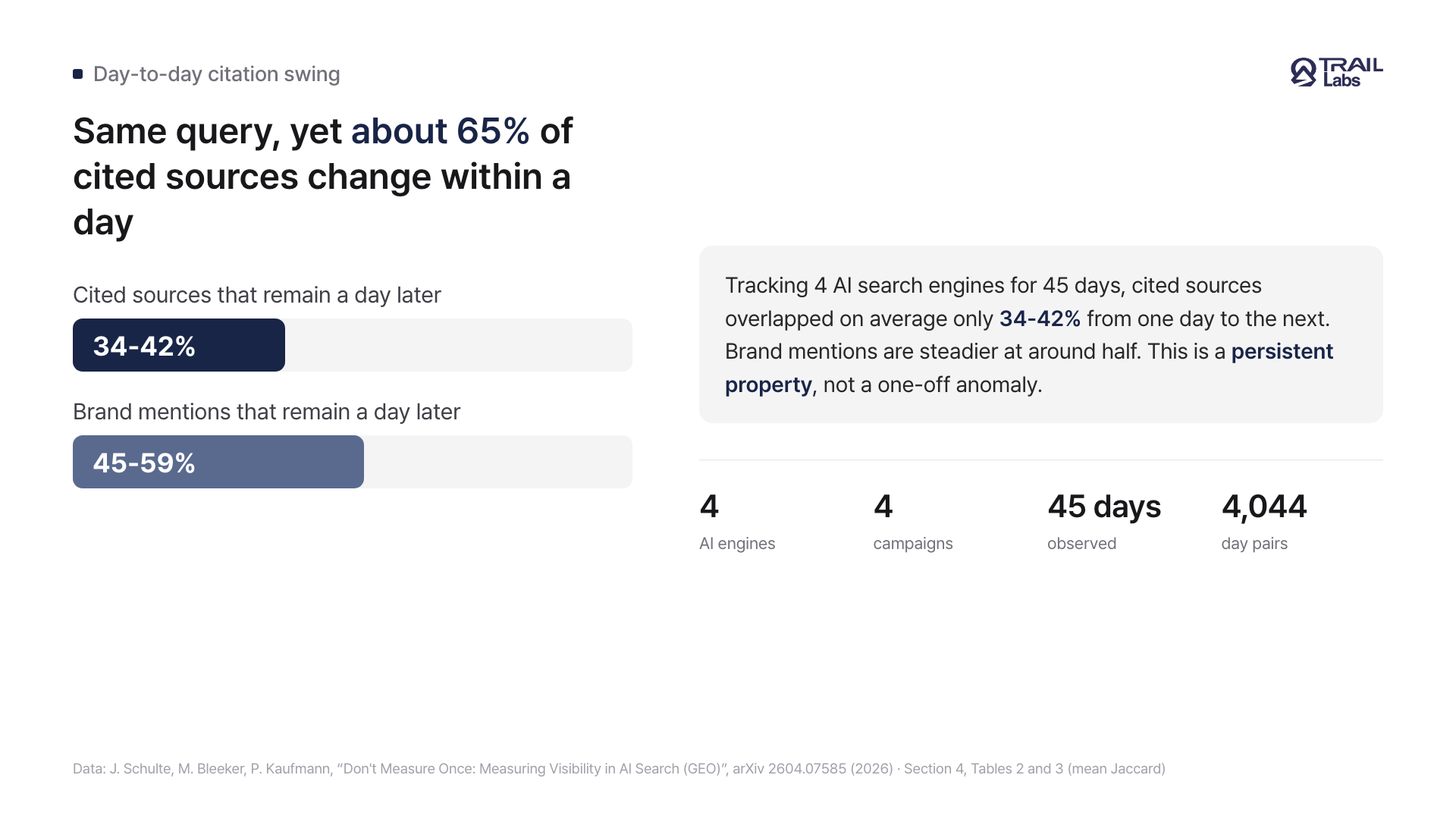
Figure 1. Day-to-day citation swing.
Is the cause time, or the model?
The team separated change that accrues over time from the model's own variation [1]. Sources re-run at the same moment overlapped by a Jaccard of 0.32-0.43, close to the 0.34-0.42 measured a day apart [1]. That a re-run with almost no time elapsed swings this much is an observation that much of the instability comes from the model's probabilistic generation [1].
So the noise in any single measurement does not shrink by measuring more often [1]. Noise shrinks by averaging, and you average either by repeated runs at one moment or by accumulating several days of observation [1]. Prompt-level variation was also large: some queries stayed above a Jaccard of 0.8, while others fell below 0.2 and changed almost every time [1].
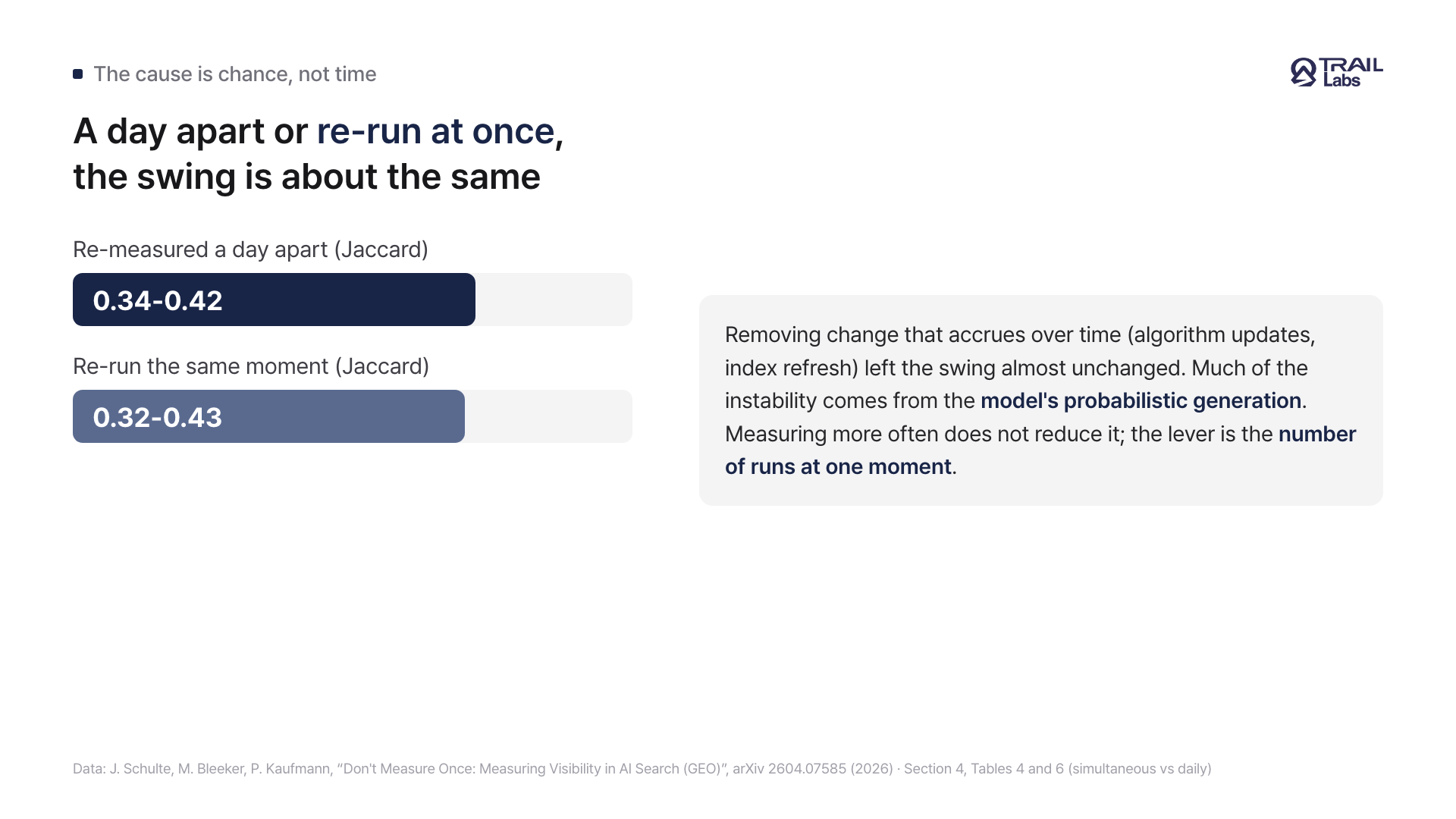
Figure 2. The cause looks more like the model's randomness than time.
How many runs and days does trust take?
A single measurement has a standard error (SE) of 0.37, effectively no information [1]. Even at a true detection rate of 50%, the nominal 95% interval spreads very wide [1]. The team treated the 10-run data as the truth and raised the number of runs to estimate the SE [1].
| Number of runs | Standard error (SE) | Interval half-width (±) |
|---|---|---|
| 1 run | 0.370 | 0.724 |
| 2 runs | 0.246 | 0.483 |
| 3 runs | 0.188 | 0.369 |
| 7 runs | 0.081 | 0.158 |
| 8 runs | 0.062 | 0.121 |
Table 1. Standard error and 95% interval half-width of brand-detection rate by number of runs [1].
The SE of brand-detection rate fell below 0.10 at 7 runs and below 0.08 at 8 [1]. Seeing which URLs are cited converges more slowly, needing 8 runs [1]. Because the truth was set as the mean of the same 10 runs, the SE at 7-8 runs may be somewhat optimistic [1].
Apart from runs, accumulating one run a day over several days also lowers the SE [1]. By window, SE reached 0.08 at 2 weeks and 0.03 at 4 weeks [1]. The authors advise at least 7 runs per prompt per day and a 2-4 week rolling window [1].
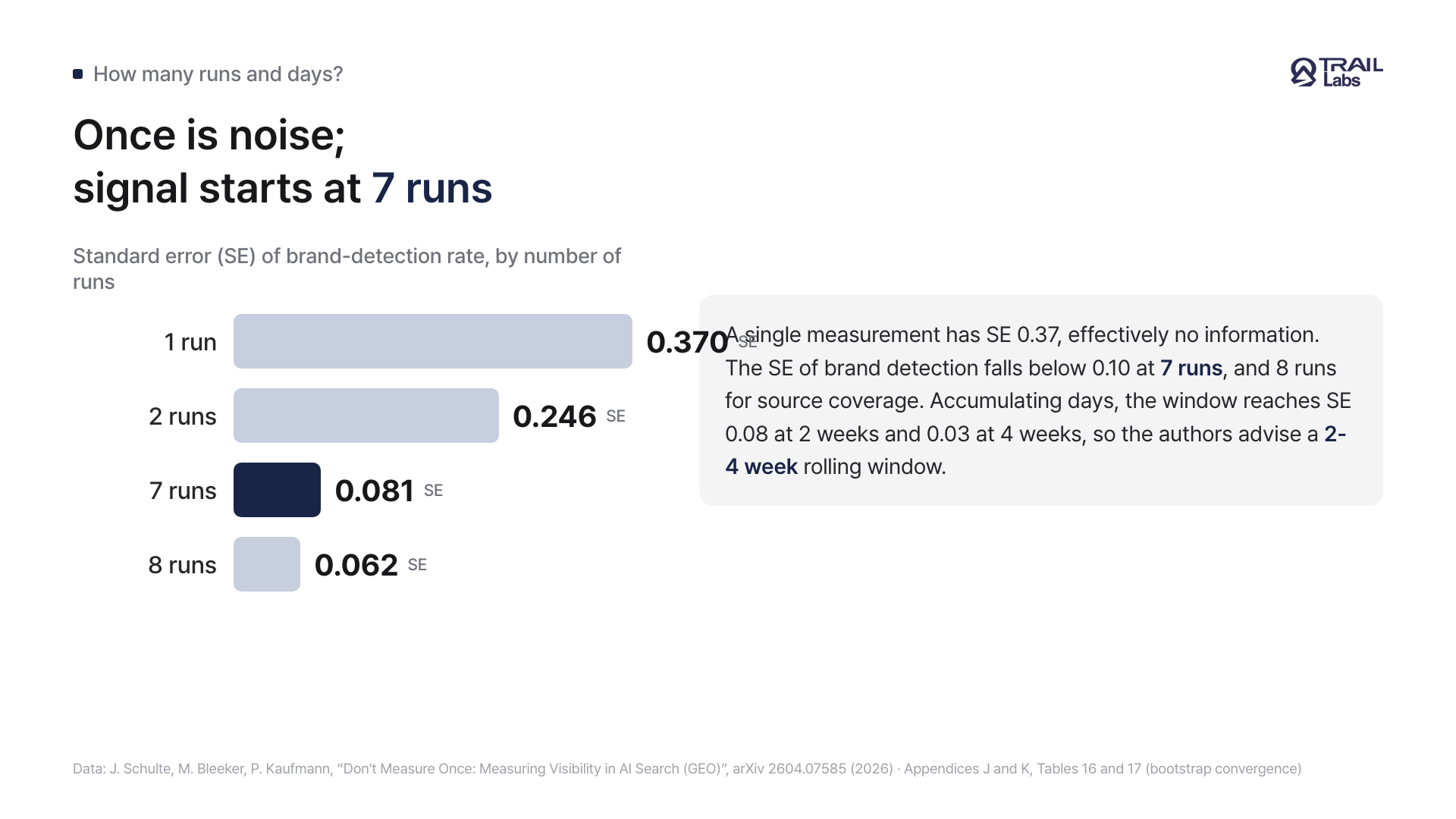
Figure 3. Once is noise; signal starts at 7 runs.
What are the limits of this study?
The authors state clear limits [1]. All data was collected from servers in Switzerland and served with a Swiss IP and locale, so it does not generalize to other regions or languages [1]. There are 4 campaigns, it is an arXiv preprint with no stated venue, and the code repository has no license [1]. Brand detection uses fixed keyword matching, so brands mentioned by a synonym or abbreviation can be missed [1].
The authors also note that one of them works for a GEO monitoring vendor [1]. A "measure more" conclusion favors sellers of repeated measurement. The same interest applies to us, who also sell repeated tracking, so we kept the conclusion at arm's length.
How does this connect to TRAIL Search?
This study puts numbers behind why we measure visibility repeatedly. TRAIL Search gathers more than ten unbranded discovery prompts and scores them as a median over several runs, attaches a preliminary, medium, or high-confidence badge by the number of runs it measured, and shows the run-to-run flip rate separately. It recommends a two-week to one-month re-measurement cycle. This paper is already on our list of measurement sources.
That said, our default number of runs is kept low for low-cost tracking, so it sits below the paper's high-confidence bar of 7-8 runs [1]. We add more runs for decision-grade verdicts. Separately, our threshold for calling a score change noise is not something this paper directly validated, because it measures overlap similarity and standard error rather than point changes in our composite score, so we keep that threshold as a working convention and calibrate it once real re-measurement data accumulates.
Frequently asked questions
Why does AI search visibility come out different every time?
Generative search works by inclusion or exclusion. A page can appear in one answer and be gone from the next. The authors attribute this to the probabilistic nature of token generation and to RAG compressing many sources into a limited answer space while selecting evidence. This study tracked 4 AI search engines for 45 days and measured that swing.
How much do AI search citations change in a day?
In this study cited sources overlapped on average only 34-42% from one day to the next (Jaccard). By the non-overlapping share, that is about 65% changing in a day. Brand mentions were steadier at 45-59%, a figure measured on the 3 campaigns with at least 70% detection.
Is AI search visibility variation caused by algorithm updates?
Algorithm updates are not the main cause. Sources re-run at the same moment overlapped by a Jaccard of 0.32-0.43, close to the 0.34-0.42 measured a day apart. That a re-run with almost no time elapsed swings this much is an observation that much of the instability comes from the model's probabilistic generation.
How many times must you measure AI search brand exposure to trust it?
Once is not enough. A single measurement has a standard error (SE) of 0.37, effectively no information. In this study the SE of brand-detection rate fell below 0.10 at 7 runs and below 0.08 at 8; seeing which URLs are cited needed 8 runs. Accumulating days, the window reached SE 0.08 at 2 weeks and 0.03 at 4 weeks, so the authors advise 7+ runs per prompt and a 2-4 week rolling window.
References
Summary
- A St. Gallen team tracked 4 AI search engines (ChatGPT, Gemini, Google AI Mode, Perplexity) across 4 campaigns for 45 days, plus up to 10 immediate re-runs the same day, to measure how visibility swings.
- Cited sources overlapped on average only 34-42% from one day to the next (about 65% by the non-overlapping share), and brand mentions were steadier at 45-59%.
- Same-moment re-runs swung by a Jaccard of 0.32-0.43, close to the day-apart 0.34-0.42, showing much of the instability comes from the model's probabilistic generation more than from time.
- A single measurement has SE 0.37, close to no information; SE dropped sharply by 7-8 runs and, by window, at 2-4 weeks. The authors advise 7+ runs per prompt and a 2-4 week rolling window.
- Data was collected only from Swiss servers, across 4 campaigns, as an arXiv preprint, and one author also works for a GEO monitoring vendor.
Check this topic against your own brand
TRAIL Search measures how ChatGPT and Perplexity answer your customers' questions and finds and fixes where the brand is missing, turning this post into a diagnosis. Start with 10 questions, no card required.
More posts
How AI search picks which page to cite: four gatekeepers
When two similar pages compete for one AI-search answer, four signals decide the citation: topic match, price, recent date, and front position.
Why a Page Is Not Cited in AI Search, and How to Repair It
Why is a page not cited in AI search? 43% of on-topic pages were never cited, and 62% of failures were an intent mismatch. Editing about 5% of a page helped.
How Much of a Cited Page Ends Up in an AI Answer?
How much of a cited page ends up in an AI answer? ChatGPT cited the fewest pages but used them most deeply, and Q&A formatting alone did not raise absorption.
Keep reading on this topic
- AI Answer Brand Mentions Track Exposure More Than Page FitWhen do AI answers mention a brand? In 34,960 GPT and Gemini runs, answers with neither its own domain nor a branded query named it 2.8–3.8% of the time.
- Does AI Search Cite AI-Written Content? About 16% of SourcesDoes AI search cite AI-written content? About 16% of sources four AI answer engines cited were AI-generated. How engines differ and what Google's policy says.
- Where Does AI Get Brand Information? 85.7% Is Third-PartyWhere does AI get brand information? Of 167,551 citations for 128 European brands, 85.7% were third-party sites. The top source shifts by language.
This post is part of the Papers category, which collects all 21 posts on the topic. See all posts in Papers