Do AI search sources change with the user's location?
Researchers asked ChatGPT and Gemini 300 questions while changing only the location, collecting 31,200 answers. ChatGPT followed the city an app declared, Gemini followed the network's country, and the cited sources and recommended businesses moved with them. Reading the arXiv short paper
A 2026 University of Toronto audit of how user location changes the sources ChatGPT and Gemini cite, and which channel each engine reads location from. The authors asked ChatGPT and Gemini 300 questions twice each while changing only the location, collecting 31,200 answers. No question named a place.
The same question, asked from different places, got different cited sources and different recommended businesses from AI search. ChatGPT followed the city an app declared and wrote it into 100% of its near-me searches, while Gemini ignored the declared location and followed the country of the network it was called from [1]. The study is a four-page short paper by Mahe Chen and Nick Koudas of the University of Toronto, posted to arXiv in October 2026. It has not yet been peer reviewed, and the measurements describe the engines in October 2026 [1].
This article reads the arXiv paper v1, its text, Tables 1 to 4 and Figures 1 to 3, as of October 2026, checking each number against the source [1]. We did not run the questions, code or answers the authors say they released. We have no relationship with the authors.
Do AI search answers change with the user's location?
GEO monitoring usually sends a fixed set of questions from one place and records the answers. In classic web search, location is the largest source of personalization after being logged in, but whether generative search personalizes by location had not been measured. The authors set out to measure it [1].
They wrote 300 questions across ten commercial topics (home services, health care, finance, insurance, telecom, dining, retail, cars, travel, public services). One hundred asked for something nearby ("best plumber near me"), one hundred depended on the place ("how much is sales tax on a car"), and one hundred were not local ("best robot vacuum"). No question named a place [1].
There were two experiments. In the first, ChatGPT (gpt-5.4-mini, Responses API with web search) got each question twice with each of 15 US cities and four cities elsewhere (London, Toronto, Sydney, Dublin) declared as the user location, or with no location (24,000 answers). In the second, no location was declared, and ChatGPT and Gemini (gemini-3.1-flash-lite with Google Search grounding) were asked from the authors' connection in Canada and from VPN exits in New York, Los Angeles, London and Sydney (7,200 answers) [1].
The measure is the Jaccard overlap of cited domains. The overlap between two "twin" answers from the same setting gives the run-to-run noise, and the localization index is how much lower the overlap is when only the location changes.
$$
Here is the mean overlap of two answers to the same question in the same location, and the mean overlap of two answers that differ only in location. Zero means location has no effect beyond noise [1].
The result depended on the kind of question. With two US cities declared, ChatGPT's index was 0.14 for near-me questions and 0.17 for place-dependent ones; for cities in different countries it was 0.28 and 0.43. For questions that do not depend on place it was 0.00 and 0.03, so location had almost no effect [1].
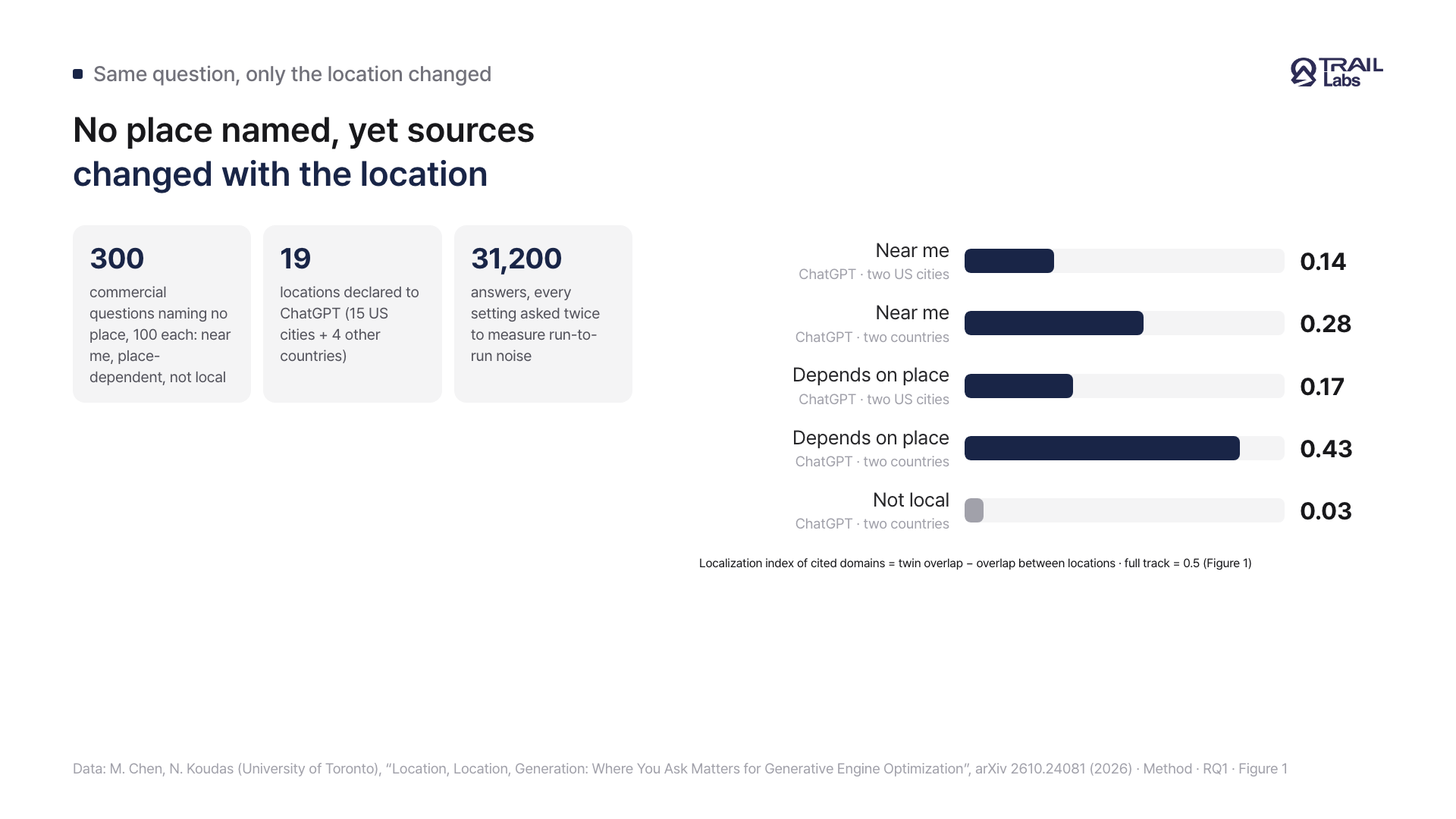
Figure 1. The same question with no place in it drew different sources depending on the location declared to ChatGPT. The difference was large for near-me and place-dependent questions [1].
By topic, public services localized most (0.57 among place-dependent questions), because answers cited each state's government sites. Telecom and utilities localized least (0.02), because answers cited national sources such as the FCC and national carriers. With ten questions per topic, the authors call the topic estimates indicative [1].
How do ChatGPT and Gemini know where the user is?
The two engines took location from different channels. ChatGPT ignored the network: across network locations in different countries its index was 0.00, 0.01 and 0.01, all within noise. Instead it followed the location the application declared through the API, down to the city [1].
Gemini did the opposite. Declared coordinates had no effect in a pilot, and Gemini followed the country of the network. It went only as far as the country: between New York and Los Angeles its index was 0.00 (95% CI −0.03 to 0.04). Gemini's queries named the country in 56% of near-me answers but never a city [1].
Drift over time does not explain this. The same connection three days apart differed by 0.03, 0.01 and 0.05, while London and Sydney, measured 30 minutes apart, differed as much as any other pair of countries. Gemini's sources changed by 0.23 (CI 0.20 to 0.27) across countries even for questions that do not depend on place [1].
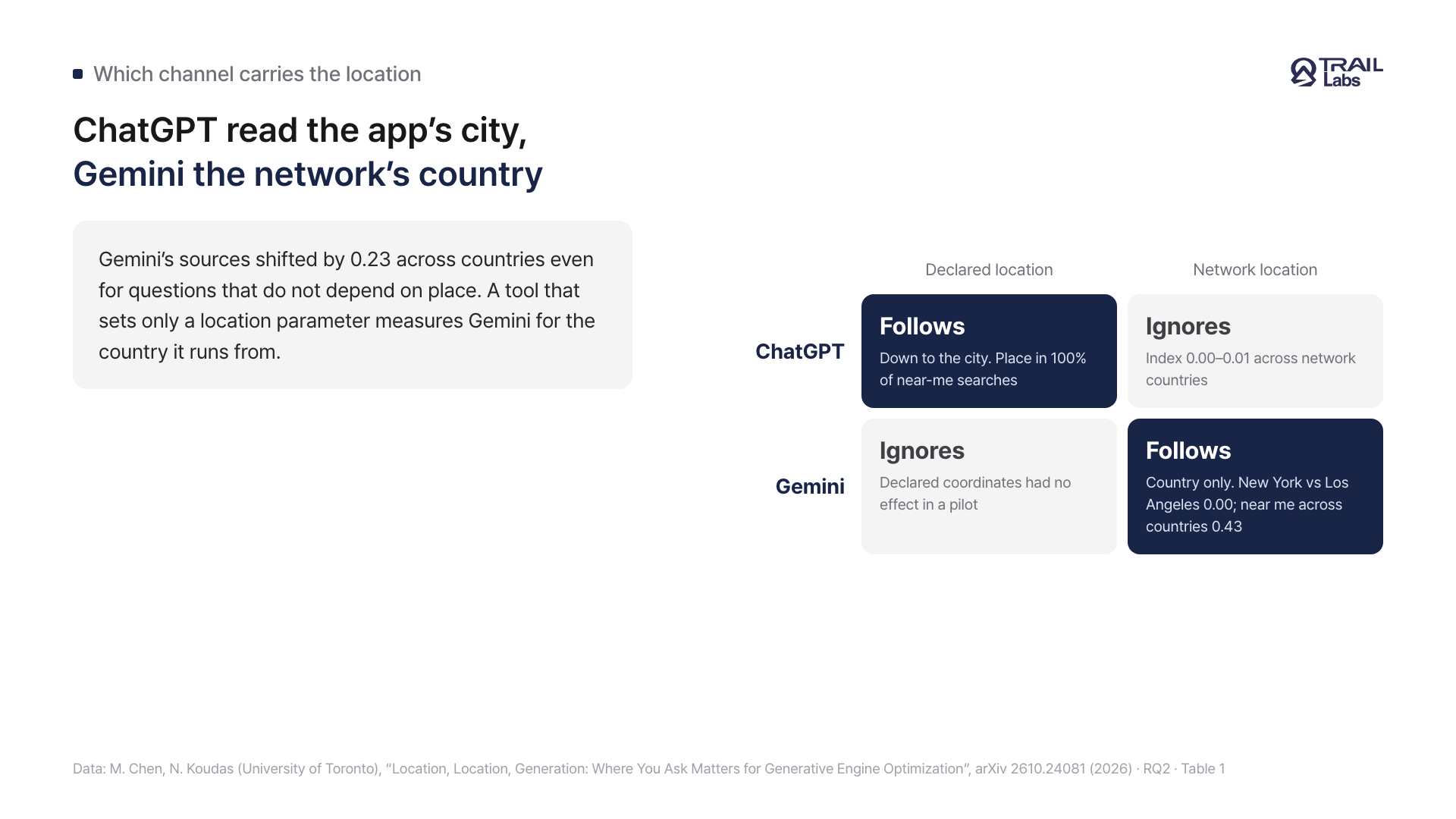
Figure 2. ChatGPT followed the declared location down to the city, and Gemini followed the network's country. A location signal that worked for one engine had no effect on the other [1].
Within ChatGPT, location entered in two ways. First, the model wrote the place into its own searches: 100% of searches for near-me questions and 48% for place-dependent ones. Second, the search backend localized results by itself. Where neither of two answers' queries named the place, the sources still differed by 0.17 (CI 0.09 to 0.25), and where both did, the index rose to 0.37 [1].
Distance did not matter. For near-me questions, the index was 0.13 between US cities under 1,000 km apart and 0.14 for pairs over 3,000 km apart (Spearman correlation with distance 0.01). To ChatGPT every other city is a different place; to Gemini, only another country is [1].
The defaults differed too. Without a declared location, ChatGPT answered 63% of near-me questions by asking for a ZIP code or city (4% with a location), and when it searched, its sources resembled those of the US cities (overlap 0.25 against 0.10 for other countries). It answered for an unspecified US user from national sources. Gemini's default was the network's country, whatever location was declared [1].
From which location should AI search visibility be measured?
The recommended businesses moved with the sources. A ChatGPT near-me answer named 4.3 businesses, brands or products on average; two identical requests shared 23% of the names, and two different declared locations shared 4%. Gemini's recommended names differed across network countries even for questions that do not depend on place (index 0.07). Names were extracted with a language model, and 29 of 36 hand-checked extractions were fully correct [1].
The numbers for monitoring were clear. For near-me questions, a request declared in one city recommended only 8% of the businesses the same request recommended in another city, against 32% when repeated in the same city. Of the businesses recommended for near-me questions, 96% appeared in only one of the 15 cities. For place-dependent questions the gap was smaller, 31% against 34% [1].
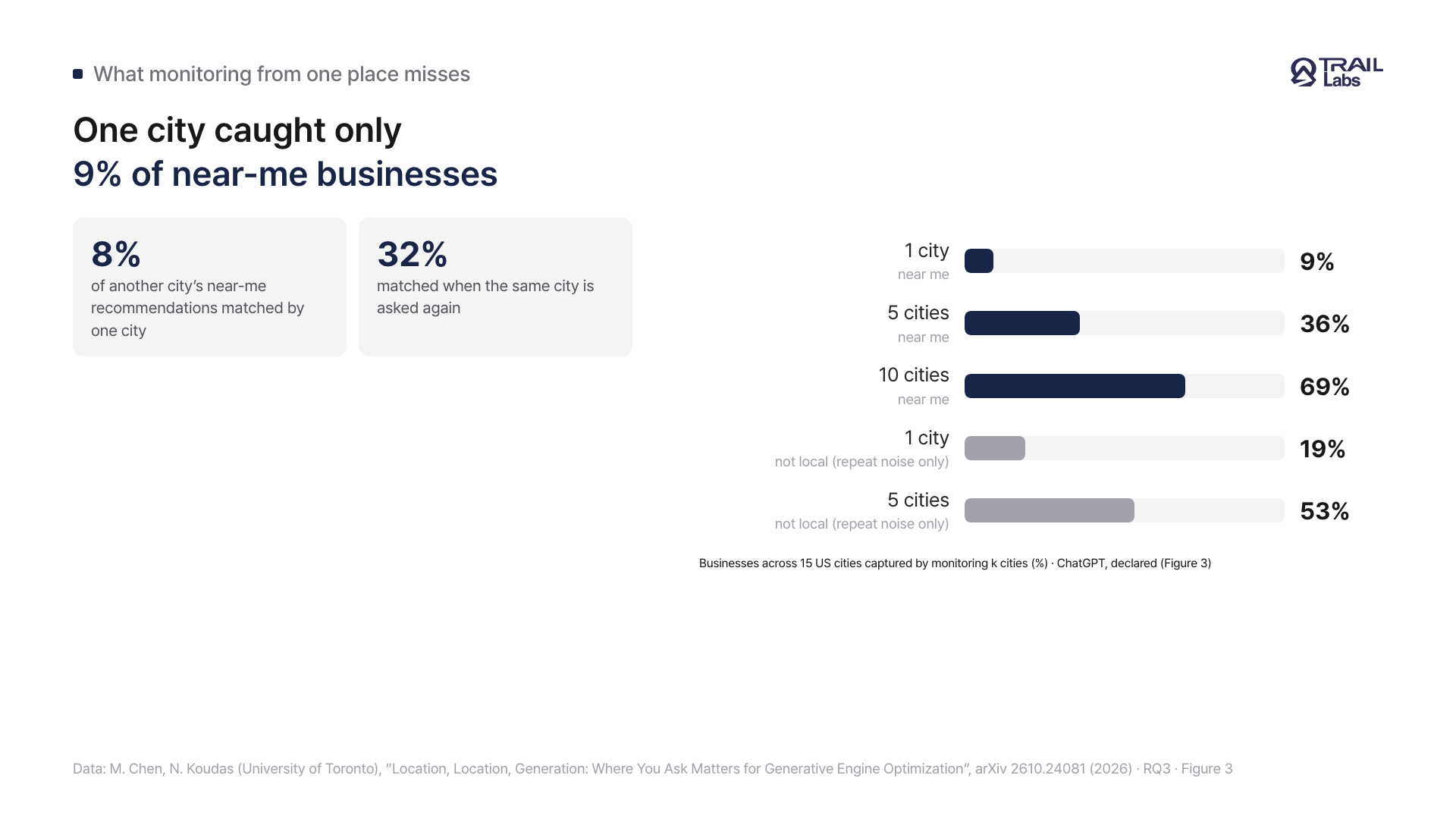
Figure 3. Monitoring one city captured only part of the businesses recommended across 15 cities for near-me questions, and the curve did not level off as cities were added [1].
Adding cities did not fill the gap quickly. For near-me questions, one city captured 9% of the businesses recommended across the 15 cities, five cities 36% and ten 69%. Even questions unaffected by location gave 19% for one city and 53% for five, so variation between repeated requests alone meant a single read captured only part. We cover the limits of single reads in How many measurements to trust AI search visibility [1].
The authors ask three things of monitoring tools. Set the location on the channel the engine reads (a location parameter for ChatGPT, the network for Gemini); measure each market on its own, by city for ChatGPT and by country for Gemini; and hold the location fixed when comparing over time or across engines. A tool that sets only a location parameter measures ChatGPT for that city but Gemini for the country the tool runs from [1].
What does a local business need to appear in AI search recommendations?
ChatGPT's answers leaned heavily on local sources. With a declared location, 79% of near-me answers in US cities cited a source naming the city or state, and 92% of those in other countries cited a source from that country's domain. For questions that do not depend on place, these shares fell to 1% and 10% [1].
The paper gives examples. Asked for "credit unions in my area", ChatGPT named local credit unions in New York, Boise, Miami and London. Asked "which store has the cheapest groceries", Gemini recommended different national chains in Canada, the US, the UK and Australia, and the same chains in the US East and West [1].
The authors' reading: because ChatGPT writes the place into its searches, a local business becomes visible through pages found by place-specific queries, such as local directories, review sites and the sites of local institutions, rather than through national rankings. For Gemini, the user's country decides which national chains and sources appear, so a brand's visibility in one country says little about another. We explain the gap between being retrieved and being cited in How are retrieval and citation different in AI search? [1].
What are the limitations of this study?
The authors' own limitations first. They used the engines' APIs and small models, which need not behave like the consumer apps, and the full-size model check covered ChatGPT only (60 questions at 6 locations, 720 answers, localizing at least as strongly as the small model). VPN exits are data-center addresses, so Gemini may localize more finely on residential connections. The questions are in English and were written by the authors [1].
As a four-page short paper, the per-topic samples are small and some confidence intervals live only in the repository. How far API measurements differ from the consumer screen is worth reading alongside the audit in How AI product recommendations vary across tools and APIs. Whether the same pattern holds for Korean questions and Korean locations needs its own measurement [1].
What this means for TRAIL
We checked TRAIL Search's code against this paper. For ChatGPT, we pass the web-search tool a location at the country level only (Korea or the US) and no city, so our ChatGPT numbers describe an unspecified-city user in that country. Google AI Overviews is measured through a search API with country and language parameters.
For Gemini we send no location. If the paper's result holds, Gemini follows the country of the server running the measurement, and our measurement server sits in the AWS Seoul region. That fits Korean-market measurement, but Gemini results measured for an English-language, US market may also reflect a Korean network. This is an inference from the paper that we still need to verify, and until then reports should state where Gemini was measured from.
Our default of a single measurement pass fits this paper too. Customers tracking local businesses or place-dependent questions need more locations and more repeats for the measurement to mean something. Why we keep unmeasured responses separate from "no mention" is in 0% vs unmeasured in an AI visibility report: how to tell, and whether to measure via API or the real screen is in Should AI visibility be measured through the API or the UI?.
Mahe Chen, Nick Koudas, "Location, Location, Generation: Where You Ask Matters for Generative Engine Optimization", arXiv 2610.24081 (2026).
Frequently asked questions
Do AI search answers change with the user's location?
They changed a lot for near-me and place-dependent questions. Declaring two US cities to ChatGPT gave a localization index (source difference beyond run-to-run noise) of 0.14 for near-me and 0.17 for place-dependent questions, rising to 0.28 and 0.43 for cities in different countries. Questions that do not depend on place stayed at 0.00 to 0.03 [1].
How do ChatGPT and Gemini know where the user is?
They use different channels. ChatGPT follows the location an application declares through the API, down to the city, and ignores the network (index 0.00 to 0.01 across network countries). Gemini ignores declared coordinates and follows the country of the network, so New York and Los Angeles looked the same (0.00) [1].
From which location should AI search visibility be measured?
Fix the location on the channel each engine reads: a declared city for ChatGPT, a network location for Gemini. Without either, ChatGPT answers for an unspecified US user and Gemini for the country the tool runs from. For near-me questions, one city's answers matched only 8% of another city's recommended businesses, so local tracking needs several locations and repeated requests [1].
What does a local business need to appear in AI search recommendations?
ChatGPT wrote the city into 100% of its searches for near-me questions, and 79% of its near-me answers in US cities cited a source naming that city or state. The authors read this as local businesses becoming visible through pages found by place-specific searches, such as local directories, review sites and local institutions, rather than national rankings [1].
References
Summary
- The authors asked ChatGPT and Gemini 300 questions twice each while changing only the location, collecting 31,200 answers. No question named a place.
- ChatGPT followed the location an app declared, down to the city, and ignored the network. Gemini ignored the declared location and followed the network's country.
- Gemini's sources changed across countries even for questions that do not depend on place (localization index 0.23).
- Recommended businesses moved with the sources: for near-me questions, two cities shared 4% of names, and one city captured only 9% of the businesses recommended across 15 cities.
- Monitoring tools must fix the channel each engine reads location from, and local questions need both several locations and repeated requests.
Check this topic against your own brand
TRAIL Search measures how ChatGPT and Perplexity answer your customers' questions and finds and fixes where the brand is missing, turning this post into a diagnosis. Start with 10 questions, no card required.
More posts

How AI product recommendations vary across tools and APIs
A 2026 study of how decisively AI chatbots recommend products, which sources they display, and whether API audits represent the consumer screen.

How often do AI answers name people, and what rosters miss
A 2026 study of 2,400 grounded AI calls measures how often AI names individual professionals, and how much a roster-based count misses.

MMDocRAG: can AI pick evidence in multimodal document RAG?
MMDocRAG is a NeurIPS 2025 benchmark for multimodal document RAG. Even with perfect retrieval, the best model reaches only 70.2% quote-selection F1.
Keep reading on this topic
- Video-RAG: retrieving OCR and speech text, not more framesVideo-RAG retrieves OCR, speech, and object text for long video QA instead of more frames. A NeurIPS 2025 paper that lifts Video-MME without training.
- DeepSeek V4.1 Flash: smaller KV cache, same post-trainingReading the DeepSeek V4.1 Flash report: a KV cache cut to a quarter of V4's, and post-training that keeps V4's SFT, RL, and OPD recipe, changing only the data.
- A reward ceiling for RL alignment, computed before trainingAn Apple study computes the reward ceiling of RL alignment before training. Best-of-N reaches it, PPO and GRPO stay below, and reward hacking gets an equation.
This post is part of the Papers category, which collects all 30 posts on the topic. See all posts in Papers