
A reward ceiling for RL alignment, computed before training
An Apple study computes the most reward alignment can add under a KL budget from base-model samples alone; best-of-N sits on that ceiling while PPO and GRPO stay below it
An Apple study computes the reward ceiling of RL alignment before training. Best-of-N reaches it, PPO and GRPO stay below, and reward hacking gets an equation.
The most reward that reinforcement learning can add under a KL constraint is computable before training from base-model samples alone, and on that ceiling best-of-N reached over 98% while PPO and GRPO stayed at 77% and 75% on the safety task [1]. An Apple team derived the optimal reward gain of KL-regularized alignment in closed form as a Jeffreys divergence and rewrote it as a covariance under the base model so it can be estimated before training [1]. The same framework proves why reward hacking happens and why reward model ensembles help [1].
This article reads the body, theorems, and appendix tables of the paper posted on arXiv and checks the figures against them [1]. The models and datasets are public assets, but we have not reproduced the experiments, and we have no relationship with the authors.
Where is the limit of RL alignment?
The reward an optimally aligned model gains over the base model equals the KL penalty λ times the Jeffreys divergence between the two models [1]. The starting point is the KL-regularized problem that RLHF-style methods share. A reward model scores an answer , and deviating from the base model is penalized through the KL divergence [1].
This problem has a known closed-form solution: the base model's probability multiplied by the exponential of the reward and renormalized [1].
Here is the strength of the KL penalty and is the normalizer. How much reward this solution gains was known only as a bound. Gao et al. reported an empirical rule that the gain grows roughly with the square root of KL [2], and Mroueh and Nitsure proved that square-root expression is an upper bound under a sub-Gaussian reward [3]. Theorem 1 of this paper gives an equality with no assumption [1].
Here is the Jeffreys divergence, the sum of the forward and reverse KL. The gain is "how far the model moved from the base," measured in both directions, times the penalty λ, and a one-directional square root of KL does not describe it [1].
Can the reward gain from alignment be computed before training?
Yes. The right-hand side of Theorem 1 needs the aligned model, but the same quantity rewritten as a covariance under the base model needs no aligned model at all [1]. Theorem 2 separates the reward used for evaluation from the reward used for training so one expression covers both cases [1].
Here is the covariance over answers sampled from the base model, and the second argument is the exponential weight each answer receives. Optimal alignment is a reweighting that favors the higher-reward answers the base model can already produce, so base samples plus reward scores are enough to see how much reweighting can add.
A Monte Carlo estimator for this covariance (Definition 1) and a KL estimator built from the same ingredients (Definition 2) follow, and both are proven to converge as the number of samples grows [1]. In the paper's experiments the reward-gain estimate converged within about 1,000 base samples per prompt, and convergence was slower for small λ because the exponential weight inflates variance [1]. Sweeping λ from 0.01 to 10 yields the maximum reward at every KL budget, the whole Pareto frontier, before training [1].
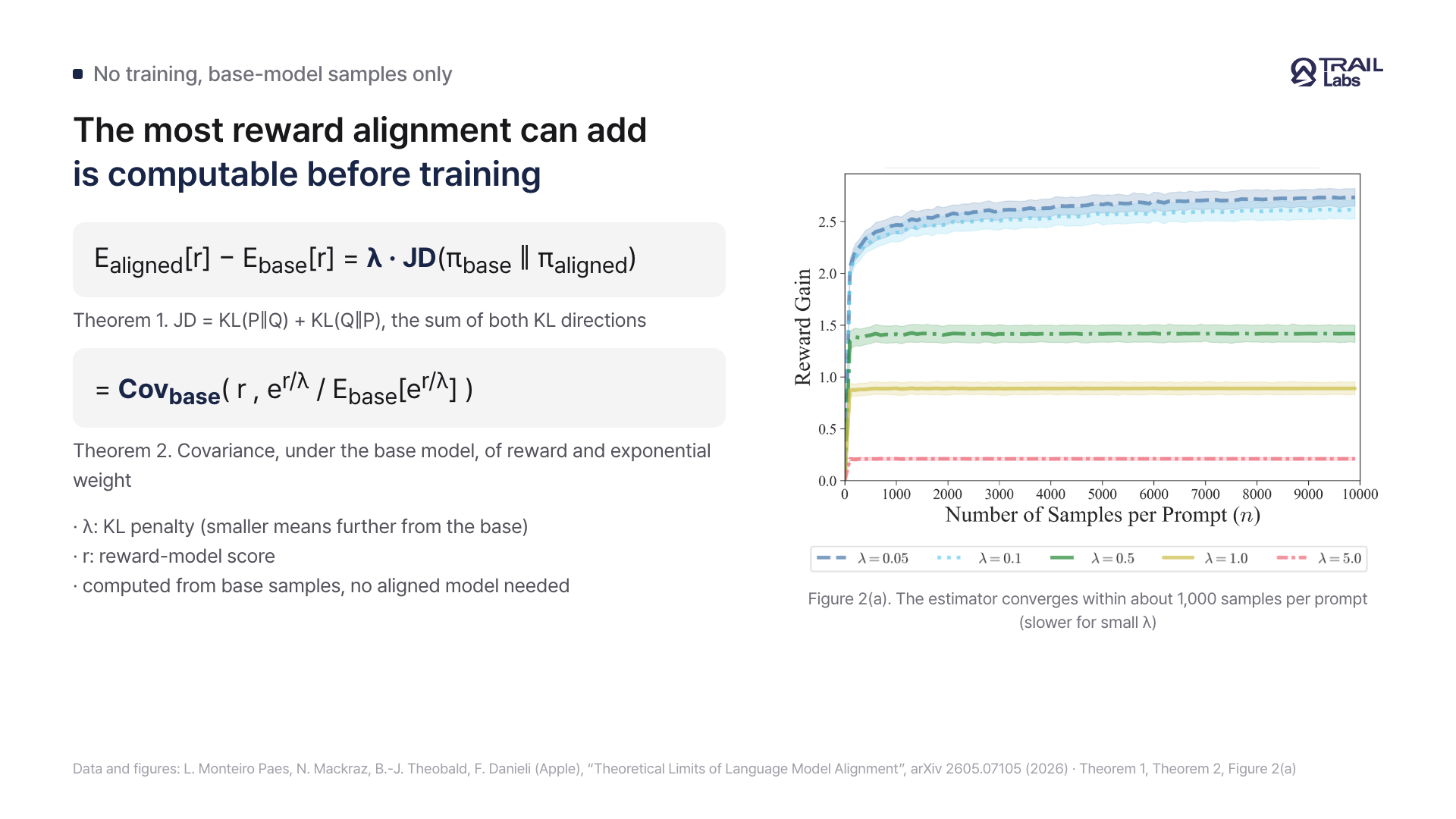
Figure 1. The most reward alignment can add is computed before training as a covariance under base-model samples, and the estimate converges as samples grow [1].
Why do PPO and GRPO get less reward than best-of-N?
On both tasks best-of-N sat almost on the ceiling curve, while PPO and GRPO stayed below it at every KL budget [1]. The experiments cover safety alignment and summarization. The safety task starts from Zephyr-7B (Mistral-7B supervised fine-tuned on UltraChat) with a Zephyr-7B-based reward model trained on PKU-SafeRLHF preferences [1]. The summarization task starts from Pythia-1B supervised fine-tuned on Reddit TL;DR with a Pythia-1B reward model trained on the same preferences [1]. The compared methods are PPO, GRPO, and best-of-N; DPO is excluded because it uses no explicit reward model [1]. PPO and GRPO went through an extensive hyperparameter sweep and the run with the best KL-reward trade-off is reported, and best-of-N varies N from 1 to 10,000 with its KL computed by the estimator of Beirami et al. [1][4].
| Task | Theoretical ceiling | Best-of-N | GRPO | PPO |
|---|---|---|---|---|
| Safety (Zephyr-7B, BeaverTails) | 2.764 | 2.722 | 2.117 | 2.084 |
| Summarization (Pythia-1B, TL;DR) | 0.387 | 0.385 | 0.282 | 0.187 |
Table 1. Maximum reward gain of each method within the KL range where the ceiling was computed (up to 9.14 for safety, up to 7.96 for summarization) [1]. GRPO and PPO values are from the runs shown in the main figure; for summarization two higher PPO runs were excluded as too noisy [1].
Computing ratios from Table 1, best-of-N reaches 98.5% and 99.5% of the ceiling, GRPO 76.6% and 72.9%, and PPO 75.4% and 48.3% [1]. The authors read GRPO and PPO staying below the ceiling at every KL budget as a structural limitation of current RL methods, and write that algorithmic improvements are needed to reach the optimum without high inference costs [1]. The paper offers no analysis of why gradient-based methods fall short of the optimal reweighting.
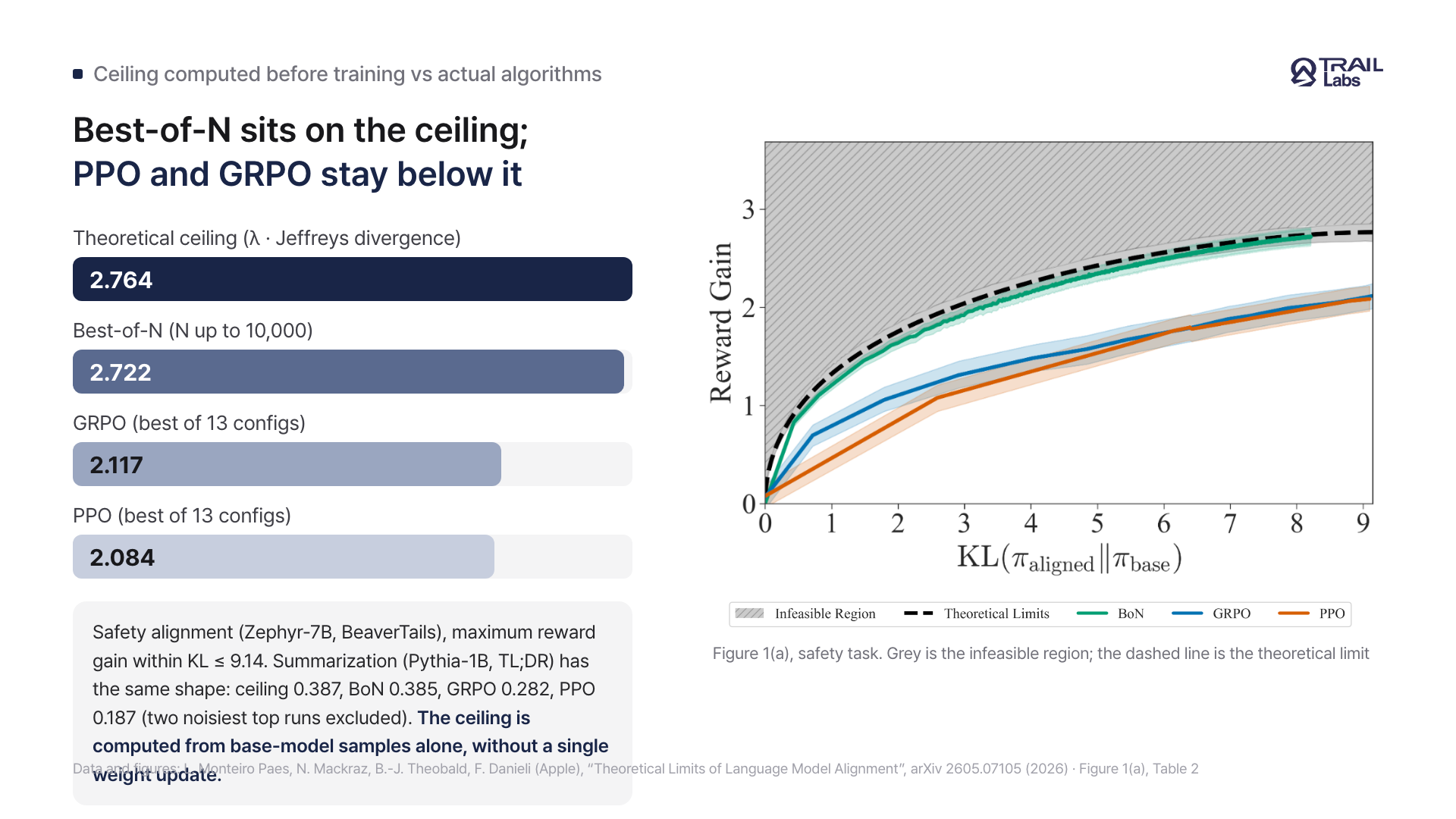
Figure 2. On safety alignment best-of-N sits on the dashed ceiling while GRPO and PPO stay below it at every KL budget [1].
The appendix sweep shows the same gap. On the safety task, 13 GRPO configurations of β, learning rate, and number of generations produced maximum gains between 1.886 and 2.117, all on one band below the ceiling, and 13 PPO configurations spread from 0.918 to 2.084, all below it [1].
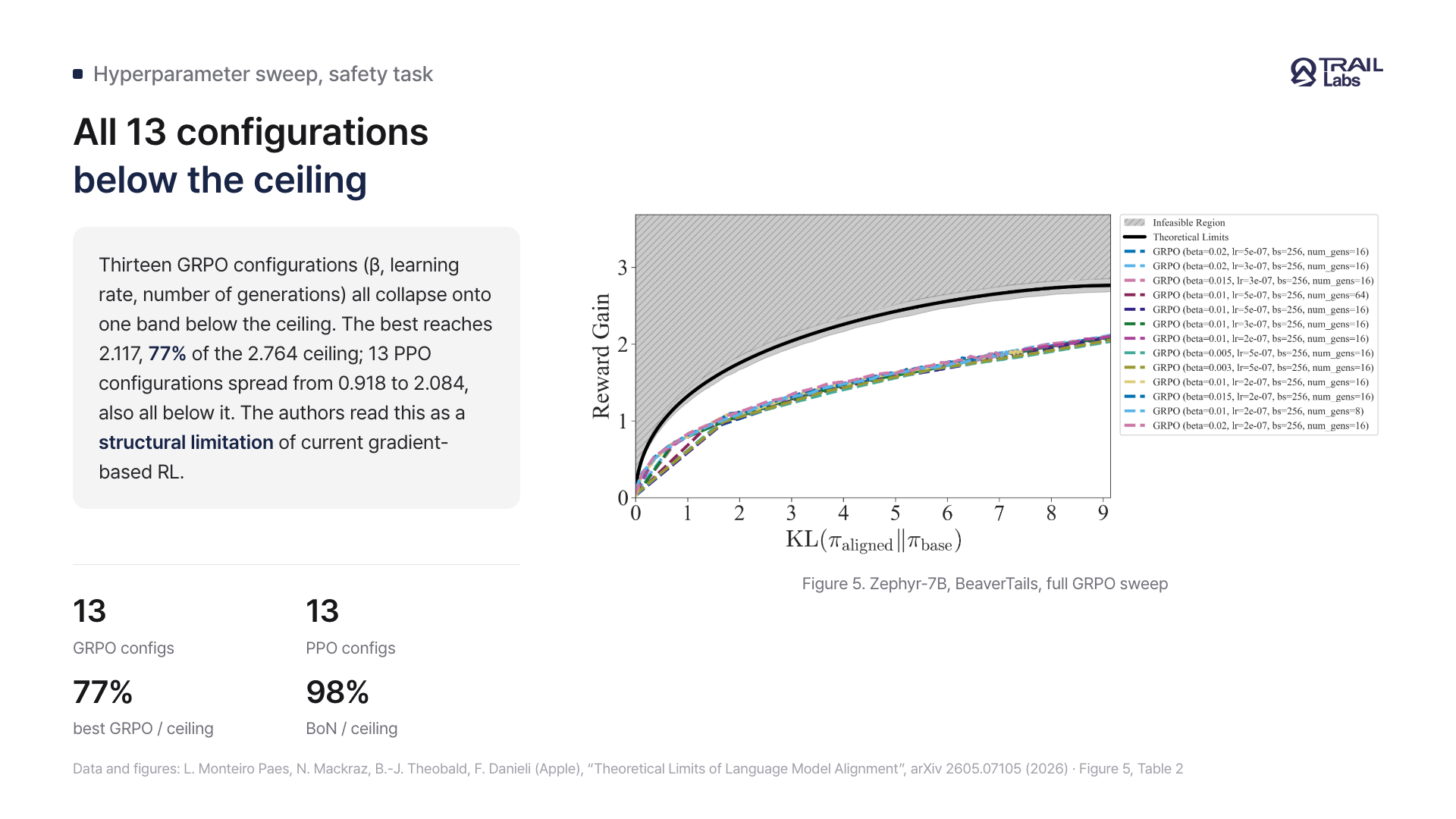
Figure 3. Every GRPO hyperparameter configuration collapses onto the same band below the ceiling [1].
Why does reward hacking happen and why do ensembles help?
Reward hacking happens because the proxy reward's error enters an exponential divided by the KL penalty λ [1]. The reward model used in training approximates the true reward that perfectly reflects human preference, and the paper calls the difference the preference residual [1]. Proposition 3 writes the true-reward gap between a model aligned to the true reward and one aligned to the proxy as a covariance containing an term [1]. Shrinking λ to move further from the base amplifies the same error exponentially, which explains the overoptimization curve that Gao et al. observed [1][2].
The effect of reward model ensembles is proven in the same framework. Proposition 4 is a Lipschitz-style bound tying the loss from aligning to a proxy to the distance between proxy and true reward, and Theorem 3 shows that averaging n independently trained reward models makes the aligned model's true reward converge to the ideal at a rate inversely proportional to the square root of n [1]. That gives a theoretical basis to the ensemble effect Coste et al. reported empirically [5]. It assumes each reward model equals the true reward on average, an unbiasedness condition [1].
Appendix C also examines how reward models are trained. Most reward models today are trained with the Bradley-Terry loss, which fits only the order of preferences and places no constraint on how much one answer is preferred [1]. So even a perfectly minimized loss leaves the preference residual free to grow [1]. The authors' example is data where comparisons happen only within separate clusters, such as helpful answers and safe refusals. The score offset between clusters never appears in the loss and can drift arbitrarily, and that offset inflates the exponential term in Proposition 3 [1]. Their proposal is reward modeling that also learns the magnitude of preference [1].
What are the limits of this study?
The authors state three limits. The results characterize the optimal solution of the KL-regularized objective, so they do not transfer directly to f-divergence regularization, win-rate maximization, or per-token KL [1]. The estimators converge slowly for small λ [1]. The reward hacking and ensemble analysis assumes proxy rewards are unbiased on average, and systematic bias is not covered [1].
We add a few from our reading. The experiments cover two model-dataset pairs, Zephyr-7B and Pythia-1B, on two single-turn tasks, with no multi-turn agent or coding task [1]. Reward gain is scored with the same reward model used for training, so sitting on the ceiling is not a claim about human-judged quality. Best-of-N's KL is an estimated value [1][4]. PPO and GRPO are the best runs of the authors' sweep, so how the gap behaves under other implementations or larger models is open. It is an arXiv preprint, and peer review is unconfirmed.
How can this result be used?
The first use is measuring the ceiling before training. Sampling about 1,000 answers per prompt from the base model and scoring them gives the maximum reward at each KL budget, and the KL budget needed for a target reward can be read off in reverse [1]. In our reading, a low ceiling points to the base model or the reward model as the constraint, not the algorithm.
The second is narrowing down where to look when training stalls. The ceiling can be estimated from base samples, and the gap between an actual run and the ceiling shows up by plotting the run on the same axes [1]. The proxy reward's residual cannot be measured directly, since it needs the true reward, but the paper gives its direction, exponential amplification as λ shrinks, and a mitigation, ensembling [1].
The third is keeping best-of-N as the reference line. In the paper's experiments best-of-N sat on the ceiling, so a new algorithm's result can be read as its distance from best-of-N [1]. The authors leave algorithmic improvement that reaches the optimum without high inference costs as the open task [1].
Frequently asked questions
Where is the performance limit when aligning language models with reinforcement learning?
Under a KL constraint, the reward an optimally aligned model gains over the base model equals the KL penalty λ times the Jeffreys divergence (the sum of both KL directions) between the base and aligned models. Earlier work had only an upper bound proportional to the square root of KL; this study gives the equality with no assumption on the reward distribution.
Can the reward gain from alignment be computed before training?
Yes. The same gain can be rewritten as the covariance, under the base model, between each sampled answer's reward and an exponential weight, so no aligned model is needed. In the paper's experiments the estimate converged within about 1,000 base samples per prompt, and sweeping λ traces the full KL-reward Pareto frontier before any training.
Why do PPO and GRPO get less reward than best-of-N?
In the paper's experiments best-of-N reached over 98% of the theoretical ceiling on both tasks, while GRPO reached 77% on the safety task and 73% on summarization, and PPO 75% and 48%. On the safety task, 13 GRPO configurations landed on one band below the ceiling, and the authors read this as a structural limitation of current gradient-based RL. The paper does not analyze why.
Why does reward hacking happen and why do reward model ensembles help?
Because the gap between the proxy reward and the true reward (the preference residual) enters an exponential divided by λ. Moving further from the base by shrinking λ amplifies small errors exponentially. The same framework proves that averaging n independently trained reward models shrinks the error at a rate inversely proportional to the square root of n, assuming each model is unbiased on average.
References
- [1]Lucas Monteiro Paes, Natalie Mackraz, Barry-John Theobald, Federico Danieli (Apple), "Theoretical Limits of Language Model Alignment", arXiv 2026
- [2]Leo Gao, John Schulman, Jacob Hilton, "Scaling Laws for Reward Model Overoptimization", ICML 2023
- [3]Youssef Mroueh, Apoorva Nitsure, "Information Theoretic Guarantees for Policy Alignment in Large Language Models", TMLR 2025
- [4]Ahmad Beirami et al., "Theoretical Guarantees on the Best-of-n Alignment Policy", ICML 2025
- [5]Thomas Coste, Usman Anwar, Robert Kirk, David Krueger, "Reward Model Ensembles Help Mitigate Overoptimization", ICLR 2024
Summary
- An Apple team derived the optimal reward gain of KL-regularized alignment in closed form as λ times the Jeffreys divergence, replacing the earlier square-root upper bound with an equality.
- Rewriting that gain as a covariance under base-model samples lets the whole KL-reward Pareto frontier be estimated without training, converging within about 1,000 samples per prompt.
- On safety and summarization tasks best-of-N reached over 98% of the ceiling while GRPO reached 77% and 73% and PPO 75% and 48%, with the safety task's 13 GRPO configurations landing on one band below the ceiling.
- Reward hacking arises because the proxy reward error enters an exponential divided by λ, and reward model ensembles shrink that error at a rate inversely proportional to the square root of n.
- Only two model-dataset pairs on single-turn tasks were measured, gain was scored with the training reward model, and the work is a preprint.
Check this topic against your own brand
TRAIL Search measures how ChatGPT and Perplexity answer your customers' questions and finds and fixes where the brand is missing, turning this post into a diagnosis. Start with 10 questions, no card required.
More posts

Do AI search sources change with the user's location?
A 2026 University of Toronto audit of how user location changes the sources ChatGPT and Gemini cite, and which channel each engine reads location from.

How AI product recommendations vary across tools and APIs
A 2026 study of how decisively AI chatbots recommend products, which sources they display, and whether API audits represent the consumer screen.

How often do AI answers name people, and what rosters miss
A 2026 study of 2,400 grounded AI calls measures how often AI names individual professionals, and how much a roster-based count misses.
Keep reading on this topic
- MMDocRAG: can AI pick evidence in multimodal document RAG?MMDocRAG is a NeurIPS 2025 benchmark for multimodal document RAG. Even with perfect retrieval, the best model reaches only 70.2% quote-selection F1.
- Video-RAG: retrieving OCR and speech text, not more framesVideo-RAG retrieves OCR, speech, and object text for long video QA instead of more frames. A NeurIPS 2025 paper that lifts Video-MME without training.
- DeepSeek V4.1 Flash: smaller KV cache, same post-trainingReading the DeepSeek V4.1 Flash report: a KV cache cut to a quarter of V4's, and post-training that keeps V4's SFT, RL, and OPD recipe, changing only the data.
This post is part of the Papers category, which collects all 30 posts on the topic. See all posts in Papers