
What marketers worry about most in AI search: reporting data
We regrouped a survey by company size into information and existence problems, then counted the sample sizes from the public response sheet
Marketers worry less about vanishing from AI search than about lacking reliable reporting. We checked whether that differs by company size.
What marketers worry about most in AI search isn't their brand disappearing. It's not being able to see what is happening. In an in-house marketing survey Smarty Marketing published in September 2026, the top AI visibility concern was "not having access to reliable reporting and monitoring data" (39.7%), while "not being able to get my business found online" and "total loss of organic search" came in at 5.5% each [1]. Regroup the five options into information problems and existence problems and that gap holds at every company size.
First, the scope of our evidence. Our primary sources are the Smarty Marketing article with its charts, and the anonymized response sheet linked in its methodology section [1][2]. We copied chart values as they appeared in the article as of October 2026, and we counted sample sizes ourselves from a copy of the public sheet downloaded at the same time. The interval calculations (95% Wilson intervals) are also ours. A note on our own interest: TRAIL Labs runs a product that measures AI search visibility, so a conclusion that "measurement is the problem" favors us. That's why this post makes no claims beyond what the survey shows, and why we show how solid each number is.
The marketing survey asked in-house teams and business owners directly
Respondents were in-house marketing and SEO teams (87%) and business owners (13%) whom the author personally contacted [1]. The author, Ann Smarty, explains that she wanted to hear from teams that run one brand with a unified strategy, as opposed to agencies and freelancers juggling many clients. For the same reason she focused on bigger brands and decision makers, and the article itself says the sample skews toward larger companies.
The company size breakdown published in the article is Enterprise (100+ employees) 58.9%, Medium (up to 100) 35.6%, and Small (1–10) 5.5%. Of the responding companies, 69.9% have been in business for more than 10 years [1]. It's an annual survey run in the same format, so the article also compares results with 2025.
Here is how respondents answered when asked to pick their single biggest AI visibility concern [1].
| Concern | Share of all responses | Group |
|---|---|---|
| Not having access to reliable reporting and monitoring data | 39.7% | Information |
| Not knowing which optimization tactics to prioritize | 26% | Information |
| Loss of traffic (and click attribution) | 21.9% | Other |
| Not being able to get my business found online | 5.5% | Existence |
| Total loss of organic search | 5.5% | Existence |
Table 1. Distribution of AI visibility concerns in Smarty Marketing's 2026 survey (all respondents). The "Group" column is our own classification and does not appear in the original [1].
The article frames this as a shift from last year. In 2025 the most common worry was not being found online; this year reporting and monitoring moved to the top [1]. The share worried about the future of online visibility because of AI fell from 87.76% (2025) to 69.90% (2026), and the share saying they have some understanding of what an AI visibility strategy should include rose from about 60% to 87.7%. As overall worry shrank, what remained was "so what is actually happening right now?"
Do AI search concerns differ by company size?
At the group level, what company sizes share outweighs how they differ. Information problems led existence problems at every size [1]. Grouping the five options into two kinds makes the structure clearer. Information problems are not knowing which tactics to prioritize and not having reliable reporting and monitoring data. Existence problems are not being found online and losing organic search entirely. Traffic loss doesn't fit cleanly into either, so we kept it separate.
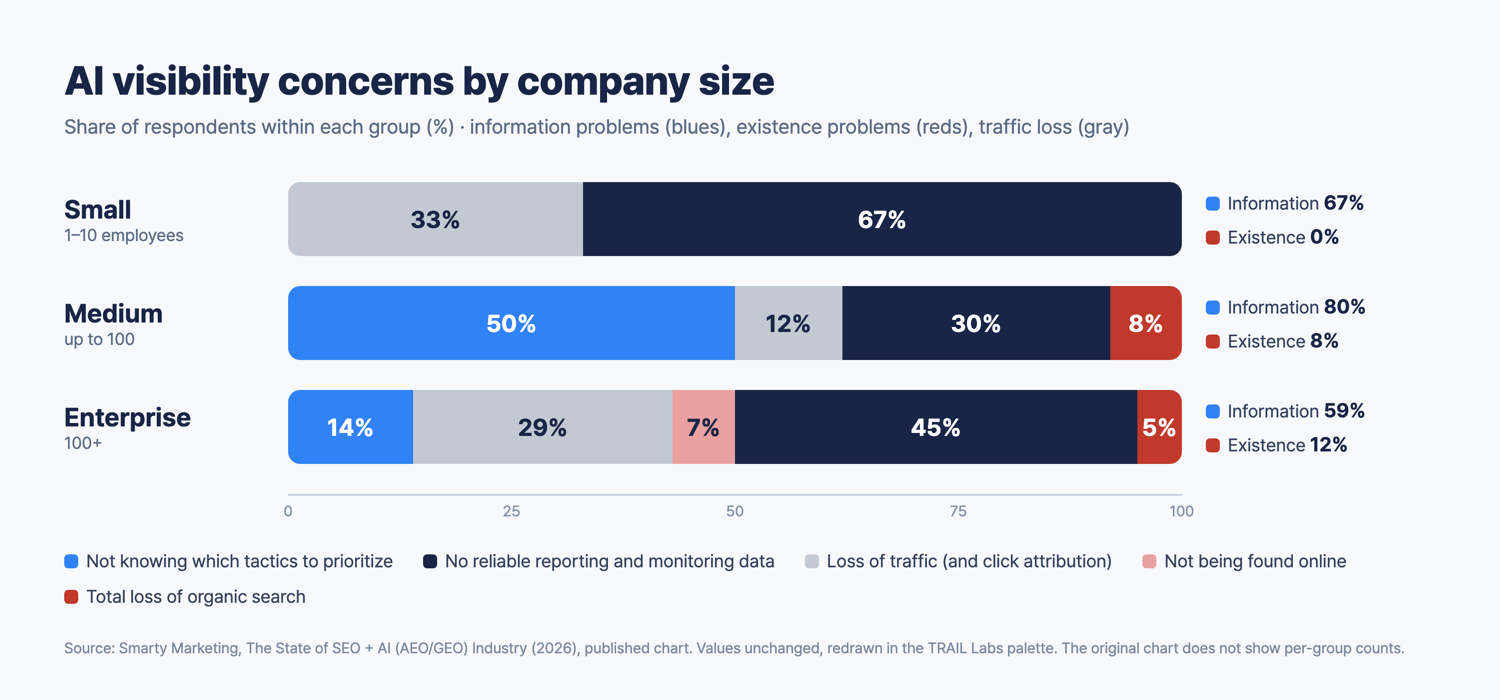
Figure 1. AI visibility concerns by company size. We redrew Smarty Marketing's published chart in our palette without changing any values; the totals on the right are our own groupings [1].
| Company size | Information (tactics + reporting) | Existence (not found + organic loss) | Traffic loss |
|---|---|---|---|
| Small (1–10 employees) | 67% (0 + 67) | 0% (0 + 0) | 33% |
| Medium (up to 100) | 80% (50 + 30) | 8% (0 + 8) | 12% |
| Enterprise (100+) | 59% (14 + 45) | 12% (7 + 5) | 29% |
Table 2. Chart values regrouped into information and existence problems. Each row sums to 100% [1].
Grouping the chart values in Table 2 ourselves, information problems are more than five times larger than existence problems at every size [1]. Even in Enterprise, where the gap is smallest, it's 59% vs. 12%. The most solid fact in this survey is this group-level gap. What respondents fear is less a scene where AI answers erase their brand and more a state where they can't explain what changed.
The top concern differs by size
Unpack the groups and the top item changes by size. Small has responses in only two items, reporting and monitoring (67%) and traffic loss (33%), with zero everywhere else. In Medium, not knowing which tactics to prioritize is first at 50%. In Enterprise, reporting and monitoring is back on top at 45% [1]. The article summarizes it the same way: Medium worries most about tactical priorities, Enterprise about reporting, monitoring, and data reliability.
Here's how we read the pattern. The Small distribution looks like the view from inside a single channel: either measurement fails or traffic drops, with no room for anything else. Medium looks like a team with enough options to choose wrong, and in the article about 89% of Medium companies said they worry about the future of their online visibility because of AI, higher than Enterprise (64%) [1]. Enterprise has more surfaces and more stakeholders, which means more numbers you didn't run yourself but still have to explain to someone else. This is our reading of the response distribution, not something the survey tested directly.
The article's open-ended "what else worries you" answers point the same way. They include not having actionable KPIs to justify budgets, and finding it hard to assess the criteria behind AI recommendations and their contribution to sales [1]. In the same survey, the main GEO/AEO KPIs teams chose were more brand mentions in AI answers (33.7%), a higher AI visibility score (20.2%), more citations in answers (19.5%), and more clicks from LLM platforms (18.5%). The targets are set, but the instruments for trusting those targets are missing.
Read a chart that doesn't disclose sample sizes by counting the response sheet
A share without a sample size should be read only after you find and count the responses yourself. The original chart shows shares per group but no response counts. A share alone can't tell you how firm it is. Fortunately, the article's methodology section links an anonymized response sheet, so we downloaded it as of October 2026 and counted the "biggest concern" question by company size ourselves [2]. The sheet contained 71 responses submitted between September 14 and 19, 2026.
| Company size | Responses | Item | Matching | Share | 95% Wilson interval |
|---|---|---|---|---|---|
| Small | 3 | Reporting and monitoring | 2 | 66.7% | 20.8–93.9% |
| Small | 3 | Existence problems | 0 | 0% | 0–56.2% |
| Medium | 26 | Tactical priorities | 13 | 50.0% | 32.1–67.9% |
| Medium | 26 | Information total | 20 | 76.9% | 57.9–89.0% |
| Enterprise | 42 | Reporting and monitoring | 19 | 45.2% | 31.2–60.1% |
| Enterprise | 42 | Information total | 25 | 59.5% | 44.5–73.0% |
| Enterprise | 42 | Existence problems | 5 | 11.9% | 5.2–25.0% |
Table 3. Response counts, shares, and 95% Wilson intervals by company size, counted by us from the public response sheet. The sheet is a copy as of October 2026 [2].
By our count of the public response sheet, Small's 67% is 2 people out of 3 [2]. The 95% interval we calculated for that share is 20.8–93.9%, so there's no basis for comparing Small and Enterprise on reporting and monitoring (67% vs. 45%) and saying "small companies worry about measurement 22 points more." Even groups with dozens of responses, like Medium and Enterprise, have intervals around 30 points wide. On the other hand, the conclusion that information problems outweigh existence problems holds within these intervals. Enterprise's lower bound for information problems (44.5%) sits above its upper bound for existence problems (25.0%).
We should also note that the sheet and the chart don't match exactly [1][2]. The chart shows Medium as 50% / 12% / 30% / 8% with no "not found" segment, while the sheet's 26 Medium responses were 13 tactics, 7 reporting and monitoring, 3 traffic loss, 2 organic loss, and 1 not found. The size breakdown in the article (58.9 / 35.6 / 5.5%) also differs from the 71-row sheet by fractions of a point. The article alone doesn't tell us which snapshot the chart was built from, so Figure 1 keeps the chart values and Table 3 keeps the sheet counts, each as is. Either way, the group-level conclusion is the same.
Publishing a survey and opening the response sheet is rare in this field, and it's what made this check possible. Our point isn't a criticism. A share without its denominator can't carry a confidence statement, so when you read a chart, it's worth looking for the response counts too. We hold our own numbers to the same discipline.
Why reliable AI visibility reporting and monitoring data matters
If the center of the worry is measurement, the first thing to fix in AI search work is the instrument, ahead of content volume. If visibility itself were the main problem, the job would be to publish more and optimize harder. If the main problem is that nobody can say what is happening right now, the bottleneck is the tooling, not the output. You can triple your content and, if you don't know which piece changed an AI answer, the next decision still rests on gut feel.
Lining up the survey's investment answers next to its concerns makes the gap clearer. All responding companies (100%) said they are already investing or plan to invest in AI visibility (85.7% in 2025), and 66% plan to raise their SEO budget because of LLMs. Among Enterprise companies that share is 76% [1]. The top tactics started because of AI were optimizing new content for AI (25.2%), Reddit marketing (24.4%), and refreshing existing content (23.6%), mostly on the output side. Budgets and execution flow into content, while the biggest worry is the data needed to read the results. The author also writes in her conclusion that teams don't have actionable first-hand data and that third-party data is easily skewed by which prompts you choose [1].
The measurement tool itself can't be run once and trusted either. The Don't Measure Once study reported that when the same question was rerun on the same day, the overlap (Jaccard) between cited source sets was only 0.32–0.43 (in the paper's experiments) [3]. A report built from a single query carries that wobble with it. So the conditions for "reliable reporting" have to include rules like repeated measurement, separating unmeasured vs. zero, and flagging periods when the question set changed. We laid these out as weekly and monthly routines in the AI search measurement framework.
Report format follows the same principle. Collapse every engine into one score and you can't explain what changed in which engine. We covered engine-level breakdowns in why a single AI visibility score is risky, and question-level tracking continues in prompt tracking and monitoring. This kind of explainability is what the survey respondents are asking for. The core worry is less whether a number went up and more whether you can tell someone else why it did.
Limits
There are clear limits to what this survey and our analysis can say.
- It isn't a random sample. Respondents are in-house teams and business owners the author contacted directly, skewed toward bigger brands and decision makers [1]. Don't generalize it to the whole industry.
- The Small group is effectively uninterpretable. With 3 responses in the public sheet, Small's per-item shares are closer to a record of a few individual answers [2].
- Respondents could pick only one option. Teams with several concerns still picked one, so this data can't tell you how large the second or third concerns are.
- The information vs. existence grouping is ours. It isn't in the original, and the totals change depending on where you put traffic loss. We put it in neither group.
- The sheet and the chart differ in places. This likely reflects responses being added or cleaned at different times, but the article alone can't confirm it. That's why we kept the two sources separate instead of mixing values.
- This isn't Korean market data. The concern distribution for in-house teams in Korea would need its own survey.
Wrap-up
Marketers' biggest worry about AI search is operating blind, more than disappearing. In Smarty Marketing's 2026 survey, information problems clearly led existence problems at every company size, and that conclusion holds after checking sample sizes against the public response sheet. Fine-grained comparisons, like a few points' difference between sizes, aren't supported by the sample, so read those only as direction. The fact that concern clusters around measurement is a signal to check what you measure, and how much you trust it, before deciding what to do next in AI search.
Frequently asked questions
What concern about AI search did marketers pick most often?
In Smarty Marketing's 2026 survey, "not having access to reliable reporting and monitoring data" ranked first at 39.7%. Add the 26% who don't know which tactics to prioritize and information problems make up nearly two thirds of responses. Not being found online and total loss of organic search were 5.5% each.
Do concerns differ by company size?
The top item does. By the chart, Small (1–10 employees) and Enterprise (100+) ranked missing reporting and monitoring data first (67% and 45%), while Medium (up to 100) ranked not knowing which tactics to prioritize first at 50%. Across all three sizes, though, information problems (59–80%) outweighed existence problems (0–12%).
Is the 67% for Small companies a reliable number?
Not beyond direction. Counting the anonymized response sheet linked in the article, the Small group had 3 responses, so 67% is 2 people out of 3. The 95% Wilson interval for that share is 20.8–93.9%, so it shouldn't be used to compare magnitudes against other groups.
Who did this survey ask?
In-house marketing and SEO teams (87%) and business owners (13%) whom the author contacted directly. The author says she focused on bigger brands and decision makers, and 58.9% of responding companies have more than 100 employees. It isn't a random sample, so don't generalize it to the whole industry.
References
- [1]Ann Smarty, "The State of SEO + AI (AEO/GEO) Industry: What Do In-House Marketing Teams Prioritize and Fear?", Smarty Marketing (published 2026-09-21, updated 2026-09-24)
- [2]Smarty Marketing, anonymized response sheet for the 2026 survey (linked in the article's methodology section)
- [3]Schulte, Bleeker & Kaufmann, "Don't Measure Once: Measuring Visibility in AI Search (GEO)", arXiv 2026
Summary
- In Smarty Marketing's 2026 survey, the top AI visibility concern was missing reliable reporting and monitoring data (39.7%), while the two vanishing-related options combined came to 11%.
- Grouping the five options into information and existence problems gives Small 67% vs. 0%, Medium 80% vs. 8%, and Enterprise 59% vs. 12%: information problems lead at every size.
- Counting the anonymized response sheet linked in the article gave 3 Small, 26 Medium, and 42 Enterprise responses, so Small's 67% is 2 people out of 3.
- Per-group 95% intervals are wide, so read this survey as "measurement problems dominate" and not as precise point gaps between company sizes.
- If the center of the worry is measurement, the first thing to fix in AI search work is what you measure and how, ahead of content volume.
Check this topic against your own brand
TRAIL Search measures how ChatGPT and Perplexity answer your customers' questions and finds and fixes where the brand is missing, turning this post into a diagnosis. Start with 10 questions, no card required.
More posts

How is AI answer visibility defined and measured?
How is AI answer visibility defined and measured? Three metrics with formulas and paper figures: visibility (GEO), contribution (Shapley), and stability.
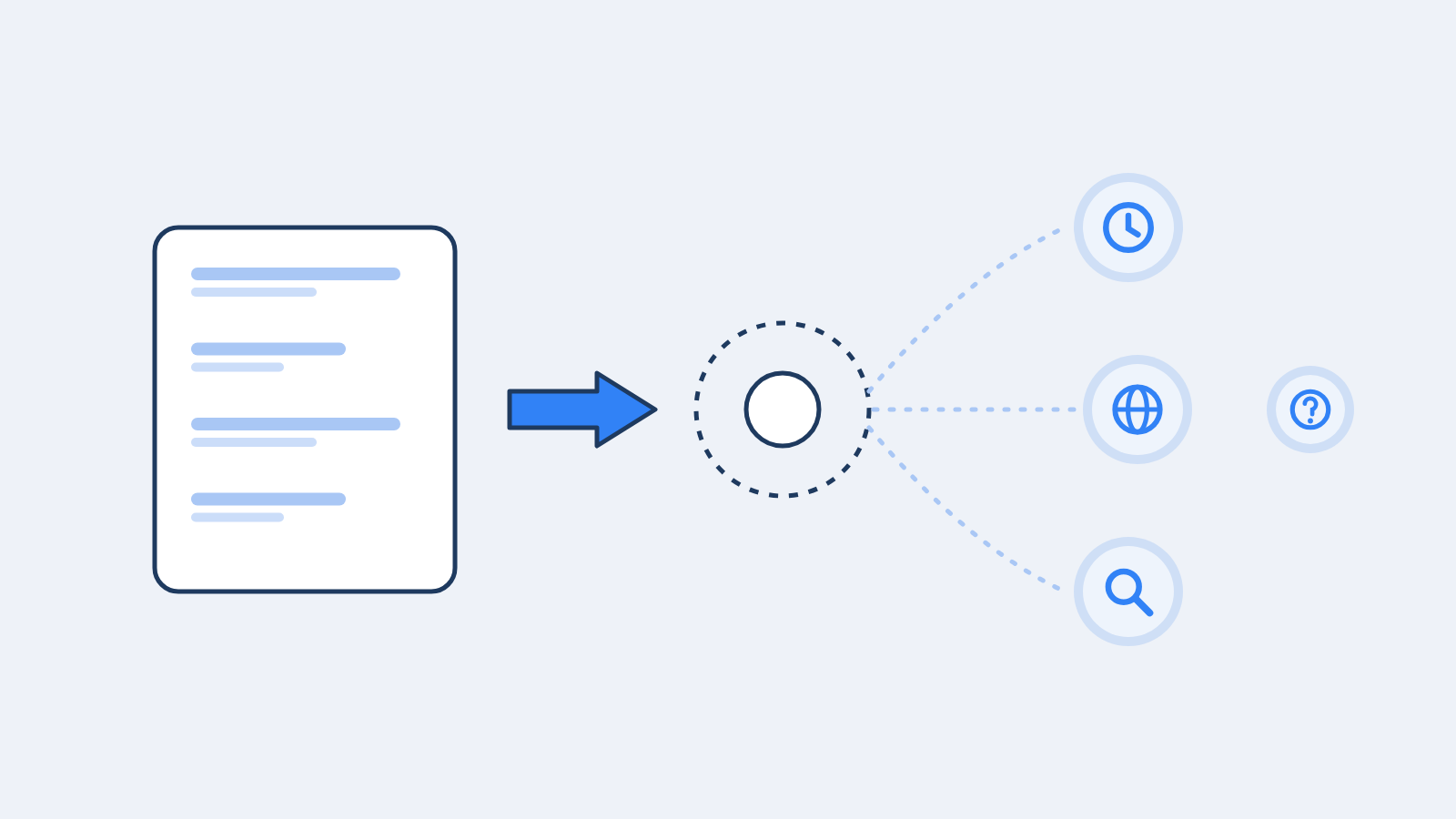
The prompt you track is not the query AI actually searched
AI visibility reports score each tracked prompt, but retrieval and citation happen on fan-out sub-queries. What year and English injection mean for measurement.
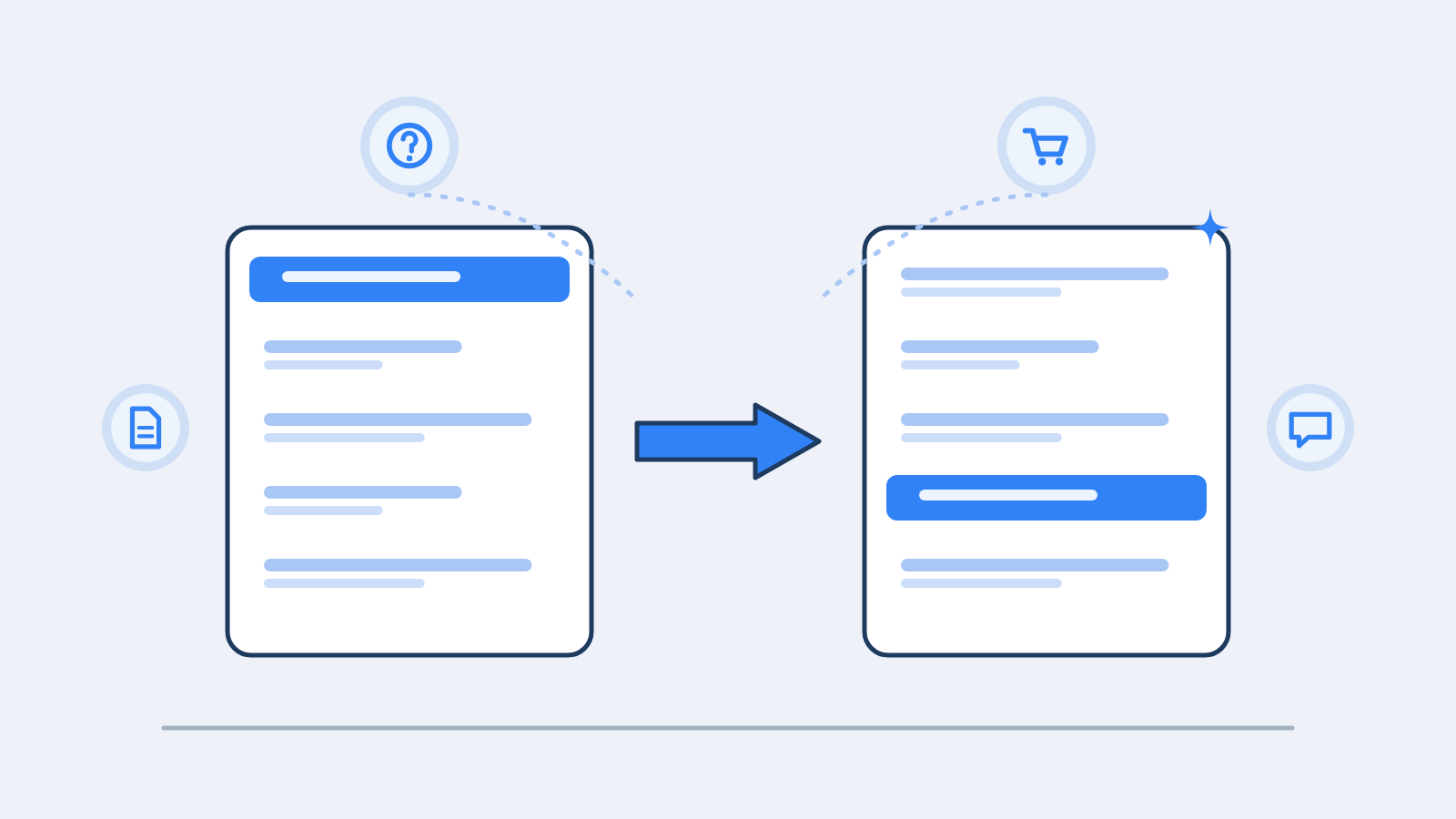
Which content types AI cites, by search intent
The content type AI search cites flips with intent: articles lead informational prompts (45.5%), listicles lead commercial ones (40.9%).
Keep reading on this topic
- How are retrieval and citation different in AI search?Retrieval and citation are different stages in AI search. Does ChatGPT cite YouTube? Why our content is missing from AI answers, and what zero citations mean.
- The LLMO trap: training data vs. AI answer citationsSeeding your brand in LLM training data and getting cited in AI answers are different mechanisms. How they differ, what you can measure, and why advice splits.
- Should AI visibility be measured through the API or the UI?The same prompts through the ChatGPT API and UI shift brand visibility 41% on average and change cited sources. What to check when choosing a measurement tool.
This post is part of the Analysis category, which collects all 34 posts on the topic. See all posts in Analysis