Why Your Site Isn't in AI Search: A 10-Gate Checklist
Before writing more content, find out which gate you're stuck at
AI search visibility is a pipeline of gates from discovery to answer selection. How to audit each step, what to fix first, and what to check if new posts fail.
There isn't just one reason your brand doesn't show up in AI search. You have to pass several gates in order, from discovery to final answer selection, and if you get stuck at any one of them, no amount of improvement to the later steps will help. "Just write more good content" is sometimes right, but not always. Even if you already have good content, crawlers may not have found the page, or JavaScript rendering may have kept the body from being read properly. Or everything may be technically fine, yet AI hasn't understood your brand as a trustworthy candidate in a particular category.
Why look at it as a pipeline?
The most common problem pattern looks like this. The page gets crawled. It gets indexed. But it doesn't show up in recommended answers. Jumping straight to "let's write more content" here creates inefficiency, because you're just adding pages without knowing which step you're stuck at.
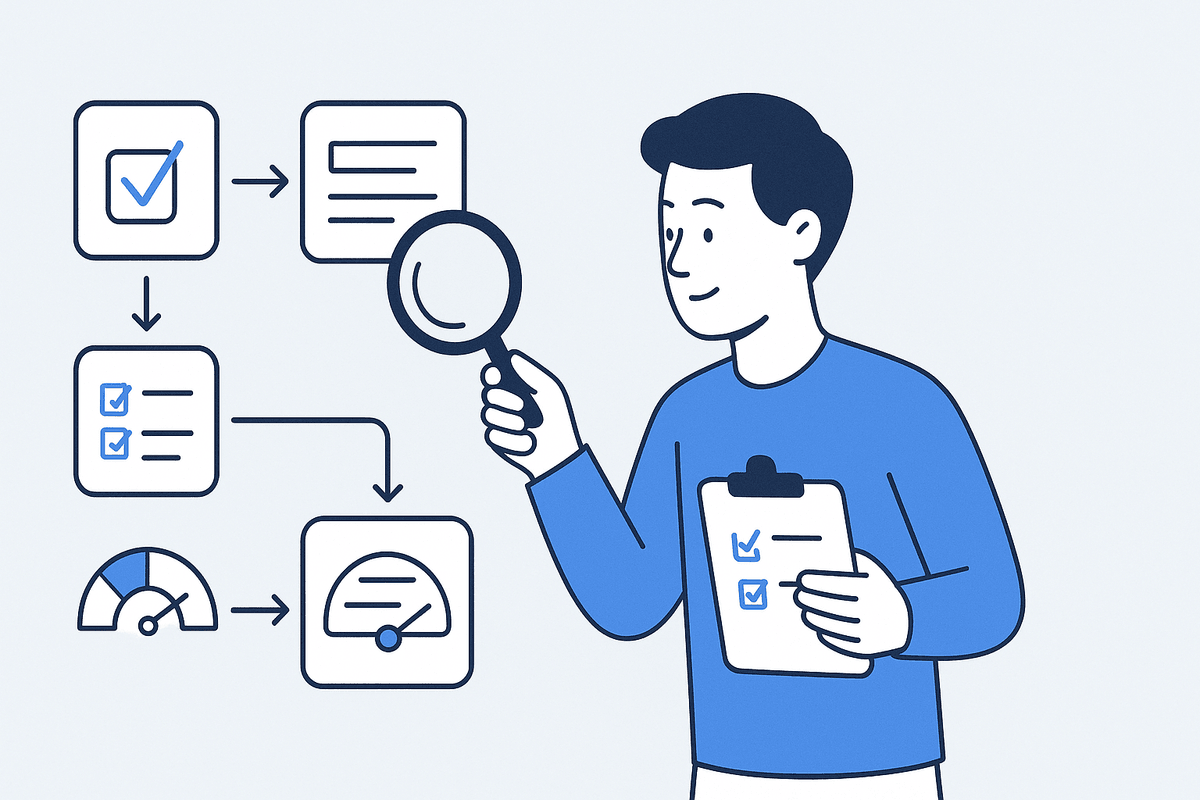
AI search diagnosis isn't something to sum up in a single score. It should be treated as work that checks each gate of the pipeline one by one.
Reading the 10 gates as 3 layers
The original concept is organized into 10 gates: Discovered, Selected, Crawled, Rendered, Indexed, Annotated, Recruited, Grounded, Displayed, and Won. Those terms can be a bit hard to use as-is, so in practice it's easier to understand them in three layers.
| Layer | Gates included | Core question |
|---|---|---|
| Technical access | Discovered / Selected / Crawled / Rendered / Indexed | Can AI and search systems discover, fetch, read, and store the page? |
| Meaning | Annotated / Recruited / Grounded | Does AI understand the brand, product, category, and evidence with enough confidence? |
| Answer selection | Displayed / Won | Does the brand appear in real answers, and is it chosen over competitors at the recommendation, comparison, and action stages? |
What matters here is the order. If the front is blocked, the later steps lose their meaning. If a page isn't discovered, it can't be cited. If it doesn't render, the system has a hard time reading it even if it contains good sentences. If your entity and category are unstable, it's hard to get into the candidate pool. And even if you get into the candidate pool, weak external evidence can push you out of the final answer.
Layer 1, technical access: can the system know, fetch, and read it?
The first layer is the fundamentals that mattered even before AI search. It includes discovery, selection, crawling, rendering, and indexing. Put simply: "Does the system know this page exists, can it fetch it, can it read it, and does it judge it worth storing?"
| Gate | Failure symptom | What to check |
|---|---|---|
| Discovered | Bots don't know the URL exists | Sitemap, internal links, inbound links |
| Selected | Discovered but deprioritized for processing | Internal link depth, anchor text, page importance, update signals |
| Crawled | Fetch fails | robots.txt, status codes, redirect chains, server performance |
| Rendered | Fetched, but meaning extraction fails | Whether SSR is used, JavaScript dependence, visible on-screen text, HTML tables, schema |
| Indexed | Processed, but not worth storing or indexing | canonical tags, duplicate content, thin content, index status |
Much of this area can be confirmed with official tools such as Search Console, and understanding how bots access your site through official crawler documentation also helps [1]. That said, claiming any single tool measures these five gates perfectly on its own would be an overstatement. You need to look at several tools together to be accurate.
Layer 2, meaning: does AI understand your brand with confidence?
Being technically accessible isn't the end. The second layer covers how confidently AI understands your brand, products, and category.
- Annotated: Whether structured data and entity markup make the relationships in your content clear. Schema markup helps AI and search engines accurately recognize question-answer pairs and relationships such as author and publish date [2].
- Recruited: Whether your brand is included in the candidate pool for answers to a specific category or question.
- Grounded: Whether external sources, statistics, and citations back you up so AI judges you as trustworthy evidence. GEO research also reports that figures presented with sources raise the likelihood of being cited [3].
This step is hard to diagnose perfectly with automated tools alone. You need to query real AI engines with prompts and directly observe whether your brand appears in the candidate pool.
Layer 3, answer selection: are you actually displayed and chosen?
The last layer is the outcome on the actual answer screen. Even if you're in the candidate pool, it won't lead to real results unless you're mentioned earlier and in more detail than competitors.
- Displayed: Whether your brand appears in the actual answer.
- Won: Whether you're ultimately chosen over competitors at the recommendation, comparison, and action stages.
This layer often can't be completed through content improvements alone. It's an area shaped by everything together: brand consensus, external trust signals, and even real product competitiveness.
The order for applying the diagnosis in practice
- Check technical access first. Make sure there are no problems with crawl and index status.
- Review structured data and content structure. Check for direct-answer definitions, sources, and comparison tables.
- Query AI engines with your actual target prompts and observe whether your brand appears in the candidate pool.
- If you appear but aren't chosen, compare whether you lack evidence and trust signals relative to competitors.
Skipping the earlier steps and working on later ones first only wastes resources. You have to go through them in order to find where the problem actually is.
Making the diagnosis repeatable
Checking these 10 gates by hand every time isn't sustainable. TRAIL Search (search.traillabs.ai) diagnoses technical access signals together with whether your brand appears and is chosen in real AI answers, so you can use it to see which gate you're stuck at right now.
The reason you don't show up in AI search is usually not one thing but several gates tangled together. Rather than adding content without diagnosis, the most efficient starting point is to first find out where you're stuck.
For related reading, see Whose job is AEO? Beyond the SEO team to brand consensus, A guide to core SEO and GEO metrics: five GEO metrics and how to read them when they disagree, and What is GEO (Generative Engine Optimization)? Which pages to start with, and in what order.
Frequently asked questions
If my content quality is good, won't I show up in AI search too?
Not always. Even good content never reaches AI in the first place if it can't be crawled or if JavaScript rendering prevents the body from being read properly. On the other hand, there are also cases where everything is technically fine but you're left out of the candidate pool because AI doesn't understand your brand or category well enough.
Which step should I start checking from?
Check in order, starting from the front. If technical access such as discovery, crawling, rendering, and indexing is blocked, no amount of improvement to later steps like meaning or answer selection will help.
Can I measure all 10 steps on my own?
You can confirm much of the technical access layer with official tools such as Search Console. But the meaning and answer selection steps require querying real AI engines with prompts and observing the results, so there are limits to measuring them on your own.
References
Summary
- AI search visibility isn't a single fix like "just write good content." It's a pipeline problem where you have to pass several gates.
- The 10 gates can be grouped into three layers: technical access (discovery, selection, crawl, render, index), meaning (entity, candidate inclusion, grounding), and answer selection (display, adoption).
- If the front is blocked, later steps don't matter. If you aren't discovered, you can't be cited; if the page doesn't render, even good sentences won't be read.
- Adding content without knowing which gate you're stuck at piles up inefficiency. Step-by-step diagnosis comes first.
Check this topic against your own brand
TRAIL Search measures how ChatGPT and Perplexity answer your customers' questions and finds and fixes where the brand is missing, turning this post into a diagnosis. Start with 10 questions, no card required.
More posts
Getting cited when Google AI Mode builds the answer
In November 2025 Google put Gemini 3 in AI Mode to build custom layouts and tools per query while keeping links to web sources. Here is what gets cited.
How is AI answer visibility defined and measured?
How is AI answer visibility defined and measured? Three metrics with formulas and paper figures: visibility (GEO), contribution (Shapley), and stability.
The prompt you track is not the query AI actually searched
AI visibility reports score each tracked prompt, but retrieval and citation happen on fan-out sub-queries. What year and English injection mean for measurement.
Keep reading on this topic
- Which content types AI cites, by search intentThe content type AI search cites flips with intent: articles lead informational prompts (45.5%), listicles lead commercial ones (40.9%).
- How are retrieval and citation different in AI search?Retrieval and citation are different stages in AI search. Does ChatGPT cite YouTube? Why our content is missing from AI answers, and what zero citations mean.
- The LLMO trap: training data vs. AI answer citationsSeeding your brand in LLM training data and getting cited in AI answers are different mechanisms. How they differ, what you can measure, and why advice splits.
This post is part of the Analysis category, which collects all 35 posts on the topic. See all posts in Analysis