Who Owns AEO? Beyond the SEO Team to Brand Consensus
SEO organizes your site; AEO organizes how the whole market describes you
AEO isn't a solo SEO job but market consensus built by brand, product, and sales. Who fixes it when AI answers skip your brand, and how to split ownership.
AEO (Answer Engine Optimization) is something the SEO team can't complete alone. Because AI's understanding of a brand draws not only on your own site but also on reviews, PR, comparison content, and sales language, you need a "market consensus" (brand consensus) built jointly by brand, product, and sales teams to be cited in AI answers. Many teams show up reasonably well in search results, yet competitors appear more often in AI answers. In this post, we'll lay out why that happens and how AEO ownership should be split.
Why doesn't an SEO checklist alone get you into AI answers?
Many teams approach the problem "we don't show up in AI answers" as an SEO problem. They check whether pages are indexed, fix technical errors, and add FAQ sections. This is necessary work. If technical accessibility is broken, AI can't even read your content in the first place.
The problem comes when strange things keep happening even after all this work is done. The site is well organized, but competitors are mentioned more often in AI answers. The product description is written accurately, but review sites and comparison content introduce it under a different category. The phrases the sales team uses with customers differ subtly from the homepage copy, and the positioning in press coverage and product documentation is out of step too.
In this situation, no matter how many times you repeat technical site improvements, the root problem isn't solved. That's because the "consistent description within the market" that AI references hasn't been sorted out yet. The GEO research from Princeton and IIT Delhi also points not only to content structure but also to signals that back up trust, like adding statistics, quotations, and authoritative sources, as factors that raise the probability of being cited [1]. Trust signals aren't completed within your own pages alone.
The distinction "SEO is product, AEO is brand"
There's a framework often cited in the industry: SEO is closer to product, and AEO is closer to brand.
SEO no longer stops at writing a few blog posts and inserting keywords. It's closer to ongoing operations that let search engines discover, read, and evaluate a website. Whether pages are crawlable, whether important pages are indexed, whether the information architecture matches search intent, whether content answers real questions, whether structured data matches what's on screen: these are the practice of SEO. That's why it's closer to product operations than to a campaign.
AEO and GEO, on the other hand, are closer to "in what context will AI understand our brand when it builds an answer?" AI answers aren't built by looking at your own site alone. Many sources work together: search results, external content, press coverage, reviews, comparison posts, community mentions, partner pages, and documented case studies. Google also explains that AI Overviews build answers by synthesizing multiple sources [2].
Of course, companies can't fully control this process. Having many external mentions doesn't necessarily mean being cited in AI answers either. But if you've written great sentences only on your own site while the market as a whole describes you differently, it's clearly hard for AI to understand your brand consistently.
What is brand consensus?
"Brand consensus" means a state where what you say about yourself and what the market says about you point in the same direction. Contrasting them like this makes the difference clear.
| Category | Description on your own site | Description across the market |
|---|---|---|
| Controllability | Fully controllable | Only partially influenceable |
| Sources | Homepage, product docs, blog | Reviews, comparison posts, PR, communities, partner pages |
| Weight in AI's reference | Starting point | Evidence for verifying credibility |
| Result when misaligned | The site is accurate but you get pushed out of the candidate pool | AI understands your category and strengths differently |
AI doesn't judge a brand by looking only at its own site. It uses whether multiple sources tell the same story as a credibility signal. So no matter how much you polish your site copy, if you're called by a different category and different strengths externally, it's hard for AI to cite you with confidence.
Four ingredients AI uses to understand a brand
To make brand consensus concrete, the four ingredients below must not contradict each other.
- Product Truth: An accurate, consistent description of what the product actually does. The key isn't a feature list but a one-line definition of "what problem this product solves, and how."
- Customer Language: The words real users use for your product. If the jargon used internally differs from the words customers use when they search and ask questions, AI can miss the connection.
- Third-party Sources: Reviews, comparison content, press coverage, and industry reports. AI tends to treat these sources as independent verification signals.
- Owned Content: Homepage, product docs, and blog. Credibility builds up only when they tell the same story as the three ingredients above.
Structured data also helps AI connect these four ingredients accurately. Google says schema markup helps make the relationships in your content clear [3].
How should you split ownership?
A realistic division of roles can be summed up like this.
- SEO and engineering team: Owns technical accessibility. Crawling, indexing, structured data, and site structure belong here.
- Brand and product team: Owns product truth and the consistency of positioning language. Homepage copy, product docs, and messaging guides belong here.
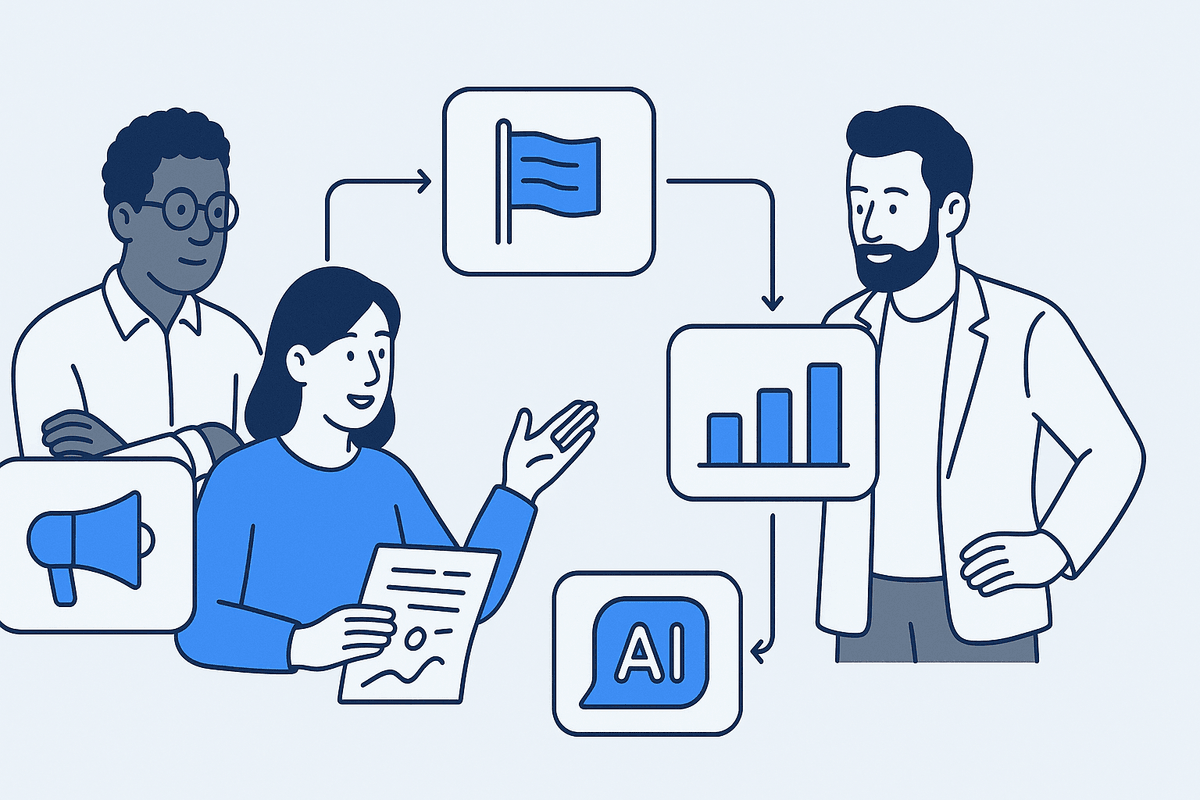
- Sales and customer success team: Collects the language customers actually use and frequently asked questions, and passes them on to the content team.
- Content and PR team: Coordinates so that the messages appearing in external sources (reviews, press, partners) don't drift from your own tone.
If these four roles move separately, brand consensus doesn't form on its own. You need a routine that regularly reviews "how are we being described in the market?" in one place.
Where should you start?
Brand consensus is hard to judge by gut feeling. TRAIL Search (search.traillabs.ai) is a tool that diagnoses in what context, and alongside which competitors, your brand is mentioned across multiple AI search engines. You can use it as a first step to check whether there's a gap between the description on your own site and the description across the market.
In the end, AEO isn't a checklist you can hand off to the SEO team. It's organizational work that aligns what you say with what the market says, and as that consensus builds up, your brand gets selected as a clearer candidate in AI answers.
For related reading, see Why your site doesn't show up in AI search: a 10-step diagnostic checklist, A guide to core SEO and GEO metrics: five GEO metrics and how to read them when they disagree, and What is GEO (Generative Engine Optimization)? Which pages to start with, and in what order.
Frequently asked questions
Isn't AEO the SEO team's job?
The technical half is. Page discovery, crawling, and structured data are the SEO team's domain. But how AI understands your brand's category and positioning also includes mentions outside your own site. So the SEO team can't complete AEO alone; it only works when the language of brand, product, and sales lines up.
What problems actually happen when brand consensus is off?
If your homepage, PR articles, sales scripts, and reviews each describe your product with a different category and different strengths, it becomes hard for AI to build one consistent answer. As a result, AI may judge your credibility as unclear and avoid citing you, or pick a competitor as the clearer candidate.
What's a realistic way to split ownership?
A realistic collaboration structure has SEO and engineering own technical accessibility (crawling, indexing, structured data), brand, product, and sales own consistency of how you're described in the market (positioning, terminology, product truth), and ties the two into one dashboard that everyone reviews together on a regular schedule.
References
Summary
- The problem of a brand not appearing in AI answers usually can't be solved with an SEO checklist alone. What matters more is whether the brand is described consistently across the whole market.
- The distinction 'SEO is product, AEO is brand' means SEO handles site discoverability, while AEO and GEO handle the brand context AI understands.
- AI doesn't look at your own site alone; it understands your brand by combining reviews, comparison posts, PR, and community mentions. That's 'brand consensus.'
- A realistic collaboration structure splits ownership into technical accessibility (SEO and engineering) and descriptive consistency (brand, product, and sales), and reviews both together on a regular schedule.
Check this topic against your own brand
TRAIL Search measures how ChatGPT and Perplexity answer your customers' questions and finds and fixes where the brand is missing, turning this post into a diagnosis. Start with 10 questions, no card required.
More posts
Getting cited when Google AI Mode builds the answer
In November 2025 Google put Gemini 3 in AI Mode to build custom layouts and tools per query while keeping links to web sources. Here is what gets cited.
How is AI answer visibility defined and measured?
How is AI answer visibility defined and measured? Three metrics with formulas and paper figures: visibility (GEO), contribution (Shapley), and stability.
The prompt you track is not the query AI actually searched
AI visibility reports score each tracked prompt, but retrieval and citation happen on fan-out sub-queries. What year and English injection mean for measurement.
Keep reading on this topic
- Which content types AI cites, by search intentThe content type AI search cites flips with intent: articles lead informational prompts (45.5%), listicles lead commercial ones (40.9%).
- How are retrieval and citation different in AI search?Retrieval and citation are different stages in AI search. Does ChatGPT cite YouTube? Why our content is missing from AI answers, and what zero citations mean.
- The LLMO trap: training data vs. AI answer citationsSeeding your brand in LLM training data and getting cited in AI answers are different mechanisms. How they differ, what you can measure, and why advice splits.
This post is part of the Analysis category, which collects all 35 posts on the topic. See all posts in Analysis