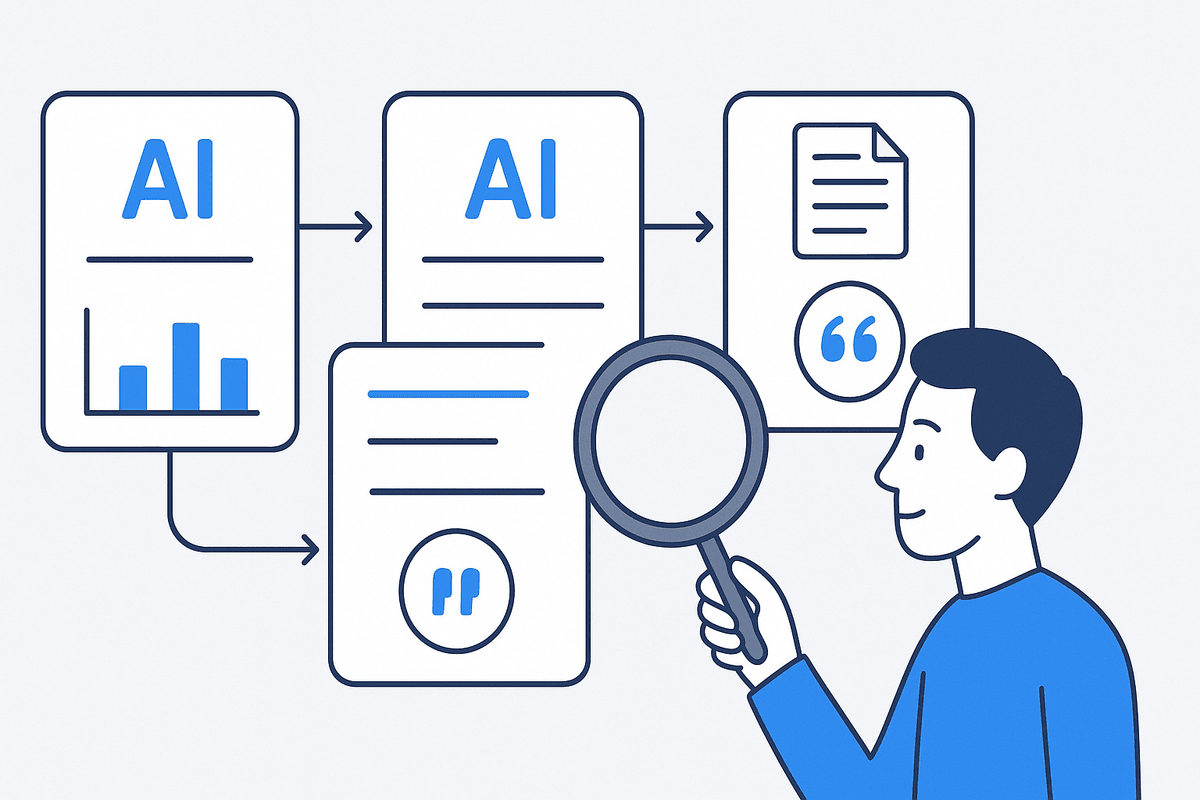
How ChatGPT, Perplexity, and Gemini cite sources
Platforms with inline citations and platforms without need different strategies
ChatGPT, Perplexity, and Gemini choose and show sources differently, so GEO strategy should split by platform. How each cites and how to track them all at once.
ChatGPT, Perplexity, and Gemini are structurally different in how they select and display sources when building AI answers, so it's hard to target all three platforms at once with one GEO strategy. As AI search takes a larger share of overall web traffic, there's growing agreement that SEO alone isn't enough. Princeton's GEO study also reports that optimization strategies such as adding cited statistics, quotations, and authoritative sources can meaningfully raise visibility in AI answers [1]. But how you apply these strategies has to differ by platform.
Why split strategy by platform
In the era of search engine optimization, "doing well on Google alone" covered most search traffic. But the AI search ecosystem is split across many platforms, and each platform has a fundamentally different philosophy for building answers.
ChatGPT is closer to a conversational assistant, and Perplexity defines itself as an "answer engine." Gemini works as an extension of the Google Search ecosystem. These aren't just UI differences; they have a real effect on which content gets selected and how it's displayed.
The three platforms at a glance
| Criterion | ChatGPT | Perplexity | Gemini (+ AI Overviews) |
|---|---|---|---|
| Basic character | Conversational AI assistant | Answer-focused search engine | AI answers integrated with Google Search |
| Citation display | No citations in default mode; source links shown in web search mode | Inline citations in every answer by default | Source cards shown in AI Overviews at the top of results |
| Source transparency | Medium | High | High (tied to search results) |
| Response format | Conversational | Search and answer combined | Summary at the top of search results |
| Real-time information | Requires web search mode | Built in | Built in through Google Search |
ChatGPT: default mode and web search mode in a conversational AI
By default, ChatGPT generates answers based on its training data. In this mode, no inline citations are attached. When web search is turned on, it builds answers by consulting real-time search results and shows source links below the answer.
What this structure means is clear. To be cited in ChatGPT, its web search mode has to find your content and choose it as a trustworthy source. For that, your pages need to be crawlable and indexable, and your content needs to show direct-answer definitions and evidence clearly.
Perplexity: inline citations in every answer
Perplexity is a platform focused on citation transparency, enough to define itself as an "answer engine." Nearly every answer comes with numbered inline citations, and users can check the original source with a single click.
For GEO practitioners, this makes it the easiest platform to verify, because when you query a specific prompt you can see with your own eyes whether your content actually appears as a numbered citation. A common approach in practice is to use Perplexity as a benchmark to improve content structure, then apply what works to other platforms.
Gemini: AI Overviews integrated with Google Search
Gemini and AI Overviews are built into the Google search results page itself. Google describes AI Overviews as a feature that synthesizes multiple sources and shows a summarized answer at the top of search results [2]. Users see the AI-generated summary right on the results page without opening a separate app.
What matters in this structure is the connection with your existing SEO assets. AI Overviews work from content Google has already crawled and indexed, so sites with solid technical SEO are also more likely to be cited in AI Overviews. Making relationships within your content clear through structured data is still valid in this context [3].
Practical strategy by platform
- ChatGPT: strengthen technical SEO and content trust signals (sources, author, publish date) together so you get chosen as a trustworthy source in web search mode.
- Perplexity: use its inline citation structure to verify directly whether you're cited, find the prompts where you aren't, and improve your content.
- Gemini: building solid SEO fundamentals (crawling, indexing, structured data) is a prerequisite for appearing in AI Overviews.
Why one strategy doesn't work, and the common foundation
Even though the approach has to differ by platform, there's a common foundation that works everywhere. Direct-answer definitions, statistics with stated sources, comparison tables, and structured data tend to act as positive signals on all three platforms [1] [3]. In other words, the realistic approach is to build the fundamentals of content structure in common, then layer platform-specific verification and fine-tuning on top.
However, the platforms don't disclose their citation algorithms, so all of these strategies have the limitation of being estimates based on observable patterns. Exact citation rates can vary with each platform's internal data.
Tracking multiple platforms at once
Manually entering prompts and recording results platform by platform quickly hits its limits. TRAIL Search (search.traillabs.ai) tracks whether you're cited for the same target prompts across multiple AI search engines, so you can compare at a glance where you're strong and where you're weak.
In the end, a multi-platform GEO strategy is a repeating job of "building the common foundation and verifying platform-by-platform differences." If you judge the whole picture by results on one platform, you're bound to miss something.
You can continue with How to monitor AI search citations with prompt tracking: how it differs from keyword rank tracking, How to design AI search visibility experiments: setting a baseline, measurement cycles, and one variable at a time, and What is query fan-out? Observing firsthand how AI splits one question into several searches.
Frequently asked questions
Which of the three platforms should I optimize for first?
The first criterion is which platforms your target customers actually use. After that, starting with the platform whose citations are most transparent makes it easier to verify results, because on platforms with clear inline citations you can see directly which content was selected.
Can one piece of content target all three platforms at once?
The basic structure (direct-answer definitions, source footnotes, comparison tables) works across all of them. But each platform selects sources through a different mechanism, so it's hard to expect identical results on every platform from a single strategy.
Can I know each platform's citation algorithm exactly?
No. The platforms don't disclose their citation algorithms. You can only estimate based on observable patterns and official documentation, and you should go in aware that exact citation rates can vary with each platform's internal data.
References
Summary
- ChatGPT, Perplexity, and Gemini are structurally different in how they select and display sources, so it's hard to target every platform with one strategy.
- Perplexity provides inline citations in every answer by default, giving it the highest source transparency.
- Gemini appears as AI Overviews at the top of Google search results, so connecting with your existing SEO assets matters especially.
- Platform algorithms aren't public, so you need strategies grounded in observable patterns and ongoing re-verification.
Check this topic against your own brand
TRAIL Search measures how ChatGPT and Perplexity answer your customers' questions and finds and fixes where the brand is missing, turning this post into a diagnosis. Start with 10 questions, no card required.
More posts
Getting cited when Google AI Mode builds the answer
In November 2025 Google put Gemini 3 in AI Mode to build custom layouts and tools per query while keeping links to web sources. Here is what gets cited.
How is AI answer visibility defined and measured?
How is AI answer visibility defined and measured? Three metrics with formulas and paper figures: visibility (GEO), contribution (Shapley), and stability.
The prompt you track is not the query AI actually searched
AI visibility reports score each tracked prompt, but retrieval and citation happen on fan-out sub-queries. What year and English injection mean for measurement.
Keep reading on this topic
- Which content types AI cites, by search intentThe content type AI search cites flips with intent: articles lead informational prompts (45.5%), listicles lead commercial ones (40.9%).
- How are retrieval and citation different in AI search?Retrieval and citation are different stages in AI search. Does ChatGPT cite YouTube? Why our content is missing from AI answers, and what zero citations mean.
- The LLMO trap: training data vs. AI answer citationsSeeding your brand in LLM training data and getting cited in AI answers are different mechanisms. How they differ, what you can measure, and why advice splits.
This post is part of the Analysis category, which collects all 35 posts on the topic. See all posts in Analysis