6 Copy Principles That Lift Card News Click Rates
There's one way to raise click rates without misleading anyone: remove the moment the reader hesitates. Apply six principles proven in field experiments to your content today.
Card news loses clicks when readers hesitate. Six copy principles that lift click rates without clickbait, why specific numbers win, and how to polish AI copy.
The way to raise click rates without misleading anyone is to remove the moment the reader hesitates. Sometimes the offer is clearly good, yet your card news and Instagram captions get a lukewarm response. Sometimes it's the design, but surprisingly often it's a single line of copy. Today we'll unpack the common principles behind copy that gets clicked. You can use them right away, even without a dedicated copy team.
This post starts from "6 principles for raising the click rate of marketing copy" (Aran Yoo) [1], published by a Korean fintech team. We reworked the principles they found through many experiments from the perspective of how solo marketers and small business owners like us can apply them to our own content.
What blocks clicks is the moment of hesitation
The original's core point is surprisingly simple. The way to raise click rates without misleading people is to remove the moment the reader hesitates. That half second of pausing over the copy, "What does this mean?" or "Does this apply to me?", is what stops the hand.
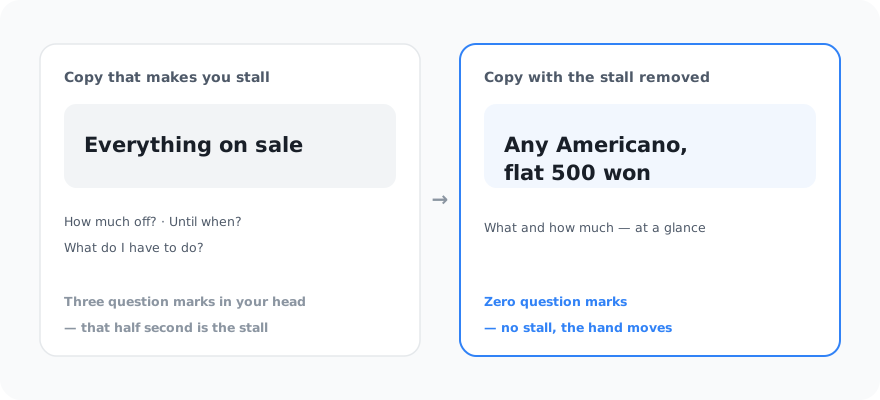
For example, if a cafe's card news says "Discount on all menu items," readers silently ask: "How much off? Until when? What do I have to do to get it?" Those three question marks are the hesitation. Write "One Americano, guaranteed 500 won" instead, and the question marks disappear. Removing hesitation means telling people specifically how much, until when, and what to do. The cafe copy is our own example; the experimental evidence that specific copy raises clicks comes from the original [1]. The six principles below are ways to make that specific.
Principles 1 and 2: one key point, a certain reward
① Say only one key point. List several benefits and none of them sticks. In the original experiments, a couples app got about 10 times more clicks when it promoted just one thing, a "couples test," than when it pitched several features at once [1]. The same goes for us. Don't cram "fresh ingredients, fast delivery, friendly service" onto the first card. Say your single strongest point clearly.
② Offer a certain reward. A certain "minimum" draws more action than a vague "maximum." In the original experiments, "Draw at least 100 won" got about 20 times more participation than "Up to 1 million won" [1]. "Up to" sounds like someone else's story; "at least" is mine, because everyone gets it.
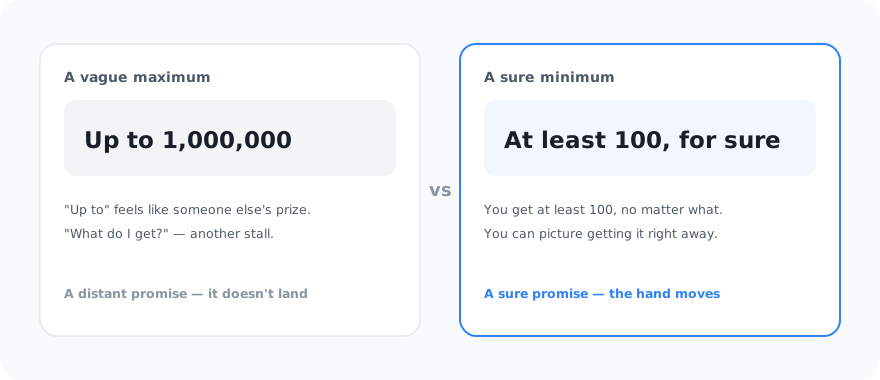
On your detail page, "Add to cart now for a guaranteed instant 3,000 won off" lands better than "Up to 50% off," because readers can picture getting it right away. (These numbers are our own example, though. The evidence is the original's maximum versus minimum experiment [1], so adjust them to match your real offer. A promise you can't keep is worse than hesitation.)
Principles 3 and 4: make the action light, state the type of information first
③ Make the action light. The same button can carry words of different weight. The original team says that changing "Sign up" to "Get ready" lowered the burden and raised clicks. Use words that take just one step instead of words that sound like a big commitment. For your Instagram buttons, "Save to cart" is lighter than "Buy now," and "Hold my spot" is lighter than "Apply."
④ State the type of information first. The same content changes when you put "what kind of information this is" up front. In the original experiments, "Newly launched ○○ benefit" performed about 6 times better than "○○ benefit" [1]. The words "newly launched" signal "I haven't seen this before." If you put a label like "New for summer" or "This week only" at the front of a detail page title, readers can decide quickly.
Principles 5 and 6: specific numbers, everyday words
⑤ Make conditions and actions specific. Add a number to vague wording and it gets sharp. In the original experiments, "4 missions" performed about 4 times better than "missions," and "Fill 8 boxes" about 2 times better than "Fill in the blanks" [1]. When people can see the end, they start. In your card news, nail down the task and the reward with numbers, like "Write a one-line review, get 2,000 won" instead of "Review event."
⑥ Use words from everyday life. Spoken words feel closer than formal ones. The original team made "See the answer" friendlier by changing it to "Take a guess." Likewise, "Check in 3 seconds" is closer to how people actually talk than "See details," and "See it up close" beats "View product."
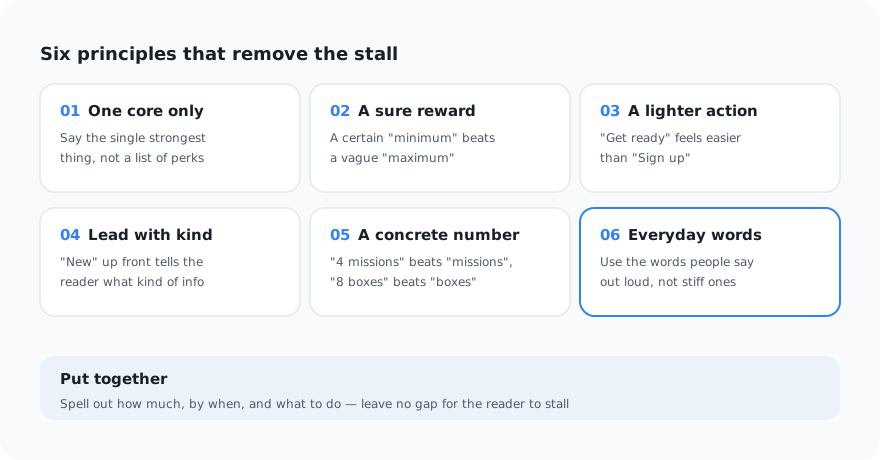
The six principles at a glance
| Principle | Not this | But this | Effect (original experiments) |
|---|---|---|---|
| ① One key point | Listing several benefits | Only the strongest one | About 10x clicks [1] |
| ② Certain reward | Up to 1 million won | At least 100 won, guaranteed | About 20x participation [1] |
| ③ Light action | Sign up | Get ready | Lower burden |
| ④ Type of information first | ○○ benefit | Newly launched ○○ benefit | About 6x clicks [1] |
| ⑤ Specific conditions | Missions | 4 missions | About 4x start rate [1] |
| ⑥ Everyday words | See the answer | Take a guess | Friendlier feel |
On one page: a checklist to remove hesitation from your copy
Memorizing six principles every time is hard. After you write your copy, scan these six boxes. If any one is empty, that's likely where readers are hesitating.
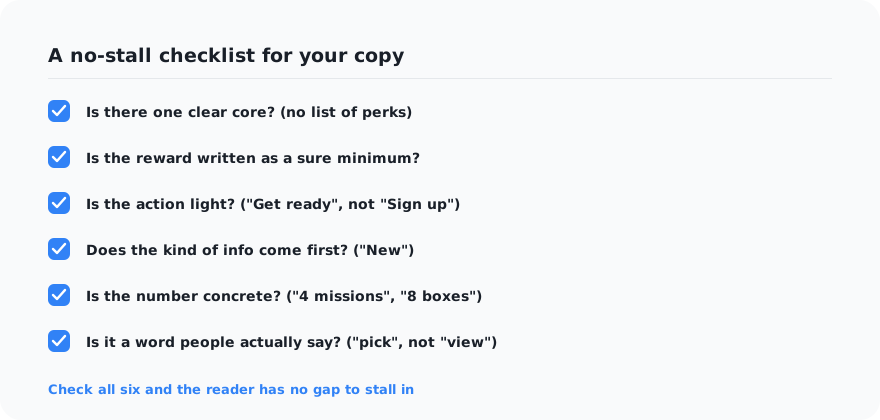
- Is the key point a single, clear one?: If you're listing benefits, keep only the strongest.
- Is the reward written as a "certain minimum"?: Try changing "up to" to "at least" or "guaranteed."
- Is the action light?: Swap words that sound like a big commitment for one-step words.
- Did you state the type of information first?: Put labels like "newly launched" or "this week only" up front.
- Are the numbers specific?: Make the end visible, like "4 missions" or "8 boxes."
- Are these everyday words?: Turn "see" into spoken phrases like "take a guess" or "see it up close."
Wrapping up: don't skip the polishing step
Copy gets better when you polish it once than when you first write it. If you quickly generated card news or detail page copy with AI, don't post it as is. Scan it against the six boxes above. Find where readers might hesitate, change a word or two, and you'll feel the difference.
The same goes for copy generated with TRAIL Studio. Generation is the starting point; do the final polish with this checklist. Good copy isn't flashy wording. It's copy that doesn't make the reader hesitate.
> You can read the original post that these principles start from here. The multiples in this post (10x, 20x, and so on) were observed in the original experiments; test the effect of our example copy in your own content.
For related reading, see 6 copy principles that drive clicks: keep CTAs light and numbers specific, What are AEO and GEO? Preparing content for AI search, and 10 copywriting psychology principles: how to use loss aversion, anchoring, and social proof in copy.
Frequently asked questions
Where do these principles come from?
They start from a Toss Tech Blog post published by a Korean fintech team, "6 principles for raising the click rate of marketing copy." We reworked the original's experimental findings from the perspective of solo marketers and small business owners writing card news and detail pages.
Are figures like 10x and 20x in this post our own data?
No, those values were observed in the original experiments. The real effect of our example copy is something you need to test in your own content.
Can I use this checklist on AI-generated copy too?
Yes. AI generation is the starting point. Run a polishing step where you scan the copy against these six boxes once before posting, and you'll feel the difference.
References
Summary
- What blocks a click is the moment a reader hesitates and thinks, "Wait, what's this?"
- Six principles remove that hesitation: one key point, a certain minimum reward, a light action, the type of information first, specific numbers, and everyday words.
- The multiples (10x, 20x, and so on) are values from the original experiments; the effect of our example copy has to be verified yourself.
- Even AI-generated copy changes when you give it one last pass with this checklist.
Produce the content this post covers from your brand standard
TRAIL Studio registers the brand standard once and produces cardnews, detail pages, product photos, shorts and blog posts from it. Generated output is reviewed and edited by a person before it ships.
More posts
Best AI Search Optimization Tools 2026: 6 GEO Tools Ranked
We compared six tools that check whether ChatGPT and other AI answers mention your brand, on measurement, action, engines, Korea support, and price.
Why Does ChatGPT Cite Listicles? Format vs. Hierarchy
Listicles split items cleanly, so AI can extract just what it needs. How to write citable listicles, whether format alone is enough, and how to build hierarchy.
What is GEO? Which pages to start with, and in what order
GEO structures content so generative search like ChatGPT and AI Overviews cites it. Does it replace SEO, what order to run it in, and how to measure it.
Keep reading on this topic
- Topical authority: why pillar-cluster beats a single postTopical authority comes from content clusters, not single posts: the pillar-cluster model, how to design one, why it wins in AI search, and when it's enough.
- A 4-step framework for SEO and GEO: split teams or merge?SEO and GEO work best on one content quality foundation. Whether to split or merge teams, a 4-step framework, why unified plans fail, and one shared metric.
- SEO and GEO top spots: high rankings, missing in AI answersReaching the top now covers how AI answers mention you, not just rankings. What changed, how to manage both tops, and why competitor comparison matters.
This post is part of the Content category, which collects all 41 posts on the topic. See all posts in Content