The LLM wiki and Open Knowledge Format for agent knowledge
Karpathy showed an LLM-maintained wiki for personal research; Google turned the pattern into a format organizations can exchange, and v0.2 added fields for provenance and verification
Karpathy's LLM wiki and Google's Open Knowledge Format, read from the originals: a format for agent knowledge bases, the RAG difference, and v0.2 trust fields.
Karpathy's LLM wiki, shown for personal research, has an LLM write and keep updating a markdown wiki from collected raw sources, and Google turned the pattern into an open specification, the Open Knowledge Format (OKF), designed so that other tools and organizations can exchange it as is [1][3]. Version 0.2, merged into the repository in July, assumes more and more documents are written by agents and adds frontmatter fields for who wrote a document, where it came from, and who confirmed it [4]. In Google's own public samples, those fields are not yet filled in [5].
We read Karpathy's X post and gist, the Google Cloud blog, and the OKF specification (SPEC.md) in October 2026 and cross-checked them against each other [1][2][3][4]. The sample-bundle counts are our own, taken from commit 5d1345c of the official repository [5]. We have not used the OKF tooling ourselves and have no relationship with Google.
What is an LLM wiki and how is it different from RAG?
An LLM wiki answers questions from a wiki the LLM has already compiled from raw sources and keeps updating, instead of re-finding the source on every question [2]. On April 2, 2026, Karpathy posted "LLM Knowledge Bases" on X, writing that a large share of his recent token throughput goes into manipulating knowledge rather than code [1]. The flow is to index sources into a raw/ folder, have an LLM "compile" a markdown wiki of summaries, backlinks, and concept articles, ask the wiki questions, and file the answers back into it [1].
His observation on scale is specific. His research wiki was about 100 articles and 400K words, and although he expected to need fancy RAG, the LLM maintained index files and short summaries of every document well enough to read the relevant material at that scale [1]. The LLM writes and maintains the wiki; he rarely touches it directly [1].
The gist "LLM Wiki" he also published lays this out in three layers [2]. Raw sources are an immutable source of truth, the wiki is a directory of markdown the LLM owns entirely, and the schema (a file such as CLAUDE.md or AGENTS.md) tells the LLM the wiki's structure and workflows [2]. The operations are ingest, query, and lint, and lint means finding contradictions between pages, stale claims superseded by newer sources, and orphan pages with no inbound links [2].
Karpathy frames the difference from RAG as accumulation. NotebookLM and upload-style RAG re-find and stitch fragments every time a question needs five documents, while an LLM wiki starts with cross-references and contradiction flags already in place [2]. People abandon wikis over the cost of bookkeeping more than over reading or thinking, and LLMs do not get bored and can touch 15 files in one pass, so that cost drops to near zero [2].
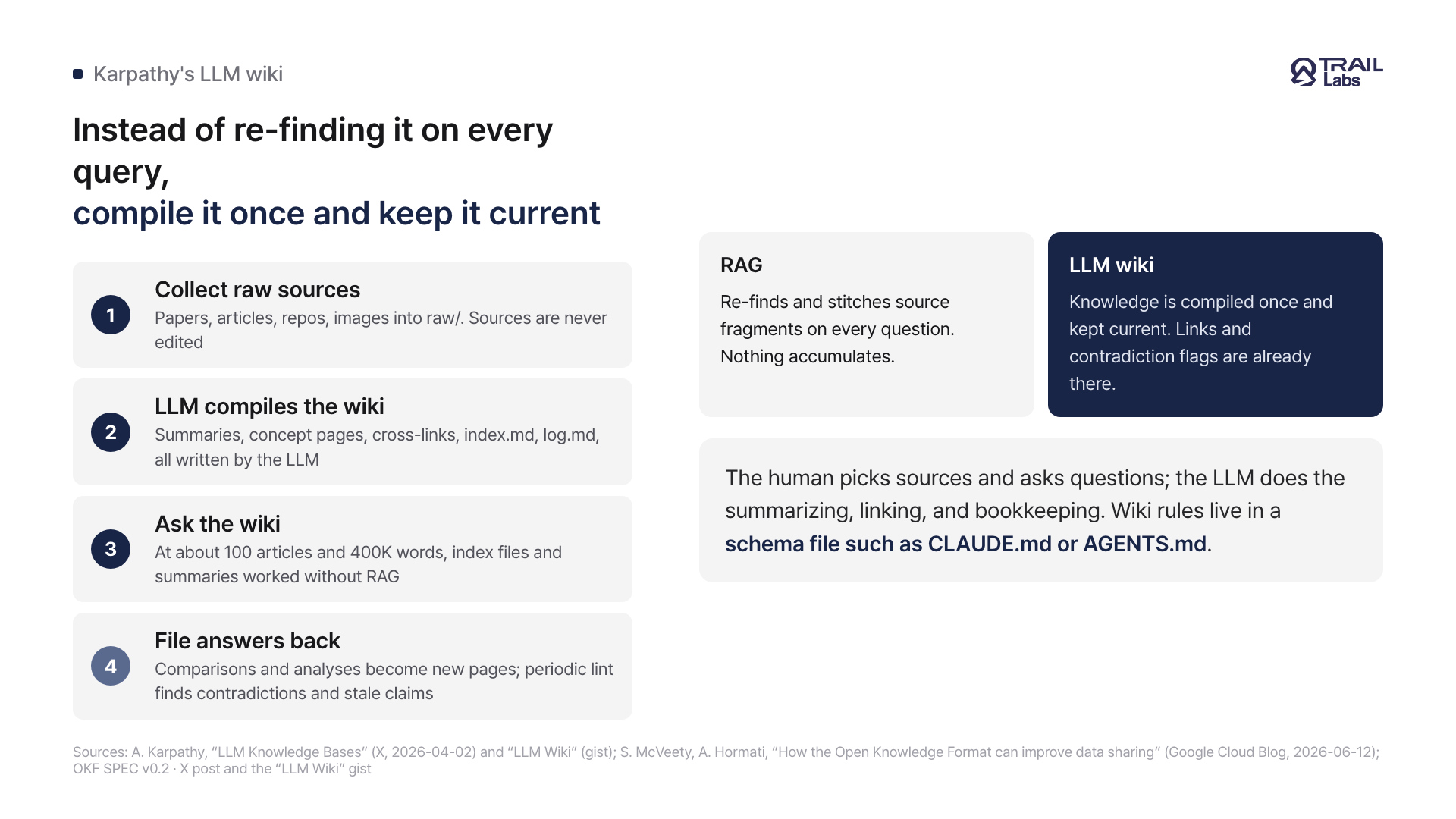
Figure 1. An LLM wiki keeps updating a wiki compiled once from raw sources, and answers are filed back into it [1][2].
What is the Open Knowledge Format?
OKF is an open specification that lets different producers and consumers exchange the LLM wiki pattern without translation [3]. Sam McVeety and Amir Hormati of the Google Cloud Data Cloud team announced v0.1 on the Google Cloud blog on June 12, 2026, citing Karpathy's gist directly [3]. Their point: Karpathy's wiki, a team's wiki, and a vendor's catalog export all look alike (markdown, frontmatter, cross-links), but none were designed to cooperate, so there is no agreement on which fields every document carries or what filenames mean [3].
So OKF ships a format, not a service [3]. A bundle is a directory of markdown files, each file is one concept, and the file path is the concept's identity [4]. In the frontmatter only type is required; title, description, resource, and tags are recommended [4]. index.md (a directory listing for progressive disclosure) and log.md (change history) are reserved filenames, and concepts link with ordinary markdown links, forming a graph richer than the folder tree [4].
| Karpathy's LLM wiki | OKF counterpart | Note |
|---|---|---|
| Concept and summary pages | Concept document, type required | File path is the identity |
| index.md | index.md reserved filename | Allowed in every folder |
| log.md | log.md reserved filename | Dated change history |
| raw/ sources | sources field, references/ convention | Moved into frontmatter in v0.2 |
| Lint (contradictions, stale claims) | status, stale_after, verified | v0.2; the lint process itself is not specified |
| Schema file (CLAUDE.md, AGENTS.md) | Not specified | Left to the producer |
Table 1. How the wiki elements Karpathy describes in the gist map onto the OKF specification [2][4]. The mapping is ours, drawn by comparing the two documents.
Three principles guide the design: be minimally opinionated (type is the only requirement), keep producers and consumers independent (a bundle a person wrote can be read by an agent, and one LLM's bundle can be queried by another), and stay a format rather than a platform (no proprietary account or SDK to read or write) [3]. Alongside the spec Google released a reference agent that walks a BigQuery dataset, writes a concept document per table, and enriches it from official documentation, a static HTML viewer that renders a bundle as a graph, and sample bundles [3]. The repository is Apache-2.0 licensed, and the blog says Google Cloud's Knowledge Catalog was updated to ingest OKF [3].
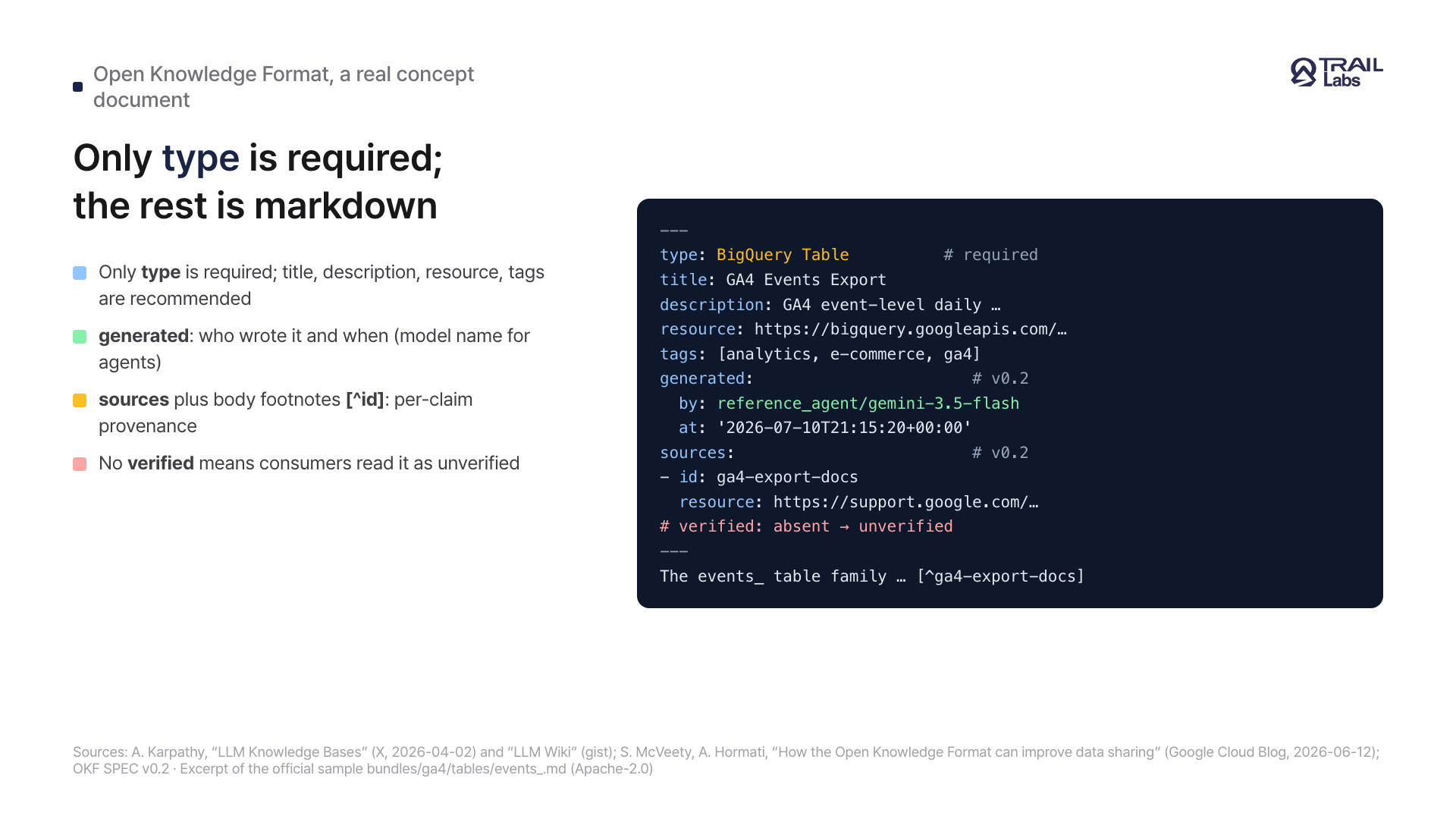
Figure 2. One concept document from the official GA4 sample. Only type is required, and provenance links frontmatter sources to body footnotes [4][5].
How can you trust documents written by AI agents?
Version 0.2 starts from the premise that a bundle is continuously rewritten by agents [4]. The specification says that when most concepts are machine-generated, a consumer needs five answers: what it was created from (provenance), how much to trust it (trust), whether it is still true (freshness), whether it is the current version (lifecycle), and whether a number was produced the way it must be (attestation) [4]. According to the specification in the repository, the move to v0.2 happened on July 24, 2026 [4].
Provenance goes in a sources list, and per-claim provenance links a body footnote label to a sources id [4]. The reason for stable ids over positions is telling: agents keep rewriting these documents, the list gets reordered, and a positional reference silently attaches a source to the wrong sentence [4]. Each source can record its author, usage count, and last modification time, but the format stores no credibility score, because a score is subjective, differs across consumers, and goes stale [4].
Trust separates who wrote a document from who confirmed it. generated records who wrote it and when, verified records who confirmed it and when, and a human confirmer must use an id starting with human: [4]. Consumers read no verified field as unverified, confirmation by processes or agents only as machine-confirmed, and a human confirmer as human-reviewed [4]. status is draft, stable, or deprecated, and stale_after is an absolute instant after which the content is stale [4]. A document must not be rejected for lacking these fields, and the tiers are advisory signals, not access control [4].
Counting the official sample bundles ourselves showed that making room for a field and filling it are separate things. The 44 concept documents in the three bundles Google's reference agent built from public GA4, Stack Overflow, and Bitcoin data all carry generated and sources, and none carries verified [5]. Read by the spec, all 44 are unverified. The bundle with verification records filled in is acme_retail, built as an example around a fictional retailer: 8 of its 9 concept documents name a human verifier and 7 carry an expiry [5].
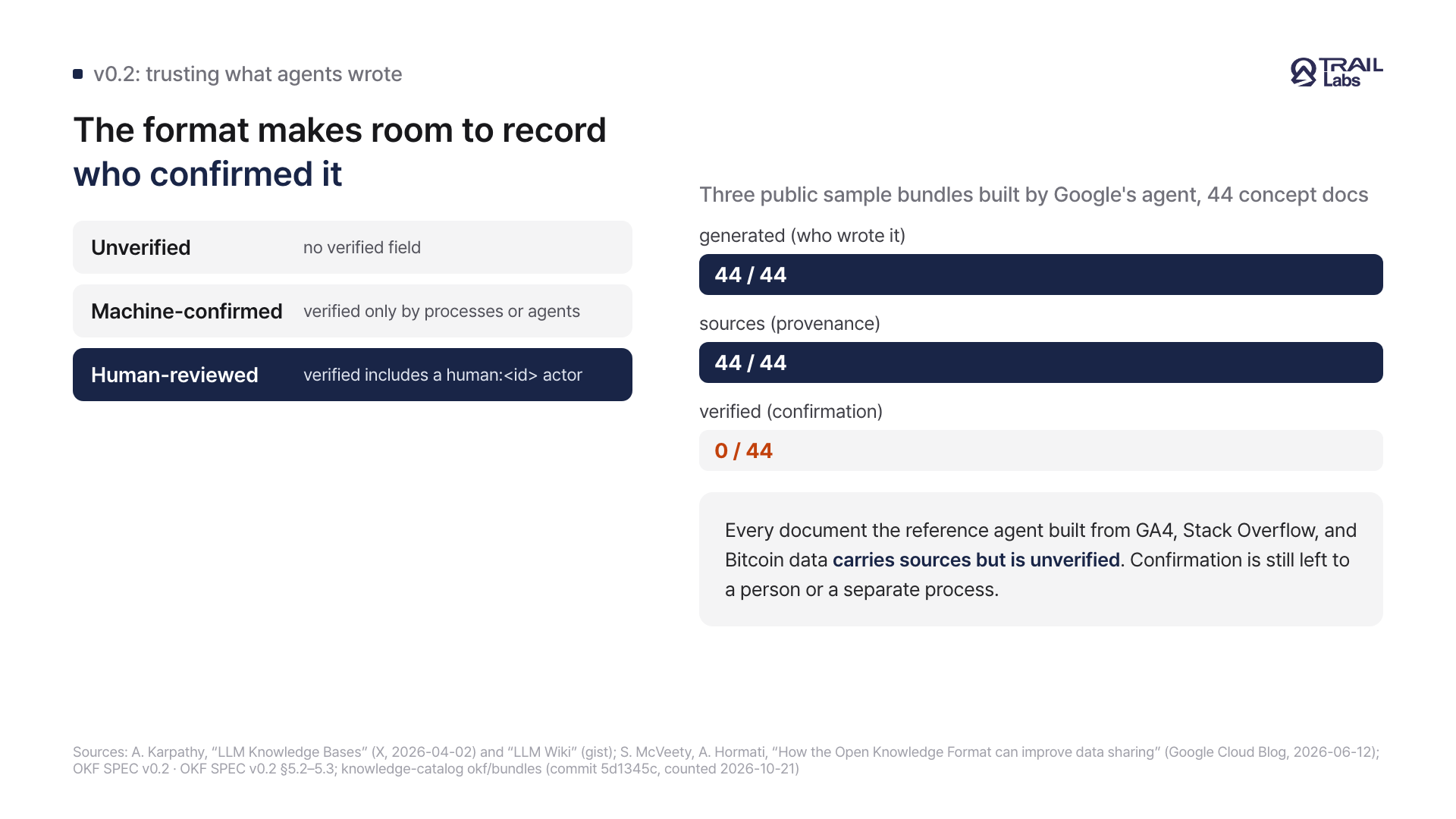
Figure 3. The 44 public sample documents built by Google's agent all name an author and sources, and none records a verification [4][5].
What format should a knowledge base for AI agents use?
A directory of markdown files with frontmatter, which a person reads in any editor and an agent parses without extra tooling, is where the two lines of work meet [1][4]. You do not need the whole spec on day one. OKF requires only type and says a bundle must not be rejected for missing fields or broken links [4]. A small starting sequence:
- Put one concept per file, with type and a one-line description in the frontmatter [4].
- Give each folder an index.md listing its documents with one-line descriptions, and record dated changes in log.md. Karpathy notes that starting every log entry with the same prefix lets one grep line pull the latest entries [2].
- For documents an agent wrote, put the model name in generated, and link supporting sentences to sources ids through footnotes [4].
- Add verified only to documents a person has confirmed, and set stale_after on content that ages quickly, such as numbers [4].
- Put the wiki's structure and workflows in a schema file such as CLAUDE.md or AGENTS.md. OKF does not specify this part [2][4].
At TRAIL Labs we also keep company facts as a directory of markdown files and have agents read it before writing anything that mentions the company. The problem we ran into matches one part of what v0.2 addresses, the time of confirmation. As more sentences are edited by agents, we need to know when a file was last confirmed, so each file carries a last-verified date and changes are logged separately. We have not moved to the OKF format, and our verification records stay at the file level.
What are the limits of this article?
OKF is a v0.x specification, and we could not confirm how widely it has been adopted outside Google. Neither the Google blog nor the specification reports a measurement of how much agent answer accuracy changes with OKF [3][4]. What the spec promises is that conforming documents can be read across tools.
Karpathy's observation comes from one person's research wiki at about 100 articles [1]. He notes that proper search becomes necessary as a wiki grows and that he built a small search engine over his own wiki [1][2]. There is no public evidence on whether the same approach works without RAG for an organization's wiki of thousands or tens of thousands of documents.
The sample counts reflect the official repository on October 21, 2026, and cover only public examples produced by the reference agent [5]. How often verification records are filled in for real working bundles, inside Google or elsewhere, is unknown. A trust tier records that someone confirmed a document, which falls short of guaranteeing the content is correct, and the spec itself calls the tiers advisory [4].
Frequently asked questions
What is an LLM wiki and how is it different from RAG?
You collect raw sources, and an LLM writes and keeps updating a markdown wiki of summaries, concept pages, and cross-links. RAG re-finds and stitches source fragments on every question, while an LLM wiki keeps its compiled result, so later questions and new sources build on it. Karpathy wrote that at about 100 articles and 400K words, index files and summaries were enough without a separate RAG pipeline.
What is the Open Knowledge Format?
An open specification Google Cloud published in June 2026 that turns the LLM wiki pattern into a format other tools and organizations can exchange as is. Knowledge is a directory of markdown files with YAML frontmatter, and the only required field is type. index.md and log.md are reserved filenames, and documents link to each other with ordinary markdown links.
What format should a knowledge base for AI agents use?
Start with something a person can read in any editor and an agent can parse without an SDK. One concept per file, type and a one-line description in the frontmatter, an index.md listing each folder and a log.md recording changes fits both OKF and Karpathy's wiki. As more documents are written by agents, sources, verifiers, and expiry can also go in the frontmatter, and OKF v0.2 defines those fields.
How can you trust documents written by AI agents?
OKF v0.2 records who wrote a document (generated), where it came from (sources plus per-claim footnotes), who confirmed it (verified), and until when it holds (stale_after). With no verification record a consumer reads it as unverified, process-only confirmation as machine-confirmed, and a human confirmer as human-reviewed. The spec only makes room for these records, and none of the 44 public sample documents built by Google's agent carried one.
References
- [1]Andrej Karpathy, "LLM Knowledge Bases", X post, 2026-04-02
- [2]Andrej Karpathy, "LLM Wiki", GitHub gist, 2026
- [3]Sam McVeety, Amir Hormati, "How the Open Knowledge Format can improve data sharing", Google Cloud Blog, 2026-06-12
- [4]Open Knowledge Format Specification v0.2, GoogleCloudPlatform/knowledge-catalog (Apache-2.0)
- [5]OKF sample bundles (acme_retail, crypto_bitcoin, ga4, stackoverflow), GoogleCloudPlatform/knowledge-catalog okf/bundles
Summary
- In an April 2026 X post and gist, Karpathy described collecting raw sources and having an LLM write and maintain a markdown wiki, with accumulation instead of RAG-style re-retrieval as the point.
- In June 2026 Google Cloud formalized the pattern as Open Knowledge Format v0.1: a directory of markdown files with YAML frontmatter, type as the only required field, and index.md and log.md as reserved filenames.
- v0.2, merged in July, assumes knowledge is continuously rewritten by agents and adds sources, generated, verified, status, and stale_after.
- All 44 documents in the three public sample bundles built by Google's reference agent carry an author and sources but no verification record, so the spec reads them as unverified.
- OKF is still v0.x, and no published measurement covers adoption outside Google or effects on agent accuracy.
Check this topic against your own brand
TRAIL Search measures how ChatGPT and Perplexity answer your customers' questions and finds and fixes where the brand is missing, turning this post into a diagnosis. Start with 10 questions, no card required.
More posts
What is different about Gemini 4 Argon? Verification
What is different about Gemini 4 Argon compared with earlier models? We check the 1M-token output limit and use cases plus the criteria for verifying AI output.

Why Reddit search grew again: AI cites community signals
AI answers favor real community reviews, comparisons, and complaints over official feature lists. How brands can use community signals, by industry.
GPTBot vs OAI-SearchBot: Is AI Crawling a Search Signal?
AI bot crawling may signal a new search channel, but crawl counts aren't visibility. GPTBot vs. OAI-SearchBot, scale vs. Googlebot, and how to track it.
Keep reading on this topic
- Naver AI Briefing Didn't End SEO: Korean GEO vs Google GEOSEO basics still matter in the Naver AI Briefing era. What Naver Mate is, Naver's content quality bar, and how to get cited as a source in AI Briefing.
- Naver AI Tab's Next KPIs: Sourcing and the Path to ActionAfter Naver AI Tab, GEO must measure the path from AI answers to bookings, purchases, and inquiries, not just citation rate. Sourcing vs. actionability.
- Why Searches Got Longer After AI BriefingAfter AI Briefing, people search with longer questions. How long tail changes, how to plan content and question clusters, and what AI Mode data means for Korea.
This post is part of the Trend category, which collects all 13 posts on the topic. See all posts in Trend