Off-Site AEO: Why AI Won't Cite Your Flawless Site
Why AI may not cite you even when your own site is flawless
AI search reads communities, reviews, video, and media alongside your own site. Why a flawless site still goes uncited, and how to map off-site sources.
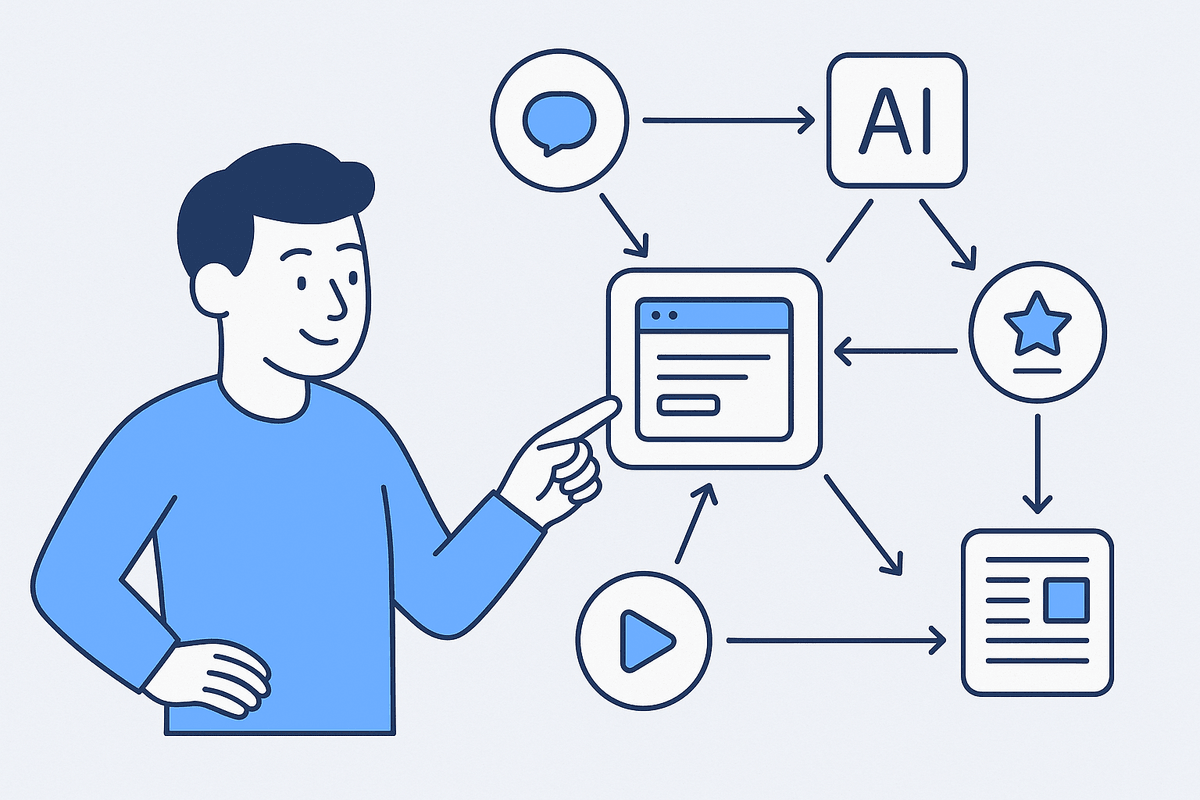
AI search builds its answers by combining not only how your own site describes your brand, but also how your brand is mentioned on external channels like communities, reviews, video, and media. So no matter how well organized your own site is, you can lose out as an AI answer candidate if you're barely mentioned externally or described incorrectly.
In traditional SEO, your own site was the center. The core work was building pages with a structure search engines can read easily, writing posts that match search intent, and cleaning up technical SEO. These fundamentals are still needed. But AI search constructs the answer to a question directly. In the process, AI doesn't look at a single brand site. It scans many sources and combines recurring descriptions, comparisons, reviews, usage experiences, and recommendation contexts into one answer.
In other words, visibility in AI search is no longer just a question of "what did we write on our site?" It's become closer to a question of in what context your brand is cited across the web as a whole. This perspective also connects to the basic concept of GEO (Generative Engine Optimization). The joint Princeton and IIT Delhi paper that first formalized GEO research academically showed through experiments that content rich in citations, statistics, and sources is selected more often in AI answers[1].
Why does AI scan beyond your site?
Think about how AI search engines build answers and the reason becomes clear. When a user asks "which is better, A or B?", AI doesn't answer by looking only at A's and B's official sites. It's likely to also reference posts comparing the two brands, real user reviews, conversations in communities, YouTube reviews, and introductory articles in industry media. Google also explains that AI Overviews build answers by synthesizing information from multiple web pages[2].
In this structure, "what the brand says itself" and "what third parties say" carry different weight. A brand's own site will naturally describe it favorably. From AI's perspective, rather than trusting this description as is, it tends to also check whether similar stories are repeated externally. So if your external citation surfaces are empty, AI lacks the very evidence it needs to make a judgment.
The gap you get from managing only your own site
Many teams still see AI search only as an extension of SEO. So they start by writing more blog posts, fixing landing pages, and adding FAQs. The direction is right, but it may not be enough.
Picture a B2B SaaS brand, for example. Its own site neatly covers features, pricing, and customer case studies. But external comparison posts only feature competitors, there are almost no how-to videos on YouTube, and old misconceptions remain as is in communities. Review platforms have too few ratings, and there are almost no professional social posts sharing the perspective of the CEO or team.
In this state, what happens if a user asks AI "recommend a collaboration tool for our team," "which is better, A or B?", or "what automation tools work well for a marketing team?" Because AI doesn't answer by looking only at brand sites, if your brand is nowhere in comparison documents, reviews, community opinions, videos, or articles, your very chance of becoming an answer candidate shrinks.
Drawing a citation surface map
Off-site management doesn't mean abandoning your own site. It means keeping your own site as the reference point while also checking the external surfaces AI is likely to draw on when building answers. In the Korean market, splitting citation surfaces like the table below makes what you need to manage much more concrete.
| Citation surface | Meaning in AI search | Where to look in the Korean market | Question to check |
|---|---|---|---|
| Your own site | Reference description the brand controls directly | Official site, blog, customer case studies | Are key descriptions organized to match question-style search intent? |
| Communities | Where real users' voices and debates build up | Naver Cafe, Blind, Naver KnowledgeiN, industry communities | In what terms is your brand being mentioned? |
| Reviews and comparisons | Evidence for comparison and trust judgments right before purchase | Review platforms, comparison posts, category recommendation posts | When compared with competitors, are you left out or described incorrectly? |
| Video | Usage scenes and visual explanations | YouTube, Shorts, webinar clips | Are strengths that are hard to explain in text captured on video? |
| Media and industry outlets | Trust signals organized by third parties | News outlets, industry media, partner blogs | Which category is your brand cited as an example of? |
| Professional social | Context seen by experts and decision makers | LinkedIn, Brunch, newsletters, posts by the CEO and team members | Is expertise and perspective building up externally? |
What matters in this table isn't "where should we spread the most content?" It's first looking at which external surfaces which engine is likely to reference for which questions. For example, in a category used heavily by B2B decision makers, professional social and media may carry more weight, while for consumer goods, communities and reviews may carry more.
Each engine draws on different sources
There's one more practically important hint here. Google AI Overviews, ChatGPT, and Perplexity aren't structured to look at the same sources for the same question. Search-based engines tend to reference pages crawled directly from a fresh index, while engines with stronger training-based answers tend to prioritize authoritative sources that are already widely known. Google officially explains the principle that Search crawls and indexes a wide range of sources to build answers[3].
So managing AI search is less like watching a single ranking screen and more like looking at each engine's citation surfaces separately. You can't assume a brand that shows up well in Google AI Overviews also shows up well in ChatGPT. Nor can you assume a source frequently cited in Perplexity carries the same weight in other engines.
| Diagnostic axis | Question to ask |
|---|---|
| Source distribution by engine | What kinds of sources are frequently cited in Google AI Overviews, ChatGPT, and Perplexity? |
| Own vs. competitor sources | From which sources are your brand and competitors each cited? |
| External surface coverage | Among communities, reviews, video, media, and professional social, which surfaces are empty? |
| Citation surfaces by intent | Which sources make it into answers for comparison, recommendation, alternative-seeking, and review questions? |
| Cause of weakness by engine | Is weakness in a specific engine due to missing sources, missing explanations, or missing reputation? |
Seen this way, your content strategy changes too. It's not simply writing more blog posts; you start to see concretely which external surfaces need strengthening for which questions.
What brands should check now
If you want to manage visibility in AI search, it's safer to start with small checks rather than big campaigns.
- List 15-20 key buying questions. These are questions like "alternatives to A," "B comparison," "recommended tools for our industry," and "best value solutions."
- Check which sources are cited in Google AI Overviews, ChatGPT, and Perplexity.
- Record your own site and external surfaces separately.
- Also check where competitors are repeatedly cited.
- Pick the empty surfaces and split them into content, reviews, video, PR, and community responses.
Doing this reveals problems much more specific than "our blog isn't good enough." Things like "only competitor review posts are cited for comparison questions," "there's no YouTube demo, so the usage scene is weak," or "old misconceptions in communities remain as is."
If you want to see firsthand how your brand is being cited in AI search, you can use the diagnosis report from TRAIL Search (search.traillabs.ai) to check, for each key question, the sources each engine cites along with the gap in external citation surfaces versus competitors. Instead of repeating optimization only within your own site, the starting point of off-site AEO is drawing a picture of how your brand is being read across the web as a whole.
For related reading, see What is GEO (Generative Engine Optimization)? Which pages to start with, and in what order, A four-step framework that unifies SEO and GEO: should you split teams or combine them?, and SEO fundamentals in the AI search era: what changed in on-page, off-page, and technical SEO.
You can continue with Reworking existing blog posts for SEO and GEO and Writing for SEO and GEO at once.
Frequently asked questions
Once I start managing off-site channels, can I stop worrying about my own site's content?
No. Your own site is still the reference point. In the end, the most accurate source for AI to understand your brand is your official pages. But that description alone only fills in part of the full picture AI draws on. Keep your own site as the reference point, and also check whether the same description is repeated externally.
Do I need to manage every external channel?
No. The first step is to check which channels AI actually draws on for questions related to your brand. Among communities, reviews, video, media, and professional social, it's most efficient to prioritize the channels closest to your category's buying journey.
How do I check off-site citation surfaces?
The basic method is to ask AI search engines your key buying questions directly and record which sources are cited. With a diagnosis tool like TRAIL Search, you can organize cited sources by engine and the gap versus competitors in one place.
References
Summary
- AI search doesn't look only at your own site; it combines external citation surfaces like communities, reviews, video, media, and professional social to build its answers.
- No matter how well organized your own site is, you can lose out as an AI answer candidate if you're barely mentioned externally or described incorrectly.
- Each engine (Google AI Overviews, ChatGPT, Perplexity, and others) draws on different kinds of sources, so looking at just one channel leaves blind spots.
- Start by making a list of key buying questions and recording which sources each engine cites, split into your own site and external sources.
Produce the content this post covers from your brand standard
TRAIL Studio registers the brand standard once and produces cardnews, detail pages, product photos, shorts and blog posts from it. Generated output is reviewed and edited by a person before it ships.
More posts
Best AI Search Optimization Tools 2026: 6 GEO Tools Ranked
We compared six tools that check whether ChatGPT and other AI answers mention your brand, on measurement, action, engines, Korea support, and price.
Why Does ChatGPT Cite Listicles? Format vs. Hierarchy
Listicles split items cleanly, so AI can extract just what it needs. How to write citable listicles, whether format alone is enough, and how to build hierarchy.
What is GEO? Which pages to start with, and in what order
GEO structures content so generative search like ChatGPT and AI Overviews cites it. Does it replace SEO, what order to run it in, and how to measure it.
Keep reading on this topic
- Topical authority: why pillar-cluster beats a single postTopical authority comes from content clusters, not single posts: the pillar-cluster model, how to design one, why it wins in AI search, and when it's enough.
- A 4-step framework for SEO and GEO: split teams or merge?SEO and GEO work best on one content quality foundation. Whether to split or merge teams, a 4-step framework, why unified plans fail, and one shared metric.
- SEO and GEO top spots: high rankings, missing in AI answersReaching the top now covers how AI answers mention you, not just rankings. What changed, how to manage both tops, and why competitor comparison matters.
This post is part of the Content category, which collects all 41 posts on the topic. See all posts in Content