GEO vs SEO vs AEO: How They Differ and What Comes First
The three strategies don't compete. AEO sits on top of SEO, and GEO sits on top of that
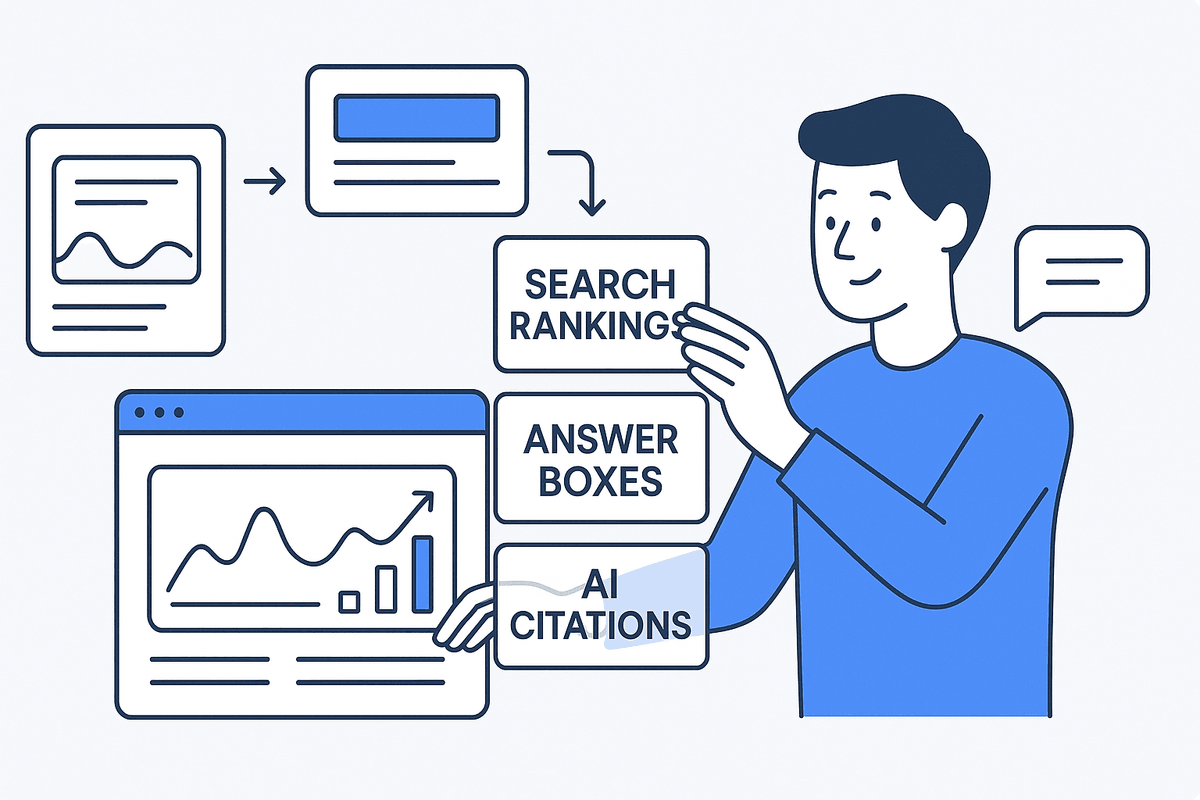
SEO targets rankings, AEO targets answer boxes, GEO targets AI citations. How to set priorities, from unstable indexing to covering all three in one page.
SEO aims to rank high in search results, AEO aims to win answer boxes like Featured Snippets, and GEO aims to get cited in generative AI answers such as ChatGPT, Perplexity, and Google AI Overviews. The names are similar, so it's easy to mistake them for competing strategies, but in practice they work more like one stack, with AEO and GEO built on top of SEO. The problem is that few teams can give a clear answer to "So what do we do first?"
The most common confusion on search marketing teams starts when the three terms get split into separate projects with separate budgets and headcount. If the SEO team, the content team, and a newly formed GEO task force all edit the same page by different standards, efficiency actually drops. This post draws clear lines between the three and lays out how to decide where your team should put its effort first.
Side-by-side comparison
| SEO | AEO | GEO | |
|---|---|---|---|
| Goal | Appear on page one of search results | Win answer boxes and voice answers | Get cited as a source in AI-generated answers |
| What you optimize for | Traditional search engines like Google and Naver | Featured Snippets, People Also Ask, voice assistants | ChatGPT, Perplexity, Gemini, AI Overviews |
| Key metrics | Rankings, traffic, CTR | Position Zero win rate, snippet adoption rate | Citation rate, AVI, share of voice (SOV) |
| Content format | Comprehensive long-form posts, keyword optimization | Concise definitions, lists, step-by-step explanations | Structured data, citable numbers, source footnotes |
| Measurement tools | Search Console, Ahrefs, Semrush | Search Console (Position Zero filter) | Prompt tracking, GEO diagnosis tools |
| When results show | Relatively fast (varies with competition) | Fairly fast if the SEO foundation is in place | Slower, because of AI model training and crawl cycles |
The relationship is easiest to see as layers. SEO is the foundation. Nothing above it works unless the site is crawled and indexed and the content matches search intent. AEO is the layer above that, where you shape content so it "answers the question directly." GEO sits on top again, adding "the evidence an AI needs to trust you when it builds an answer."
SEO: still the largest traffic channel
SEO (Search Engine Optimization) has been the backbone of digital marketing for more than 20 years. Search engines crawl and index web pages, then rank them by combining relevance to search intent, authority, and user experience.
SEO's strengths are clear.
- Proven data and tools: Decades of case studies and performance forecasting models.
- Still the largest source of visits: In most industries, organic search is still the biggest traffic source.
- Infrastructure for the other strategies: SEO's technical base, including site speed, mobile support, and structured data, carries straight over to AEO and GEO[3].
Its limits are getting sharper, though. As AI Overviews take over the top of search results, even former number-one content is increasingly pushed below the fold, and AI search engines like ChatGPT and Perplexity, which skip the traditional results page entirely, are growing fast[2].
What AEO is trying to achieve: winning answer boxes
AEO (Answer Engine Optimization) optimizes for the spots where a search engine serves an "answer" directly. Featured Snippets, People Also Ask, and voice assistant responses are the main targets.
Its goal is more precise than SEO's.
| SEO | AEO | |
|---|---|---|
| Goal | "Get on page one" | "Get picked for the answer box" |
| Content format | Comprehensive, long-form | Concise definitions, lists, tables |
| Success criterion | Top 10 | Position Zero |
Three patterns work well for AEO: definition sentences in the form "X is Y," numbered lists and step-by-step explanations, and comparison tables for "A vs B" queries. These patterns overlap heavily with GEO, which we'll get to next.
GEO: giving AI a reason to cite you
GEO (Generative Engine Optimization) is needed separately from AEO because AI engines work in a fundamentally different way. Traditional search ranks by keyword matching and link analysis, while generative AI reads and synthesizes dozens of sources to "generate" a single answer, choosing which sources to cite based on credibility and structure along the way.
A 2023 joint study by Princeton and IIT Delhi was the first to frame this academically. Its experiments showed that tactics like adding citations, including statistics, and using an authoritative tone can noticeably raise how visible content is inside AI engines, with gains reported as high as the 30–40% range depending on the domain[1].
Here's what GEO adds on top.
| Shared across SEO/AEO/GEO | GEO-only additions |
|---|---|
| High-quality content | Citable numbers and data |
| Structured data (Schema Markup) | Coverage across multiple AI engines (ChatGPT, Gemini, Perplexity each) |
| Clear definition sentences | Prompt tracking and monitoring |
| Technical site optimization | A hierarchy of source credibility |
What to do first, by situation: if your site's indexing is unstable, start with SEO
Doing everything at once would be ideal, but resources are limited. Here are priorities by situation, along with how to decide.
When SEO should come first
- Your site is at an early stage and isn't properly indexed by search engines yet
- Technical SEO, such as site speed, mobile support, and crawling, is lacking
- Your target keywords have high search volume and strong purchase intent
> How to decide: If even basic indexing and impressions aren't stable in Search Console, fix SEO first.
When you should run GEO alongside it
- Your SEO foundation is already in place and informational queries drive most of your traffic
- AI Overviews are showing for your target keywords
- You're in an industry with a long research and comparison stage, such as B2B SaaS, finance, or education
- Competitors get cited in AI search and you don't
> How to decide: If you ask ChatGPT or Perplexity your core keywords directly and only competitors get cited, that's a signal GEO is urgent.
When to focus on AEO
- Definition and how-to queries like "What is X" or "How to do X" are core for you
- You already hold some Featured Snippets and there's room to expand
A closer look at the key metrics
To run the three separately, you have to separate the metrics first. The same claim that "performance is good" means something completely different depending on which metric backs it.
| Metric | Strategy | What it shows | Common misconception |
|---|---|---|---|
| Ranking | SEO | Where you appear in search results | Assuming a high ranking means AI will cite you too |
| CTR | SEO | Clicks as a share of impressions | On queries with AI Overviews, brand visibility can still grow even when CTR is low |
| Position Zero win rate | AEO | How often you're picked for the Featured Snippet | Winning one snippet doesn't mean you lead the whole category |
| Citation rate | GEO | The share of monitored prompts where you're actually cited | Treating "visible but not cited" as the same thing |
| Share of voice | GEO | Your share of all brands mentioned on the same topic | SOV can be low even with a high citation rate if competitors are mentioned more often |
It's tempting to merge all three into one dashboard, but because the metrics are different in nature, forcing them together muddies interpretation. It's more accurate to keep the metrics side by side and read each trend separately, as in "Rankings held steady this week, but citation rate dropped."
Deciding priorities: hypothetical scenarios
Walking through three hypothetical teams makes the decision flow easier to follow.
Scenario 1: A startup that just relaunched its site
Search Console shows fewer indexed pages than expected, and a few key pages don't appear in search results at all. At this stage, crawling and indexing problems need fixing before anyone talks about AEO or GEO. A technical SEO audit is the top priority.
Scenario 2: A B2B service with stable SEO that's invisible only in AI search
It holds page-one rankings for its main keywords, but when you ask ChatGPT or Perplexity the same keywords, only competitors get cited. That means the SEO foundation already exists, so strengthening GEO elements (inline citations, structured data, source credibility) is the fastest path to improvement.
Scenario 3: A local service brand where voice search traffic matters
Queries like "best X near me" make up a large share, and winning Featured Snippets and voice answers ties directly to revenue. Here it's most efficient to tune the AEO structure first (concise definitions, step-by-step explanations, explicit local information).
All three scenarios come down to the same question: "Where is our content stuck right now?" Answering that takes data, not gut feeling, and the fastest way to get that data is to actually run your target keywords through both search engines and AI search engines and compare the results side by side.
How one piece of content can cover SEO, AEO, and GEO at once
In practice, rather than running three separate projects, it's more efficient to fold all three perspectives into one piece of content.
- SEO-based keyword research: Search volume, competition, and intent analysis work the same as in traditional SEO.
- AEO structure design: Put a definition sentence at the top and add an FAQ and comparison tables. Optimizing for Featured Snippets works for GEO at the same time.
- Strengthen GEO elements: Attach inline citations
[n]to every number, cite high-credibility sources, and apply structured data. - Multi-channel validation: Test the same content in Google, ChatGPT, and Perplexity to see where and how it shows up.
- Prompt-based monitoring: Set target prompts and track regularly whether you're cited.
Running these five steps by hand every time is hard. Diagnosis tools like TRAIL Search automate the multi-engine validation and prompt tracking in steps 4–5 and show with data whether your bottleneck is SEO, AEO, or GEO.
Common misconceptions
- "If SEO is good, GEO takes care of itself": Even content ranked number one in search can be left out of AI citations. AI looks at structure and credibility, not rankings.
- Treating the three as fully separate projects: This only adds duplicate work and creates the inefficiency of different teams editing the same page by different standards.
- Optimizing by feel without measurement: Moving forward on "this should be good enough" without prompt tracking just wastes resources.
- Thinking it's fine to start GEO later than SEO: Given AI model training and crawl cycles, GEO results tend to show up more slowly than SEO results. Once competitors establish citation patterns first, catching up gets harder, so if your SEO foundation is in place, don't put off GEO.
- Thinking AEO alone covers both voice search and AI search: The criteria for Featured Snippet selection and AI answer citation overlap but aren't the same. Even content picked for a snippet can be left out of AI answers if it lacks what AI needs to cite it (sources, statistics, recency).
SEO, AEO, and GEO aren't different games. They're different scoring criteria for the same game. Build up in order, laying the foundation, shaping content into answers, and adding evidence AI can trust, and you can score on all three.
For related reading, see What is GEO (Generative Engine Optimization)? Which pages to start with, and in what order, SEO fundamentals for the AI search era: what changed in on-page, off-page, and technical SEO, and What you don't need to do for GEO: checking llms.txt, AI-specific schema, and AI-only writing styles.
You can continue with How to get cited by AI and Backlink strategy that stays inside Google's spam policy.
Frequently asked questions
If I can only pick one of the three, which should it be?
If your site isn't even indexed reliably yet, start with SEO. If indexing is stable but competitors show up in AI answers more often, GEO is the urgent one. If your industry runs on definition and how-to questions, AEO is an efficient way to win snippets quickly. In the end, the right order is to diagnose where your bottleneck is right now rather than to pick just one.
If I do AEO well, does GEO follow automatically?
They overlap a lot, but it isn't automatic. Definition sentences, Q&A structure, and concise answer formats are shared assets that work for both AEO and GEO. GEO, though, needs another layer on top: source credibility, inline citations, and coverage across multiple AI engines.
Do I need separate tools to measure each of the three?
The underlying data often comes from the same places. Search Console shows SEO and AEO signals, and prompt-tracking tools show GEO signals. GEO diagnosis tools like TRAIL Search automate that prompt-tracking layer and lay out how you're mentioned in each AI engine.
References
Summary
- SEO aims for search result rankings, AEO for Featured Snippets and voice answers, and GEO for citations inside generative AI answers.
- The three aren't competitors. They form layers, with AEO and GEO built on an SEO foundation.
- Priorities depend on where your site is. Unstable indexing means SEO first; if only competitors get cited by AI, GEO; if definition and how-to queries dominate, AEO.
- In practice, it's most efficient to put definition sentences, comparison tables, citation footnotes, and structured data into a single piece of content so it satisfies all three at once.
Produce the content this post covers from your brand standard
TRAIL Studio registers the brand standard once and produces cardnews, detail pages, product photos, shorts and blog posts from it. Generated output is reviewed and edited by a person before it ships.
More posts
Best AI Search Optimization Tools 2026: 6 GEO Tools Ranked
We compared six tools that check whether ChatGPT and other AI answers mention your brand, on measurement, action, engines, Korea support, and price.

Why Does ChatGPT Cite Listicles? Format vs. Hierarchy
Listicles split items cleanly, so AI can extract just what it needs. How to write citable listicles, whether format alone is enough, and how to build hierarchy.

What is GEO? Which pages to start with, and in what order
GEO structures content so generative search like ChatGPT and AI Overviews cites it. Does it replace SEO, what order to run it in, and how to measure it.
Keep reading on this topic
- Topical authority: why pillar-cluster beats a single postTopical authority comes from content clusters, not single posts: the pillar-cluster model, how to design one, why it wins in AI search, and when it's enough.
- A 4-step framework for SEO and GEO: split teams or merge?SEO and GEO work best on one content quality foundation. Whether to split or merge teams, a 4-step framework, why unified plans fail, and one shared metric.
- SEO and GEO top spots: high rankings, missing in AI answersReaching the top now covers how AI answers mention you, not just rankings. What changed, how to manage both tops, and why competitor comparison matters.
This post is part of the Content category, which collects all 41 posts on the topic. See all posts in Content