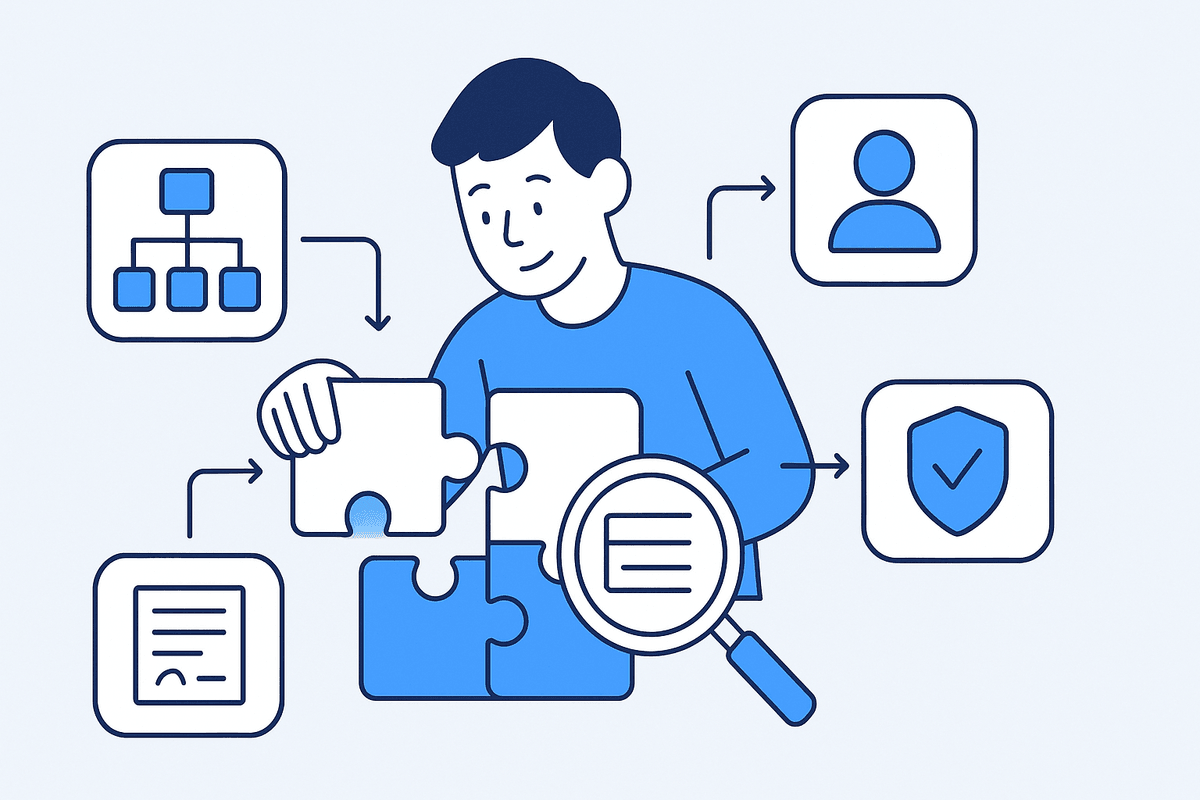
Brand entity SEO: keep AI from confusing you with others
Even with the same name, if AI sees you as a different entity, no citation happens
Brand entity SEO aligns schema and outside signals so AI sees you as one entity: fixing AI mix-ups, auditing consistency, and the link to E-E-A-T. Entity SEO is the work of keeping your name, description, and category consistent so AI recognizes your brand as one clear entity.
Brand entity SEO is the work of keeping your name, description, and category signals consistent so that AI search engines recognize your brand as one clear entity, without confusing it with similarly named companies. No matter how good your content is, if AI can't tell "which company this is about," no citation happens. If your entity is shaky, every other GEO effort can go to waste.
What exactly is an entity?
An entity is the unit of "unique thing" that search engines and AI work with when they make sense of the world. People, companies, products, and places can all be entities. Google has long organized information by entity, beyond keyword matching, and AI search engines push this trend one step further. If your company name is not clearly distinguished from a same-name company in another industry or a similarly named competitor, AI may mix the two up in its answer, or choose to avoid mentioning either.
The problem is that this confusion is hard to see from the company's side. You know your brand so well that it's easy to think "surely no one would confuse us," but AI forms its judgment by combining many phrases scattered across training data and live search results. If your company description differs slightly from site to site and channel to channel, AI can't be sure it's really looking at information about the same company.
Why look at it together with E-E-A-T?
The E-E-A-T principle (experience, expertise, authoritativeness, trustworthiness) that Google has emphasized is really another way of describing the same problem as entity trust[2]. Search engines and AI only lift content up as a top answer candidate when they can confirm who made it and whether that party actually exists and can be trusted. Sites that hide author information or don't clearly reveal the company behind them lose out on trust signals, however high their content quality.
What schema does, and what it can't do
Organization schema[3] gives AI and search engines structured information stating that this website is run by an organization with this name, this logo, and this industry[1]. But schema is not a magic citation button. If the information in your schema differs from the text visible on the page, AI has a harder time deciding which to believe. It's more accurate to think of schema as "a tool that repackages facts already clearly written on the page so machines can read them easily."
Why do external platforms matter?
AI doesn't judge your brand from your site alone. It also combines company descriptions from external platforms such as Crunchbase, LinkedIn, industry directories, and review sites. The more these external signals match your site's description, the more confidently AI identifies your brand. Conversely, if each platform has a different industry classification or one-line description, it can look to AI as if several blurry entities exist.
In practice: build a brand entity ledger
The first thing to do is create an "official wording ledger" for your brand. Lock down the items below in a single document and reflect them identically on every channel.
| Item | What to lock down |
|---|---|
| Official brand name | Unified English and Korean spelling, down to spacing |
| One-line description | Standard wording covering industry + core product + differentiator |
| Category | Industry classification (for example, "AEO/GEO diagnosis SaaS") |
| Product and feature names | Mapping between official names and commonly used aliases |
| Primary URL | Canonical official domain |
In practice: which pages to fix
1. Homepage hero and About copy
If your first-screen copy is vague, AI's summary will be vague too. State clearly in one sentence "what the company does."
2. Product name and feature name mapping table
Check whether your blog, product pages, and outside articles call the same feature by different names. If naming wavers, AI may mistake the same feature for different things.
3. Sync Organization schema with visible text
Confirm that the company name and description in your schema exactly match the actual page text[1][3].
4. Comparison and alternatives pages
Pages that describe you against competitors are an important source from which AI learns your positioning within a category. Fact-based comparisons earn trust more than promotional copy.
5. Correct the wording on external profiles
Unify the company descriptions on LinkedIn, industry directories, and review sites with the ledger wording[4].
Three common scenarios where entities get shaky
Entity confusion usually happens when a company grows or changes. If you know ahead of time and prepare, you can correct the confusion before it hardens into AI training data.
Scenario 1: A brand with the same or a similar name exists
Even if it's not in the same industry, a company with a similar name creates the risk that AI mixes the two up when building an answer. In this case, raise distinctiveness by stating your industry, location, and founding details concretely on your About page and in your Organization schema. It helps to put your own category definition at the front of the sentence rather than common modifiers like "global standard."
Scenario 2: You rebranded or changed the company name
When you change your name, information learned or indexed under the old name keeps circulating for a while. In this case, repeatedly show a sentence that explicitly links the old and new names ("formerly ○○, now ○○") on your About page and in press releases, which raises the chance that AI connects both names to the same entity. Updating external profiles as close to simultaneously as possible, rather than one by one, also shortens the period of confusion.
Scenario 3: You group several product lines under one brand
As products multiply, it's common for brand names and product names to get mixed up. In this case, clearly document the hierarchy "company name > product line > individual product" and mark it consistently on every page. If the hierarchy wavers, AI may mistake one product for the whole company, or conversely shrink the company down to one of its individual products.
Brand entity consistency checklist
- Is the company name written the same way on every channel (including spacing and English spelling)?
- Does the one-line description match across your site and external profiles?
- Are product and feature names being called something different on different pages?
- Do the Organization schema and the actual visible text match?
- Is author and organization information clearly shown?
Where teams most often go wrong in practice
1. Describing schema as an "AI citation button"
Expecting citations to rise just by adding schema leads to disappointment. Schema is a tool that reinforces content that is already clear.
2. Describing the company too broadly
A phrase like "a total solutions company" could apply to any company, so it has no distinctiveness. State your specific industry, functions, and target.
3. Neglecting external profiles
It's common for a team to clean up the site while leaving external directory information registered three years ago untouched. AI can reference both old and current information, so neglected channels become a source of confusion.
4. Turning comparison pages into ad pages
AI finds it hard to adopt exaggerated comparison copy as a trusted source. Balanced, fact-based comparisons actually raise the chance of citation.
5. Hiding author and organization information
Highly anonymous content has weak E-E-A-T signals[2]. Clearly stating who wrote it and which organization is behind it is the baseline.
Where to start
The order that shows results fastest is (1) lock down the brand ledger, (2) clean up the homepage hero and About copy, (3) sync the Organization schema, and (4) correct external profiles. With a diagnosis tool such as TRAIL Search, you can check what wording and which category AI actually uses to describe your brand, and close the gap with your ledger.
Entity work isn't glamorous, but it's the foundation of GEO. However well you build your content and schema, if AI is confused about "who this is about," everything you've built on top of it wobbles.
For related reading, see What is GEO (generative engine optimization)? Which pages to start with, and in what order, SEO fundamentals in the AI search era: what changed in on-page, off-page, and technical SEO, and llms.txt setup guide: how it differs from robots.txt, templates, priorities, and measuring the effect.
Frequently asked questions
If we add schema markup, will AI cite us right away?
No. Schema tells AI clearly which entity a page is about; it is not a button that guarantees citations. If the schema and the visible text on the page don't match, it can actually lower trust.
How specific should our company description be?
The more explicitly it states your industry, core product, and differentiator, the better. Abstract phrases like "we deliver innovative solutions" make it hard for AI to tell you apart from other brands with similar wording. Spell out what you provide, to whom, and how.
Do we also need to care about external profiles (LinkedIn, Crunchbase, and so on)?
Yes. AI weighs signals from outside your site to judge your brand. If the company description on an external profile differs from the one on your site, AI risks seeing them as two different entities. Keep your core wording (industry, category, one-line description) consistent across every channel.
References
Summary
- Entity SEO is the work of keeping your name, description, and category consistent so AI recognizes your brand as one clear entity.
- Schema markup is only a signal that tells AI about the entity, and if it doesn't match the visible text, it actually erodes trust.
- Check five places first: your homepage hero and About copy, a product name mapping table, Organization schema, comparison pages, and external profiles.
- The most common mistakes are describing the company too broadly, or using different wording on external profiles and on your site.
Produce the content this post covers from your brand standard
TRAIL Studio registers the brand standard once and produces cardnews, detail pages, product photos, shorts and blog posts from it. Generated output is reviewed and edited by a person before it ships.
More posts
Best AI Search Optimization Tools 2026: 6 GEO Tools Ranked
We compared six tools that check whether ChatGPT and other AI answers mention your brand, on measurement, action, engines, Korea support, and price.
Why Does ChatGPT Cite Listicles? Format vs. Hierarchy
Listicles split items cleanly, so AI can extract just what it needs. How to write citable listicles, whether format alone is enough, and how to build hierarchy.
What is GEO? Which pages to start with, and in what order
GEO structures content so generative search like ChatGPT and AI Overviews cites it. Does it replace SEO, what order to run it in, and how to measure it.
Keep reading on this topic
- Topical authority: why pillar-cluster beats a single postTopical authority comes from content clusters, not single posts: the pillar-cluster model, how to design one, why it wins in AI search, and when it's enough.
- A 4-step framework for SEO and GEO: split teams or merge?SEO and GEO work best on one content quality foundation. Whether to split or merge teams, a 4-step framework, why unified plans fail, and one shared metric.
- SEO and GEO top spots: high rankings, missing in AI answersReaching the top now covers how AI answers mention you, not just rankings. What changed, how to manage both tops, and why competitor comparison matters.
This post is part of the Content category, which collects all 41 posts on the topic. See all posts in Content