When ChatGPT cites Google's store page instead of yours
What the google.com/storepages citation pattern says about source independence, and why one worldwide average can't track it
ChatGPT sometimes cites Google's store page (google.com/storepages) instead of the seller's own site. Why the source domain matters, by market.
When ChatGPT describes a product or a seller, it sometimes cites Google's store page (google.com/storepages) as the source instead of the seller's own page. The brand still appears in the answer, but the document the model read to describe it is not yours. The published distribution shows this pattern heavily concentrated in one URL variant and one country. So it should be read as a source independence problem more than a visibility problem, and as one that a single worldwide average can't manage.
The figures in this article come from distribution data that David Konitzny, a GEO researcher at Peec AI, published on LinkedIn[1]. He collected cases where URLs matching the google.com/storepages pattern showed up as sources in ChatGPT answers, and published the shares by URL variant, country and store. We redrew those figures with the values unchanged, and we cross-checked what storepages are against the official Google Merchant Center documentation (as of October 2026). The source data is a social post that has not been peer-reviewed, total volume and the sampling window were not disclosed, and we have not reproduced it. We should also disclose an interest: Peec AI builds AI visibility measurement tools and works in the same market we do. We credit the effort of publishing the raw data and add one layer of interpretation on top of it.
google.com/storepages is Google Shopping's per-merchant store page
google.com/storepages is a per-merchant profile page on Google's shopping surfaces. Google Merchant Center Help describes store pages as shopping surfaces that let businesses share more about their brand, mission and identity[2]. They carry a business description and logo, a homepage link and contact details, customer ratings and reviews, top trending products, customer video reviews, and a panel of shopping experience metrics.
Only part of it is in the merchant's hands. A logo, social profiles, business identity attributes and customer support details can be added through Merchant Center, but customer reviews, ratings and video content are pulled in by Google automatically[2]. The store ratings help page tells merchants to check whether they have a rating with a URL of the form https://www.google.com/storepages?q={your website}[3]. That is exactly the URL pattern captured in this data.
According to the same help page, a store rating consists of a rating out of 5 stars, the number of reviews received, a qualifier that highlights why the store got the rating, such as average delivery time (when data is available), and a link to recent reviews[3]. These ratings appear in both ads and unpaid formats, on mobile and web across the Search Network and YouTube. If a model's description of a store says it is "highly rated" or "ships fast," keep open the possibility that the evidence was this summary page rather than your site.
The shopping experience metrics on store pages are defined by the Store Quality program[4]. They fall into four groups: shipping experience (delivery time and cost), return experience (return window and cost), browsing experience (share of high-resolution images, images per item and site speed) and purchase experience (promotion disapproval rate and number of e-wallet types accepted). In short, a store page is a document that layers Google's collected ratings and operational metrics on top of some merchant-supplied information, and much of it is out of the merchant's hands.
The storepages ChatGPT cited cluster in one variant and one country
In the published distribution, about three in four storepages citations used the mobile URL, and by country the United States accounted for more than half[1]. The source notes that this pattern's overall share of citations is small. What deserves attention is the shape of the distribution rather than its size.
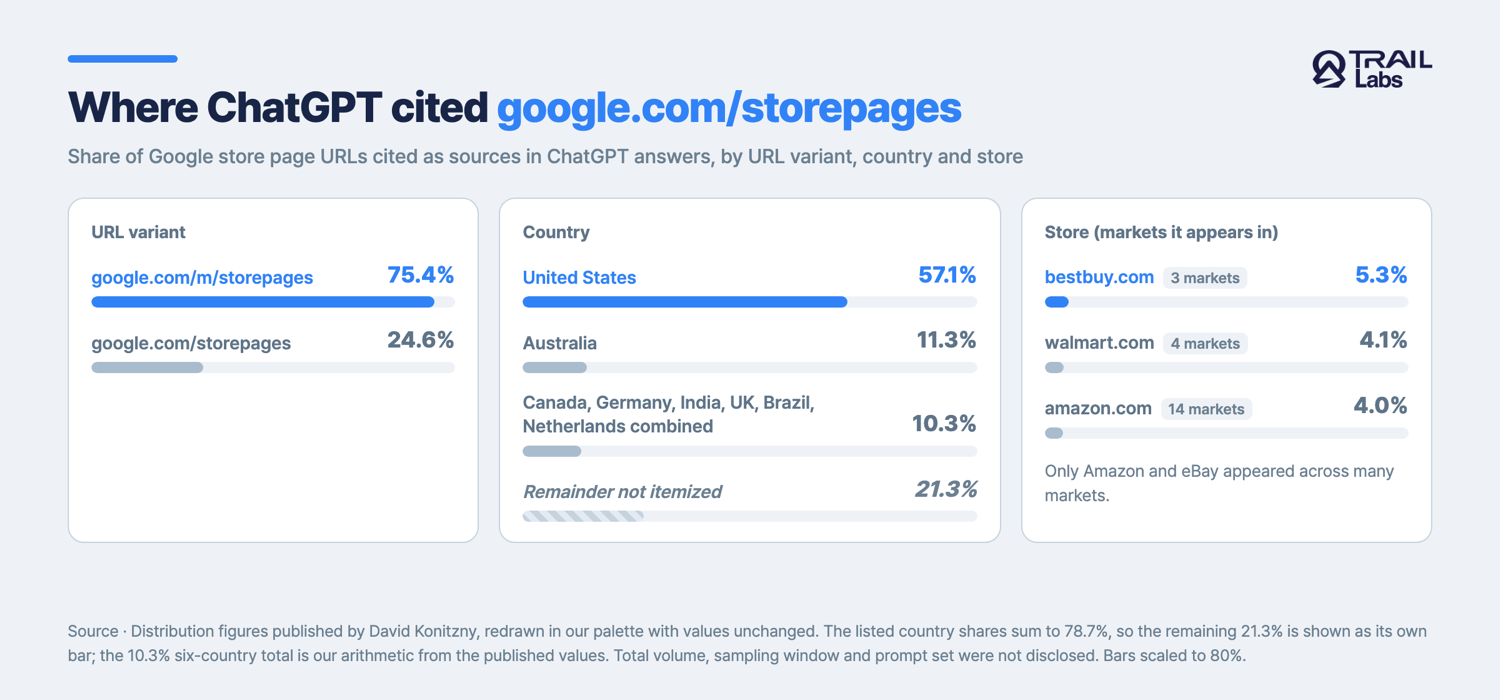
Figure 1. Left: URL variant (google.com/m/storepages, google.com/storepages). Center: country (United States, Australia, six other countries combined, remainder not itemized). Right: share by store and the number of markets each appears in. The bar values match Table 1, and we redrew the source values unchanged in our palette.
| Dimension | Item | Share |
|---|---|---|
| URL variant | google.com/m/storepages | 75.4% |
| URL variant | google.com/storepages | 24.6% |
| Country | United States | 57.1% |
| Country | Australia | 11.3% |
| Country | Canada, Germany, India, UK, Brazil, Netherlands | 10.3% combined (our arithmetic) |
| Country | Sum of the published country values | 78.7% |
| Country | Remainder not itemized | 21.3% (our arithmetic) |
| Store | bestbuy.com (3 markets) | 5.3% |
| Store | walmart.com (4 markets) | 4.1% |
| Store | amazon.com (14 markets) | 4.0% |
Table 1. The published distribution of storepages citations. The listed country shares do not add up to the whole, so we calculated the six-country total and the off-list share from the published values[1].
The country distribution is not evenly spread. The United States and Australia together account for a little over two thirds, followed by a thin tail through Canada, Germany, India, the UK, Brazil and the Netherlands. By store, bestbuy.com, walmart.com and amazon.com each held a share in the low single digits, while the number of markets they appeared in varied widely: 3, 4 and 14 (Table 1). Only Amazon and eBay appeared across many markets.
When we redrew the chart, we added the remaining country share as its own bar. Plotting the listed country shares as they are makes them look like the whole, when in fact more than a fifth of cases fall outside the list. Leaving that out would invite a reading the source data can't support.
Your brand appearing and whose page is the source are different questions
A storepages citation is a source independence problem, not a visibility problem. Your brand still appears in the answer. What changed is the document the model read to describe it. The intermediary page has its own ratings, its own shipping and returns metrics, its own trending product list and its own update timing, and as shown above, the merchant can't directly edit much of it[2][4].
This is the same mechanism as the pricing result in competitive citation research. In Sprinklr researchers' What Gets Cited experiment, a page that stated a price beat a page that didn't at odds ratios from 6.26 to above 10,000[5]. Those figures hold under the paper's experimental conditions. In practice, if your page doesn't answer a question, the model finds a page that does. If your page leaves blank the information shopping questions ask for, such as price, stock, shipping terms and reputation, the intermediary page that fills those blanks becomes the source. We covered the full experiment in which of two pages AI cites.
The distinction matters because the fixes differ. If your brand doesn't appear at all, you need more grounds to be mentioned. If your brand appears but the source is someone else's page, start by checking whether your own page contains the answer to that question. A single "AI shopping visibility" number doesn't separate the two situations.
ChatGPT shopping answers already connect to Google Shopping data
Storepages are not the only sign that ChatGPT's shopping results connect to Google Shopping data. In an analysis of ChatGPT shopping carousels, Tom Wells of the same company examined 43,000 carousel products and reported that 83% matched products in the top 40 organic Google Shopping results[6]. The analysis named organic rankings, not paid ads, and Merchant Center feed quality as the key factors for carousel placement.
Put the two observations side by side and Google Shopping surfaces look like one of the input paths for ChatGPT shopping answers. Whether storepages citations come in through the same path as the carousel, though, can't be confirmed from the published data. What we can say goes only as far as the direction: "your information on Google Shopping also shapes ChatGPT answers." We covered why product packs and Merchant Center operations are a sales channel question in commerce GEO: getting your products into Google's product pack.
A pattern concentrated in one country can't be managed with a worldwide average
A pattern concentrated in one country, like the more than half in the United States, can't be managed with one worldwide visibility number[1]. That number averages a market where the pattern dominates with markets where it barely exists. The average erases the one piece of information that would change what you do next: where this is happening.
It is the same structural error as averaging across engines. As we covered in why a single AI visibility score is risky, engines barely overlap in the URLs they cite, and merging them into one score hides which engine is weak. Mixing countries likewise hides the markets where the source moved to someone else's page. That is why a brand selling in several markets should measure each one separately.
Korea is not on the published country list. That doesn't mean the pattern is absent in Korea. It may sit inside the off-list share, or the prompts collected may not have covered Korean-language shopping questions. The accurate status is that this data can't tell. Unmeasured and zero should be recorded differently.
In practice, check the cited domain first
If you track transactional prompts, don't stop at whether your brand was mentioned. Go on to check which domain received the citation. Being described accurately by someone else's page is a different outcome from being cited on your own, and only the second one is yours to fix. Narrowed down, the practical steps look like this.
- Record the source domain separately. When you track AI shopping answers, log the domain of the cited URL along with whether you were mentioned. Separating your own domain, Google surfaces, large retailers and review sites shows where the source went.
- Open your own store page. Put your homepage address after
google.com/storepages?q=to see how Google summarizes your store[3]. Fill in the items you can supply, such as your logo and customer support details, and remember that ratings and shipping and returns metrics change only when actual operations improve[4]. - Check whether your pages answer shopping questions. State price, stock and shipping and returns terms on your product pages. Leave an answer blank and another page that has it becomes the source. Our GEOcommerce guide covers whether to start with category pages or product detail pages.
- Measure by market. If you sell in several countries, look at the distribution of source domains for each country separately.
Limits
The core figures in this article come from a social post that has not been peer-reviewed, and we have not reproduced them[1]. Total volume, the sampling window and the prompt set used were not disclosed. The listed country shares do not add up to the whole, so more than one in five cases sits outside the list (Table 1). None of that makes the finding wrong, but it means the honest reading is the shape of the distribution, not the precision of any single figure.
The source data was observed on one engine, ChatGPT. Whether the same pattern shows up in Perplexity or Google AI Mode is unknown. Which question types storepages were mainly cited for (store reputation questions or product recommendation questions) was not disclosed either. There is no data on the Korean market or Korean-language questions.
Tying the Google Shopping carousel analysis[6] and storepages citations into a single mechanism is our interpretation. The public material offers no evidence that the two observations came from the same collection path. The price-stating effect[5] is also a result under controlled experimental conditions, and there is no basis to assume it shows up at the same size in real shopping answers.
The short version
Which page ChatGPT read when it recommended your product is worth checking separately from whether you were mentioned. In the published distribution, google.com/storepages citations clustered in the mobile URL (75.4%) and the United States (57.1%)[1], and much of that page's ratings and operational metrics sit outside the merchant's hands[2]. That makes this a source independence problem, and one to read by country. The next time an answer engine recommends your product, start by recording whose page it relied on.
Frequently asked questions
What is google.com/storepages?
It is a per-merchant store page on Google's shopping surfaces. Alongside a business description, logo and contact details, it shows ratings and reviews that Google collects, shopping experience metrics such as shipping and returns, and trending products. Merchants can add only some of it through Merchant Center, such as a logo or customer support details. Reviews and ratings are pulled in by Google automatically.
Is it a problem if ChatGPT cites Google's store page instead of ours?
Your brand still appears in the answer, so it isn't a visibility problem. What changed is the document the model read to describe you. That document's ratings, shipping details, trending product list and update timing are not under your direct control. It is more accurate to treat it as a source independence problem.
Can we apply the published storepages figures to our own market?
We don't recommend it. Total volume, the sampling window and the prompt set were not disclosed, and the listed country shares add up to 78.7%, so 21.3% sits outside the list. Korea is not among the listed countries. Read the shape of the distribution, not the precision of any single figure.
What should we check in AI shopping answers?
If you track transactional prompts, don't stop at whether your brand was mentioned. Check which domain received the citation. Being described accurately by someone else's page is a different outcome from being cited on your own, and only the second one is yours to fix.
References
- [1]David Konitzny (Peec AI), public LinkedIn post on the distribution of google.com/storepages cited as sources in ChatGPT answers, 2026
- [2]Google Merchant Center Help, "About store pages"
- [3]Google Merchant Center Help, "Google store ratings: An overview for Merchants"
- [4]Google Merchant Center Help, "About the Store Quality program"
- [5]Vishwakarma, Kumar & Jamidar, "What Gets Cited: Competitive GEO in AI Answer Engines", SIGIR 2026
- [6]Tom Wells (Peec AI), "How ecommerce managers can optimize ChatGPT product rankings step by step", Peec AI Blog, 2026-03-17
Summary
- Public data shows ChatGPT citing Google's store pages (google.com/storepages) as sources instead of the seller's own pages.
- The mobile URL variant (google.com/m/storepages) accounted for 75.4%, and by country the pattern was concentrated in the United States (57.1%) and Australia (11.3%).
- This is a source independence problem. Your brand is visible, but the ratings, shipping details and update timing of the document the model read are outside your control.
- A pattern concentrated in one country can't be managed with a single worldwide average. It is the same structural error as averaging across engines.
- Total volume, window and prompts were not disclosed and the country shares sum to 78.7%, so read the shape of the distribution rather than any single figure.
Check this topic against your own brand
TRAIL Search measures how ChatGPT and Perplexity answer your customers' questions and finds and fixes where the brand is missing, turning this post into a diagnosis. Start with 10 questions, no card required.
More posts
How is AI answer visibility defined and measured?
How is AI answer visibility defined and measured? Three metrics with formulas and paper figures: visibility (GEO), contribution (Shapley), and stability.
The prompt you track is not the query AI actually searched
AI visibility reports score each tracked prompt, but retrieval and citation happen on fan-out sub-queries. What year and English injection mean for measurement.
Which content types AI cites, by search intent
The content type AI search cites flips with intent: articles lead informational prompts (45.5%), listicles lead commercial ones (40.9%).
Keep reading on this topic
- How are retrieval and citation different in AI search?Retrieval and citation are different stages in AI search. Does ChatGPT cite YouTube? Why our content is missing from AI answers, and what zero citations mean.
- The LLMO trap: training data vs. AI answer citationsSeeding your brand in LLM training data and getting cited in AI answers are different mechanisms. How they differ, what you can measure, and why advice splits.
- What marketers worry about most in AI search: reporting dataMarketers worry less about vanishing from AI search than about lacking reliable reporting. We checked whether that differs by company size.
This post is part of the Analysis category, which collects all 34 posts on the topic. See all posts in Analysis