Preparing content for the age of AI answers
What Are AEO and GEO?
When you have a question these days, do you ever skip the search box and just ask ChatGPT or Perplexity? Even on Google, search now puts an AI-written answer right at the top. Search is changing — and that means the way we prepare content has to change with it. Today we'll unpack the two keywords behind that shift: AEO and GEO.
Search has changed — from ten links to one answer
Old-school search was simple. You typed a query, ten blue links appeared, and you picked one to click and read. Finding information came down to a person clicking a link.
Now it's different. Google's AI Overviews (the AI summary that appears above the results) read several pages and fold them into a single answer. Ask ChatGPT or Perplexity and you get the answer as a conversation. Getting the answer without ever clicking a link is what people call zero-click search.
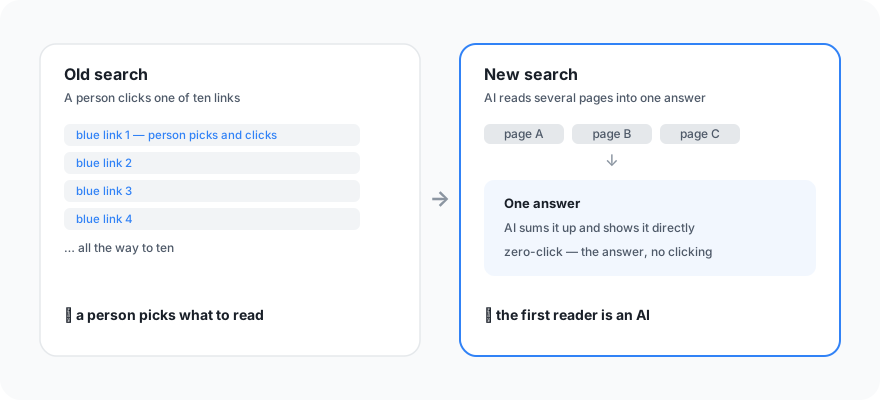
This changes something important. The first reader of your content is now often an AI, not a person. The AI reads your page and decides whether to cite it in its answer. So writing "content an AI likes to pick" has become a new job — and that job is AEO and GEO.
AEO — writing that AI likes to cite
AEO (Answer Engine Optimization) is about writing in a form that's easy for AI to cite when it builds an answer. AI doesn't lift your whole page. It takes one piece that fits the answer. AEO makes that piece easy to lift.
Content that's easy to cite tends to share a few traits.
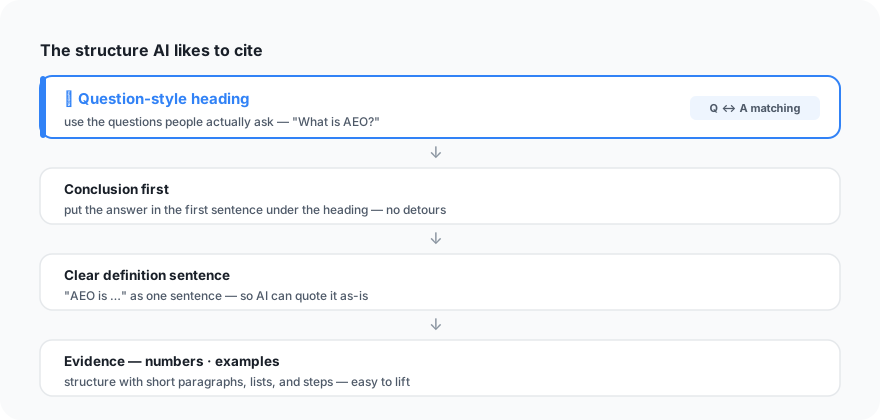
- Question-style headings — use the actual questions people ask ("What is AEO?") as your subheadings. AI looks for question-and-answer pairs.
- Conclusion first — put the answer in the first sentence right under the heading. Bury it and the AI can't lift a clean piece.
- Clear definition sentences — state it as one sentence: "AEO is …" so the AI can quote it as-is.
- Structure — favor short paragraphs, lists, and steps over long blocks. Content that's easy to break into pieces gets cited more.
Notice anything? This post is written that way too. The subheadings are questions, and the first sentence under each is the answer.
GEO — content that generative AI picks as a reference
GEO (Generative Engine Optimization) goes one step further. If AEO is about a form that's easy to cite, GEO is about becoming content that generative AI trusts enough to reference. Looking the part isn't enough — AI tries to pick sources it can rely on.
Trusted content carries signals like these.
- Data with clear sources — instead of "everyone says so," use numbers and facts you can attribute. Content with solid grounding gets chosen.
- A unique point of view — generic takes you'd find anywhere give AI no reason to pick your page. Your own experience, examples, and interpretation are the differentiator.
- Trust signals — who wrote it (expertise), when it was written (freshness), and whether you publish consistently all add up to trust.
In short, AEO is about writing so AI can lift it easily, and GEO is about making AI trust and choose it — form and trust, the two axes.
SEO isn't dead
At this point you might think, "So is traditional SEO finished?" No. SEO isn't dead. A few layers have just been stacked on top of it.
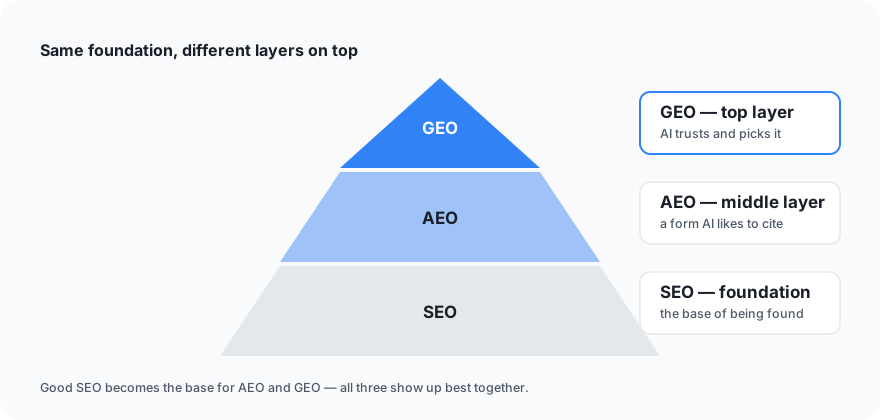
- SEO (Search Engine Optimization) is the foundation — being found in search. Fast pages, accurate titles, readable structure. Without it, AI can't even discover your page.
- AEO is the layer above. It shapes a discovered page into a form AI likes to cite.
- GEO is the top layer. It makes AI trust and choose that page.
These three aren't rivals. The foundation is the same; the layers you stack on top are different. Good SEO becomes the base for AEO and GEO, and all three show up best when they work together.
So what do we prepare?
Enough theory. Here's a practical checklist you can act on right away.
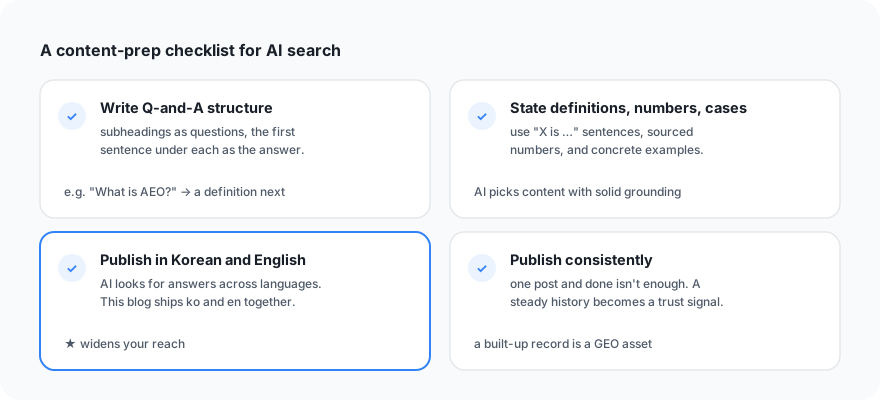
- Write in a question-and-answer structure — subheadings as questions, the first sentence under each as the answer.
- State definitions, numbers, and examples — use "X is …" definition sentences, sourced numbers, and concrete cases.
- Publish in both Korean and English — AI looks for answers across languages. In fact, this blog publishing in both ko and en is part of that prep. Putting the same post in two languages widens your reach.
- Publish consistently — one post and done isn't enough. A steady publishing history becomes a GEO trust signal.
Doing all of this by hand every time is a chore. TRAIL Studio helps you produce structured content — question-style headings, definition sentences, bilingual Korean-and-English versions — quickly. It makes getting ready for the AEO and GEO era a little lighter.
> You can try Trail Studio right now. Content generation runs on credits.
More posts
Open Models — Owning the Model Layer Itself
The final stage of the evolution — own the model instead of renting it. Nous Research Hermes (4.3, open weights), the Hermes function-calling standard, and the data flywheel a harness produces to tune a domain model — with code.
Harness Engineering — What Makes the Same Model Behave Differently
Running agents safely and consistently is about the harness around the model — scoped tools, hooks, context layering, verification loops, executable knowledge. The MCP server we built (self-call = SSOT) and hook patterns, in code.
Agents — When the Model Started Running the Loop
OpenClaw (formerly Moltbot) put autonomous agents in the spotlight — the model uses tools, observes results, and runs the loop itself. The perceive→plan→act→observe loop, and the permission/HITL problem broad autonomy brings — with code.